Case Study: A Cookstove Developer Getting to a CORSIA-Eligible Unit
· DSTechnoverse · CORSIA & Carbon Markets
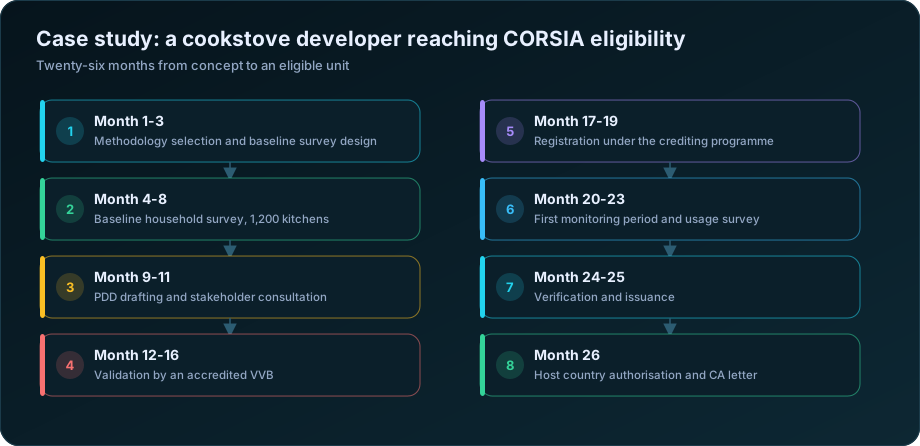
Twenty-six months from methodology selection to a unit an airline could actually buy. Where the schedule went, what the baseline survey cost, and the step most developers underestimate.
A developer with an established clean cookstove distribution business in central India decided to convert it into a carbon project, with CORSIA buyers as the target market. The business already existed: manufacturing partnerships, a distribution network across four districts, and roughly 40,000 stoves in the field.
The carbon project took twenty-six months to produce a unit an airline could buy. The stoves were the easy part.
Why the existing stoves did not count
The developer's first assumption was that 40,000 stoves already distributed represented a large, immediately creditable emission reduction. They did not, for a reason that catches most first-time developers.
| Requirement | Position of the existing programme |
|---|---|
| Additionality | Stoves already sold commercially; hard to argue carbon finance was decisive |
| Baseline measurement | No pre-distribution fuel consumption data collected |
| Start date rules | Distribution predated any project documentation |
| Monitoring data | Sales records existed; usage data did not |
| Ownership of reductions | Contracts with buyers said nothing about carbon rights |
The last row caused a specific problem. Stoves had been sold under ordinary sales contracts with no assignment of environmental attributes. Establishing that the developer, rather than the household, held the right to the emission reductions required a supplementary consent process across the existing customer base — which was feasible but slow.
The project therefore proceeded on new distribution only, with the existing 40,000 stoves excluded. That was a substantial write-down of the developer's initial expectations and the correct decision.
Months 1 to 3: methodology and the decisions it forces
Methodology selection is presented as a technical step and is really a commercial one, because the methodology dictates the monitoring cost for the project's whole life.
| Decision | Options | Choice and reason |
|---|---|---|
| Baseline fuel establishment | Kitchen performance test, survey, default values | Survey plus KPT subsample — defaults were too conservative |
| Fraction of non-renewable biomass | Default national value or project-specific study | National default — a study was not worth the cost |
| Usage monitoring | Annual survey, or sensor-based | Annual survey with a sensor subsample |
| Stacking assumption | Conservative default, or measured | Measured — the default assumed heavier stacking than observed |
| Crediting period | Fixed or renewable | Renewable, for a longer revenue horizon |
Stacking — households continuing to use the traditional stove alongside the new one — is the assumption that most affects credit volume in cookstove projects. Default values often assume substantial continued traditional use. Measuring it costs money and, where usage is genuinely high, materially increases creditable reductions. Here the measurement paid for itself several times over.
Months 4 to 8: the baseline survey
The baseline survey covered 1,200 households across the target districts before any project stove was distributed.
| Component | Detail | Cost (INR) |
|---|---|---|
| Survey design and translation | Instrument in Hindi and one regional language | 2,50,000 |
| Enumerator training and certification | 18 enumerators, six days | 3,00,000 |
| Fieldwork, 1,200 households | CAPI with GPS and photographs | 14,00,000 |
| Kitchen performance tests | 90 households, controlled measurement | 6,50,000 |
| Data cleaning and analysis | Including usage modelling | 4,00,000 |
| Total | 30,00,000 |
Thirty lakh before a single credit existed. This is the number that surprises developers, and it is not optional — the baseline is what every subsequent claim is measured against, and a verifier will examine its design closely.
The survey methodology matters as much as the sample size. Sampling had to be genuinely random within the target population, not drawn from the developer's existing customer list, precisely because existing customers are not representative of the households the project would reach. The design principles are the same as any household study, covered in sampling methods for household surveys and how to design a baseline survey questionnaire.
Months 9 to 19: documentation, validation and registration
| Stage | Duration | Notes |
|---|---|---|
| PDD drafting | 10 weeks | Iterative with the methodology requirements |
| Stakeholder consultation | 6 weeks | Local consultation with documented responses |
| VVB selection and contracting | 4 weeks | Availability was the binding constraint |
| Validation fieldwork | 3 weeks | Site visits and household interviews |
| Validation findings resolution | 7 weeks | Eleven findings, two material |
| Programme registration | 9 weeks | Administrative review |
The validation findings resolution took longer than the fieldwork, which is normal and consistently underestimated in project schedules. Two material findings concerned the additionality argument and the treatment of the excluded legacy stoves — both requiring additional written analysis rather than new data.
VVB availability was the other schedule risk. Accredited bodies working on the relevant methodology in India are not numerous, and lead times of two to four months are common. Booking the validation slot before the PDD is finished, rather than after, would have saved about six weeks.
Months 20 to 26: issuance, and the step that decides CORSIA eligibility
The first monitoring period ran for twelve months of stove distribution and use, with a usage survey at the end. Verification and issuance followed.
At that point the developer held issued, registered credits — and they were not CORSIA eligible.
CORSIA eligibility requires more than registration under an approved programme. It requires the host country to have authorised the units for use towards another country's or scheme's target, and to have committed to a corresponding adjustment so the reduction is not counted twice. Without that authorisation, a perfectly valid credit is a voluntary-market unit, not a CORSIA one.
| Step | Duration | Outcome |
|---|---|---|
| Application for host country authorisation | 6 weeks preparation | Submitted |
| Government review | 9 weeks | Approved |
| Corresponding adjustment letter issued | 3 weeks | Received |
| Registry labelling as CORSIA eligible | 2 weeks | Complete |
That five-month sequence sits at the very end of a twenty-six month project, and it is where developers most often stall. The details are in corresponding adjustments for CORSIA explained and CORSIA corresponding adjustment in India.
What the whole thing cost
| Item | Cost (INR) |
|---|---|
| Baseline survey and KPT | 30,00,000 |
| Methodology and PDD development | 18,00,000 |
| Stakeholder consultation | 4,00,000 |
| Validation | 22,00,000 |
| Registration fees | 6,00,000 |
| First monitoring period survey | 16,00,000 |
| Verification | 19,00,000 |
| Authorisation and legal | 8,00,000 |
| Total to first eligible unit | 1,23,00,000 |
Roughly 1.23 crore and twenty-six months before the first saleable CORSIA-eligible credit. Against a project expected to issue in the low hundreds of thousands of credits annually, the economics work — but the working capital requirement is substantial and front-loaded, which is why financing structure matters as much as project design. See financing carbon projects in India.
What the developer would change
Book the VVB early. Availability, not readiness, set the validation date.
Measure stacking rather than accepting the default. The single highest-return technical decision in the project.
Start the authorisation conversation in year one. Not at month twenty. Understanding the host country process early would have compressed the final five months substantially.
Deal with carbon rights at the point of sale. A clause in the household sales contract from the beginning would have preserved the option to include legacy distribution.
For the wider project landscape see cookstove carbon projects guide and CORSIA eligible projects in India. Programme requirements are published by Verra and Gold Standard.
Frequently Asked Questions
How long does it take to develop a CORSIA-eligible cookstove project?
Around twenty-four to thirty months from methodology selection to the first eligible unit, of which validation and registration take roughly ten months and host country authorisation a further four to five at the end.
Can stoves already distributed be included in a carbon project?
Usually not. Additionality is difficult to argue for stoves already sold commercially, no pre-distribution baseline data exists, and sales contracts rarely assign carbon rights to the developer. Most projects proceed on new distribution only.
What does a cookstove baseline survey cost?
Around 25 to 35 lakh rupees for 1,200 households including kitchen performance tests on a subsample, covering instrument design, translation, enumerator training, CAPI fieldwork and analysis. It is incurred before any credit exists.
Why are registered credits not automatically CORSIA eligible?
Because CORSIA additionally requires host country authorisation and a commitment to a corresponding adjustment, so the reduction is not counted towards both the host country's target and an airline's obligation. Without it, the credit is a voluntary-market unit.
What is stove stacking and why does it matter?
Households continuing to use their traditional stove alongside the improved one. Methodology default values often assume heavy stacking, which reduces creditable reductions. Measuring actual stacking costs money but frequently increases credit volume substantially.
What is the largest schedule risk in project development?
Verification body availability. Accredited bodies working on a given methodology in India are few, and lead times of two to four months are common. Booking the validation slot before the project documentation is finished saves weeks.
Planning your CORSIA position? DSTechnoverse provides CORSIA carbon credit services for Indian operators and project developers — scope and readiness assessment, monitoring plans, data pipelines, verification support, unit sourcing and second-phase modelling. We are based in Indore, Madhya Pradesh and work across India.
Apply as a CORSIA buyer or seller
Talk to our carbon markets team about your position.