Case Study: How One Airline Built a Multi-Vintage CORSIA Unit Portfolio
· DSTechnoverse · CORSIA & Carbon Markets
Rather than buying its obligation in one transaction, an operator built a five-tranche portfolio across spot, forward, offtake and development-stage exposure. The allocation logic and what each tranche was for.
An operator facing a multi-year offsetting obligation of meaningful size approached unit procurement the way most first-time buyers do: identify the requirement, run a tender, buy it.
The treasury function pushed back, on grounds that had nothing to do with carbon markets. A single-transaction purchase concentrates price risk at one moment, counterparty risk in one entity, and delivery risk in one project. For any other input of comparable value, the company would never do that.
What emerged was a five-tranche portfolio. The logic is transferable to any operator of similar scale.
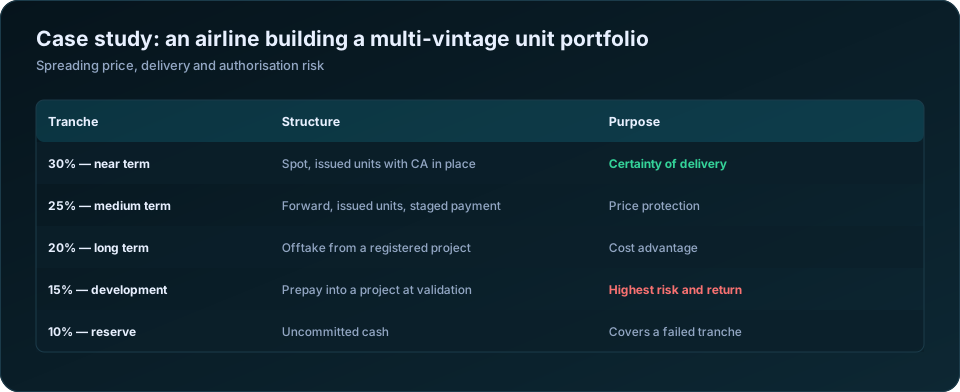
The five tranches
| Tranche | Share | Structure | Purpose |
|---|---|---|---|
| Near term | 30% | Spot purchase of issued units with authorisation in place | Certainty — this covers the immediate obligation |
| Medium term | 25% | Forward contract on issued units, staged payment | Price protection without development risk |
| Long term | 20% | Offtake from a registered, operating project | Cost advantage from committing early |
| Development | 15% | Prepayment into a project at validation stage | Lowest unit cost, highest risk |
| Reserve | 10% | Uncommitted cash | Covers the failure of any single tranche |
The reserve is the tranche most often omitted and the one that makes the rest of the structure safe. Without it, a failure in the development tranche forces a distressed spot purchase against a deadline — which is precisely the exposure the portfolio was built to avoid.
What each tranche is actually buying
The spot tranche buys certainty. Units already issued, already authorised, already labelled CORSIA eligible in a registry. There is no delivery risk and no eligibility risk. It costs the most per unit and it is the tranche that guarantees the operator can meet its nearest obligation regardless of what happens elsewhere.
The forward tranche buys price. Units that exist and are authorised, contracted for future delivery at a fixed price. Delivery risk is low; the risk is counterparty performance. Staged payment against delivery milestones manages that.
The offtake tranche buys cost advantage. A registered, operating project commits volume to the buyer over several years at a price below spot. The risks are real but bounded: the project may under-deliver, and authorisation for future vintages may not follow. The contract must address both — see CORSIA offtake agreement terms and an offtake dispute over corresponding adjustments.
The development tranche buys optionality at the lowest unit cost. Prepaying into a project at validation stage secures units at a substantial discount and carries genuine risk that the project never issues, never obtains authorisation, or issues less than projected. Fifteen percent is a deliberate cap.
The reserve buys the ability to absorb a failure without a forced purchase.
The risk each tranche carries
| Risk | Spot | Forward | Offtake | Development |
|---|---|---|---|---|
| Price | High — pay the market | Managed | Low | Lowest |
| Delivery | None | Low | Medium | High |
| Eligibility | None — verified at purchase | Low | Medium | High |
| Counterparty | Low | Medium | Medium | High |
| Timing | None | Low | Medium | High |
Reading down the columns rather than across is what makes the structure coherent. The tranches are not a spectrum of the same thing at different prices; they carry genuinely different risks, and the portfolio holds several small exposures to different failure modes instead of one large exposure to a single one.
Diversifying beyond structure
Within tranches, the operator applied three further diversification rules:
No more than 40% from a single project. A project-specific issue — a verification delay, an authorisation problem, a reversal — should not compromise the majority of the portfolio.
At least three crediting programmes represented. Programme approval status can change, and concentration in one programme is a live risk.
Vintages spread across the eligible window. Concentrating in the oldest eligible vintages saves money and risks units aging out if compliance timing shifts. See CORSIA vintages and eligibility windows.
The project concentration rule proved its worth when one supplying project experienced a verification delay pushing issuance back two quarters. Because it represented under a third of a single tranche, the effect on the overall position was minor.
Governance around the portfolio
| Element | Practice |
|---|---|
| Approval authority | Board sub-committee above a defined value |
| Counterparty due diligence | Documented per seller before any commitment |
| Unit-level due diligence | Programme, vintage, authorisation, registry label |
| Quarterly position report | Committed volume against forecast obligation |
| Mark to market | Portfolio value against current spot |
| Delivery tracking | Milestone monitoring per contract |
| Escalation trigger | Any tranche slipping more than one quarter |
The quarterly position report is the operational core. It compares committed volume against the current forecast obligation, which moves as traffic forecasts move. An operator whose network expands faster than planned is under-covered; one that contracts is over-covered and holding units it does not need. Either is manageable if seen early. Reporting practice is covered in CORSIA board reporting and governance.
What the portfolio approach costs
The blended unit cost was below what a single spot purchase would have been, because three of the five tranches priced below spot. Against that, the portfolio carried real overheads: five contracts rather than one, ongoing delivery monitoring, and due diligence on four counterparties instead of one.
For an operator with a small obligation, that overhead is not worth it — buy spot, close to the deadline, from a reputable counterparty. For an operator with a multi-year obligation of significant value, the treasury argument holds, and it is the same argument the company already applies to fuel.
For procurement mechanics see CORSIA unit procurement process in India, how to buy CORSIA carbon credits and CORSIA credit price negotiation in India. Market context is published in the ICAO CORSIA eligible units documentation.
Frequently Asked Questions
Should an airline buy its CORSIA units in one transaction?
Only if the obligation is small. A larger multi-year obligation concentrated in one purchase carries price risk at a single moment, counterparty risk in one entity and delivery risk in one project — an exposure profile the company would not accept for any other input of similar value.
What is a sensible mix of spot, forward and offtake units?
A common structure is roughly 30% spot for certainty, 25% forward for price protection, 20% offtake for cost advantage, 15% development-stage for the lowest unit cost, and 10% held as uncommitted reserve against the failure of any single tranche.
Why hold an uncommitted reserve?
Because a failure in a development or offtake tranche otherwise forces a distressed spot purchase against a deadline. The reserve is what allows the higher-risk, lower-cost tranches to be held safely.
How much of a portfolio should come from one project?
No more than around 40%. A project-specific problem — verification delay, authorisation refusal, reversal — should not be able to compromise the majority of the position.
Why diversify across crediting programmes?
Because programme approval status can change, and a portfolio concentrated in a single programme carries that risk in full. Three or more programmes represented is a reasonable minimum for a portfolio of any size.
What should quarterly CORSIA portfolio reporting cover?
Committed volume against the current forecast obligation, mark to market against spot, delivery milestone status per contract, and an escalation flag for any tranche slipping more than one quarter. The forecast obligation moves with traffic, so coverage must be re-tested regularly.
Planning your CORSIA position? DSTechnoverse provides CORSIA carbon credit services for Indian operators and project developers — scope and readiness assessment, monitoring plans, data pipelines, verification support, unit sourcing and second-phase modelling. We are based in Indore, Madhya Pradesh and work across India.
Apply as a CORSIA buyer or seller
Talk to our carbon markets team about your position.