When a dispersion study shows an exceedance, the first question asked is almost always "can we raise the stack?". Sometimes yes, often with less effect than expected, and sometimes it is not permitted at all.
This article covers what each stack parameter actually does to ground-level concentration, and where the regulatory limits on stack-height solutions sit.
The Six Levers
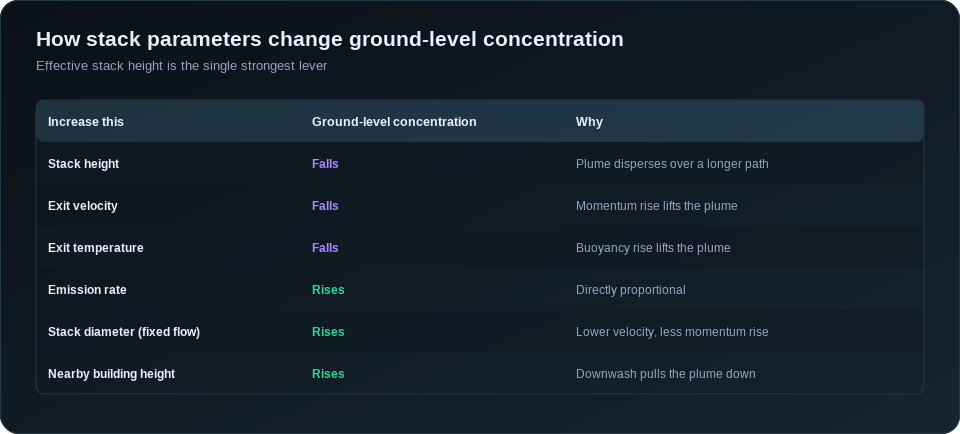
| Increase this | Ground-level concentration | Mechanism |
|---|---|---|
| Stack height | Falls | Longer dispersion path before touchdown |
| Exit velocity | Falls | Momentum rise adds effective height |
| Exit temperature | Falls | Buoyancy rise adds effective height |
| Emission rate | Rises, proportionally | Directly proportional in the Gaussian equation |
| Stack diameter at fixed flow | Rises | Lower exit velocity means less momentum rise |
| Nearby building height | Rises | Downwash pulls the plume into the wake |
Only two of those actually reduce the mass emitted. The rest move where the mass ends up. That distinction matters both technically and in a permitting conversation — dilution by height is not abatement, and regulators treat it accordingly.
Effective Stack Height
The height governing ground-level impact is not the physical stack:
H_effective = H_physical + Δh (plume rise)
Plume rise comes from two sources.
Momentum rise dominates for cool, high-velocity exits. It scales with exit velocity and stack diameter relative to wind speed. A high-velocity exit can add tens of metres of effective height, which is why a stack that is too wide for its flow performs worse than a narrower one passing the same volume.
Buoyancy rise dominates for hot exhausts. It depends on the buoyancy flux — a function of exit temperature relative to ambient, exit velocity and diameter. For hot combustion sources this typically contributes more than momentum, and it is why cooling the exhaust before discharge, sometimes for corrosion or heat recovery reasons, can quietly worsen ground-level impact.
Most regulatory models use Briggs plume rise formulations, with separate treatment for buoyant and momentum-dominated cases in stable and unstable conditions.
The practical consequence: the same physical stack performs very differently under different operating loads. A plant at 40% turndown has lower exit velocity and often lower exit temperature, so less plume rise and a lower effective height. Part-load operation is frequently the worst case, and modelling only full-load emissions is one of the most common omissions in a permit application.
Why Height Helps Less Than Expected
In the Gaussian equation, effective stack height appears inside an exponential term, squared and divided by the vertical dispersion coefficient. The consequences are not linear:
- Doubling effective height reduces maximum ground concentration by considerably more than half — the relationship is steep.
- But the location of the maximum moves further downwind, so a receptor that was previously beyond the peak may now sit under it. Raising a stack can increase concentration at a specific location while reducing the site maximum.
- Above a certain height the returns flatten, particularly in stable conditions where the plume may simply remain aloft near the source and touch down far away.
- Terrain sets a ceiling. If elevated ground downwind reaches near plume height, additional stack height does not help at that receptor.
This is why the answer to "how much higher must the stack be?" comes from a model run, not from a rule of thumb.
Good Engineering Practice Stack Height
Regulators do not permit unlimited dilution by height. The GEP stack height concept caps the credit a study may claim.
The standard formulation:
GEP height = H_building + 1.5 × L
where H_building is the height of a nearby structure and L is the lesser of that building's height or its projected width. A common alternative floor is 65 m.
What it means in practice:
- A stack below GEP height is exposed to building downwash and must be modelled with downwash effects included.
- A stack at or below GEP height is generally credited at its actual height.
- A stack above GEP height may have its credited height limited to GEP for regulatory purposes, preventing dispersion credit that is really just dilution.
The intent is straightforward: emission reduction should come from control, not from building a taller chimney. Check the specific requirements applicable to your jurisdiction — the US EPA SCRAM guidance sets out the GEP framework, and Indian consent conditions specify minimum stack heights by source category through CPCB.
Building Downwash
A stack shorter than GEP height sits in the turbulent wake of nearby structures. The plume is entrained and dragged to ground much closer to the source than open-terrain physics predicts.
The effect is large. Ground-level concentrations in the cavity and wake regions can be several times what the same source would produce with no building present.
| Situation | Downwash risk |
|---|---|
| Stack well above 2.5 × building height | Minimal |
| Stack near or below building height | Severe |
| Wide building perpendicular to prevailing wind | Higher |
| New building constructed near an existing stack | Often overlooked |
That last row causes real problems. A plant with a comfortable compliance margin can breach it after a new warehouse is built nearby, with no change in emissions at all. Downwash analysis uses BPIP (Building Profile Input Program) to compute direction-specific building dimensions for the model — see building downwash and BPIP.
Designing a Stack
Order of operations when a study shows an exceedance:
- Verify the emission inventory. Over-stated emission factors produce phantom exceedances. Check before redesigning anything.
- Check part-load and start-up cases. If the exceedance only occurs at part load, the answer may be operational rather than physical.
- Reduce emissions. Control equipment, fuel switching, process change. This is the only option that reduces total environmental burden.
- Optimise exit conditions. A narrower stack at the same flow raises exit velocity and momentum rise, often at modest cost. Check the induced draft fan can take the additional pressure drop.
- Preserve exhaust temperature where heat recovery permits. Buoyancy rise is free effective height.
- Increase physical height, within GEP and structural, aviation and visual constraints.
- Relocate the stack away from buildings and elevated terrain, where the site permits.
- Re-model each option. The interactions are not intuitive, and a change that helps the site maximum may worsen a specific sensitive receptor.
Steps 4 and 5 are frequently overlooked in favour of jumping to step 6, and they are usually cheaper.
Common Errors
Modelling only full-load emissions. Part load often produces lower plume rise and the actual worst case.
Rain caps and horizontal discharge. Both destroy vertical momentum. Some models zero the momentum rise entirely for horizontal or capped discharges, which can turn a compliant design into a non-compliant one. Use a conical cap or a drain instead.
Ignoring nearby structures. Downwash is a large effect and is the most common omission in first-time studies.
Treating exit temperature as constant. It varies with load, fuel and ambient conditions.
Assuming stack height is a free variable. Aviation constraints, structural cost, visual impact assessment and GEP limits all constrain it.
Not re-modelling after a design change. Every parameter change alters the answer non-linearly.
More of these in common AERMOD mistakes and the QA/QC checklist for a dispersion report.
Multiple Stacks and Merged Plumes
Sites with several stacks close together behave differently from the sum of their individual predictions.
Plume merging. Two or more buoyant plumes released close together can combine into a single larger plume, which rises higher than either would alone because the combined buoyancy flux is greater and the merged plume entrains proportionally less ambient air. This reduces ground-level concentration relative to a naive sum. Some models handle merging explicitly; others do not, and ignoring it is conservative rather than dangerous.
Superposition. Where plumes do not merge, concentrations at a receptor add. A receptor downwind of three stacks sees the sum of three contributions, and the maximum may occur at a location that is not the maximum for any single stack.
| Configuration | Effect on ground-level concentration |
|---|---|
| Several hot stacks close together | Merging raises effective height, reducing impact |
| Several stacks spread across a site | Superposition, with the peak between them |
| One tall stack plus several short vents | Short sources usually dominate near-field impact |
| A new stack added to an existing site | Cumulative impact must be re-modelled, not added on paper |
The last row is the practical one. Adding a source to an existing site changes the maximum's location as well as its magnitude, and the existing consent was granted against a different configuration. Re-model the whole site rather than modelling the new source alone — see cumulative impact assessment modelling.
Frequently Asked Questions
Does a taller stack reduce ground-level concentration? Yes, usually substantially, but with diminishing returns and with the location of maximum impact moving further downwind. Regulatory GEP limits also cap how much credit a study may claim.
What is effective stack height? Physical stack height plus plume rise from momentum and buoyancy. It is what governs ground-level impact.
What is plume rise? The additional height a plume gains from its exit velocity (momentum) and from being hotter than ambient air (buoyancy).
What is GEP stack height? Good engineering practice stack height — typically building height plus 1.5 times the lesser of building height or width — which caps the dispersion credit a study may claim.
Why does part-load operation matter? Lower exit velocity and temperature mean less plume rise and a lower effective height, so part load is frequently the worst case.
Do rain caps affect dispersion? Significantly. They deflect the plume and eliminate vertical momentum rise; many models zero the momentum contribution for capped or horizontal discharges.
What is building downwash? Entrainment of the plume into the turbulent wake of nearby structures, sharply increasing ground-level concentration close to the source.
Can a new building affect an existing stack's compliance? Yes. A new structure near an existing stack can introduce downwash and breach a previously comfortable consent without any change in emissions.
Should I increase stack height or exit velocity? Check exit velocity first — a narrower stack at the same flow is often cheaper than a taller one and adds momentum rise. Model both.
Need a dispersion study run properly? DSTechnoverse works as a confidential, white-label modelling desk for environmental consultancies, EPC contractors and industry — AERMOD and CALPUFF studies, emission inventories, meteorological processing and EIA-ready reporting. We are based in Indore, Madhya Pradesh and work with clients across India. See our AERMOD air dispersion modelling and air quality analysis services, or get in touch to scope a study.
Sources and Further Reading
Official and primary sources for the standards, rules and data discussed on this page.
- WHO Global Air Quality Guidelines (2021): health-based guideline values for PM2.5, PM10, NO2, SO2, O3 and CO.
- NOAA Integrated Surface Database (ISD): hourly surface meteorology often used to build AERMET inputs.
- CPCB: National Air Quality Index portal: live AQI and continuous monitoring station data across India.
- PARIVESH (Ministry of Environment, Forest and Climate Change): the online system for Environmental Clearance applications in India.