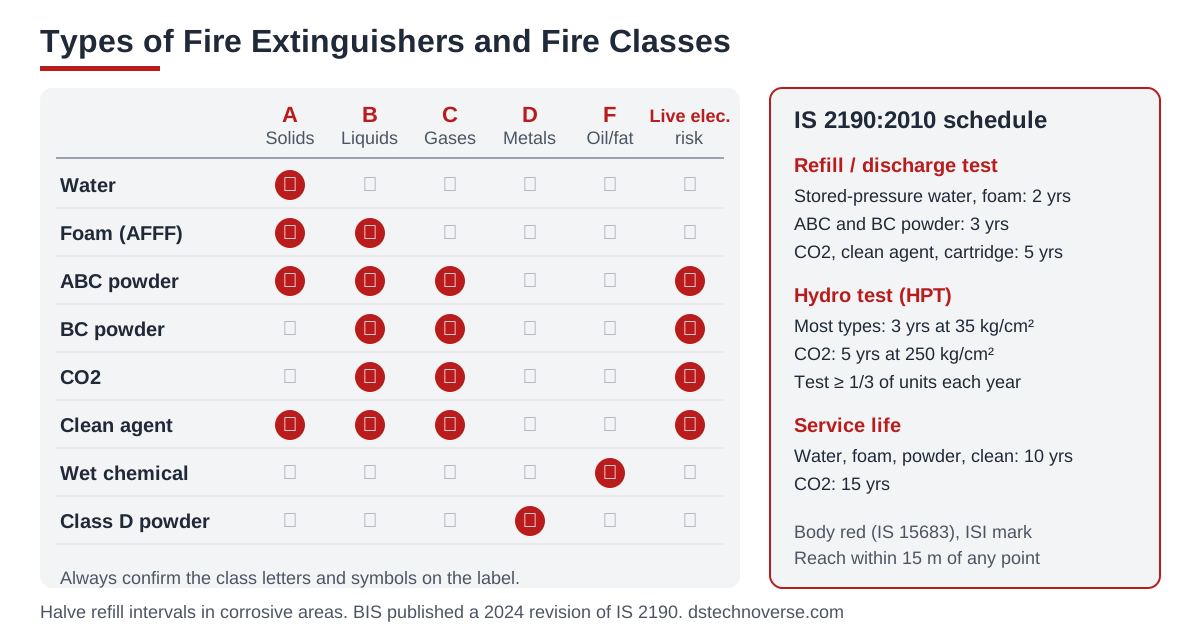
Quick answer: The main types of fire extinguishers used in India are water, foam, ABC dry powder, BC dry powder, carbon dioxide (CO2), clean agent, wet chemical and special Class D powder. Each is matched to a class of fire: A (solids), B (flammable liquids), C (flammable gases), D (metals) and F (cooking oils and fats), with electrical fires needing a non-conductive agent. IS 15683 covers how portable extinguishers are built and rated, IS 2190 covers how many to install, where to place them and how to maintain, refill and hydro test them, and every extinguisher sold must carry the BIS Standard Mark.
Portable fire extinguishers are the most common piece of fire safety equipment in any building, and the most commonly misunderstood. Many premises have the wrong type in the wrong place: a water extinguisher beside an electrical panel, a CO2 unit in an open loading bay where the gas blows away, or a row of powder extinguishers whose refill dates passed years ago.
This guide explains the types of fire extinguishers and the fire extinguisher classes they are designed for, how to read the label, how many you need, where to mount them, how often refilling and the hydro test are due, and how extinguishers fit into your Fire NOC. The numbers come from the Indian Standards themselves, with a worked example showing how a quantity is estimated for a small factory.
Extinguishers are only one part of a building's fire protection. For the full picture by occupancy, see our guide to fire safety requirements by building type.
Fire Extinguisher Classes: Classes of Fire in India
Before choosing between the types of fire extinguishers, you need to know what can burn in the area. Indian Standards group fires into classes by fuel. IS 2190:2010 and IS 15683 define Classes A to D, and BIS describes Class F for cooking media in its current guidance on extinguisher standards.
| Class | Fuel | Examples | How it is put out |
|---|---|---|---|
| A | Solid combustible materials of organic nature | Wood, paper, cloth, rubber, plastics | Cooling, mainly with water-based agents |
| B | Flammable liquids or liquefiable solids | Petrol, diesel, kerosene, paints, solvents, wax | Blanketing to cut off oxygen |
| C | Flammable gases under pressure, including liquefied gases | LPG, PNG, acetylene, hydrogen | Isolating the gas supply, then inhibiting the flame quickly |
| D | Combustible metals | Magnesium, aluminium powder, sodium, potassium, zinc | Special dry powder only |
| F | Cooking media | Vegetable and animal oils and fats in cooking appliances | Wet chemical agent that cools and forms a soap layer |
Two points cause most of the confusion:
- Electrical fires are not a separate class in Indian Standards. The burning material is usually Class A or B. What matters is that live electrical equipment needs a non-conductive agent. IS 2190 says only dry powder, carbon dioxide without a metal horn, or clean agent extinguishers should be used on energised equipment.
- Class K is the American label for kitchen oil fires. You will see it on some imported or international labels. In BIS terms the same risk is Class F.
Types of Fire Extinguishers at a Glance
This table summarises the types of fire extinguishers commonly supplied in India, what they are suitable for and where they must not be used. Always confirm suitability from the class letters and symbols printed on the extinguisher itself.
| Type | Suitable for | Do not use on | Typical portable sizes | Typical locations |
|---|---|---|---|---|
| Water (stored pressure or gas cartridge) | A | B, C, D, F, live electrical | 9 litre | Offices, schools, hotels, warehouses with paper and wood |
| Mechanical foam (AFFF) | A and B | D, F, live electrical | 9 litre; 50 litre wheeled | Fuel stores, DG rooms, workshops, paint areas |
| ABC dry powder | A, B, C, and electrical risks | D, F; avoid sensitive electronics if possible | 2 kg to 9 kg; larger wheeled units | General purpose in offices, shops, factories, vehicles |
| BC dry powder | B, C, and electrical risks | A (poor on deep-seated solids), D, F | 5 kg, 10 kg | Fuel and gas handling areas |
| Carbon dioxide (CO2) | B and electrical risks | A in the open, D, F; confined spaces where people stay | 2 kg, 4.5 kg, 6.5 kg; larger trolley units | Electrical panels, server rooms, laboratories |
| Clean agent | A (rated sizes), B, C, electrical risks, sensitive equipment | D, F | 2 kg to 6 kg | Server rooms, control rooms, archives, hospitals |
| Wet chemical | F, and A in many models | B, D | Commonly 6 litre | Commercial kitchens, canteens, hotels |
| Class D special powder | D | All others unless labelled | 10 kg | Metal machining, foundries, battery and chemical plants |
| Water mist | A, plus other classes only where the label shows them | Classes not shown on the label | As per manufacturer | Mixed-risk offices and similar areas |
Water Extinguishers
Water cools burning solids, which makes it the most effective agent for Class A fires in paper, cloth and wood. It conducts electricity and spreads burning liquids, so it must never be used on live electrical equipment or oil fires. Stored-pressure water units have a gauge; gas cartridge units are pressurised only when operated.
Foam Extinguishers
Mechanical foam, usually AFFF, forms a film over a burning liquid and seals off its vapours. It also wets solids, so it covers Class A and B. For polar solvents such as alcohols, IS 2190 recommends alcohol-resistant foam or dry powder, because ordinary foam breaks down on water-miscible liquids.
Dry Powder Extinguishers
Dry chemical powder interrupts the combustion reaction and knocks down flames very quickly. IS 2190 calls it probably the most effective medium against Class B fires and ideal for running or three-dimensional fuel fires. Its limits are poor visibility when discharged indoors, the risk of re-ignition once discharge stops, and a fine residue that damages electronics.
CO2 Fire Extinguisher
A CO2 fire extinguisher discharges carbon dioxide that smothers the fire and leaves no residue, so it is the standard choice beside electrical panels and in server rooms. It is less effective outdoors or in draughts, and it gives little cooling, so solid materials can re-ignite. IS 2190 specifies CO2 without a metal horn for live electrical equipment. In small rooms, a discharge lowers oxygen levels, so people should leave the space after use.
Clean Agent Extinguishers
Clean agent extinguishers use gaseous agents that leave no residue and are suited to sensitive equipment, records and data rooms. IS 2190 recommends CO2 or clean agent units where cleanliness and contamination of sensitive electronic equipment matter. They cost more per kilogram than powder.
Wet Chemical Extinguishers
Wet chemical agents, usually potassium-based solutions, cool hot cooking oil and react with it to form a soapy crust that stops re-ignition. Water and ordinary foam can make a deep fat fire erupt, so a commercial kitchen should have a wet chemical extinguisher alongside its kitchen hood suppression system.
ABC Fire Extinguisher: Why It Is the Default, and Where It Is Not
The ABC fire extinguisher is the most widely installed type in India because one unit covers Class A, B and C fires and can be used on electrical risks. For a mixed office or shop floor, a 4 kg to 6 kg ABC unit is a practical default.
It is not the right answer everywhere:
- Server rooms and control rooms: powder residue is corrosive and hard to clean from electronics. Use CO2 or clean agent.
- Kitchens with deep fat fryers: ABC powder is not rated for Class F. Use wet chemical.
- Metal fires: ordinary ABC powder can make them worse. Use Class D powder.
- Hospitals, ICUs and operation theatres: powder clouds reduce visibility and affect patients and equipment. Clean agent or CO2 are usually preferred near equipment, with water or foam for general areas.
- Large fuel spills: foam is better at sealing the surface and preventing re-ignition.
Standards for Fire Extinguishers in India
Four instruments govern portable extinguishers in India:
| Standard or rule | What it covers |
|---|---|
| IS 15683:2018 | Portable fire extinguishers, performance and construction; a fully charged portable extinguisher weighs no more than 17 kg |
| IS 16018 | Wheeled fire extinguishers, from over 17 kg up to 450 kg |
| IS 2190 | Selection, installation, maintenance, refilling and testing of extinguishers; the 2010 edition is widely used and BIS has published a 2024 fifth revision |
| Fire Extinguishers (Quality Control) Order, 2023 | Portable and wheeled extinguishers must conform to the Indian Standards and carry the BIS Standard Mark under a valid licence |
| NBCS 2026 (SP 7:2026) Part F | Requires first-aid fire fighting appliances in buildings, with detailed rules by occupancy. Replaced NBC 2016 Part 4 from 30 April 2026; state rules may still cite the 2016 edition |
Because of the Quality Control Order, buy only extinguishers bearing the ISI mark. BIS suggests checking a licence number through the Verify Licence Details feature of the BIS Care app. The figures in this guide come from IS 2190:2010; ask your supplier or fire authority whether any have changed under the 2024 revision.
Fire Extinguisher Colour Coding and Labelling in India
People often ask about fire extinguisher colour codes. In India the body is red: IS 15683 recommends red conforming to shade 536 or 538 of IS 5. Unlike older British practice, the medium is not identified by painting the whole body a different colour.
What tells you the type is the label. Under IS 15683, the marking must include:
- The class letters A, B and C (and others where applicable) with the fire rating, such as 2A or 55B.
- Use code symbols for the classes the extinguisher is suitable for, positioned directly below the operating instructions.
- Operating instructions facing outward.
- Serial number, year of manufacture and factory test pressure, permanently marked.
- Gross mass, and for gas cartridges, their own markings.
- Recharging instructions and, for clean agent units, a warning statement.
- The BIS Standard Mark.
Many suppliers also add a coloured band or panel to help quick recognition, often following the European convention (for example cream for foam, blue for powder, black for CO2, yellow for wet chemical and green for clean agent). These bands are a convenience, not the rule. Train staff to read the class letters and pictograms.
IS 2190 adds that labels showing extinguisher use or classification must be on the front, and that after every refill an inspection card is stencilled or attached showing the serial number, date of charging and the next refill due date.
How Many Fire Extinguishers Are Required?
"How many fire extinguishers are required?" is the most common question we get. IS 2190 Annex B gives a recommended scale by class of fire and hazard level: light hazard (LH), moderate hazard (MH) and high hazard (HH). It also lists typical occupancies for each: for example, schools and hospitals appear as moderate hazard for Class A, and workshops, painting shops and large kitchens as moderate hazard for Class B.
| Class and hazard | IS 2190:2010 Annex B recommendation | Reach |
|---|---|---|
| Class A, light hazard | One 9 litre water or one ABC 5 to 6 kg per 200 m² or part, minimum two per floor or compartment | Within 15 m |
| Class A, moderate hazard | Two 9 litre water or ABC 5 to 6 kg per 200 m², minimum four per floor or compartment | Within 15 m |
| Class A, high hazard | As moderate, plus one 50 litre water or CO2, or 25 kg ABC, per 100 m² or part | As moderate |
| Special hazard (Class A table) | One 4.5 kg CO2 or one 2 to 3 kg clean agent per 100 m², minimum two | Within 10 m |
| Class B, light hazard | One 9 litre foam or BC/ABC 5 to 6 kg per 200 m², minimum two | Within 15 m |
| Class B, moderate hazard | Two 9 litre foam or 5 to 6 kg powder per 200 m², minimum four | Within 15 m |
| Class B, high hazard | As moderate, plus 50 litre foam or 25 kg BC per 100 m², and one 135 litre foam per 300 m² | As designed |
| Class C, moderate hazard | One 10 kg powder, 6.5 kg CO2 or 5 kg clean agent per 100 m², minimum one per compartment | Within 15 m |
| Class D, high hazard | One 10 kg special powder per 100 m², minimum two per room | Within 10 m |
Three rules sit on top of the table:
- Travel distance: nobody should have to travel more than 15 m from a fire to reach an extinguisher (10 m in the special hazard and Class D rows).
- Every floor and compartment counts separately: the minimum quantities apply per floor or compartment, even if the floor is small.
- The authority decides: IS 2190 says the number and size are determined by the appropriate authority. Your fire authority may ask for more, and the NBC's occupancy rules also apply.
IS 2190 also notes that, following IS 15683, 6 kg and 9 kg powder units are replaced by 5 kg and 10 kg sizes, and lower-capacity powder, CO2 or clean agent units can be used where equivalent.
Worked Example: Extinguishers for a Small Factory (Illustrative)
The numbers below are illustrative, to show the method. The final scale depends on the hazard classification your designer and fire authority agree.
Scenario: a single-storey light engineering unit in Pithampur, 50 m by 30 m (1,500 m²). It has a machining shop with oil and coolant, a small paint store of 20 m², an electrical panel room of 40 m², a DG set area and an office of 150 m² inside the building.
Step 1, classify. The shop floor is treated as moderate hazard for Class A and Class B. The panel room is a special hazard for electrical equipment. The paint store and DG area are Class B risks.
Step 2, shop floor. Moderate hazard Class A asks for two units per 200 m². The shop and stores area is about 1,500 − 150 − 40 = 1,310 m². 1,310 ÷ 200 = 6.55, rounded up to 7 blocks, so 7 × 2 = 14 units. In this illustration the designer and fire authority accept 6 kg ABC powder as covering both the Class A and Class B scale on the open floor.
Step 3, office. Light hazard: one unit per 200 m², minimum two. 150 m² gives one, so the minimum of two applies: two 6 kg ABC units, or one ABC and one CO2 near the server rack.
Step 4, panel room. Special hazard: one 4.5 kg CO2 per 100 m², minimum two, within 10 m. So two 4.5 kg CO2 units at the panel room door.
Step 5, paint store and DG. One 9 litre foam at the paint store door and one 9 litre foam plus one 4.5 kg CO2 near the DG set, because foam suits the fuel and CO2 suits the alternator and control panel.
Step 6, check reach. On a 50 m by 30 m floor, place units at columns and exits so no point is more than 15 m away, adjusting positions rather than relying on the count alone.
Step 7, spares. IS 2190 recommends keeping replacement refills equal to at least 10 percent of each type in service.
| Area (illustrative) | Type | Quantity |
|---|---|---|
| Shop floor | 6 kg ABC powder | 14 |
| Office | 6 kg ABC, or ABC plus CO2 | 2 |
| Panel room | 4.5 kg CO2 | 2 |
| Paint store | 9 litre foam | 1 |
| DG set | 9 litre foam plus 4.5 kg CO2 | 2 |
| Total | 21 |
Where to Place Fire Extinguishers
IS 2190 gives practical placement rules:
- Place extinguishers in conspicuous, readily accessible positions, as near as possible to exits and stair landings without blocking escape routes.
- Keep similar positions on each floor so people know where to look.
- Site special-risk extinguishers near the risk but not so close that they cannot be reached in a fire. For a confined risk, place them outside the space.
- Mount them firmly on a wall or keep them on a trolley, never loose on the floor where they get kicked aside.
- Protect outdoor units from heat, cold and corrosion with a shade or cover that does not slow removal.
- Do not place them where they pick up heat from nearby equipment or processes.
- For wheeled units, check that doorways and passages are wide enough to move them.
Signage helps people find extinguishers, especially in large floors or where they are behind columns. Our fire extinguisher supply and refilling service includes layout marking and signage.
Inspection, Maintenance and Fire Extinguisher Refilling
IS 2190 makes the owner or occupier responsible for inspection, maintenance and recharging, and requires that the work is done by trained persons with the right manuals, tools and refills.
| Frequency | What happens |
|---|---|
| At least monthly | Trained person checks location, access, visibility, legible instructions, seals and tamper indicators, gauge pressure, physical damage and that the unit has not been discharged |
| Quarterly | Clean the exterior, check nozzle and vent holes, cap washer and threads, gauge pressure, and run the type-specific checklist in IS 2190 Annex C; carried out by the manufacturer, an authorised agent or professional firemen |
| Annually | Thorough inspection; units due for a discharge test are operated; others are emptied, inspected inside for rust and damage, and refilled; combined with staff training |
| After any use | Recharge every rechargeable extinguisher, even if only partly used |
Refilling and Discharge Test Schedule
IS 2190 sets how often each type is discharged and refilled, spread in an annual cycle so a share of units is done each year:
| Interval | Extinguisher types |
|---|---|
| Every 2 years | Water stored-pressure; mechanical foam stored-pressure |
| Every 3 years | BC and ABC powder |
| Every 5 years | Water and foam gas cartridge types (9 litre and 50 litre); CO2; higher capacity trolley powder; Class D powder; clean agent |
In corrosive environments, IS 2190 recommends halving these intervals. Premixed AFFF and FFFP foam charges are replaced at least once a year. CO2 and clean agent units are not emptied routinely; they are weighed, and a loss of more than 10 percent of the contents means the unit goes for recharging. Gas cartridges with more than 10 percent mass loss are replaced.
Fire Extinguisher Refilling Steps
- Record the serial number, type and last service date, and provide a temporary replacement of the same class and rating.
- Discharge or depressurise safely; never remove a valve from a pressurised unit.
- Inspect the body inside and out for corrosion, dents and damage; reject unfit units.
- Clean and check nozzle, hose, strainer, valve and washers; replace worn parts with manufacturer parts.
- Refill with the agent and quantity on the nameplate, using refills of the same fire rating.
- Pressurise stored-pressure units only to the nameplate pressure, using dry nitrogen for powder.
- Leak test, fit a new seal and tamper indicator, and update the inspection card and register.
Hydro Test of Fire Extinguishers
The hydro test, or hydraulic pressure test, checks that the extinguisher shell can still safely hold pressure. IS 2190:2010 Annex E sets the schedule:
| Extinguisher type | Test interval | Test pressure | Held for |
|---|---|---|---|
| Water types (gas cartridge and stored pressure) | 3 years | 35 kg/cm² | 2.5 minutes |
| Mechanical foam types, including 135 litre | 3 years | 35 kg/cm² | 2.5 minutes |
| Dry powder, stored pressure | 3 years | 35 kg/cm² | 2.5 minutes |
| Dry powder, gas cartridge | 3 years | 35 kg/cm² | 2.5 minutes |
| Clean agent | 3 years | 35 kg/cm² | 2.5 minutes |
| Carbon dioxide | 5 years | 250 kg/cm² | 2.5 minutes |
Key points from the standard:
- At least one-third of the extinguishers in a premises should be hydraulically tested every year, so the whole stock is covered on cycle.
- CO2 and clean agent cylinders are pressure tested every time they are sent for recharging, at the pressure in their product standard.
- There must be no leakage or visible distortion. A unit that fails is replaced.
- After testing, powder and stored-pressure units must be completely dried before refilling.
- CO2 cylinders also fall under the Gas Cylinders Rules, and IS 2190 asks for the approval stamp on the cylinder neck to be checked.
IS 2190:2010 Annex F also sets a service life from the date of manufacture: 10 years for water, foam, powder and clean agent extinguishers, and 15 years for CO2. A unit that fails its hydro test is rejected even before that age.
Choosing Between Types of Fire Extinguishers: Common Mistakes
| Mistake | Why it matters | Fix |
|---|---|---|
| Water extinguisher near electrical panels | Risk of electric shock | CO2 or clean agent at panels |
| Only ABC powder in server rooms | Corrosive residue damages equipment | CO2 or clean agent |
| No wet chemical in commercial kitchens | ABC and water are unsuitable on cooking oil | Wet chemical beside the cooking line |
| Extinguishers on the floor or behind stock | Not found or not reachable in a fire | Wall-mount at a visible, clear position |
| Refill dates and hydro test overdue | Unit may fail to discharge or rupture | Maintain a register and service schedule |
| Units without the ISI mark | Not compliant with the Quality Control Order | Buy BIS-certified units only |
| Nobody trained to use them | Extinguishers are only useful if staff act quickly | Annual hands-on training with the annual inspection |
Fire Extinguishers and Your Fire NOC
Portable extinguishers appear in almost every Fire NOC, from small shops to high-rise towers. They are shown on the fire fighting drawings submitted at the provisional stage and physically checked at the final inspection. Our guides to provisional vs final Fire NOC, the Fire NOC process in Madhya Pradesh and Fire NOC documents explain the stages.
Fire officers typically check the type and number against the approved drawings, the ISI mark, inspection cards with valid refill and hydro test dates, mounting, signage and access. At renewal, outdated refill or test records are one of the most common gaps. Extinguishers support but do not replace hydrants, sprinklers and alarms; see our fire hydrant system design guide and fire alarm system types guide. A periodic fire safety audit, using our fire safety audit checklist, catches these issues before an inspection does.
How DSTechnoverse Helps
DSTechnoverse supplies, installs and maintains fire extinguishers from Indore for sites across Madhya Pradesh, including Pithampur, Dewas, Ujjain and Bhopal. Mohit Malviya, our accredited fire engineer, leads selection and layout so that each area gets the right type and quantity under IS 2190, and so that extinguishers match your Fire NOC drawings. We handle refilling, hydro testing, inspection cards and registers. See fire extinguisher supply and refilling, Fire NOC services, fire fighting AMC and fire fighting system installation, or contact us.
Frequently Asked Questions
What are the main types of fire extinguishers?
The main types of fire extinguishers are water, mechanical foam, ABC dry powder, BC dry powder, carbon dioxide, clean agent, wet chemical and special Class D powder. Each suits particular classes of fire. Water and foam are for solids, foam and powder for flammable liquids, CO2 and clean agent for electrical equipment, wet chemical for cooking oil, and Class D powder for burning metals.
What are the fire extinguisher classes in India?
Indian Standards classify fires as Class A for solid combustibles such as wood and paper, Class B for flammable liquids, Class C for flammable gases such as LPG, Class D for combustible metals, and Class F for cooking oils and fats. Electrical fires are not a separate class; live equipment needs a non-conductive agent such as powder, CO2 or clean agent.
Which fire extinguisher is best for home and office use?
For most homes and offices, an ABC dry powder extinguisher of 4 kg to 6 kg is a practical general-purpose choice because it covers solids, liquids, gases and electrical risks. Add a CO2 or clean agent extinguisher near server racks or electrical panels where powder residue would damage equipment, and a wet chemical extinguisher in a kitchen with deep fat frying.
Can a CO2 fire extinguisher be used on all fires?
No. A CO2 fire extinguisher is effective on flammable liquid fires and live electrical equipment, and leaves no residue. It gives little cooling, so burning wood or paper can re-ignite, it works poorly outdoors or in wind, and it is unsuitable for metal and cooking oil fires. In small rooms, people should leave after discharge because oxygen levels fall.
How often should fire extinguishers be refilled?
Under IS 2190:2010, stored-pressure water and foam extinguishers are discharged and refilled every two years, ABC and BC powder every three years, and gas cartridge water and foam, CO2, clean agent and Class D units every five years. Intervals are halved in corrosive environments. Any extinguisher must be recharged after use, and CO2 and clean agent units are refilled if they lose over 10 percent of their contents.
What is the hydro test interval for fire extinguishers?
IS 2190:2010 sets a hydraulic pressure test every three years at 35 kg/cm² for water, foam, powder and clean agent extinguishers, and every five years at 250 kg/cm² for CO2, each held for 2.5 minutes. At least one-third of a building's extinguishers should be tested each year. A unit that leaks or distorts must be replaced.
How many fire extinguishers are required for a building?
IS 2190 Annex B gives the scale. For ordinary Class A areas, light hazard needs one unit per 200 m² with at least two per floor, and moderate hazard needs two per 200 m² with at least four per floor. Nobody should travel more than 15 m to reach one. Special risks, liquids, gases and metals have their own rules, and the fire authority has the final say.
What is the colour of a fire extinguisher in India?
Fire extinguisher bodies in India are red; IS 15683 recommends shade 536 or 538 of IS 5. The type is identified by the label, which shows the class letters, fire rating, use symbols and operating instructions. Some suppliers add coloured bands for quick recognition, but staff should be trained to read the label rather than rely on band colours.
What is the life of a fire extinguisher?
IS 2190:2010 gives a service life of 10 years from the date of manufacture for water, foam, powder and clean agent extinguishers, and 15 years for CO2 extinguishers. An extinguisher that fails its hydraulic pressure test, or shows serious corrosion or damage, must be withdrawn earlier. The year of manufacture is permanently marked on the body or nameplate.
Need a Fire NOC or a fire safety installation? DSTechnoverse handles provisional and final Fire NOC applications and renewals, and designs, supplies, installs and commissions fire fighting systems: hydrants, sprinklers, fire alarms, extinguishers and suppression systems. Work is led by Mohit Malviya, our accredited fire engineer, from our base in Indore, Madhya Pradesh. Talk to our team.