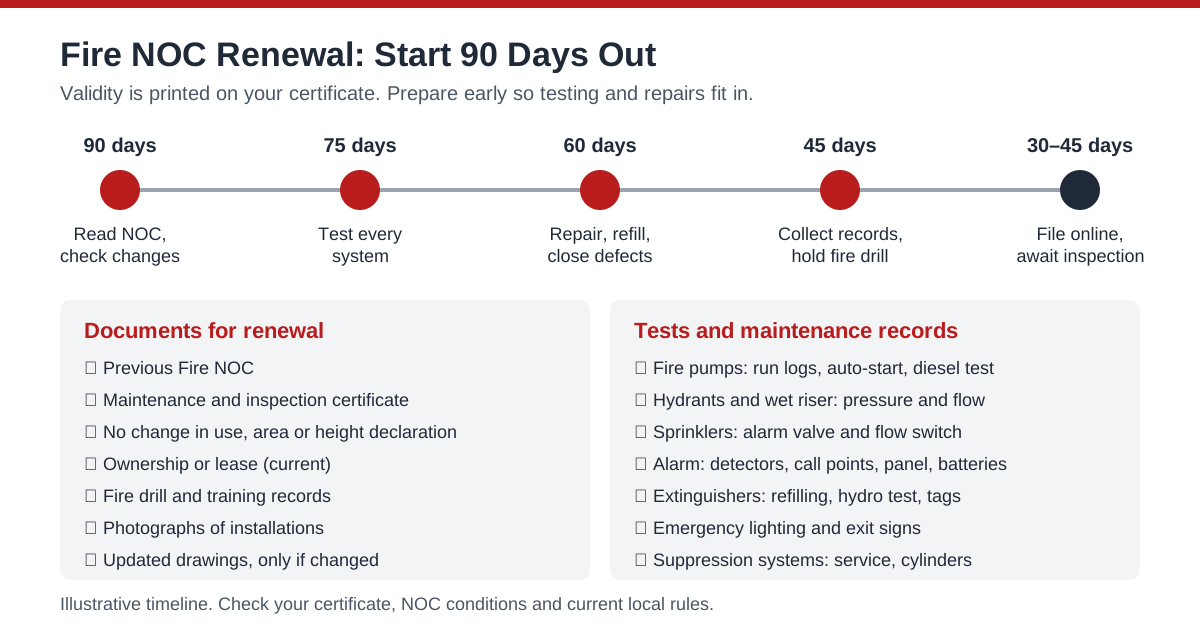
Quick answer: Fire NOC renewal is the periodic re-approval of a building's fire safety clearance, granted when the owner shows that the fire systems approved at the final stage are still installed, maintained and working, and that the building's use, area and height have not changed. The validity period is printed on the certificate and set by the state's rules (in Madhya Pradesh it is commonly reported as one year, but confirm it on your own certificate). Start 60 to 90 days before expiry, test every system, gather maintenance records and file through the authority's portal, which in Madhya Pradesh is usually e-Nagarpalika.
Fire NOC renewal is the part of fire compliance that most owners think about least, until the certificate has already expired and a bank, insurer, licensing department or inspection team asks for it. A final Fire NOC is not a lifetime approval. It confirms that on the day of inspection the building had the protection it needed. Renewal confirms that the protection is still there, still working and still matched to the building as it is used today.
This guide explains fire NOC validity, when to start, the documents and maintenance records needed, the tests to complete before applying, how to renew fire NOC online, and what to do if your fire NOC has expired. It is written for building owners, facility and factory managers, hospital and school administrators and housing societies. For the full first-time document set, see our documents required for fire NOC guide, and for the online filing steps in Indore and across the state, see how to get a Fire NOC in Madhya Pradesh.
What Fire NOC Renewal Actually Involves
A renewal application is short on paper but long on evidence. The authority wants to know three things:
- Is the building the same? Same occupancy, same floor areas, same height, no new basements, mezzanines or floors, and no change from, say, office to restaurant or warehouse to manufacturing.
- Are the fire systems still installed and working? Pumps start, hydrants deliver water at pressure, sprinklers and alarms operate, extinguishers are charged and in date, exits are clear and emergency lights work.
- Is there a maintenance regime? Logbooks, service reports, test records and, for many occupancies, evidence of fire drills and staff training.
If all three answers are yes, renewal is largely a documentation and inspection exercise. If any answer is no, the owner needs to fix the gap first, and in some cases the authority will treat the file as a fresh application rather than a renewal.
Fire NOC Validity: How Long Does It Last?
Fire NOC validity depends on the state's fire services law and rules, the occupancy and sometimes the size of the building. There is no single national figure.
| Jurisdiction | What applies (summary) | What to check |
|---|---|---|
| Madhya Pradesh | The Madhya Pradesh Fire and Emergency Services Act, 2026 is in force, with rules being notified; under the earlier arrangements, published guidance commonly described annual renewal of NOCs issued by urban local body fire departments | The validity on your certificate, the current Act and rules, and your local fire office |
| Maharashtra | Owners or occupiers must furnish a certificate (Form B) from a licensed agency twice a year, in January and July, confirming fire safety measures are maintained | Form B schedule and any changes from recent rule amendments |
| Delhi | Rules were amended in 2025 so that the Fire Safety Certificate stays valid unless suspended or cancelled, subject to an annual declaration; earlier certificates carried fixed validity periods and renewal applications | The current Delhi Fire Service rules and transition provisions |
| Other states | Each has its own fire services act, portal and validity period, which can differ by occupancy | The local fire service's current notification |
The practical rule is simple: the date on your certificate governs. This matters especially in Madhya Pradesh, where the Madhya Pradesh Fire and Emergency Services Act, 2026 (Madhya Pradesh Agnishaman Evam Apatkalin Sevayen Adhiniyam, Act 16 of 2026) is now in force and general rules under it were reported as notified on 12 October 2026, with further rules being notified. Forms, fees, validity and renewal arrangements may change as the new framework beds in, so each renewal should be checked against the current Act and rules rather than past practice. Read the validity line and any conditions on your current NOC, put the expiry in the compliance calendar of whoever is responsible, and do not rely on general figures from the internet, including this page, for your legal deadline.
Validity is also conditional. Most certificates state, in one form or another, that the approval stands only while the fire systems are maintained and the building is used as approved. An NOC that is "in date" on paper can still be treated as invalid if an inspection finds the hydrant pumps dismantled or the building converted to another use.
When to Start Your Fire NOC Renewal
Late renewal is the most common problem we see, and it is almost always caused by starting the paperwork in the last week. Renewal needs testing, and testing often reveals defects that take weeks to repair. Some sources suggest filing 30 to 45 days before expiry; we recommend starting the preparation at least 60 to 90 days ahead so that the filing itself happens comfortably inside that window.
| Time before expiry | Action |
|---|---|
| 90 days | Read the current NOC and its conditions. Confirm no change in use, area or height. Book the pre-renewal inspection with your AMC contractor or fire engineer. |
| 75 days | Carry out a full system test: pumps, hydrants, risers, sprinklers, alarm, extinguishers, emergency lighting, suppression. Record every result. |
| 60 days | Complete repairs and replacements. Refill or replace extinguishers that are due. Close every defect in the logbook. |
| 45 days | Collect certificates and records. Conduct and record a fire drill if one is due. Update drawings if any minor changes occurred. |
| 30 to 45 days | File the renewal application online and pay the prescribed fee. Keep the acknowledgement or request number. |
| Until issue | Keep the site ready for inspection. Respond to queries quickly. Keep systems on auto mode and exits clear. |
Documents Required for Fire NOC Renewal
The renewal document set is lighter than a first application but must be current. Expect the following, subject to your local authority's list.
| Document | Why it is needed | Source |
|---|---|---|
| Copy of the previous Fire NOC (and provisional NOC where relevant) | Links the renewal to the existing approval | Owner's records |
| Application form with applicant identity and authority | Identifies the responsible person | Owner, company signatory |
| Ownership or lease document (current) | Confirms continued right to occupy | Owner |
| Declaration of no change in use, area or height | Confirms the NOC scope still matches | Owner; format as prescribed |
| Fire systems inspection and maintenance certificate | Independent confirmation systems are working | AMC contractor or fire engineer |
| Test records for pumps, hydrants, sprinklers, alarm | Evidence of recent testing | AMC contractor |
| Extinguisher refilling and pressure test records | Shows extinguishers are charged and in date | Extinguisher service provider |
| Maintenance logbooks and service reports | Shows ongoing maintenance, not one-off testing | AMC contractor, facility team |
| Fire drill and training records | Shows people know what to do | Facility or safety manager |
| Electrical safety certificate (where asked) | Electrical faults are a major ignition source | Licensed electrical contractor |
| Photographs of key installations | Visual evidence for the file | Owner or consultant |
| Updated drawings (only if anything changed) | Shows the current layout | Architect, fire consultant |
Our documents required for fire NOC guide explains each of the first-time documents in detail if your authority asks for a fuller set.
Maintenance Records and Testing Needed for Renewal
Maintenance records are the real substance of a renewal. A fire officer can tell very quickly whether a logbook has been kept month by month or filled in the night before. The table below shows the records that should exist for each system and what the officer typically checks on site. Inspection, maintenance and test intervals are set by the relevant Indian Standards (for example IS 2190 for portable extinguishers and IS 2189 for detection and alarm systems), by manufacturers and by your NOC conditions; follow those rather than a generic schedule.
| System | Records to keep | What the officer often checks on site |
|---|---|---|
| Fire pumps (main, diesel, jockey) | Run logs, auto-start tests, diesel fuel level, battery checks, service reports | Pumps on auto, diesel starts, pressure gauges working, no leaks |
| Fire water tank | Level records, cleaning records | Tank full, fire reserve not used for domestic supply |
| Hydrants and wet riser | Pressure and flow test records, valve exercise records | Landing valves open and close, hoses and branch pipes present, pressure at top floor |
| Hose reels | Function test records | Reel turns, hose intact, water at nozzle |
| Sprinklers | Alarm valve tests, flow switch tests, head inspection, spare heads stock | Heads not painted or obstructed, storage below required clearance, valves locked open |
| Fire detection and alarm | Detector tests, call point tests, panel event log, battery replacement | Panel normal with no faults or isolations, sounders audible |
| Portable extinguishers | Inspection tags, refilling records, hydraulic pressure test records, BIS marks | Gauges in green, tags current, correct type for the risk, mounted and visible |
| Emergency lighting and exit signs | Function and duration test records | Lights work on mains failure, signs visible and lit |
| Gas, clean-agent or kitchen suppression | Service reports, cylinder weight or pressure checks, hydro test dates | Cylinders in date, nozzles clear, interlocks working |
| Means of escape | Inspection notes | Stairs and corridors clear, fire doors close and latch, exits unlocked |
| People | Drill records, training attendance, fire warden list | Staff know alarm and evacuation procedure |
A few practical points:
- Panels with isolated zones are a red flag. It is common to isolate a detector zone during works and forget to restore it. Check the panel shows normal before inspection.
- Diesel pumps fail quietly. A diesel pump that has not been run for months may not start. Weekly run logs are common good practice and give the officer confidence.
- Extinguishers are the most visible item. Missing tags, low gauges or the wrong type for the risk are noticed immediately. See our fire extinguisher types guide for selection, refilling and hydro testing.
- Sprinklers and storage do not mix well. Goods stacked up to the sprinkler heads defeat the system. This is a recurring finding in warehouses and shops. The sprinkler design guide explains clearances.
An annual maintenance contract for fire systems is the simplest way to make sure these records exist and stay current.
Pre-Renewal Self-Inspection Checklist
Walk the building with this list about 75 days before expiry. Anything you cannot tick is a job to finish before filing.
- Current NOC located, validity date and conditions read
- No change in occupancy, floor area, height, basements or mezzanines since the last NOC
- Fire tank full and fire reserve isolated from domestic draw-off
- All fire pumps on auto, diesel pump starts on test, jockey pump maintaining pressure
- Hydrant and wet riser pressure test completed and recorded
- Every landing valve and hose reel accessible, hoses and branch pipes present
- Sprinkler alarm valve test done, heads clean and unobstructed, storage clearances respected
- Alarm panel normal with no faults, no isolated zones, batteries in date
- All detectors and call points tested within the period
- Extinguishers charged, tagged, mounted and of the right type, refilling and hydro tests in date
- Emergency lights and exit signs tested on mains failure
- Suppression systems serviced and cylinders in date
- Exits, stairs and corridors clear, fire doors closing and latching
- Fire drill held and recorded, fire wardens named
- Maintenance logbooks complete with no open defects
- Electrical safety check done where required
If several items fail, consider a formal fire safety audit and use our fire safety audit checklist to structure it.
How to Renew Fire NOC Online
Most states now accept renewal applications online. The steps below are general; the Madhya Pradesh route, including portal navigation, is set out in our Madhya Pradesh Fire NOC process guide, so it is not repeated here.
- Log in to the state or city portal. In Madhya Pradesh, fire services for urban local bodies have commonly been accessed through e-Nagarpalika; check whether the route or forms have changed under the new Act and rules. Use the same registered mobile number or account used for the original NOC where possible.
- Choose the renewal service rather than a new application, and enter the details of the existing NOC.
- Confirm or update the building details. Declare honestly whether anything has changed. Changes may move the application to a fresh NOC route.
- Upload the renewal documents as clear PDFs: previous NOC, maintenance certificate, test records, extinguisher records, declarations and photographs.
- Pay the prescribed fee online. Fees vary by authority and building and are confirmed per building.
- Save the acknowledgement or request number sent by SMS or email.
- Prepare for inspection. The authority may inspect before issuing the renewed NOC. Keep the master file on site and make sure the person who knows the systems is available.
- Respond to queries promptly and upload any additional documents asked for.
- Download and display the renewed NOC, and update the expiry date in your compliance calendar straight away.
Fire NOC Expired: What Happens and What to Do
If your fire NOC has expired, treat it as urgent. The consequences vary by state and by building, but can include:
- Enforcement action. Fire authorities in Madhya Pradesh have carried out inspection and sealing drives, including in Indore, aimed at hospitals, educational and coaching buildings and commercial premises found without valid fire safety clearance or working systems.
- Knock-on effects on other approvals. Trade licences, health facility registrations, factory licences, school recognition, bar and hotel licences and some environmental consents may ask for a valid Fire NOC.
- Insurance problems. Insurers may query cover or claims where fire safety clearance has lapsed or systems were not maintained.
- Liability. If a fire occurs while the NOC has lapsed and systems were not maintained, owners and occupiers face serious legal exposure.
What to do, in order:
- Do not wait for a notice. Start immediately.
- Check the systems first. Run a full test of pumps, hydrants, sprinklers, alarm, extinguishers and emergency lighting. Fix critical defects before anything else.
- Check for changes. If the building has been altered since the last NOC, renewal may not be the right route; a fresh application with updated drawings may be needed.
- Ask the local fire office how a lapsed NOC is handled. Some authorities accept a late renewal with a penalty or late fee; others require a fresh application after a certain period. Confirm the current position in writing where you can.
- File with complete records, and be ready for a thorough inspection, because lapsed premises usually receive closer scrutiny.
Changes That Turn a Renewal into a Fresh Application
Renewal assumes the building is the same building. The following changes usually mean the authority will want updated drawings and may require a fresh NOC or a revised approval:
| Change | Why it matters |
|---|---|
| Additional floor or increase in height | May cross the 15 m high-rise threshold under the NBC, changing the systems required |
| New basement or change of basement use | Basements need specific ventilation, detection and sprinkler provisions |
| Change of occupancy (for example office to restaurant, warehouse to manufacturing) | Different occupancy group under the NBC, different requirements |
| Significant increase in floor area or occupant load | Exit widths, travel distances and system coverage may no longer be adequate |
| New hazardous storage or processes | Special-hazard protection and separation may be needed |
| Major alteration to fire systems | Approved design no longer matches the installation |
| Mezzanines or high racking in warehouses | Changes sprinkler design basis and escape routes |
If you are unsure whether a change is significant, ask before filing. Declaring a change at the start is far less painful than having an inspector discover it. Our fire safety requirements by building type guide explains how occupancy and height drive the systems needed.
Worked Example: An Illustrative 60-Room Hotel in Indore
All figures and dates are illustrative and are not taken from any real project.
A 60-room hotel in Indore with a ground-floor restaurant, a banquet hall on the first floor and rooms on four upper floors holds a final Fire NOC that, in this example, is valid until 31 March. The general manager wants renewal without a gap.
Early January (about 90 days out): The GM reads the NOC and its conditions. One condition requires the kitchen suppression system to be serviced and records kept. The GM confirms there has been no change in use, but notes that a small rooftop seating area was added last year. The fire engineer is asked to assess it.
Mid January (75 days): The AMC contractor tests all systems. Results, illustrative:
| Item | Result | Action |
|---|---|---|
| Main and diesel pumps | Main pump fine; diesel pump slow to start | Battery replaced, starter serviced, retested |
| Wet riser pressure at top floor | Within the design value | None |
| Alarm panel | Two detectors on fourth floor faulty, one zone isolated after painting works | Detectors replaced, zone restored |
| Extinguishers | 6 of 48 due for refilling, 2 due for hydraulic pressure test | Refilled and sent for testing, spares placed meanwhile |
| Kitchen suppression | Service due | Serviced, cylinder checked |
| Emergency lights | 4 fittings fail duration test | Batteries replaced |
| Rooftop seating | Not on approved drawings | Fire engineer advises declaring it and updating drawings |
Early February (60 days): Repairs completed and retested. Drawings updated for the rooftop area, with additional extinguishers and exit signage shown.
Mid February (45 days): A fire drill is held with staff on all shifts and recorded. Logbooks are reviewed and every defect is closed with a date and signature.
Late February (about 35 days): Renewal filed online with the previous NOC, maintenance certificate, test records, extinguisher records, kitchen suppression service report, drill record, updated drawings for the rooftop area and photographs. The request number is saved.
March: The fire officer inspects, asks for a demonstration of the diesel pump and the alarm, checks the rooftop area and the kitchen suppression, and the renewal proceeds. The decision rests with the authority after its own inspection; what the hotel controlled was having everything ready.
Lesson from the example: three of the issues found (diesel pump battery, isolated alarm zone, undeclared rooftop area) would have been inspection failures if discovered for the first time by the fire officer. Starting 90 days out turned them into routine maintenance jobs.
Common Fire NOC Renewal Pitfalls
| Pitfall | Consequence | How to avoid |
|---|---|---|
| Expiry date not tracked | NOC lapses unnoticed | Put expiry in a shared compliance calendar with 90-day reminders |
| Testing done after filing | Defects found at inspection | Test and repair before filing |
| Logbooks filled in retrospectively | Officer loses confidence in the records | Keep logs monthly through an AMC |
| Alarm zones left isolated | Panel shows faults at inspection | Check panel status the day before inspection |
| Extinguisher refills overdue | Visible non-compliance | Track refill and hydro test dates per unit |
| Undeclared changes | Renewal refused or converted to fresh application | Declare changes and update drawings |
| Fire reserve used for domestic water | Insufficient water for fire-fighting | Separate draw-off levels and check regularly |
| Storage blocking exits or sprinklers | Serious finding at inspection | Housekeeping walk before inspection |
| Wrong portal service selected | Application delayed | Choose renewal, quote the existing NOC number |
Fire NOC Renewal for Different Building Types
The renewal principles are the same everywhere, but the emphasis differs:
- Hospitals and nursing homes: detection, compartmentation, horizontal evacuation arrangements, medical gas areas and staff training are examined closely. Hospitals have been a particular focus of enforcement in Madhya Pradesh, so records should be impeccable.
- Schools, colleges and coaching centres: exits, alarm audibility, drill records and occupant numbers matter most. Coaching centres in upper floors of commercial buildings are a recurring concern for authorities.
- Hotels, restaurants and banquet halls: kitchen suppression, LPG or gas bank safety, exit widths and emergency lighting in assembly areas.
- Factories and warehouses: hydrant ring main condition, pump performance, storage heights relative to sprinklers, hazardous material storage and housekeeping.
- Residential high-rise societies: wet riser and pump maintenance, which often lapses when the builder hands over to the society, and clear staircases and refuge areas.
Who Is Responsible for Fire NOC Renewal?
Responsibility is often unclear, and unclear responsibility is how certificates lapse. In general, the owner or occupier named on the NOC is responsible for keeping it valid, but day-to-day duties are shared:
| Situation | Who normally holds the NOC | Who should track renewal |
|---|---|---|
| Owner-occupied factory or office | The company | Plant head, facility manager or EHS lead, with a named deputy |
| Multi-tenant commercial building | Building owner or management body for common systems; tenants sometimes for their own premises | Building manager for the building NOC; each tenant for any separate NOC |
| Housing society | Society after handover from the builder | Society secretary or managing committee, with the AMC contractor |
| Hospital, school or hotel | The institution or operating company | Administrator or general manager, with the safety officer |
| Leased warehouse | Depends on the lease | Agree in writing who holds the NOC and who pays for maintenance |
Two practical recommendations: write the renewal duty into job descriptions and lease agreements, and make sure the AMC contract requires the contractor to send expiry reminders and a pre-renewal test report. Builder-to-society handover is a common weak point, because the builder's NOC file and maintenance contracts do not always pass to the society. If you are a society that has recently taken over, ask for the original NOC, the as-built fire drawings and the last test records immediately.
Keeping the Building Renewal-Ready All Year
The cheapest renewal is the one that needs no special preparation because the building is always ready. That means treating fire safety as a monthly routine rather than an annual event:
- Monthly: walk-through of exits, extinguishers, panel status and pump room; check fire tank level; record findings in the logbook.
- Quarterly: functional tests of alarm devices on a rotating basis, hose reel checks, emergency lighting checks, review of open defects.
- Half-yearly: wider testing of hydrants, risers and sprinkler alarm valves, and a fire drill for each shift where operations run round the clock.
- Annually: full system test and service, extinguisher refilling and hydraulic testing as due, a fire safety audit where required or useful, and the renewal file itself.
The exact intervals for each system come from the relevant Indian Standards, manufacturers' instructions and your NOC conditions, so use this as a framework rather than a rule. The point is that records accumulate naturally, defects are fixed while they are small, and the renewal file can be assembled in days rather than weeks.
How DSTechnoverse Helps
DSTechnoverse handles Fire NOC renewal for buildings in Indore, Pithampur, Dewas, Ujjain, Bhopal and across Madhya Pradesh. Our accredited fire engineer, Mohit Malviya, leads a pre-renewal inspection, testing of pumps, hydrants, sprinklers, alarms and extinguishers, repairs and upgrades, preparation of the renewal file and liaison with the fire authority until the renewed NOC is issued. To keep records current all year, our fire fighting AMC and extinguisher refilling service cover routine maintenance. The authority decides after its own inspection. See our Fire NOC service or contact us with your current NOC.
Frequently Asked Questions
What is fire NOC renewal?
Fire NOC renewal is the periodic re-approval of a building's fire safety clearance. The owner shows the fire authority that the fire systems approved at the final stage are still installed, maintained and working, and that the building's use, area and height are unchanged. The authority may inspect before issuing the renewed certificate. Validity periods and procedures depend on the state and the building.
What is the fire NOC validity in Madhya Pradesh?
Under earlier arrangements, published guidance commonly described annual renewal. Madhya Pradesh now has the Fire and Emergency Services Act, 2026 in force, with rules being notified, so validity and renewal arrangements may change. The governing date is the validity printed on your certificate, read with the current Act and rules. Validity is also conditional on systems being maintained, so check your certificate and confirm with the local fire office.
How do I renew fire NOC online?
Log in to the portal used by your authority, which in Madhya Pradesh is commonly e-Nagarpalika, choose the renewal service, enter the existing NOC details, declare whether anything has changed, upload the renewal documents and maintenance records, and pay the prescribed fee. Keep the request number, prepare for inspection and respond to any queries quickly.
How early should I apply for fire NOC renewal?
Start preparing 60 to 90 days before expiry and file comfortably before the certificate lapses; some sources suggest filing 30 to 45 days ahead. The preparation time is needed for testing and repairs, which often reveal defects such as faulty detectors, weak diesel pump batteries or extinguishers due for refilling. Starting early turns these into routine maintenance rather than inspection failures.
What happens if my fire NOC has expired?
An expired NOC can lead to notices, sealing in enforcement drives, problems with trade or health licences and insurance difficulties. Start immediately: test and repair the systems, check whether the building has changed, and ask the local fire office how lapsed NOCs are handled, since some accept late renewal with a penalty while others require a fresh application.
What maintenance records are needed for renewal?
Typical records include pump run and auto-start logs, hydrant and riser pressure tests, sprinkler alarm valve tests, alarm panel and detector tests, extinguisher inspection, refilling and hydraulic pressure test records, emergency lighting tests, suppression system service reports, and fire drill and training records. They should be dated, signed and kept continuously, not completed just before filing.
Do I need a fire safety audit before renewal?
It is not always mandatory, but it is useful, especially for older buildings, buildings that have changed since the last NOC, or where the previous inspection raised issues. An audit identifies gaps in systems, escape routes and records before the fire officer does, so repairs can be made in time. Some occupancies and authorities do require periodic audits.
Can I renew fire NOC if I have added a floor?
Usually not as a simple renewal. An additional floor, new basement, change of use or major increase in area changes the building the NOC approved. The authority will normally want updated drawings and may treat the application as a fresh NOC or revised approval. Declare the change at the start and update the fire systems and drawings to suit.
Who signs the fire systems maintenance certificate?
It is normally signed by the maintenance contractor or fire engineer who inspected and tested the systems. Some states prescribe the format and require a licensed or registered agency; Maharashtra, for example, requires a twice-yearly certificate from a licensed agency. At DSTechnoverse, inspection and certification work is led by our accredited fire engineer, Mohit Malviya.
Need a Fire NOC or a fire safety installation? DSTechnoverse handles provisional and final Fire NOC applications and renewals, and designs, supplies, installs and commissions fire fighting systems: hydrants, sprinklers, fire alarms, extinguishers and suppression systems. Work is led by Mohit Malviya, our accredited fire engineer, from our base in Indore, Madhya Pradesh. Talk to our team.
Related services
Related articles
- Documents Required for Fire NOC: Complete Checklist by Stage and Building Type
- Fire Alarm System Types: Conventional vs Addressable, Detectors and IS 2189
- Fire Safety Audit Checklist: 14 Areas, Report Format and Who Can Do a Fire Audit
- Fire Safety Requirements for Buildings: NBC Occupancy Groups, Height and Systems by Building Type