Case Study: A Registered Carbon Project That Failed CORSIA Eligibility
· DSTechnoverse · CORSIA & Carbon Markets
The project was real, registered, verified and issuing credits. It still could not sell into CORSIA. The four requirements it met, the two it did not, and what the failure cost.
A renewable energy project in western India had been registered under a major crediting programme for several years, had passed multiple verifications and held a meaningful inventory of issued credits. When CORSIA demand emerged, the owner approached the market expecting a straightforward premium sale.
The credits were not CORSIA eligible, and most of the inventory never became eligible. This is why.
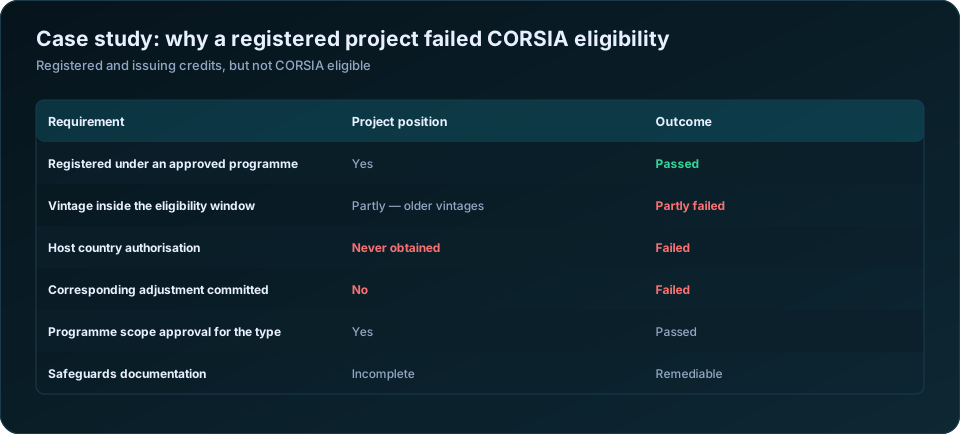
Six requirements, and where the project stood
CORSIA eligibility is not a single test. It is a set of conditions applied to both the programme and the individual unit.
| Requirement | Project position | Result |
|---|---|---|
| Registered under an ICAO-approved programme | Yes | Passed |
| Project type within the programme's approved scope | Yes | Passed |
| Safeguards documentation complete | Partly | Remediable |
| Vintage within the eligibility window | Partly — much of it older | Partly failed |
| Host country authorisation obtained | No | Failed |
| Corresponding adjustment committed | No | Failed |
Passing four of six is not a partial pass. The two failures are absolute: without authorisation and a corresponding adjustment commitment, a unit cannot be used for CORSIA regardless of how impeccable the project is on every other dimension.
The vintage problem
CORSIA restricts eligibility by vintage — the period in which the emission reduction actually occurred — with windows tied to the compliance phase. The project's inventory was distributed across many years, and a substantial share sat outside the eligible window.
| Vintage band | Share of inventory | CORSIA position |
|---|---|---|
| Older vintages | 47% | Outside the eligibility window |
| Middle vintages | 31% | Within the window, subject to authorisation |
| Recent vintages | 22% | Within the window, subject to authorisation |
Nearly half the inventory was ineligible on vintage alone, before authorisation was even considered. Those credits retain voluntary-market value, but they will never command a CORSIA price.
This is a general point for anyone holding legacy inventory: age is not neutral. Credits held in the expectation of a future price rise can age out of the highest-value market while being held. The windows are set out in CORSIA vintages and eligibility windows.
The authorisation problem, which is the real one
The decisive failure was the absence of host country authorisation and a corresponding adjustment commitment.
Under the Paris Agreement architecture, if an emission reduction occurring in India is used by an airline towards its CORSIA obligation, India must make a corresponding adjustment — adding that quantity back to its own reported emissions so the reduction is not counted twice. That requires a deliberate government act.
| What the project had | What CORSIA requires |
|---|---|
| Registration under an approved programme | The same, plus |
| Verified issuance | The same, plus |
| A serial-numbered unit in a registry | The same, plus |
| Nothing from the host government | An authorisation, and a CA commitment |
For a project whose credits were issued years before this architecture settled, retrospective authorisation was not straightforward. Government authorisation processes generally look forward, and a host country weighing whether to authorise units — and therefore accept an adjustment against its own targets — has limited incentive to do so for historic vintages that contribute nothing to current policy.
The owner applied. The application for the older vintages was not progressed. For the more recent vintages, authorisation was possible in principle but subject to the country's evolving position on which project types and volumes it was willing to authorise, described in CORSIA corresponding adjustment in India and CORSIA vs CCTS for Indian companies.
What it cost
| Consequence | Effect |
|---|---|
| Inventory written down from CORSIA to voluntary pricing | Substantial per-credit value loss |
| Sales process time invested | 7 months, no CORSIA sale concluded |
| Advisory and legal costs on the authorisation attempt | 11,00,000 INR |
| Buyer relationships | Two buyers withdrew after due diligence |
| Reputational | Credits now carry a due diligence history |
The last row is worth noting. Once a unit has been through a buyer's due diligence and failed, that outcome is known in a small market. Subsequent buyers ask why it is still available.
What a buyer's due diligence should have caught immediately
From the buyer's side, this failure is detectable in under an hour. Four checks, in this order:
- Is the programme ICAO-approved, and for this project type? Public information.
- Is the vintage inside the eligibility window? Arithmetic against a published table.
- Is there a host country authorisation, with a reference number? Ask for the document, not an assurance.
- Is the unit labelled as CORSIA eligible in the registry? Check the registry record directly.
Any seller unable to produce a document for check three is offering a voluntary unit. The checklist is in CORSIA credit due diligence checklist and CORSIA eligible emissions units criteria.
What a developer should take from it
Authorisation is a project design decision, not a sales step. Begin the host country conversation during development, not after issuance. Retrospective authorisation is far harder than prospective.
Do not hold inventory speculatively past its vintage window. Credits age out of the eligible market.
Register the intent early. Where a host country operates a pipeline or notification process for units intended for international transfer, entering it early costs little and preserves the option.
Distinguish the two markets in your financial model. A model assuming CORSIA pricing for an unauthorised unit is not conservative, it is wrong.
For the eligibility framework see ICAO-approved CORSIA crediting programmes and CORSIA carbon credit vs voluntary carbon credit. The ICAO CORSIA eligible emissions units page publishes the current programme and unit criteria.
Frequently Asked Questions
Why are some registered carbon credits not CORSIA eligible?
Because registration is only one of several requirements. The unit must also fall within the eligible vintage window, come from a project type within the programme's approved scope, and carry host country authorisation with a corresponding adjustment commitment. Missing either of the last two is disqualifying.
Can older carbon credits become CORSIA eligible later?
Generally no. Vintage windows are tied to compliance phases, and a credit outside the window does not re-enter it. Retrospective host country authorisation for historic vintages is also difficult, since it obliges the country to adjust its own reported emissions for a reduction that no longer supports current policy.
What is a corresponding adjustment in simple terms?
The host country adding the emission reduction back to its own reported emissions when the credit is used by someone else, so the same tonne is not counted twice — once towards the country's target and once towards an airline's obligation.
How do I check whether a credit is CORSIA eligible before buying?
Confirm the crediting programme is ICAO-approved for that project type, check the vintage against the published eligibility window, ask for the host country authorisation document with its reference number, and verify the CORSIA eligible label on the registry record itself.
What should a seller produce as evidence of authorisation?
The authorisation document or its reference number, not a verbal assurance or a statement that authorisation is expected. A seller who cannot produce it is offering a voluntary-market unit whatever the asking price implies.
Does a project need authorisation before or after issuance?
Ideally the process starts during project development. Prospective authorisation is substantially easier to obtain than retrospective, and beginning the host country conversation early preserves options that become unavailable once credits are issued and aging.
Planning your CORSIA position? DSTechnoverse provides CORSIA carbon credit services for Indian operators and project developers — scope and readiness assessment, monitoring plans, data pipelines, verification support, unit sourcing and second-phase modelling. We are based in Indore, Madhya Pradesh and work across India.
Apply as a CORSIA buyer or seller
Talk to our carbon markets team about your position.