A result of 10 CFU per swab does not mean ten organisms were on the surface. It means somewhere between twenty and fifty were, and possibly more. Recovery efficiency is the proportion of organisms actually present that the sampling method captures and the laboratory then grows — and programmes that ignore it report numbers that understate reality by a factor nobody has quantified.
Why Recovery Is So Poor
Organisms on a surface are not sitting loose waiting to be collected. They adhere through electrostatic and hydrophobic interactions, they lodge in surface irregularities invisible to the eye, and where a biofilm has formed they are embedded in a matrix that physically resists removal.
A swab passed across that surface removes some fraction. How large a fraction depends on the surface material, the surface finish, the organism, how long it has been drying there, the swab material, the wetting agent, and the technique of the person swabbing.
That list is why a single generic correction factor is inadequate and why the study has to be done on your materials with your method.
What Affects Recovery
| Factor | Effect |
|---|---|
| Surface material | Polished stainless recovers far better than porous silicone or degraded plastic |
| Surface finish | Roughness above ~0.8 µm Ra traps organisms in surface irregularities |
| Organism type | Spores and hydrophobic cells adhere more strongly than most vegetative cells |
| Drying time | Recovery falls sharply as cells dry onto the surface over hours |
| Swab material | Foam and flocked swabs release organisms better than cotton |
| Wetting agent | A dry swab recovers poorly; surfactant substantially improves release |
| Operator technique | Pressure, angle, coverage pattern and rotation each matter |
| Neutralisation | Residual disinfectant kills recovered cells before they are counted |
The Coupon Study
The standard approach uses inoculated coupons of the same material as the equipment surface. It is straightforward and does not need special equipment.
- Select coupons representative of every product contact material in the equipment train — stainless 316L, PTFE, silicone, glass, polycarbonate, and any gasket material.
- Match the surface finish to the actual equipment. A polished coupon standing in for a scratched production surface will overstate recovery.
- Inoculate with a defined low count, typically 10 to 100 CFU, spread evenly over a defined area.
- Include a representative organism panel — a Gram-negative, a Gram-positive, a spore former and a yeast or mould. Recovery differs substantially between them.
- Dry under conditions matching real production, since drying time significantly affects recoverability. Sampling a still-wet coupon overstates recovery considerably.
- Sample using the exact routine technique — same swab type, same wetting agent, same swabbing pattern, same operator training level.
- Neutralise any residual disinfectant where the routine method involves sampling a disinfected surface.
- Plate and enumerate under the routine method conditions.
- Calculate recovery as the count obtained divided by the count applied, expressed as a percentage.
- Repeat across at least three coupons per material and organism combination, and report the mean with its variability.
The Repeat-Extraction Alternative
For bioburden work under ISO 11737-1, the repeat-extraction method is generally preferred, because it uses the product's natural contamination rather than a laboratory inoculum that may adhere differently.
Take a product unit carrying its natural bioburden. Perform the extraction and enumerate — this is the first extract. Repeat the identical extraction on the same unit and enumerate again. Repeat a third time. Successive extracts should decline in a roughly geometric pattern.
Recovery efficiency is then calculated from the series, commonly as the first extract divided by the sum of all extracts, or by fitting the geometric decline to estimate the total originally present.
This method has a significant advantage: laboratory-applied organisms adhere differently from organisms deposited naturally during manufacturing, so the repeat-extraction figure is usually closer to the truth.
Applying the Correction
Once established, the correction factor is applied to routine results and — importantly — both the corrected and uncorrected figures should appear in the report.
If a swab recovers 45 per cent and the plate count is 18 CFU, the estimated surface load is 18 ÷ 0.45 = 40 CFU. Comparing the uncorrected 18 against a limit of 25 gives a pass. Comparing the corrected 40 gives a fail. That is the entire practical significance of the exercise.
Reporting both makes the basis of the decision transparent and prevents the confusion that arises when one report quotes raw counts and another quotes corrected ones.
Extraction Methods for Bioburden
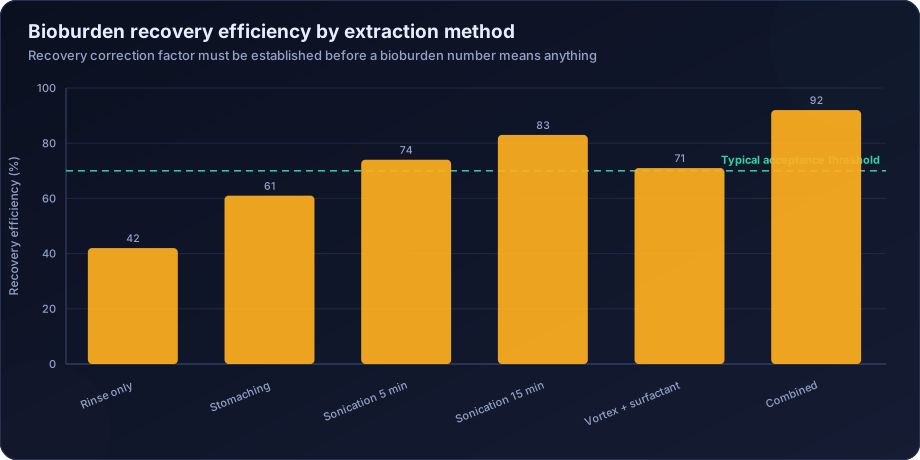
For product bioburden rather than surface swabbing, the extraction method choice drives recovery just as strongly.
| Method | Typical recovery | Best for |
|---|---|---|
| Rinse only | ~40% | Lumens, catheters, tubing |
| Stomaching | ~60% | Flexible materials, textiles |
| Sonication 5 min | ~74% | Rigid components |
| Sonication 15 min | ~83% | Rigid components, better penetration |
| Vortex + surfactant | ~71% | Small items, complex shapes |
| Combined sonication + vortex | ~92% | Where recovery matters most |
Extended sonication improves recovery but can damage vegetative cells if excessive, so the optimum is validated rather than assumed.
When to Revalidate
- Change of surface material or a change in surface condition — a scratched or pitted surface recovers differently.
- Change of swab supplier or swab type, which affects release meaningfully.
- Change of wetting agent, diluent or neutraliser.
- Change of disinfectant, since the neutralisation requirement changes.
- Change of cleaning procedure or product residue type.
- Change of extraction method or equipment for bioburden work.
- Periodic reconfirmation, typically every two to three years.
Why Regulators Care
Recovery efficiency appears in inspection findings because it determines whether a number means what the specification assumes it means.
A cleaning validation demonstrating surfaces below 25 CFU per plate, based on a method recovering 40 per cent, has actually demonstrated surfaces below approximately 62 CFU. If the acceptance criterion was derived from a risk assessment that assumed the measured value was the true value, the validation does not support the conclusion drawn from it.
For bioburden under ISO 11737-1, the standard explicitly requires that extraction efficiency be determined and the correction applied. A sterilisation dose calculated from an uncorrected bioburden carries a hidden and unquantified deficit in its sterility assurance argument — see bioburden testing.
Operator Technique and Variability
Recovery studies establish what the method can achieve. Operator technique determines what it does achieve on a given day.
Two trained operators sampling the same surface typically agree within a factor of two. Two untrained operators can differ by a factor of five, which is larger than most of the differences a monitoring programme is trying to detect. A defined technique, trained and periodically reassessed, is the only remedy — and the recovery study should be performed using that same defined technique rather than by the most skilled person in the laboratory.
Worked Example: What the Correction Changes
A device manufacturer swabs a moulded polymer component and reports 18 CFU against an acceptance limit of 25 CFU per 25 cm². Every batch passes and the trend looks stable.
A coupon recovery study on the actual polymer, using the routine swab and technique, with a mixed organism panel dried for four hours, returns 38 per cent recovery.
The corrected estimate is 18 divided by 0.38, which is approximately 47 CFU — nearly double the acceptance limit. Every batch that had been passing was, on a corrected basis, failing.
Two consequences follow, and they point in different directions.
The immediate one is that the acceptance limit and the measured value were never on the same basis. Either the limit was derived assuming corrected values, in which case the process has been out of specification, or it was derived from uncorrected historical data, in which case it is internally consistent but does not mean what the risk assessment says it means.
The more useful one is that once recovery is known, the limit can be set deliberately. A limit of 25 CFU corrected translates to roughly 9 CFU uncorrected with this method, and the routine test can be run and judged against that figure without applying arithmetic to every result. What matters is that the relationship is documented, so anyone reading the file knows which basis a given number is on.
This is why we report both figures. A file containing only corrected values invites confusion when someone later compares against a raw count, and a file containing only raw values conceals the correction entirely.
How DSTechnoverse Helps
Recovery efficiency is the step that converts a swab count into a defensible number, and it is missing from most of the programmes we are asked to review.
We run coupon-based recovery studies per surface material and organism group, repeat-extraction studies for bioburden under ISO 11737-1, neutraliser validation alongside, extraction method development and optimisation, correction factor documentation for routine reporting, and operator technique training with periodic competence assessment.
The study is quick and inexpensive relative to what it protects — and where a client has never run one, it is usually the first thing we recommend.
Frequently Asked Questions
How much does recovery efficiency actually vary?
Substantially. Swabs typically recover 20 to 50 per cent, contact plates 40 to 60 per cent, sponges 50 to 70 per cent, and combined extraction methods above 90 per cent. Within those ranges, surface material and organism shift the figure considerably.
Can we use a published recovery factor?
Not defensibly. Recovery depends on your surface, your swab, your technique and your organisms. A published figure is useful for planning and not for correcting your results.
Should we report corrected or uncorrected counts?
Both. Report the raw count, the recovery factor and the corrected estimate, so the basis of the comparison against the limit is transparent.
Does recovery matter if we only trend rather than compare to a limit?
Less, but it still matters, because a consistent correction is what makes results comparable over time and across sites. If the swab type changes and recovery shifts, the trend breaks without anyone noticing.
What organisms should the study use?
A panel spanning the relevant physiology — a Gram-negative such as Pseudomonas, a Gram-positive such as Staphylococcus, a spore former such as Bacillus, and a yeast or mould. Recovery differs enough between them that a single organism is not representative.
Can recovery be improved rather than just measured?
Often substantially, and it is worth trying before accepting a poor factor. Switching from cotton to flocked or foam swabs commonly adds ten to twenty percentage points. Adding a surfactant such as polysorbate 80 to the wetting solution improves release from hydrophobic surfaces markedly. For bioburden extraction, combining sonication with vortexing routinely reaches above ninety per cent where either alone reaches seventy. Improving recovery narrows the gap between what you measure and what is there, which is more valuable than applying a large correction to a poor method.
Does recovery efficiency apply to contact plates as well as swabs?
Yes, and it is measured the same way. Contact plates recover better than swabs on the flat surfaces they suit, typically forty to sixty per cent, but that is still a correction of roughly two-fold. The reason contact plate recovery is studied less often is that the method feels more direct — the agar touches the surface, so it seems as though everything should transfer. In practice the agar only contacts the high points of the surface topography, and organisms sitting in the microscopic valleys are never touched.
What recovery is good enough?
There is no regulatory threshold, which surprises people. What matters is that the figure is measured, documented and applied, not that it exceeds some value. That said, a method recovering below about thirty per cent is worth improving, because the correction becomes so large that small variations in recovery translate into large swings in the corrected estimate — the result becomes imprecise even though it is now unbiased.
Is this required by regulation?
For medical device bioburden under ISO 11737-1, explicitly yes. For cleaning validation it is an expectation rather than a numbered clause, and its absence is a recurring inspection finding.
Are your swab results clean because the surface is clean, or because the neutraliser failed? DSTechnoverse provides surface and swab testing with recovery efficiency studies, neutralisation validation and cleaning validation support. Based in Indore, Madhya Pradesh, with on-site sampling across India. Talk to our microbiology team.
Related services
Related articles
- Bioburden Testing Under ISO 11737-1: Extraction, Recovery and Why the Raw Count Is Wrong
- Medical Device Microbiological Testing: Bioburden, Sterility and the ISO 11737 Framework
- ATP Testing vs Microbiological Swabbing: What Each Measures and Where ATP Misleads
- Cleaning Validation for Shared Equipment: Cross-Contamination, Worst Case and MACO