Stack Emission Modelling Explained: A Complete Technical Guide
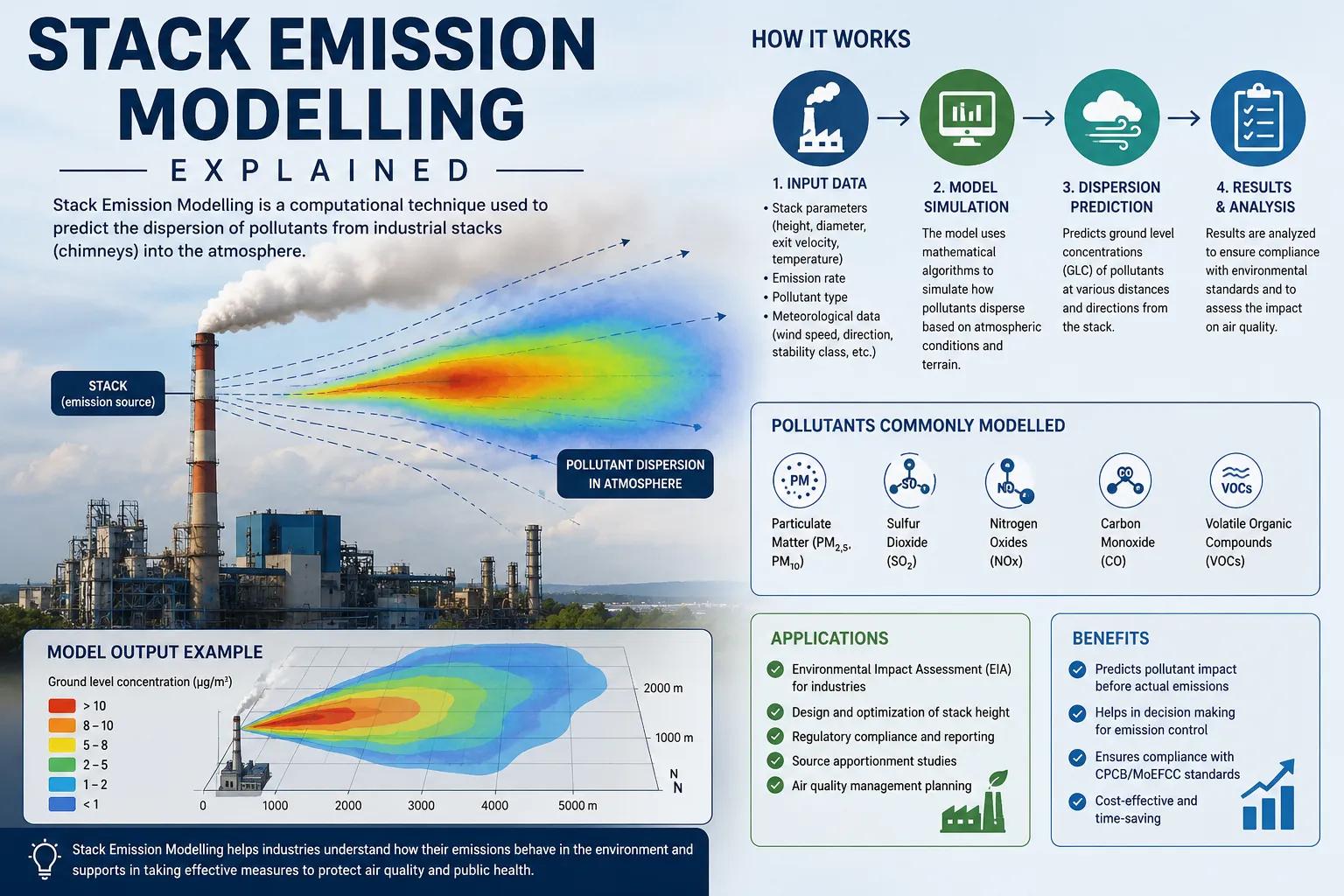
Stack Emission Modelling Explained in simple terms means predicting how pollutants released from industrial chimneys travel and disperse in the atmosphere. Industries use this scientific process to estimate Ground Level Concentration (GLC) of pollutants before and after a project begins operations.
This modelling plays a critical role in Environmental Impact Assessment (EIA) studies and is often mandatory for obtaining Environmental Clearance (EC) from regulatory authorities. Without accurate stack emission modelling, industries cannot demonstrate that their emissions comply with national air quality standards.
For thermal power plants, cement industries, steel plants, refineries, and chemical units, this process helps decision-makers understand pollution impact zones, protect public health, and plan sustainable operations. Simply put, Stack Emission Modelling Explained clearly means converting raw emission data into scientifically validated pollution predictions.
What is Stack Emission Modelling?
Stack Emission Modelling is a scientific technique used to simulate how pollutants emitted from an industrial stack or chimney disperse into the surrounding atmosphere. It relies on atmospheric physics, primarily the Gaussian Plume Model, which calculates pollutant concentration based on wind speed, atmospheric stability, and stack characteristics.
The purpose of this modelling is to predict pollutant concentration at various receptor points around a project site. This helps environmental engineers assess whether emissions will remain within permissible limits set by CPCB and MoEFCC.
Many people confuse Stack Emission Modelling with Stack Emission Monitoring, but the two serve different purposes.
Stack Emission Monitoring:
- Measures actual emissions using physical instruments installed at the source
- Provides real-time or periodic emission data
- Used primarily for compliance verification during plant operation
- Cannot predict future or hypothetical scenarios
Stack Emission Modelling:
- Predicts pollutant dispersion using mathematical and computer-based simulation
- Applied mainly during the project planning stage, before construction
- Generates Ground Level Concentration values at multiple receptor points
- Required for Environmental Clearance approval, since future impact cannot be physically measured
This distinction matters because most Environmental Clearance applications require modelling results, not just monitoring data, since a plant's future impact cannot be measured before it is built.
How Stack Emission Modelling Works
The complete workflow of Stack Emission Modelling follows a structured, step-by-step scientific process.
Project Understanding: The consultant first studies the project layout, fuel type, production capacity, and number of emission sources involved.
Identification of Emission Sources: Each stack, vent, or chimney is identified separately, since every source contributes differently to overall Industrial Air Pollution Modelling.
Stack Parameter Collection: Key details such as stack height, stack diameter, exit velocity, exit temperature, and emission rate are collected from design drawings or site measurements.
Emission Inventory Preparation: All pollutants, including PM, SO2, NOx, and CO, are quantified based on fuel consumption and combustion efficiency, forming the emission inventory.
Meteorological Data Analysis: Wind speed, wind direction, temperature, and humidity data are analyzed. A wind rose diagram is prepared to understand prevailing wind patterns at the site.
Terrain and Land-Use Assessment: Surrounding terrain, elevation, and land use are studied, since hilly or complex terrain significantly affects Stack Air Dispersion Modelling accuracy.
Receptor Grid Creation: A grid of receptor points is placed around the project boundary to calculate pollutant concentration at each location.
Model Setup Using AERMOD: All collected data is fed into AERMOD, the most widely accepted Air Dispersion Modelling software recommended by USEPA for regulatory applications in India.
Simulation: The software runs simulations combining meteorological, terrain, and emission data to predict pollutant behavior over time.
Ground Level Concentration Prediction: The model generates GLC values at each receptor, showing where pollution impact will be highest.
Result Interpretation: Environmental engineers analyze results against National Ambient Air Quality Standards to check compliance.
Report Preparation: A detailed technical report with contour maps, tables, and conclusions is prepared for submission to authorities.
For example, a cement plant in Madhya Pradesh may use this workflow to demonstrate that its predicted PM10 levels remain within CPCB limits at the nearest residential receptor, supporting faster Environmental Clearance approval.
Applications of Stack Emission Modelling
Stack Emission Modelling supports environmental planning across multiple industrial sectors.
Thermal Power Plants use it to assess SO2 and NOx dispersion from tall stacks over large geographical areas.
Cement Plants rely on modelling to control particulate matter impact near residential zones.
Steel Industries use it for evaluating emissions from blast furnaces and sintering units.
Chemical Industries apply modelling to assess dispersion of hazardous air pollutants.
Pharmaceutical Manufacturing units use it for solvent recovery and VOC emission assessment.
Refineries depend on Chimney Emission Modelling to manage multiple stack sources simultaneously.
Fertilizer Plants use it to evaluate ammonia and particulate dispersion patterns.
Waste-to-Energy Plants require modelling to demonstrate safe combustion emission levels.
Mining Projects use dispersion modelling for dust and particulate impact assessment.
Industrial Parks with multiple emission sources use cumulative modelling to assess combined impact zones.
In each case, modelling results directly support Environmental Clearance applications and long-term environmental planning decisions.
Benefits of Stack Emission Modelling
Professional Stack Emission Modelling offers several measurable advantages for industries and regulators alike.
It enables accurate pollution prediction before construction begins, allowing design modifications if predicted concentrations exceed limits. This leads to better environmental planning and reduces costly project delays.
Since regulatory authorities require scientific evidence, proper modelling often results in faster Environmental Clearance approvals. It also ensures CPCB and MoEFCC compliance, minimizing legal and operational risks.
Modelling supports scientific decision-making rather than assumptions, helping industries choose optimal stack height and location. This directly protects public health by identifying high-risk zones early, and it contributes to sustainable industrial development along with better environmental reporting.
Accuracy in modelling depends heavily on the quality of input parameters used:
Stack Height: Determines how high the plume rises before dispersing, directly affecting how far pollutants travel before reaching ground level.
Stack Diameter: Affects exit velocity and plume behavior, influencing how quickly pollutants mix with surrounding air.
Exit Velocity: Influences how high pollutants rise before dispersing outward, with higher velocity generally reducing ground-level impact near the source.
Exit Temperature: Affects plume buoyancy and rise height, since hotter emissions rise higher before dispersing.
Emission Rate: Directly determines the concentration levels predicted at each receptor point.
Meteorological Data: Governs dispersion direction and dilution rate, making wind speed and stability class critical inputs.
Even small errors in these parameters can significantly change Ground Level Concentration predictions, which is why professional expertise matters.
Why Choose DS Technoverse for Stack Emission Modelling Services?
DS Technoverse brings experienced environmental engineers with deep expertise in AERMOD and CALPUFF-based Air Dispersion Modelling for diverse industrial sectors.
The team follows a scientific modelling approach, ensuring accurate simulations that align with CPCB Guidelines and MoEFCC Regulations. Every project undergoes rigorous quality checks before report submission.
DS Technoverse provides strong regulatory compliance support, helping clients navigate complex Environmental Clearance requirements smoothly. Technical reports are prepared with clarity, precision, and complete documentation suitable for regulatory review.
With a fast turnaround time and customized modelling solutions tailored to project-specific needs, DS Technoverse serves clients across PAN India locations. Dedicated technical support ensures queries are resolved promptly throughout the project lifecycle.
If your organization requires reliable Stack Emission Modelling, Air Dispersion Modelling, or EIA support, DS Technoverse is ready to assist. Contact DS Technoverse today to discuss your project requirements and receive expert consultation from experienced environmental professionals.
Conclusion
Stack Emission Modelling Explained simply means using scientific simulation to predict how industrial pollutants disperse into the atmosphere. It plays a vital role in Environmental Impact Assessment, Environmental Clearance, and long-term pollution management.
Industries ranging from thermal power plants to pharmaceutical manufacturers depend on this modelling for regulatory compliance and sustainable growth. Professional modelling reduces environmental risk, supports faster approvals, and protects public health.
DS Technoverse stands as a trusted environmental consulting partner, offering accurate, science-based Stack Emission Modelling services backed by experienced engineers and proven methodologies.
Frequently Asked Questions
1. What is Stack Emission Modelling?
Stack Emission Modelling is a scientific process that predicts how pollutants from industrial chimneys disperse in the atmosphere using mathematical simulation software.
2. How does Stack Emission Modelling work?
It works by combining stack parameters, emission rates, meteorological data, and terrain information to simulate pollutant dispersion and predict Ground Level Concentration.
3. Which software is used for Stack Emission Modelling?
AERMOD is the most widely used software, along with CALPUFF for complex terrain and long-range dispersion assessments.
4. What data is required for Stack Emission Modelling?
Required data includes stack height, diameter, exit velocity, exit temperature, emission rate, meteorological data, and terrain details.
5. Is Stack Emission Modelling mandatory for Environmental Clearance?
Yes, most industrial projects require dispersion modelling results as part of their EIA report for Environmental Clearance approval.
6. Why should industries outsource Stack Emission Modelling?
Outsourcing ensures accuracy, regulatory compliance, and access to experienced consultants like DS Technoverse who specialize in AERMOD-based modelling.
Further Reading
- Stack height and ground-level concentration
- Emission inventory for dispersion modelling
- How to read AERMOD output
- AERMOD online: running the EPA model in a browser
- AERMOD air dispersion modelling
- AERMOD Software (free demo)
Frequently Asked Questions
What is stack emission modelling?
Using a dispersion model, usually AERMOD in Indian practice, to predict the ground-level concentrations that emissions from a stack will cause around a facility, for comparison with the air quality standards.
What stack data does a model need?
Location, height, inner diameter, exit temperature and velocity, and the emission rate of each pollutant, together with meteorological data and the receptor grid.
How does stack height affect ground-level concentrations?
A taller stack releases the plume higher, so it dilutes more before reaching the ground; the maximum concentration usually falls and moves further away. Plume rise from exit velocity and temperature adds to the effective height.
Can I run a stack emission model myself?
The US EPA AERMOD model is free but needs prepared meteorology and inputs. Browser-based software such as AERMOD Studio handles the meteorology and produces the results and report; complex sites still need a modeller.