Quick answer: Sterility testing checks whether a product that must be sterile, such as an injection, eye drop or sterile medical device, contains any viable bacteria or fungi. Under USP <71> and the Indian Pharmacopoeia, samples are filtered through a 0.45 µm membrane (or added directly to media), incubated in Fluid Thioglycollate Medium at 30 to 35 °C and Soybean-Casein Digest Medium at 20 to 25 °C for 14 days, and checked for growth.
Sterility testing is the final compendial check applied to a product that must contain no viable microorganisms. It is conceptually simple, operationally demanding, and more widely misunderstood than any other test in the microbiology toolkit — because what it actually proves is considerably narrower than what it is often asked to support.
What the Test Is and When It Applies
Sterility testing is required for parenteral products, ophthalmic preparations, irrigation solutions, implants, sterile devices and anything labelled sterile. The compendial methods are USP <71>, Ph. Eur. 2.6.1 and the corresponding Indian Pharmacopoeia monograph, which are harmonised in method though not identical in every detail.
The test inoculates product into two growth media and incubates for fourteen days. Growth in either medium is a positive result.
The Statistics Nobody Puts on the Certificate
This is the single most important thing to understand about the test, and it is rarely stated plainly.
Testing 20 units from a batch of 50,000 detects contamination reliably only when contamination is widespread.
| True contamination rate | Probability of detection with n=20 |
|---|---|
| 10% | ~88% |
| 5% | ~64% |
| 1% | ~18% |
| 0.1% | ~2% |
Low-level sporadic contamination — precisely what an intermittent aseptic breach produces — is very likely to pass. A batch with one contaminated unit in a thousand has roughly a 98 per cent chance of passing a twenty-unit sterility test.
This is not an argument against the test. It is the reason sterility assurance is built from validated sterilisation, aseptic process simulation, bioburden control and environmental monitoring, with the sterility test as a final confirmatory check. Any manufacturer whose sterility argument rests primarily on the test has a fragile position, and inspectors probe exactly this.
Membrane Filtration vs Direct Inoculation
Two methods are recognised. Filtration is the method of choice wherever the product allows, and using direct inoculation without documented justification is a common finding.
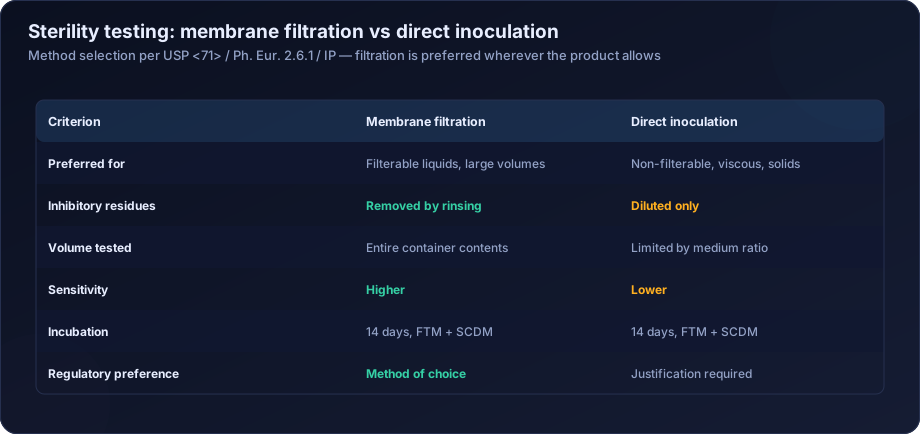
Membrane filtration passes the product through a 0.45 µm membrane that retains organisms, rinses the membrane to remove inhibitory residues, then transfers it to growth media.
Its decisive advantage is rinsing. Antibiotics, preservatives and other antimicrobial residues are physically washed away from the retained organisms, so inhibition is eliminated rather than merely diluted. It also allows the entire container contents to be tested, which substantially improves sensitivity.
Direct inoculation adds product directly to Fluid Thioglycollate Medium and Soybean Casein Digest Medium. It is used for non-filterable products — viscous liquids, ointments, oils, insoluble powders and solid devices — and is constrained by the product-to-medium ratio, typically no more than 10 per cent, which limits the quantity testable.
For devices, whole items are immersed or the fluid pathway is flushed and the eluate filtered, depending on geometry and how the sterile fluid path is defined.
Sterility Test Procedure, Step by Step
The compendial sterility test is harmonised across the major pharmacopoeias, so the procedure below applies under USP <71>, Ph. Eur. 2.6.1, JP 4.06 and the Indian Pharmacopoeia sterility test. It assumes membrane filtration, the preferred method wherever the product can be filtered.
- Prepare the environment. The test is performed in a Grade A zone, usually an isolator or a unidirectional airflow cabinet within a Grade B background, with environmental and personnel monitoring during the session.
- Disinfect the containers. The outer surfaces of the units are decontaminated and transferred into the Grade A zone without contaminating them.
- Pool and filter the sample. The required quantity from each unit is transferred aseptically and filtered through a membrane with a nominal pore size of not more than 0.45 µm. For products with antimicrobial activity, the membrane is rinsed with a sterile diluent to remove residues, using the number of rinses validated in method suitability.
- Transfer to media. The membrane is cut in half, or two filter units are used, so that one part goes into Fluid Thioglycollate Medium and the other into Soybean-Casein Digest Medium. Closed canister systems avoid handling the membrane at all.
- Run controls. A negative control (sterile diluent through the same system) runs with each session to show the handling did not introduce contamination.
- Incubate for 14 days. Fluid Thioglycollate Medium at 30 to 35 °C and Soybean-Casein Digest Medium at 20 to 25 °C.
- Read the media. Containers are examined for turbidity during and at the end of incubation. If the product makes the medium turbid, so that growth cannot be judged by eye, portions are subcultured into fresh medium after 14 days and incubated for a further period.
- Record and review. The result, controls, environmental monitoring and any deviations are reviewed together before the result is reported.
For products that cannot be filtered, such as ointments that will not dissolve, devices or insoluble solids, direct inoculation is used: the product is placed straight into the media, in a volume of product that does not exceed 10% of the medium volume unless otherwise justified.
Bacteriostasis and Fungistasis Validation
Before a sterility result can be trusted for a given product, the laboratory must demonstrate the method would actually detect a small number of organisms if present. A sterility result without this validation is not a valid result.
- Prepare the product exactly as for routine testing, including the same filtration, rinse volume and media.
- Inoculate with fewer than 100 CFU of each compendial organism — Staphylococcus aureus, Bacillus subtilis, Pseudomonas aeruginosa, Clostridium sporogenes, Candida albicans and Aspergillus brasiliensis.
- Incubate alongside a positive control containing the same inoculum without product.
- Compare growth. Clear growth within the specified period, comparable to the control, demonstrates suitability.
- Where growth is inhibited, increase the rinse volume — commonly to three 100 mL rinses — add validated neutralisers, or increase medium volume for direct inoculation.
- Repeat until suitability is demonstrated, and document the final method as routine.
- Revalidate on any formulation, container, filter, media or antimicrobial content change.
Under USP <71>, the suitability containers are incubated for not more than 5 days, and growth with product must be clearly visible and comparable to the control. Common fixes for inhibition are more rinses, a larger volume of medium, a neutraliser such as polysorbate 80 or lecithin, or an enzyme such as penicillinase for beta-lactam antibiotics. A routine test run on an unsuitable method can report "no growth" for a contaminated product, which is why missing suitability data is treated as a major deficiency.
Media, Incubation and Controls
- Fluid Thioglycollate Medium (FTM) at 30–35 °C, targeting anaerobic and aerobic bacteria.
- Soybean Casein Digest Medium (SCDM) at 20–25 °C, targeting fungi and aerobic bacteria.
- Fourteen days minimum for both, with interim observation and a final read. Not reducible without a validated rapid method.
- Growth promotion testing on every media lot before use, using the compendial organisms.
- Negative controls — media incubated without product, plus a filtration control using sterile diluent through the same apparatus, detecting contamination introduced by the test itself.
- Grade A environment — an isolator or laminar airflow within a Grade B cleanroom, with concurrent environmental monitoring of the session.
- Operator qualification through media fill simulations of the sterility test itself, requalified periodically.
Two media are used together because no single medium supports every organism that might be present.
| Medium | Main purpose | Incubation | Growth promotion organisms (typical strains) |
|---|---|---|---|
| Fluid Thioglycollate Medium (FTM) | Anaerobic and aerobic bacteria | 30 to 35 °C | Clostridium sporogenes ATCC 19404, Staphylococcus aureus ATCC 6538, Pseudomonas aeruginosa ATCC 9027 |
| Soybean-Casein Digest Medium (SCDM, also called TSB) | Aerobic bacteria and fungi | 20 to 25 °C | Bacillus subtilis ATCC 6633, Candida albicans ATCC 10231, Aspergillus brasiliensis ATCC 16404 |
FTM contains thioglycollate and a small amount of agar to keep a low-oxygen zone at the bottom of the tube, with resazurin as an indicator. If more than the upper third of the medium turns pink, oxygen has entered and the medium should be restored once by heating, or discarded.
Each batch of medium, whether prepared in-house or bought ready-made, needs:
- Sterility check: a sample of the batch is incubated to confirm the medium itself is sterile.
- Growth promotion test: each medium is inoculated with not more than 100 CFU of each test organism. Bacteria must show clearly visible growth within 3 days and fungi within 5 days.
Purchased media with a supplier certificate still need growth promotion confirmed for each lot, or a documented supplier qualification that justifies relying on the certificate.
Why Fourteen Days
The period is not arbitrary and shortening it is not a matter of laboratory efficiency.
Organisms damaged but not killed by a sterilisation process are sub-lethally injured. They require an extended lag phase to repair cellular damage before they can multiply, and they may take well over a week to produce visible growth. Those are precisely the organisms a partial sterilisation failure produces — the ones the test most needs to catch.
A shortened incubation systematically misses injured organisms, which means it is least sensitive exactly where sensitivity matters most.
Interpreting the Result
No growth: if no growth is found in any container at the end of incubation, the product complies with the test for sterility. As explained above, that confirms the sample was sterile; it does not prove the whole batch is.
Growth: if growth is found, the product does not comply, unless the test can be shown to be invalid. The pharmacopoeia allows a test to be declared invalid only when one or more of these conditions is clearly demonstrated:
- Microbiological monitoring of the sterility testing facility shows a fault
- A review of the testing procedure used shows a fault
- Microbial growth is found in the negative controls
- After identification, the organism can be unequivocally attributed to the materials or technique used in the test
If the test is declared invalid, it is repeated with the same number of units as the original test. If no growth is found in the repeat, the product complies; if growth is found, it does not. Invalidating a test is a serious decision that inspectors examine closely, and identification of the isolate to species level, compared with the environmental and personnel isolates from the session, is normally expected. Our guide on investigating a sterility test positive covers this in detail.
How Many Units to Test: USP <71> Sample Numbers
The minimum number of units depends on the type of product and the batch size. The main categories are summarised below; the pharmacopoeia table covers additional cases such as antibiotic bulk packages and bulk solids.
| Product and batch size | Minimum number of units for each medium |
|---|---|
| Parenterals, not more than 100 containers | 10% or 4 containers, whichever is greater |
| Parenterals, 101 to 500 containers | 10 containers |
| Parenterals, more than 500 containers | 2% or 20 containers, whichever is less |
| Large-volume parenterals | 2% or 10 containers, whichever is less |
| Ophthalmic and other non-injectable preparations, not more than 200 containers | 5% or 2 containers, whichever is greater |
| Ophthalmic and other non-injectable preparations, more than 200 containers | 10 containers |
| Catgut and other surgical sutures | 2% or 5 packages, whichever is greater, up to 20 packages |
| Medical devices, not more than 100 articles | 10% or 4 articles, whichever is greater |
| Medical devices, 101 to 500 articles | 10 articles |
| Medical devices, more than 500 articles | 2% or 20 articles, whichever is less |
Where the contents of one container are enough to inoculate both media, the same units supply both; otherwise twice the number of units is needed.
These are compendial minimums, not statistical guarantees. Some manufacturers of very high-risk products test above the minimum deliberately, which is a reasonable risk decision rather than a requirement.
How Much Product per Unit
Each medium receives a minimum quantity from every unit tested:
| Quantity per container | Minimum quantity for each medium |
|---|---|
| Liquids, less than 1 mL | The whole contents |
| Liquids, 1 to 40 mL | Half the contents, but not less than 1 mL |
| Liquids, more than 40 mL and up to 100 mL | 20 mL |
| Liquids, more than 100 mL | 10% of the contents, but not less than 20 mL |
| Solids, less than 50 mg | The whole contents |
| Solids, 50 mg to less than 300 mg | Half the contents, but not less than 50 mg |
| Solids, 300 mg to 5 g | 150 mg |
| Solids, more than 5 g | 500 mg |
For membrane filtration, the whole quantity from all units is usually filtered, so the membrane sees the full sample. Always check the current pharmacopoeia text for the product type, because devices, sutures and antibiotics have their own rules.
What Sterility Assurance Actually Rests On
Because the test is statistically weak, real assurance comes from controls operating before it. A regulator assessing a sterility claim examines these, and finding them weak is more damaging than a single positive result.
- Sterilisation validation delivering a Sterility Assurance Level of 10⁻⁶ for terminally sterilised product, proven across the load configurations actually used.
- Bioburden control — a known, monitored, stable pre-sterilisation load, since the cycle was designed against a specific starting population.
- Aseptic process simulation — media fills covering worst-case interventions, shift patterns, line speeds and campaign durations.
- Filter integrity testing, pre-use and post-use, with the post-use test being the one that protects the batch.
- Container closure integrity, demonstrated by a validated physical method across shelf life and transport stress.
- Environmental monitoring with a Grade A record of no recovery.
- Personnel qualification — gowning, aseptic technique, glove print monitoring for everyone entering the critical zone.
- Intervention control — every routine and non-routine intervention defined, risk-assessed and covered by media fill.
Terminal Sterilisation vs Aseptic Processing
Which route a product takes changes what the sterility test contributes, and regulators expect the choice itself to be justified.
Terminal sterilisation sterilises the product in its final sealed container, typically by moist heat, and delivers a calculable Sterility Assurance Level of 10⁻⁶. Because the assurance is a physical calculation from validated cycle parameters, the sterility test adds relatively little — it confirms nothing catastrophic happened, and the cycle records carry the argument.
Aseptic processing assembles a sterile product from separately sterilised components in a controlled environment. No terminal step corrects an error, so assurance rests on the aseptic process itself: environmental control, personnel technique, media fills and intervention discipline. The sterility test carries more weight here precisely because there is no calculable SAL, and it is still statistically weak.
The regulatory expectation is unambiguous: terminal sterilisation must be used wherever the product can withstand it. Choosing aseptic processing for a product that could have been terminally sterilised requires documented justification, usually thermal degradation data. A decision made on convenience or existing equipment will be challenged.
Where a product genuinely cannot tolerate terminal sterilisation, intermediate options are worth assessing — reduced cycles with bioburden-based dose setting, or sterilising filtration followed by aseptic fill with heavily controlled interventions.
Sterility Testing for Medical Devices
Sterile medical devices follow the same compendial principles, but the way the sample is prepared depends on the device:
- Small devices such as needles, sutures or small components are immersed whole in the media.
- Devices with a fluid path, such as infusion sets, catheters and syringes, are flushed with a sterile fluid, and the fluid is filtered and tested, because the sterile claim applies to the fluid path.
- Large or complex devices are tested on representative portions, or by flushing or swabbing defined surfaces, with the approach justified and validated for recovery.
For most devices, routine batch release does not depend on a sterility test of every batch. Assurance comes from a validated sterilisation process: for radiation, through dose setting and periodic dose audits under ISO 11137; for ethylene oxide, through cycle validation under ISO 11135; and for moist heat, under ISO 17665. Tests of sterility to ISO 11737-2 are performed as part of that validation, and bioburden testing to ISO 11737-1 monitors the starting load. A compendial sterility test is still used where a pharmacopoeia or customer specification requires it, or where a product is aseptically assembled.
Sterility Testing Requirements in India
In India, the Indian Pharmacopoeia sterility test is the legal standard for products manufactured and sold in the country, and the revised Schedule M sets the GMP expectations for the facility, environment and personnel performing it. Export-oriented manufacturers additionally test to USP <71> or Ph. Eur. 2.6.1, which are harmonised with the IP method in their main requirements. Sterility testing laboratories are commonly accredited to ISO/IEC 17025 by NABL, and contract laboratories testing for pharmaceutical release are inspected by the licensing authorities. Medical devices claimed as sterile are also tested to the relevant ISO standards, such as ISO 11737-2 for sterilisation validation, alongside bioburden testing to ISO 11737-1.
Rapid Sterility Testing
The fourteen-day incubation is a significant constraint for short-shelf-life products, radiopharmaceuticals and cell and gene therapies where product may expire before a conventional result exists.
Validated rapid methods — respiration-based systems, ATP bioluminescence, solid-phase cytometry, nucleic acid amplification — typically report within five to seven days. The regulatory price is a full equivalence validation demonstrating at least equal sensitivity across the relevant organism range, in the specific matrix, including stressed organisms. See rapid microbiological methods.
Common Failures
- Direct inoculation used without documented justification for why filtration is not feasible.
- Bacteriostasis and fungistasis validation absent, out of date, or performed on an earlier formulation.
- Rinse volume insufficient to remove antimicrobial residue, so inhibition persists.
- Negative and filtration controls not run, leaving no way to assess a positive.
- Environmental monitoring of the test session not performed, so a positive cannot be attributed.
- Incubation shortened, systematically missing injured organisms.
- A positive invalidated without documented evidence of a specific test fault.
- Sterility assurance argued primarily from the test rather than from the process.
How DSTechnoverse Helps
We perform sterility testing and, just as importantly, assess whether the assurance argument behind it holds — which is what an inspection actually examines.
That covers method suitability and bacteriostasis/fungistasis validation per product and container configuration, routine testing by filtration or direct inoculation under USP <71>, Ph. Eur. 2.6.1 and IP, device testing under the ISO 11737-2 approach, concurrent environmental monitoring of the test session, positive-result investigation with identification and strain typing, sterility assurance review across sterilisation validation and media fills, and rapid method equivalence validation where the commercial case supports it.
Our laboratory is in Indore, Madhya Pradesh. Given the fourteen-day incubation, sample logistics matter less for sterility than for most tests — clients across India ship to us without any turnaround penalty.
Frequently Asked Questions
What is a sterility test?
A pharmacopoeial test that checks a sample of a sterile product for viable microorganisms by incubating it in two growth media for 14 days. It is a release test for injectables, ophthalmic products, sterile devices and other products labelled sterile.
Which media are used for sterility testing?
Fluid Thioglycollate Medium, incubated at 30 to 35 °C for anaerobic and aerobic bacteria, and Soybean-Casein Digest Medium (tryptic soy broth), incubated at 20 to 25 °C for fungi and aerobic bacteria. Every lot must pass sterility and growth promotion checks.
How long does it take to get a sterility test result?
The incubation alone is 14 days, so a final result is normally reported 15 to 17 days after the samples are tested, allowing for sample receipt, review and reporting. Products that make the medium turbid need a further subculture, which adds several days.
What is the difference between the USP <71> and IP sterility tests?
The main requirements are harmonised across USP <71>, Ph. Eur. 2.6.1, JP 4.06 and the Indian Pharmacopoeia: the same two media, incubation temperatures, 14-day period, sample numbers and method suitability approach. Differences are mostly in wording and in some product-specific details, so the test should be run to the pharmacopoeia named in the product specification or marketing authorisation.
What is the minimum number of samples for a sterility test?
It depends on the product and batch size. For parenterals, it is 10% or 4 containers for batches up to 100, 10 containers for 101 to 500, and 2% or 20 containers, whichever is less, above 500. The full table is given above.
Why is the incubation fourteen days?
Because sub-lethally injured organisms need an extended lag phase before multiplying, and those are exactly the organisms a partial sterilisation failure produces. Shorter incubation misses them.
Which method should we use?
Membrane filtration wherever the product can be filtered, which covers most liquids. Direct inoculation requires documented justification.
Does a passing test mean the batch is sterile?
No. It means no contamination was detected in the units tested, at the sensitivity the sample size allows. Sterility assurance comes from the validated process.
Can a positive be dismissed as laboratory contamination?
Only with documented evidence of a specific test fault — a failed control, a recorded breach, a media failure. See sterility test positive investigation.
How many units must be tested?
Compendial minimums scale with batch size and fill volume, commonly 20 units for larger batches. Testing more improves sensitivity and some manufacturers do so deliberately.
Does sterility testing apply to medical devices as well as pharmaceuticals?
Yes, though the approach differs. Devices are tested under the ISO 11737-2 framework rather than USP <71> directly, and the practical difference is how the product meets the medium. A small device may be fully immersed; a catheter or tubing set has its fluid pathway flushed and the eluate filtered. The critical design decision is defining what counts as the sterile fluid path, because that determines which surfaces the test actually interrogates. A device tested by immersing only the outer body has said nothing about the lumen.
Who should perform sterility testing — an in-house laboratory or a contractor?
Either works, and the decision usually turns on facility rather than skill. Sterility testing needs a Grade A environment within a Grade B background, or an isolator, with its own environmental monitoring programme and qualified operators. For a manufacturer running occasional sterile batches, building and maintaining that infrastructure to demonstrate a low laboratory contamination rate is difficult to justify. For a high-volume sterile operation it usually makes sense in-house. What matters either way is that the testing environment is as well controlled as the manufacturing one, because a laboratory with a poor contamination rate generates false positives that are expensive in their own right.
Can we release product before the sterility result is available?
Only under a formal parametric release arrangement, and only for terminally sterilised product where the sterilisation cycle itself provides the assurance. Parametric release requires regulatory approval, extensive cycle validation and rigorous parameter monitoring, and it substitutes physical cycle data for the biological test. It is not available for aseptically processed product, where no equivalent physical measurement of the whole process exists.
What is the difference between sterility and bioburden testing?
Bioburden quantifies the microbial load before sterilisation and validates the sterilisation process. Sterility asks a binary question afterwards. Different purposes, and both are normally required.
A passing sterility test is not proof of sterility — the assurance comes from the process. DSTechnoverse provides sterility testing with method suitability validation, concurrent environmental monitoring and full positive-result investigation. Based in Indore, Madhya Pradesh, serving sterile manufacturers across India. Talk to our microbiology team.