Environmental monitoring measures the microbiological quality of the space a product is made in, rather than the product itself. It exists because finished product testing is statistically weak, and because by the time contamination appears in a batch the opportunity to prevent it has already gone. A well-designed programme detects a deteriorating facility weeks before it produces a failing batch.
The Most Common Failure Is Not Technical
The programmes we are asked to review are rarely failing because the plating is wrong. They are failing because hundreds of plates are incubated every month, results are filed, and nobody looks at the pattern until a limit is breached.
The plates were never the deliverable. The trend is. A programme that generates data nobody analyses has the cost of monitoring and none of the benefit.
What a Complete Programme Includes
- Viable active air sampling — impaction samplers drawing a defined volume, reported as CFU per cubic metre. The primary measure of airborne microbial load.
- Settle plates — open agar exposed for a defined period, measuring the rate at which viable particles deposit onto a surface. Closer to actual product risk than concentration is.
- Contact plates (RODAC) — direct-contact sampling of flat surfaces, quantitative per defined area.
- Surface swabs — for irregular geometry that contact plates cannot reach. See surface and swab testing.
- Personnel monitoring — glove prints and gown plates, the most direct measure of aseptic technique.
- Non-viable particle counting — ISO 14644 classification at rest and in operation.
- Compressed air and process gases in direct product contact — routinely omitted from programmes entirely.
- Water system monitoring, integrated rather than treated separately, since water is the most common facility contamination source.
- Temperature, humidity and differential pressure records, which explain most microbiological excursions once you have them.
Site Selection Determines Whether the Programme Works
Nothing damages a programme more than convenient site selection. Points chosen because they are easy to reach produce a reassuring dataset describing the cleanest parts of the facility. The organisms live somewhere else.
Site selection should be the documented output of a risk assessment, not a habit inherited from whoever set the programme up.
- Product contact surfaces and the zone immediately around open product — always, regardless of access difficulty.
- Points of highest personnel intervention — the aseptic operations where a hand comes closest to exposed product.
- Hard-to-clean geometry — gaskets, threads, hinges, conveyor bearings, filler nozzles, equipment underspaces.
- Wet and cold locations — drains, condensate points, chillers, any surface that stays damp between cleans.
- Air handling boundaries — supply grilles, return ducts, filter faces, pressure cascade transitions.
- Transfer points — airlocks, pass-throughs, gowning room boundaries, where grades meet.
- Historically positive locations, sampled at increased frequency until demonstrably resolved.
Timing Matters as Much as Location
Sampling immediately after cleaning measures the cleaning. It does not measure the environment in which product is made.
For a programme intended to detect risk to product, sample in the operating state — during production, at the end of a campaign or shift, when the resident population is at its highest and personnel activity has been sustained. Post-cleaning sampling has a place in cleaning verification, but it is a different question and should not be the whole programme.
Frequency by Grade
| Area | Typical frequency | Notes |
|---|---|---|
| Grade A | Every production session | Continuous non-viable particle monitoring |
| Grade B | Every production session | Full viable panel |
| Grade C | Weekly | Increase after any excursion |
| Grade D | Weekly to monthly | Risk-based |
| Controlled not classified | Monthly | Food, cosmetic, nutraceutical areas |
| Water system points | Rotating so every point is covered weekly | Daily for PW and WFI at point of use |
Frequency should tighten automatically after an excursion and relax only on documented evidence, exactly as with raw material testing.
Deriving Limits From Your Own Data
Limits lifted from a published table rarely fit the facility they are applied to. Where routine recovery has never exceeded 8 CFU and the tabulated action limit is 50, the limit is inert: it cannot fire until control has already been lost, which is precisely when an early signal would have been worth having.
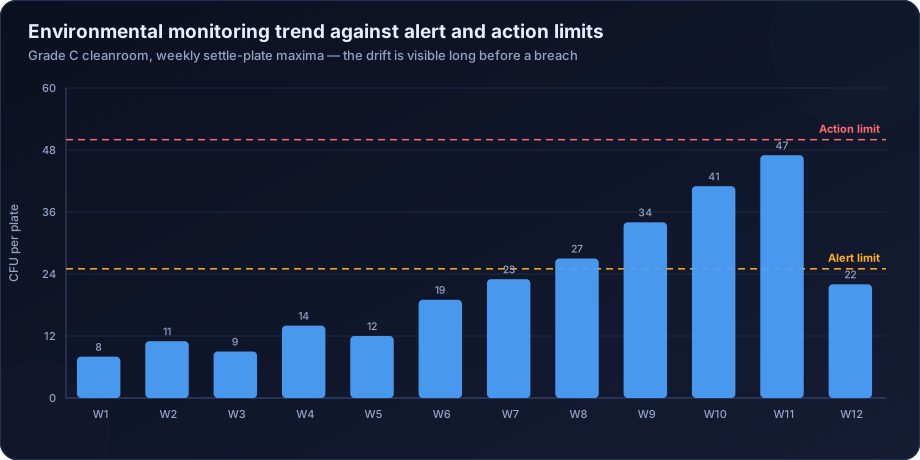
Limits should be statistical descriptions of your own performance, capped by any regulatory maximum.
- Alert limit at approximately the 95th percentile of routine historical data.
- Action limit at approximately the 99th percentile, never exceeding the regulatory maximum.
- At least 30 to 50 results per site before deriving anything, and preferably a full year to capture seasonality.
- Non-parametric percentile methods where the zero fraction is high, since normal-distribution statistics fit badly to data dominated by zeros.
- Annual review, plus review after any facility change.
Positive Rate: The Better Metric in Clean Areas
In a well-controlled cleanroom most results are zero, and a chart of counts is almost entirely flat with occasional single-colony spikes. Conventional control limits are useless on that data.
The more sensitive measure is the recovery rate — the percentage of sites showing any growth at all. A facility where 4 per cent of sites are positive is in a different state from one where 18 per cent are, even when every individual count is 1 or 2 CFU and everything is within limits.
For Grade A and B monitoring we recommend positive rate as the primary trend indicator, with magnitude secondary.
Media, Incubation and Controls
A "no growth" plate can mean a clean room or a medium that could not support growth, and the two are indistinguishable without controls.
- Tryptic soy agar for bacteria, typically 30–35 °C for 3 to 5 days.
- Sabouraud dextrose agar for fungi, typically 20–25 °C for 5 to 7 days.
- Neutralising media — TSA with lecithin and polysorbate 80 — for all post-disinfection surface sampling, or residual disinfectant suppresses whatever was recovered.
- Growth promotion testing on every media lot before use, with documented acceptance criteria.
- Sterility testing of uninoculated plates from the same batch.
- Negative control plates exposed and handled identically but not sampled, detecting handling contamination.
- Incubator mapping rather than trusting the display, with continuous monitoring and documented deviation handling.
Dual-temperature incubation matters more than most facilities realise. Single-temperature incubation systematically under-reports one organism group, and the group missed is usually fungi.
Identify the Isolates
From Grade A and B zones, identify everything. Elsewhere, identify anything above the alert limit and a periodic sample of routine recoveries.
The reason is the facility flora library. When the normal flora of each area is known, the appearance of an organism that does not belong becomes a signal in itself, even at a count well within limits. And when a product isolate appears months later, a library lets the investigation start with a comparison set rather than from nothing.
Most facilities that discover a genuine problem early discover it this way.
Trending and Excursion Handling
- Chart every site individually. Facility-average data hides the one location deteriorating, because the other forty dilute it.
- Apply run rules, not just limits. Seven consecutive results above the median, or a sustained run of increases, indicates change before any single result breaches.
- Track positive rate alongside magnitude.
- Compare against non-viable particle data. A microbiological excursion with a simultaneous particle rise points to a physical failure; one without points to personnel or procedure.
- Investigate with a defined protocol — confirm, identify, review batch and cleaning records, resample, then conclude.
- Verify effectiveness through intensified monitoring until the trend is restored, not on a single clean result.
Common Programme Failures
- Sampling only after cleaning, so the programme measures the cleaning rather than the operating environment.
- Media not growth-promotion tested, making "no growth" uninterpretable.
- No neutralisers in post-disinfection media.
- Settle plates exposed beyond the validated period, dehydrating the agar and losing recovery through the exposure.
- Single-temperature incubation, under-recovering fungi.
- Isolates discarded without identification.
- Personnel monitoring at the start of a shift rather than the end.
- Programme frozen since qualification despite line, layout and product changes.
- Limits copied from guidance rather than derived from facility capability.
Compressed Air and Process Gases
Gases in direct product contact are part of the product environment and are omitted from a large majority of the monitoring programmes we review. A nitrogen blanket, a compressed air line blowing out containers before filling, or an air knife drying a surface all contact product directly, and an unfiltered or poorly maintained line delivers organisms straight to it.
- Viable testing by impinging a defined gas volume onto a plate or through a membrane, reported as CFU per cubic metre against the grade of the area it discharges into.
- Non-viable particle counting at the point of use rather than at the compressor, since the distribution pipework is where contamination usually originates.
- Moisture content, because a line carrying condensate is a growth environment regardless of the incoming air quality.
- Oil content for compressed air from lubricated compressors, both as a product contaminant and as a nutrient source.
- Point-of-use filtration with integrity testing, since a terminal filter that has never been integrity tested is an assumption rather than a control.
- Frequency aligned to the grade of the receiving area — every session for Grade A discharge, monthly or quarterly for lower grades.
The failure mode worth checking first is a filter installed years ago and never changed or tested. It is common, and a blocked or breached terminal filter on a Grade A air knife is about as direct a contamination route as exists.
Annual Programme Review
A formal review at least yearly should reassess whether each site is still earning its place, whether limits still reflect current capability, whether frequencies remain appropriate, what the year's trend data shows, whether the facility flora has shifted, and what changed in the facility that the programme has not yet responded to.
A programme that has never been reviewed since qualification is monitoring a facility that no longer exists.
How DSTechnoverse Helps
We build environmental monitoring programmes that produce actionable intelligence rather than filed paperwork, and we bring genuine statistics to a discipline where most providers stop at the plate count.
That covers risk-based site selection with documented justification per location, limit derivation from your historical data using methods appropriate to low-count distributions, routine monitoring execution, isolate identification and flora library development, per-site control charting with run-rule drift detection, excursion investigation, and an annual programme review that says what the data means.
Frequently Asked Questions
How many sites should we monitor?
Enough to cover every product-contact zone, every high-intervention point and every hard-to-clean location, which for a typical filling suite is 20 to 40 sites. The number matters less than whether the risky locations are included.
Should we use settle plates or active air sampling?
Both, because they measure different things. Active sampling gives concentration per cubic metre at a moment in time. Settle plates give deposition rate over an extended period, which is closer to the actual risk to exposed product.
What incubation conditions should be used?
A dual-temperature regime — typically 30–35 °C for bacteria and 20–25 °C for fungi, either as separate plates or sequential incubation. Single-temperature incubation systematically under-reports one group.
Do isolates really need identifying?
From Grade A and B, always. Elsewhere, above alert limit and periodically. The flora library this builds is what makes a future contamination investigation solvable in days rather than months.
Can environmental monitoring replace product testing?
No. They answer different questions and regulators expect both. Monitoring gives early warning; product testing verifies the batch.
How do we handle a Grade A recovery?
Treat it as an event, not a data point. Identify the organism, review the session including personnel monitoring and any interventions, assess batch impact, and investigate. Grade A permits no growth, so any recovery is by definition an excursion.
Need an environmental monitoring programme that warns you early? DSTechnoverse designs and runs environmental monitoring programmes with risk-based site selection, limits derived from your own data, and statistical trending rather than filed paperwork. Our teams work from Indore and travel to client facilities across India. Talk to our microbiology team.