
Survey data looks simple — rows of responses — but analysing it well is deceptively hard. Weighting, missing data, scale construction, and the right tests all matter. A survey data analysis consultant brings that expertise. Here is how to hire one who actually helps.
What a survey analysis consultant does
- Cleans and codes raw survey responses
- Handles missing data and outliers honestly
- Builds and tests scales (e.g. combining Likert items)
- Runs cross-tabulations and significance tests
- Applies weighting where the sample requires it
- Interprets results and writes them up clearly
What to look for
1. Methodological judgement
The best consultants tell you why a method fits your data — not just which button they pressed. If someone jumps straight to a test without asking about your variables and question, be cautious.
2. The right tools
Confirm they work in the software your institution, client, or journal expects — SPSS, R, Python, or Stata. Ask whether they provide the syntax/script so your work is reproducible.
3. Clear communication
You need to understand your own results. A good consultant explains findings in plain language and can defend the choices if a reviewer pushes back.
4. Confidentiality
Your data and findings should stay private. Agree this up front, especially for commercial or sensitive research.
How to brief them well
Give your consultant:
- The research questions or hypotheses
- The questionnaire and how each item was measured
- The raw dataset in its original format
- Any required output format (report template, journal style)
- Your deadline
Red flags
- Promises of "significant results" before seeing the data
- No questions about your methodology
- Unwillingness to explain or document what they did
The payoff
A strong consultant does not just save you time — they make your survey findings more credible and defensible. Brief them well, and you get analysis you can stand behind.
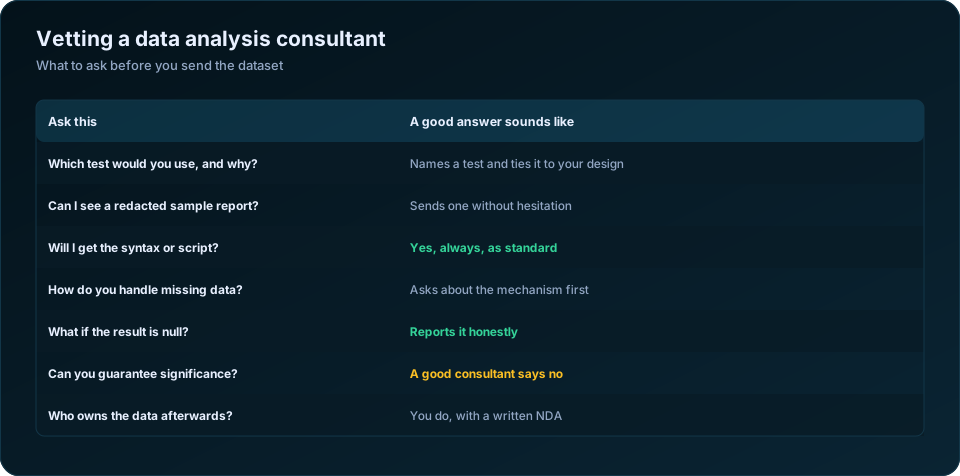
Seven questions that separate the competent from the confident
You cannot assess statistical skill by reading a profile. You can assess it in a twenty-minute conversation, if you ask the right things and listen for the shape of the answer rather than the vocabulary.
| Ask this | A strong answer | A warning sign |
|---|---|---|
| "Given my design, which test would you use?" | Names a test and ties it to your outcome type and group structure | Lists many techniques without connecting them to your data |
| "How would you handle the missing values?" | Asks about the mechanism before proposing a fix | Says "I will just remove those rows" |
| "Will I receive the syntax or script?" | Yes, as standard, with the cleaning steps included | Hesitation, or "I usually just send the output" |
| "What if the result comes back null?" | Treats it as a normal, reportable outcome | Implies significance can be arranged |
| "Can I see a redacted past report?" | Sends one promptly | Cites confidentiality for everything |
| "How will you check the assumptions?" | Names the specific diagnostics for your method | Treats it as a formality |
| "Who owns the data and results?" | You do; offers a written NDA | Vague, or wants to reuse your data |
The fourth question is the single most diagnostic. Statistics is a procedure for finding out, not a service for confirming. Anyone who signals that they can produce the result you are hoping for is telling you exactly how they will handle the analysis, and it will not withstand review.
Writing a brief that gets you an accurate quote
Most disputes over analysis work trace back to a vague brief. Six items, and a quote based on all six will be far closer to the final cost.
| Include | Example |
|---|---|
| The research questions, numbered | "Does training raise completed interviews per day?" |
| The study design | "Two groups, measured at baseline and endline, 40 villages" |
| The dataset, or a redacted sample | 200 rows with the real column structure |
| A codebook or variable list | Names, types, value labels, missing codes |
| The output format required | "APA tables for a thesis chapter four" |
| The deadline, and what is fixed about it | "Submission 14 March; supervisor review 1 March" |
Sending a redacted sample of the actual data is the highest-value thing you can do. It lets the consultant see the mess before quoting, which means the quote holds. A price given without sight of the data is an estimate of an imagined dataset.
Number your research questions. It converts a vague scope into a countable one, makes the deliverable checkable, and prevents the slow expansion where three questions quietly become eleven.
What to agree in writing
| Term | Why it matters |
|---|---|
| Scope, as a numbered list of analyses | Defines what "done" means |
| Revision rounds included | Two is normal; unlimited is a trap for both sides |
| Deliverable formats | Output file, tables, figures, script |
| Data handling and deletion | Where it is stored, when it is destroyed |
| Payment milestones | Typically part on brief acceptance, balance on delivery |
| What happens if the data proves unusable | An honest clause protects both parties |
| Named person doing the work | Avoids the bait-and-switch to a junior |
The revision clause causes the most friction. "Unlimited revisions" sounds generous and in practice means the consultant prices defensively and the client keeps changing the question. Two rounds, with a defined scope for what a revision covers, works better for everyone.
The red flags, ranked
Some of these are fatal and some are merely worth a second question.
Disqualifying. Guaranteeing significant results. Offering to write your discussion chapter and present it as your own. Refusing to hand over the syntax. Unwilling to sign an NDA. Suggesting a data adjustment to "improve" the outcome.
Serious. No named individual accountable for the work. A quote given without seeing any data. Cannot explain the chosen test in plain language. No examples of past work in any form.
Worth probing. Very low prices relative to the market — usually a sign the cleaning effort has not been priced in. Extremely fast promised turnaround. A long list of software logos with no depth in any of them.
The integrity ones matter most for academic work. Universities in India increasingly treat outsourced interpretation and writing as misconduct, while analysis support is broadly accepted. Our guide to data analysis help for PhD scholars covers exactly where that line falls and how to disclose support properly.
Managing the engagement so it goes well
Three habits make the difference between a smooth project and a drawn-out one.
Front-load the questions. Agree the analysis plan before any work starts. Changing the research question after the analysis is done means paying twice, and worse, it invites the appearance of shopping for a result.
Ask for a checkpoint after cleaning. Before any test is run, ask for the descriptive summary — sample sizes, missingness by variable, distributions of the key outcomes. This is where problems surface cheaply. If a variable you were counting on turns out to be 40% missing, you want to know before the modelling, not after.
Read the interpretation critically. You are the person who will defend this work. If a sentence in the write-up does not make sense to you, it will not make sense to a reviewer either. A good consultant expects that conversation and welcomes it.
For what the engagement should contain, see what are statistical data analysis services. For sending a dataset in a state that will not inflate your quote, how to clean survey data before analysis is worth twenty minutes. Our statistical and research data analysis service works to the terms described above, and the Royal Statistical Society's code of conduct is a reasonable benchmark for professional behaviour.
Frequently Asked Questions
What should I look for in a data analysis consultant?
Someone who asks about your design before naming a method, explains their reasoning in plain language, hands over the syntax or script as standard, and treats a null result as a legitimate finding rather than a problem to be solved.
How do I know if a consultant is qualified?
Ask them which test they would use for your specific design and why. A qualified analyst connects the answer to your outcome type, group structure and sample size. Reciting a list of techniques without that connection is the clearest sign of shallow experience.
What should I send a consultant before asking for a quote?
Numbered research questions, a description of the study design, a redacted sample of the real dataset, a codebook or variable list, the required output format, and the deadline. A quote given without sight of data is unreliable because cleaning drives the cost.
Is it ethical to hire someone to analyse my thesis data?
Analysis support — cleaning, running tests, producing tables, teaching you the method — is broadly accepted, provided you disclose it where your institution requires. Having someone write your interpretation, discussion or conclusions is not acceptable at any institution.
How many revision rounds should I expect?
Two is standard for a defined scope. Unlimited revisions usually mean the consultant has priced defensively or the scope was never pinned down. Agree what counts as a revision, as distinct from a new analysis, in writing.
Should I pay upfront?
Split payment is normal — part on acceptance of the brief, the balance on delivery. Full payment before any work is a risk; full payment after delivery is rarely accepted. Milestones on a longer project protect both sides.
Need help turning your data into defensible results? DSTechnoverse offers statistical and research data analysis services in SPSS, R, and Python — survey analysis, thesis and dissertation support, and business statistics. Get in touch to discuss your dataset.
Sources and Further Reading
Official and primary sources for the standards, rules and data discussed on this page.
- UCLA Statistical Methods and Data Analytics: worked examples for SPSS, R, Stata and SAS.
- World Bank DIME Wiki: field survey, data quality and impact evaluation guidance.
- American Statistical Association: statement on p-values (2016): six principles for interpreting p-values correctly.
- The R Project for Statistical Computing: the free software environment for statistics and graphics.