
Every survey, experiment, and business dataset holds answers — but only if the numbers are analysed correctly. Statistical data analysis services exist to bridge the gap between raw data and trustworthy conclusions, using the right methods, checked assumptions, and clear interpretation.
What these services actually include
Statistical data analysis is more than "running some numbers." A proper service covers the full journey from a messy dataset to a result you can defend:
- Data cleaning and preparation — fixing errors, handling missing values, coding variables
- Descriptive statistics — means, frequencies, distributions, and summaries
- Inferential statistics — t-tests, ANOVA, chi-square, correlation, and regression
- Advanced modelling — logistic regression, factor analysis, SEM, clustering
- Interpretation — explaining what the results mean in plain language
- Reporting — tables, charts, and figures ready for a paper or presentation
Who needs statistical analysis help
- PhD scholars and students analysing thesis and dissertation data
- Researchers in universities and institutions with project datasets
- Market research and survey agencies needing analysis capacity
- NGOs measuring programme impact and monitoring data
- Businesses wanting statistical rigour behind decisions
The signs you should bring in a consultant
You probably need help when:
- You are unsure which test to use for your question and data type.
- Your software gives output you cannot confidently interpret.
- A supervisor or reviewer has flagged your methodology.
- You have a deadline and no time to learn SPSS or R from scratch.
- Your conclusions need to withstand scrutiny from examiners or stakeholders.
What good analysis looks like
The mark of quality is not a fancy model — it is the right method, honestly applied. That means choosing the correct test, verifying its assumptions, reporting effect sizes alongside p-values, and being clear about limitations. A good analyst makes your findings stronger and more honest.
If any of this sounds like the wall you are hitting, a statistical data analysis service is the fastest way through it.
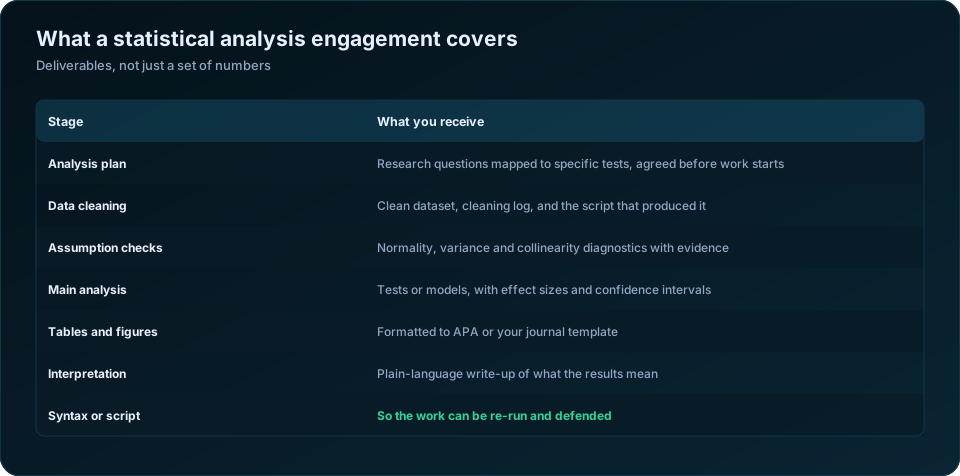
What you actually receive, stage by stage
The phrase "data analysis services" covers everything from a two-hour cross-tab job to a six-month modelling engagement. What separates a professional service from a freelancer running a test for you is the set of artefacts you end up holding.
| Stage | Deliverable | Why it matters |
|---|---|---|
| Analysis plan | Each research question mapped to a specific test, agreed in writing before work begins | Prevents the fishing expedition that produces unreportable results |
| Data cleaning | Clean dataset, a cleaning log, and the script that produced it | Lets anyone rebuild the clean file from the raw one |
| Assumption checks | Normality, variance homogeneity, multicollinearity diagnostics | This is what a reviewer will ask for first |
| Main analysis | Tests or models, with effect sizes and confidence intervals | Significance alone is not a finding |
| Tables and figures | Formatted to APA or a journal template | Saves days of reformatting |
| Interpretation | Plain-language explanation of what each result means | The part you must be able to defend |
| Syntax or script | The complete code, handed over | Without it the work cannot be re-run |
That last row is the one to insist on. An analysis you cannot reproduce is an analysis you cannot defend when a supervisor, reviewer or auditor asks a follow-up question six months later.
The categories of work
| Type of work | Typical client | Core methods |
|---|---|---|
| Survey analysis | NGOs, market research, government programmes | Cross-tabs, weighting, significance testing |
| Thesis and dissertation analysis | PhD and Masters scholars | Reliability, ANOVA, regression, SEM |
| Impact evaluation | Development programmes, CSR teams | Difference-in-differences, propensity matching |
| Scale development and validation | Academic and HR research | Factor analysis, Cronbach's alpha, CFA |
| Business and operations analytics | Companies, manufacturers | Forecasting, segmentation, control charts |
| Clinical and health research | Hospitals, public health units | Survival analysis, diagnostic accuracy |
| Environmental and monitoring data | Consultancies, industrial units | Trend analysis, compliance statistics |
Each of these calls on a different toolkit, and no single analyst is genuinely strong across all of them. When you engage a provider, ask which of these rows they do most often. A firm that runs mainly market research cross-tabs will be slower and less certain on a structural equation model, and vice versa.
What it costs, and what drives the number
Pricing in India varies enormously, and the honest driver is not the complexity of the statistics — it is the state of your data.
| Engagement | Typical range (INR) | What moves it |
|---|---|---|
| Descriptive tables and cross-tabs | 8,000 to 20,000 | Number of variables and cuts |
| Thesis chapter analysis | 15,000 to 45,000 | Number of hypotheses, method complexity |
| Regression modelling with diagnostics | 25,000 to 60,000 | Predictors, model comparison, robustness checks |
| Scale validation with factor analysis | 30,000 to 70,000 | Items, sample size, confirmatory stage |
| Full survey report | 60,000 to 2,00,000 | Sample size, subgroups, dashboards |
| Ongoing analytics retainer | 40,000 to 1,50,000 per month | Frequency and reporting depth |
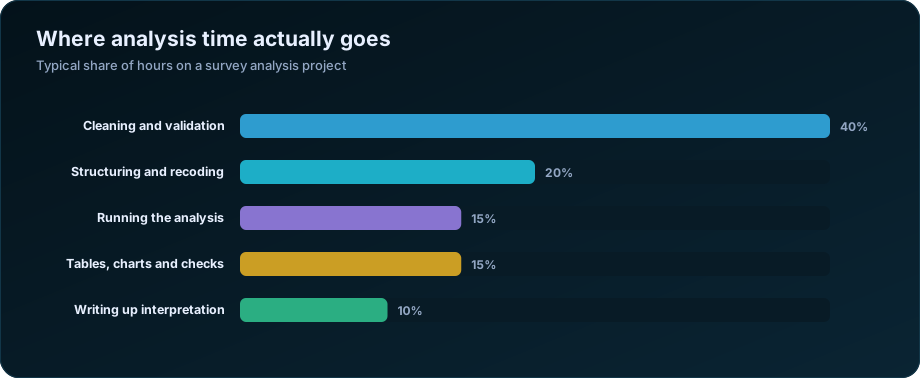
Cleaning consumes about 40% of the hours on a typical project. This is why two quotes for apparently identical work can differ threefold: one provider has seen your messy Excel file and one has not. Send a sample of the real data before asking for a firm price, and expect any quote given without seeing the data to be provisional.
Turnaround you can reasonably expect
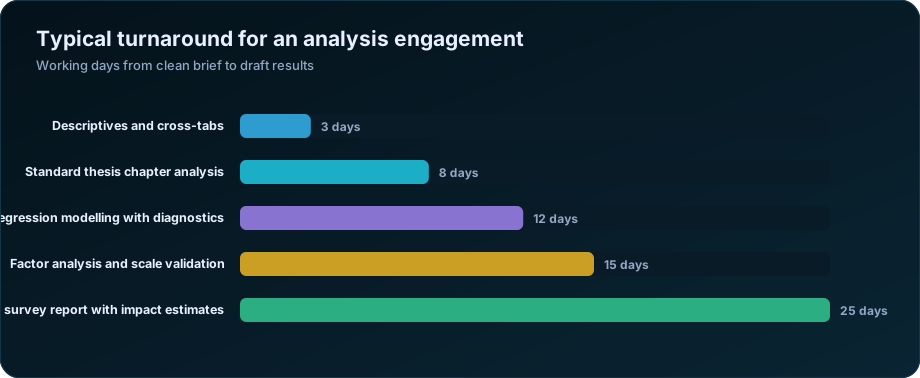
These are working days from a clean brief, meaning the dataset has arrived, the variables are documented and the research questions are settled. The clock does not start when you first make contact. In practice the largest source of delay on analysis projects is not the analyst — it is waiting for a codebook, or discovering that two variables were recorded differently across survey rounds.
When you need this, and when you do not
You probably do not need a service if you are running descriptive statistics on a clean dataset with a straightforward comparison, and you have a week to learn the tool. That work is well within reach of anyone willing to read a manual.
Bringing in a professional makes sense when at least one of these is true:
- The design involves clustering, repeated measures or weighting, where a naive test gives the wrong standard errors.
- The result must survive external scrutiny — a journal, a thesis committee, a funder, a regulator.
- Your data is genuinely messy: multiple sources, inconsistent coding, substantial missingness.
- You have run the analysis and cannot tell whether the output is sensible.
- The deadline makes the learning curve impossible.
The third and fourth are the most common in practice. A great deal of what gets called "analysis help" is really data engineering plus a sanity check on interpretation.
Choosing well
The evaluation criteria are covered in detail in how to hire a survey data analysis consultant, but one filter is worth stating here: ask what happens if the analysis returns a null result. A provider who treats that as a normal and reportable outcome is doing statistics. One who implies they can find significance is offering something else, and it will not survive review.
For the underlying decisions, see how to choose the right statistical test and how to present statistical results. Our statistical and research data analysis service works in SPSS, R and Python and delivers the syntax alongside every result. The International Statistical Institute's declaration on professional ethics sets out the standards any provider should be willing to work to.
Frequently Asked Questions
What is included in statistical data analysis services?
An analysis plan agreed before work begins, data cleaning with a documented log, assumption checks, the main tests or models with effect sizes and confidence intervals, formatted tables and figures, a plain-language interpretation, and the syntax or script so the work can be reproduced.
How much do data analysis services cost in India?
Roughly 8,000 to 20,000 rupees for descriptive tables, 15,000 to 45,000 for a thesis chapter, 25,000 to 60,000 for regression modelling with diagnostics, and 60,000 upwards for a full survey report. Data condition drives the price more than statistical complexity does.
How long does a statistical analysis take?
From a clean brief, three days for descriptives, about eight for a standard thesis chapter, twelve for regression with diagnostics, and three to five weeks for a full survey report. Messy or undocumented data adds time before analysis can begin.
Do I get the SPSS syntax or R script?
You should, and it is worth making it a condition of the engagement. Without the script the analysis cannot be re-run, extended or defended when someone asks how a particular variable was handled.
Can a consultant guarantee significant results?
No, and any provider who suggests otherwise should be avoided. Statistical significance depends on the data and the true effect. A null result is a legitimate finding and should be reported as such.
Is my data kept confidential?
It should be covered by a written non-disclosure agreement, with you retaining full ownership of the data and results. Ask about data handling, storage and deletion before sending anything sensitive.
Need help turning your data into defensible results? DSTechnoverse offers statistical and research data analysis services in SPSS, R, and Python — survey analysis, thesis and dissertation support, and business statistics. Get in touch to discuss your dataset.