
For many PhD scholars, the analysis chapter is where momentum stalls. You have collected the data — now you have to analyse it correctly, defend the methods, and interpret the results under a supervisor's and examiner's scrutiny. Here is what legitimate support looks like.
Why analysis stalls so many scholars
- Statistics may not be your primary training
- Your methods must satisfy a supervisor and examiners
- Software (SPSS, R) has a learning curve
- The stakes are high and the timeline is long
- One wrong test can undermine an entire chapter
None of this means you are not capable — it means analysis is a specialised skill that even strong researchers often need help with.
What good analysis support includes
- Method selection — choosing and justifying the right tests for your hypotheses and data
- Assumption checking — verifying the conditions each test requires
- Running the analysis — in SPSS, R, or your required tool
- Interpretation — explaining what the output means for your research questions
- Reporting — building clean, journal- or university-standard tables and figures
- Viva preparation — making sure you can defend every choice
The integrity line — this matters
Legitimate support helps you understand and execute your analysis. It does not mean someone doing your intellectual work or writing your thesis for you.
Good support:
- Explains why a method fits, so you can defend it
- Teaches you to interpret your own results
- Keeps you in control of the research
You remain the author and the expert on your own study. The right help makes you more capable, not less.
What to prepare before seeking help
- Your research questions and hypotheses
- Your dataset in its original format
- Your methodology chapter or plan
- Your university's or journal's formatting requirements
- Your deadline
The realistic outcome
With the right support, the analysis chapter goes from a roadblock to a strength — methods you can justify, results you understand, and figures ready for submission. The goal is simple: you walk into your viva able to explain and defend every number in your thesis.
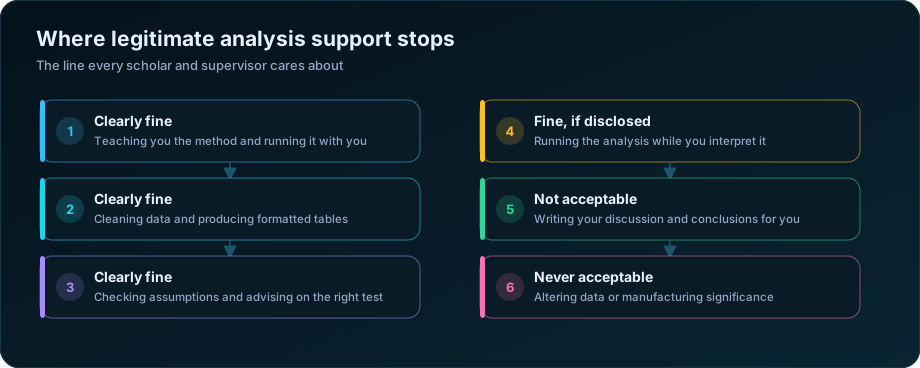
The integrity line, stated precisely
This is the question every scholar asks quietly and few ask directly, so it deserves a direct answer.
| Activity | Status | Note |
|---|---|---|
| Being taught the method and running it yourself | Always acceptable | This is what supervision is |
| Data cleaning and variable construction | Acceptable | Technical work, like transcription |
| Advice on which test suits your design | Acceptable | Equivalent to a methods consultation |
| Someone else running the analysis | Generally acceptable, disclose it | Common in the sciences; check your handbook |
| Producing formatted tables and figures | Acceptable | Presentational work |
| Someone else writing your interpretation | Not acceptable | This is your intellectual contribution |
| Someone else writing your discussion chapter | Not acceptable | Ghostwriting |
| Adjusting data to reach significance | Never acceptable | Research misconduct |
The principle underneath is simple: you may receive help doing the analysis, but the understanding and the argument must be yours. A viva panel will not ask you to re-derive a formula. They will ask why you chose that test, what the assumption checks showed, and what the coefficient means in the context of your field. If you cannot answer those three, no amount of technical assistance has helped you.
The practical test: could you sit down with your supervisor and explain every step of what was done and why? If yes, the support was legitimate. If parts of your own chapter are opaque to you, something has gone wrong.
Where analyses actually stall
Scholars rarely get stuck on the statistics itself. They get stuck at one of five predictable points.
The data does not match the plan. The proposal promised 400 responses; 214 arrived, and one subgroup has 19. This is the most common crisis, and it is a design problem, not an analysis problem. The fix is usually to collapse subgroups, drop a planned comparison, and report the limitation honestly — not to run the underpowered test anyway.
The scale does not hold together. Cronbach's alpha comes back at 0.41 on a scale borrowed from a published paper. Usually a reverse-scored item was never reversed, or the translation shifted an item's meaning. Both are fixable, but only if diagnosed. See reliability and validity in survey research.
The assumptions fail. Data is skewed, variances are unequal, residuals are not normal. This feels like a wall and is not one — every common test has a robust or non-parametric alternative, covered in how to choose the right statistical test.
The result is null. Nothing reaches significance. This is the point at which scholars are most vulnerable to bad advice. A null finding is publishable, defensible and honest; a manufactured one is a career risk.
The output is unreadable. SPSS produced forty tables and it is unclear which three belong in the chapter. This is a presentation problem, addressed in how to present statistical results.
What to prepare before asking for help
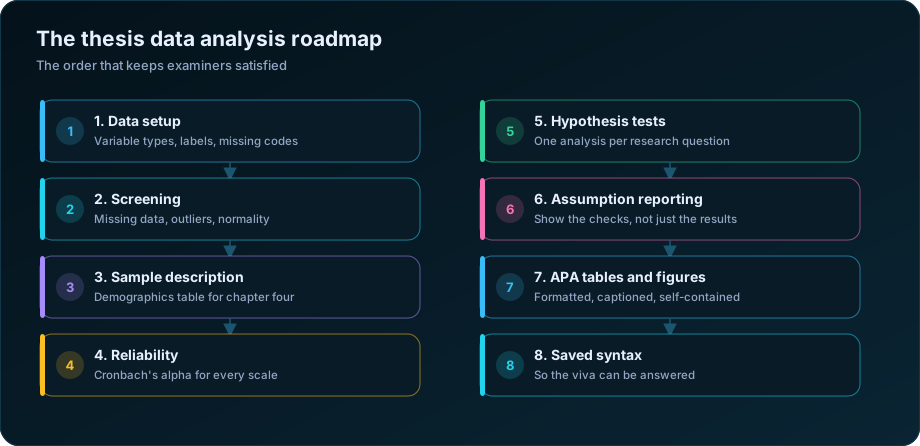
Arriving with these six things converts a vague, expensive conversation into a focused one:
| Bring | Why |
|---|---|
| Your research questions and hypotheses, numbered | The analysis is chosen from these, not from the data |
| The raw dataset in its original form | Never a version already edited by hand |
| A codebook | Variable names, types, value labels, missing codes |
| Your methodology chapter draft | It states what you already committed to doing |
| Your university's formatting requirements | APA, or a departmental template |
| Your actual deadline, with the internal milestones | Supervisor review dates matter more than submission |
The single most valuable item is the numbered hypothesis list. Analysis follows from the questions you set out to answer. Scholars who arrive saying "here is my data, what can you find?" are inviting exactly the fishing expedition that makes a chapter indefensible.
A realistic timeline for a thesis chapter
| Stage | Typical duration | Common delay |
|---|---|---|
| Data setup and codebook | 2 to 3 days | Undocumented variables |
| Cleaning and screening | 3 to 6 days | Missing data decisions |
| Reliability and factor analysis | 2 to 4 days | Scales that need respecification |
| Main hypothesis tests | 3 to 5 days | Assumption violations needing a rethink |
| Tables, figures and write-up | 4 to 7 days | Formatting to the template |
| Revisions after supervisor review | 3 to 10 days | Scope changes |
Three to five weeks end to end is realistic for a standard quantitative chapter. Scholars routinely allocate one week, and that assumption is the source of most of the panic. Build the analysis into your calendar the way you built in data collection.
Questions your viva will ask
Prepare answers to these six and the statistical portion of a viva becomes straightforward:
- Why this test rather than the obvious alternative?
- What did the assumption checks show, and what did you do about violations?
- How did you handle missing data, and why that method?
- What is the effect size, and is it practically meaningful in your field?
- What are the limitations of your sample and design?
- If you re-ran this study, what would you change?
Question four catches people out most often. Many scholars can recite a p-value and cannot say whether the effect matters. Being able to say "the difference was 0.4 standard deviations, which in this literature is a moderate and practically relevant effect" is the mark of someone who understands their own results.
For the SPSS mechanics specifically, see SPSS data analysis for your thesis. Our statistical and research data analysis service works to the disclosure standards described above and delivers the syntax so you can answer any question about how a number was produced. The UGC's academic integrity regulations set the framework Indian institutions apply.
Frequently Asked Questions
Is it allowed to get help with PhD data analysis?
Yes, at most institutions, provided the help is technical rather than intellectual. Cleaning, running tests and producing tables are widely accepted; having someone write your interpretation or discussion is not. Check your university's handbook and disclose support where required.
How long does thesis data analysis take?
Three to five weeks for a standard quantitative chapter, covering data setup, cleaning, reliability checks, hypothesis tests, tables and one revision round. Scholars commonly budget a week, which is the main reason analysis becomes a crisis.
What if my results are not significant?
Report them. A well-designed study with a null result is a legitimate contribution, and examiners are far more concerned with whether your method was sound than with which way the p-value fell. State the effect size you were powered to detect, so readers can see what the study could and could not have found.
What should I prepare before contacting an analyst?
Numbered research questions and hypotheses, the untouched raw dataset, a codebook, your methodology chapter, your university's formatting requirements, and your real deadline including supervisor review dates.
Will my examiner know I had help with the analysis?
They will find out if you cannot explain your own results. That is the real risk — not detection of the assistance, but an inability to defend the work. Make sure you understand every step, whoever executed it.
Should I use SPSS or R for my thesis?
SPSS if you are close to submission with no coding background, since it is faster to reach a defensible result. R if you have a year or more and expect to keep doing quantitative work, because the reproducibility and the skill both outlast the thesis.
Need help turning your data into defensible results? DSTechnoverse offers statistical and research data analysis services in SPSS, R, and Python — survey analysis, thesis and dissertation support, and business statistics. Get in touch to discuss your dataset.