
Quick answer: CORSIA carbon credits are carbon credits that an aircraft operator may cancel to meet its offsetting requirement under ICAO's Carbon Offsetting and Reduction Scheme for International Aviation. To qualify, a unit must come from a programme approved by the ICAO Council, fall inside the eligible vintage window and, for the first phase (2024 to 2026), carry a host-country Letter of Authorization and a corresponding adjustment. Most carbon credits in circulation do not meet all three tests.
CORSIA carbon credits are the only carbon credits an airline can use to discharge a legal offsetting obligation under ICAO's aviation scheme, and they are a much narrower product than the phrase "carbon credit" suggests. Most guides explain what a credit is and stop. That leaves the reader knowing a definition and still unable to answer the questions that actually arise: is this particular unit usable for my purpose, what could go wrong, how do I cancel it correctly, and what am I allowed to say about it afterwards.
This guide answers those questions for three groups: aircraft operators who must buy, corporate buyers who want adjusted units for their own claims, and project developers (particularly in India) who want to supply them. It is written for people who have to make a decision, not for people browsing.
Contents
- What CORSIA carbon credits are
- How a credit comes into existence
- Voluntary and compliance markets
- Who needs CORSIA credits
- What makes CORSIA carbon credits eligible
- Who buys CORSIA credits
- Judging credit quality
- Standards and certification
- What drives the price of CORSIA offsets
- Worked example
- Buyer checklist
- Cancellation steps
- Reporting and claims
- The India angle
- Frequently asked questions
What CORSIA Carbon Credits Actually Are
A carbon credit is a tradable instrument representing one tonne of carbon dioxide equivalent either not emitted or removed from the atmosphere, relative to what would otherwise have happened. A CORSIA credit is a carbon credit that has also passed ICAO's eligibility tests. ICAO's formal term is a CORSIA Eligible Emissions Unit (EEU); the knowledge base entry on CORSIA Eligible Emissions Units sets out the definition in full.
Three parts of the basic definition carry the weight.
One tonne of CO2 equivalent. Not carbon dioxide alone. Methane, nitrous oxide and industrial gases are converted to a CO2-equivalent figure using global warming potentials, which is why a methane project can generate large volumes from a modest physical intervention.
Not emitted, or removed. An avoidance credit means a tonne that would have been emitted was not. A removal credit means a tonne already in the atmosphere was taken out and stored. CORSIA accepts both if the unit meets the criteria, but buyers with claims to defend increasingly distinguish between them.
Relative to what would otherwise have happened. This counterfactual, the baseline, is where nearly every dispute about credit integrity originates. It is unobservable by definition, so it is modelled, and models can be optimistic.
The most useful mental correction for someone new to this market: a carbon credit is not a physical thing. It is a claim about a counterfactual, evidenced by documentation. A CORSIA credit adds a second layer: a claim that a government has agreed not to count the same tonne towards its own target.
How a Credit Comes Into Existence
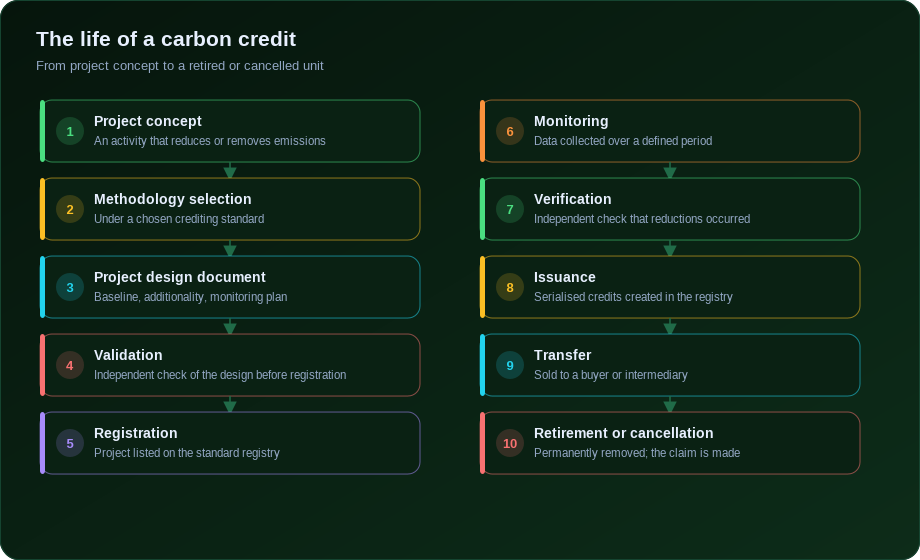
The sequence is broadly the same across every standard, with one extra step for CORSIA supply:
- Project concept. An activity that reduces or removes emissions.
- Methodology selection. Under a chosen crediting standard. If no methodology exists for the activity, no credits can be issued, however good the activity.
- Project design document. Baseline, additionality argument, monitoring plan, safeguards.
- Validation. An accredited body independently checks the design before registration.
- Registration. The project is listed on the standard's registry.
- Host-country authorisation (CORSIA only). The host government issues a Letter of Authorization for international use and commits to a corresponding adjustment.
- Monitoring. Data collected over a defined period according to the plan.
- Verification. An accredited body independently checks that the reductions actually occurred.
- Issuance. Serialised credits are created in the registry, and units eligible for CORSIA are labelled as such.
- Transfer. Sold to a buyer, directly or through an intermediary.
- Retirement or cancellation. Permanently removed from circulation. This is the step that makes the claim. Holding a credit achieves nothing.
Timeline for a new project: eighteen months to three years from concept to first issuance, longer where host-country authorisation is involved. Developers can run step 6 in parallel with steps 3 to 5, and the sensible ones do.
Voluntary and Compliance Markets
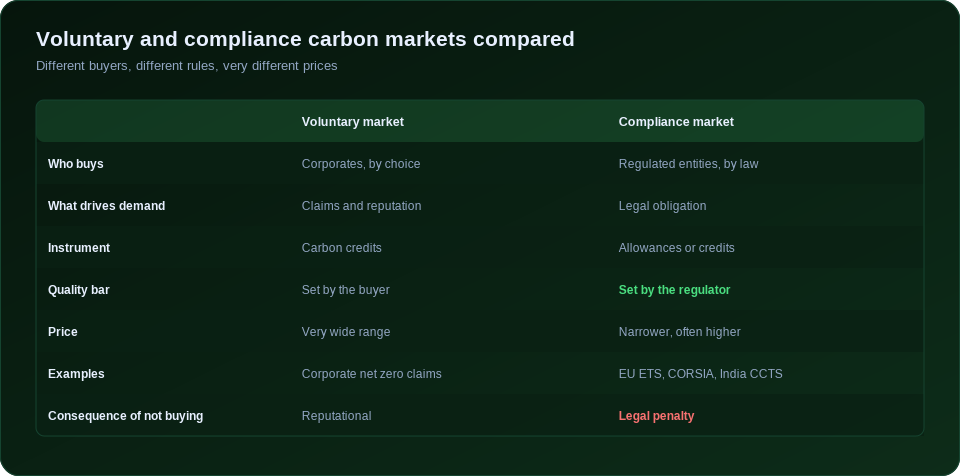
| Voluntary market | Compliance market | |
|---|---|---|
| Who buys | Corporates, by choice | Regulated entities, by law |
| What drives demand | Claims and reputation | Legal obligation |
| Instrument | Carbon credits | Allowances or credits |
| Quality bar | Set by the buyer | Set by the regulator |
| Examples | Corporate net zero claims | EU ETS, CORSIA, India's CCTS |
| Consequence of not buying | Reputational | Legal penalty |
The distinction that trips people up: a credit can be perfectly valid in the voluntary market and unusable for CORSIA. The reverse is rarely true. CORSIA eligibility is a strict subset, which creates a two-tier market where the same project can produce units worth materially different amounts depending on whether they carry authorisation. See voluntary versus compliance carbon markets and the head-to-head comparison of a CORSIA carbon credit and a voluntary carbon credit.
CORSIA in Brief: Who Needs CORSIA Credits
CORSIA requires aircraft operators to offset the growth in CO2 emissions from international flights above a baseline. This section covers only what a buyer needs; the full explanation of the scheme is in what is CORSIA.
Who is in scope:
| Test | Threshold |
|---|---|
| Flight type | International only; domestic flights excluded |
| Aircraft | Above 5,700 kg maximum certificated take-off mass |
| Operator | Above 10,000 tonnes CO2 a year from international flights (monitoring and reporting required) |
| Flight category | Not humanitarian, medical, firefighting or State aircraft |
| Offsetting | Only on routes where both States participate |
The phases:
| Period | Years | Participation | Baseline used |
|---|---|---|---|
| Pilot | 2021-2023 | Voluntary | 2019 emissions |
| First | 2024-2026 | Voluntary | 85% of 2019 emissions |
| Second | 2027-2035 | Mandatory for States above activity thresholds | 85% of 2019 emissions |
Three points matter for credit demand. From 2024 the baseline is 85% of 2019 emissions, so offsetting begins earlier in the recovery than it would against a full 2019 baseline. From 2027, participation becomes mandatory for States above defined aviation activity thresholds, which expands route coverage. Later in the second phase, an operator's own growth enters the calculation alongside the sector's, under the growth-factor rules set by the ICAO Assembly; the baseline and growth factors entry explains the mechanics.
What Makes CORSIA Carbon Credits Eligible
This is the part most guides get wrong, usually by implying that any reputable credit qualifies.
Eligibility operates at two levels, and both must be satisfied:
Programme level. ICAO's Technical Advisory Body (TAB) assesses crediting programmes against the Emissions Unit Criteria and recommends; the ICAO Council decides. Approval may be full or conditional, covers specific compliance periods, and can lapse. See approved crediting programmes.
Unit level. Even from an approved programme, the individual unit must satisfy the criteria and any conditions the Council attached to that programme's approval.
The core criteria, in summary (the Emissions Unit Criteria entry has the detail):
| Criterion | Requires |
|---|---|
| Additional | Would not have occurred without credit revenue |
| Real and measurable | Quantified conservatively under an approved methodology |
| Permanent | Not reversible, or reversal risk addressed |
| Verified | Independently checked by an accredited body |
| No double counting | Host-country authorisation and corresponding adjustment |
| Eligible vintage | Within the window set for the compliance period |
| No net harm | Social and environmental safeguards met |
| Traceable | Uniquely serialised, clear registry record |
The double-counting criterion removes more supply than the others combined. Under Article 6 of the Paris Agreement, when a host country authorises a credit for international use, it must apply a corresponding adjustment: it adds those tonnes back into its own national accounting and forgoes them against its own climate target. For first-phase units, the evidence is a Letter of Authorization from the host country, plus the programme's confirmation and, in due course, the adjustment reported by the host country.
Many governments decline for some or all project types, because it makes their own targets harder to meet. Others have no designated authority or process yet, which in practice means no authorisation.
The practical consequence: most of the world's carbon credits, including a great deal of good-quality supply, cannot be used as CORSIA eligible credits. This is not a quality judgement on those projects. It is a sovereignty and accounting constraint operating above them, and it is why eligible supply is scarce.
Three phrases you will meet that all mean not currently eligible: "CORSIA-ready", "CORSIA-aligned" and "eligible pending authorisation". None is a standard. The corresponding adjustments entry and the explainer on Article 6 of the Paris Agreement cover the mechanism.
Who Buys CORSIA Credits
Aircraft operators with an offsetting obligation. This is the primary demand and it is a legal requirement rather than a choice. How they plan, source and cancel is covered in how airlines use carbon credits under CORSIA.
Corporate voluntary buyers, increasingly, because a corresponding-adjusted unit is a strong answer to double-counting criticism of corporate claims. Some buy adjusted units with no aviation obligation at all; see can companies buy CORSIA-eligible credits.
Intermediaries and traders, holding inventory against expected demand.
The second group is often left out of supply forecasts, and it matters: operators compete with corporate demand for the same limited pool of authorised units.
Judging Credit Quality
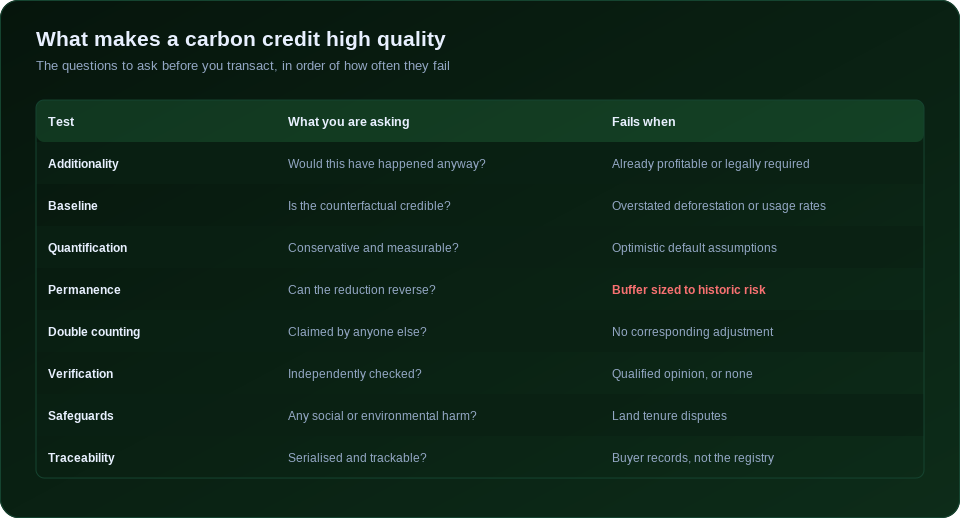
Quality is not a rating you can look up. It is a set of questions, and the answers live in documents.
| Test | What you are asking | Fails when |
|---|---|---|
| Additionality | Would this have happened anyway? | Already profitable or legally required |
| Baseline | Is the counterfactual credible? | Overstated deforestation or usage rates |
| Quantification | Conservative and measurable? | Optimistic default assumptions |
| Permanence | Can the reduction reverse? | Buffer sized to historic rather than current risk |
| Double counting | Claimed by anyone else? | No corresponding adjustment |
| Verification | Independently checked? | Qualified opinion, or none |
| Safeguards | Any social or environmental harm? | Land tenure disputes |
| Traceability | Serialised and trackable? | Evidence held only by the seller |
Ratings agencies are useful for triage. They are not a substitute for reading the documents, and a highly rated project without a corresponding adjustment is still ineligible for CORSIA. Rating measures quality; eligibility is a separate question. See carbon credit quality assessment.
Standards and Certification
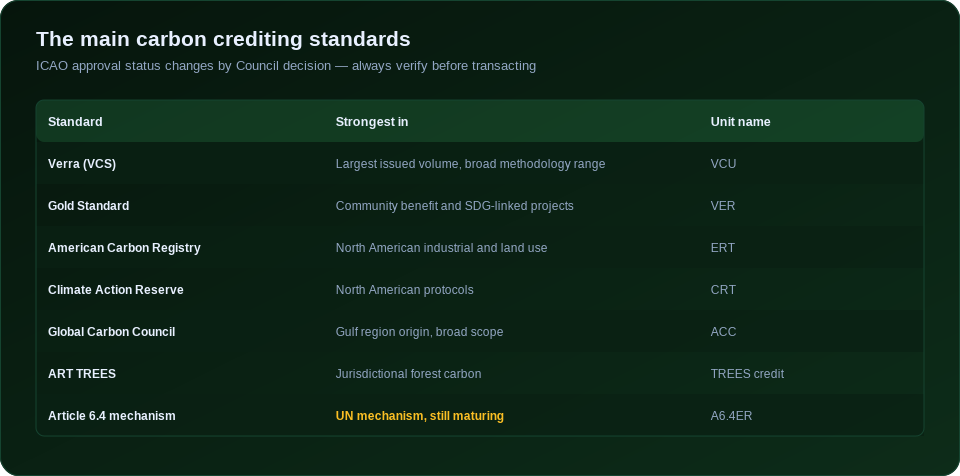
| Standard | Strongest in | Unit |
|---|---|---|
| Verra (VCS) | Largest issued volume, broad methodologies | VCU |
| Gold Standard | Community benefit, SDG-linked projects | VER |
| American Carbon Registry | North American industrial and land use | ERT |
| Climate Action Reserve | North American protocols | CRT |
| Global Carbon Council | Gulf region origin, broad scope | ACC |
| ART TREES | Jurisdictional forest carbon | TREES credit |
| Article 6.4 mechanism | UN mechanism, still maturing | A6.4ER |
Programme approval for CORSIA changes by ICAO Council decision. Any list in an article, including this one, is a snapshot. Verify against the ICAO emissions units page at the point of transaction and capture what it says on the day, because a URL is not evidence of what a page said when you relied on it.
A frequent point of confusion: ISCC certifies fuel, not credits. ISCC CORSIA certifies CORSIA Eligible Fuels, the sustainable aviation fuel that reduces an operator's offsetting requirement. It is not a carbon credit standard. See ISCC CORSIA certification and SAF or offsets.
What Drives the Price of CORSIA Offsets
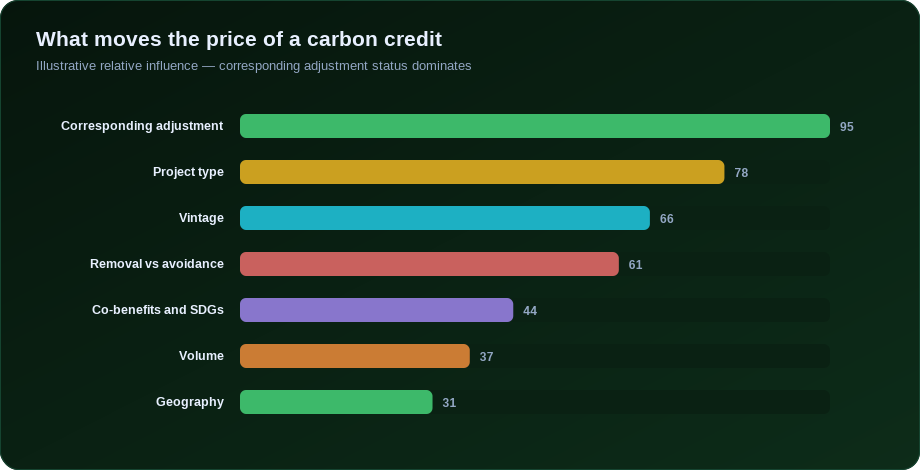
Published "average carbon credit prices" mean little, because they blend products that are not comparable. Market sources consistently report that CORSIA-eligible units trade at a premium to otherwise similar unauthorised units, but the size of that premium moves with supply, and this guide does not quote figures. The CORSIA carbon credit price and timing guide covers when and how to buy; the drivers in brief are:
- Authorisation status. The largest single determinant. Identical tonnes from the same project, differing only in whether they carry an adjustment, are different products.
- Project type. Removals generally sit above avoidance; within avoidance, project types with contested methodologies discount.
- Vintage. Units near an eligibility window boundary carry more risk than units comfortably inside it.
- Volume and structure. Forward contracts usually price below spot because the buyer absorbs delivery and authorisation risk.
Anchor a budget in actual quotes for the vintage, type and volume you would buy, not in a published index.
Worked Example: How Many CORSIA Credits to Buy
The figures below are illustrative only. They show the arithmetic, not any real operator's position or any published growth factor.
The offsetting requirement for a year is, in simplified form, the operator's CO2 emissions on routes subject to offsetting multiplied by the growth factor ICAO publishes for that year. The sector growth factor expresses how far the sector's emissions sit above the baseline (85% of 2019 in the first phase) as a share of that year's sector emissions. Claims for CORSIA Eligible Fuels then reduce the total. The offsetting requirement calculation entry gives the formal method.
| Step | Illustrative figure |
|---|---|
| International emissions, all routes | 520,000 tCO2 |
| Of which on routes where both States participate | 380,000 tCO2 |
| Illustrative sector growth factor | 0.10 |
| Requirement before fuel claims (380,000 x 0.10) | 38,000 t |
| Illustrative CORSIA Eligible Fuel emissions reduction | 2,500 t |
| Net requirement for the year | 35,500 t |
Repeat across the three years of the compliance period and the operator might need, illustratively, a little over 100,000 CORSIA credits, all to be cancelled after the State notifies the final requirement for the period.
Three practical points follow. First, route coverage drives the number more than anything the operator can influence quickly, which is why the 2027 expansion matters. Second, the operator should not buy exactly the estimated volume: a tolerance band protects against late data revisions. Third, the estimate should be refreshed when ICAO publishes each year's factor, not left in last year's budget. CORSIA offsetting requirements works through a fuller version.
How to Buy CORSIA Carbon Credits: A Buyer Checklist
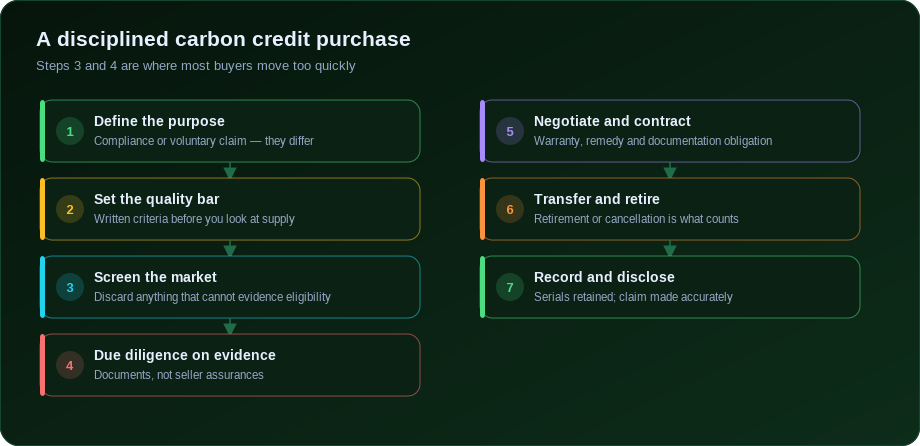
If you plan to buy CORSIA credits, the order of work matters more than the speed:
- Define the purpose. Compliance cancellation or voluntary claim. They have different eligibility requirements, and buying for the wrong one is expensive.
- Estimate the volume and timing. Using the method above, with a tolerance band and the compliance period deadlines in view.
- Open registry accounts early. Each programme runs its own registry; there is no single CORSIA registry. Onboarding can take weeks. See registries and cancellation.
- Set the quality bar in writing, before looking at supply. Otherwise the available supply sets your standard.
- Screen the market. Discard anything that cannot evidence eligibility today.
- Run due diligence on documents, not assurances. Use the checklist below.
- Contract. Eligibility warranty and remedy, authorisation risk allocation, vintage protection, delivery date against your deadline, volume tolerance and documentation as a contractual obligation. Silence leaves every one of these risks with you; see CORSIA offtake agreement terms.
- Take delivery, then cancel correctly. See the next section.
Document checklist before you sign:
| Document or check | What it must show |
|---|---|
| ICAO programme approval | Programme approved for your compliance period, with any conditions |
| Registry record | Serial numbers, vintage, project ID, current holder |
| Vintage check | Inside the eligible window for your compliance period |
| Letter of Authorization | Issued by the host country, covering these units for international mitigation purposes including CORSIA |
| Corresponding adjustment evidence | Host-country commitment and, when available, reporting of the adjustment |
| Programme eligibility label | The registry marks the units as CORSIA eligible |
| Verification report | Accredited verifier, monitoring period, any qualifications |
| Chain of custody | Every transfer from issuance to your account |
| Safeguards | No unresolved grievances or legal disputes |
The CORSIA credit due diligence checklist and the step-by-step buying process go further on each item.
Cancelling CORSIA Eligible Credits: Step by Step
Buying does not discharge an obligation. Cancellation does, and it is irreversible, so it deserves its own procedure:
- Confirm the final requirement. Wait for the State's notification of the final offsetting requirement for the compliance period, and reconcile it against your own estimate.
- Re-check eligibility on the day. Programme approval, vintage window and authorisation status can all change between purchase and cancellation. Record what the ICAO page and the registry show.
- Confirm units are in your account. Units held by a broker on your behalf are not yet yours to cancel.
- Cancel in the programme registry, designated for CORSIA. The cancellation record must identify the use as CORSIA, the operator, the compliance period and the State. A generic voluntary retirement is not a CORSIA cancellation and cannot be converted afterwards.
- Download and file the evidence. Registry cancellation confirmation, serial ranges, date and the stated purpose.
- Prepare the Emissions Unit Cancellation Report. It lists the cancelled units by serial and links them to your requirement.
- Have the report verified and submit it to your national authority within the deadline in the CORSIA compliance calendar. Choosing a verifier is covered in selecting a CORSIA verification body in India.
- Close the file. Keep the cancellation evidence, contracts and diligence records together for audit.
The common failure is step 4: units retired under the wrong purpose are consumed regardless. The case study of a registry cancellation error shows why it could not be undone.
Reporting, ESG and What You May Claim
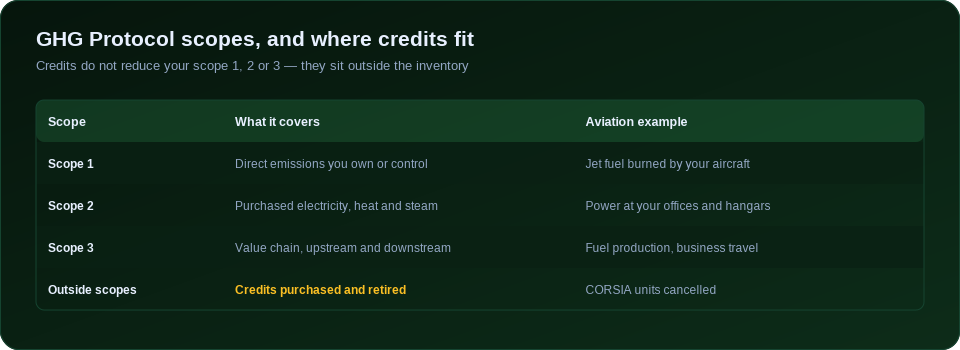
Credits sit outside your emissions inventory. Under the GHG Protocol, scope 1, 2 and 3 emissions are reported as they are. Credits purchased and retired are disclosed separately and never netted against the scopes.
| Framework | Treatment of credits |
|---|---|
| GHG Protocol | Outside the scopes; never netted against them |
| SBTi | Cannot substitute for required reductions |
| ISSB / IFRS S2 | Disclosure of use, type and quality expected |
| India BRSR | Disclosed separately from emissions |
| CORSIA | A compliance obligation, not a voluntary claim |
A critical distinction: units cancelled for CORSIA compliance discharge a legal obligation. Claiming them again as a voluntary carbon neutrality achievement is a double claim of a different kind, and disclosure regulators are increasingly alert to it. Describing what you actually did ("we cancelled X CORSIA eligible units of type Y for our CORSIA obligation") is more defensible than a summary label. See ESG reporting and carbon credits.
The Criticisms, Stated Honestly
Any guide that presents carbon markets without their controversies is selling something. These objections shape where the market is heading.
Additionality is hard to prove. Investigative reporting and academic work have found projects where the reduction would likely have happened anyway, particularly grid-connected renewables where they became the cheapest option. Several standards have narrowed methodologies as a result.
Baselines have been overstated. Avoided-deforestation projects in particular have faced criticism for projecting losses higher than materialised.
Permanence is not guaranteed. Forest carbon can be released by fire, drought or a change of ownership. The adequacy of buffer pools is under active scrutiny.
Offsetting can delay real reductions. If compensating is cheaper than changing, some organisations will compensate indefinitely.
Non-CO2 effects are excluded. Aviation's climate impact includes contrails and nitrogen oxides; CORSIA addresses CO2 only.
None of this removes a legal obligation. What it does mean is that quality varies and due diligence is not optional.
Mistakes Buyers Actually Make
| Mistake | Consequence |
|---|---|
| Buying before defining the purpose | Ineligible units bought for a compliance need |
| Treating a seller's assurance as evidence | No Letter of Authorization, no eligibility |
| Ignoring vintage | Units age out before you cancel them |
| Concentrating in one programme or host country | A single regulatory change hits everything |
| Assuming a rating means eligibility | Highly rated and unadjusted is still ineligible |
| Leaving registry accounts until purchase | Onboarding blocks delivery for weeks |
| Retiring under the wrong purpose | Irreversible; units consumed regardless |
| Claiming compliance units as a voluntary achievement | Double claim; increasingly scrutinised |
The pattern behind most of them: a decision made on an assumption that was never tested against a document. Units that arrive without the authorisation paperwork are a specific case covered in units delivered without an adjustment letter.
The India Angle: CORSIA Credits From Indian Projects
India participates in CORSIA, with the DGCA as national authority for monitoring plans, emissions reports, verification oversight and cancellation reports. For Indian carriers, the obligation steepens: route coverage expands in 2027, and fast growth is penalised once individual growth enters the calculation. See CORSIA in India and CORSIA compliance for Indian airlines.
For Indian project developers, India is a large source of carbon credits, but very little Indian supply is CORSIA eligible. The binding question is authorisation, not project quality:
| Question for an Indian developer | Why it decides eligibility |
|---|---|
| Is the activity type one India will consider authorising? | The government has published a list of activities it would consider for international transfer under Article 6, weighted towards newer technologies rather than conventional grid renewables, and may revise it |
| Which body issues authorisation, and through what process? | Authorisation runs through the national authority for Article 6 under the environment ministry; the process and timing should be confirmed before committing |
| Is the project also within the domestic Carbon Credit Trading Scheme? | Units used domestically cannot also be transferred abroad; the CCTS explainer covers the interaction |
| Does the methodology suit an ICAO-approved programme? | Approval is programme by programme, with conditions |
| Will the vintages fall inside the eligible window? | Authorisation delay burns time against the vintage clock |
The practical rule: establish the authorisation pathway before committing to a methodology, because retrofitting it later is expensive and sometimes impossible. A developer that cannot get a Letter of Authorization can still sell into the voluntary market, but at voluntary-market terms. The detailed treatment is in corresponding adjustments for Indian CORSIA projects, CORSIA-eligible projects in India and how to become a CORSIA carbon credit supplier.
Quick Reference
| Term | Meaning |
|---|---|
| EEU | CORSIA Eligible Emissions Unit |
| TAB | Technical Advisory Body, which assesses programmes for the ICAO Council |
| Letter of Authorization | Host-country approval of units for international use |
| Corresponding adjustment | Host country adds transferred tonnes back to its own accounts |
| Vintage | The period in which the reduction physically occurred |
| Cancellation | Permanent removal from circulation, with CORSIA stated as the purpose |
| CEF | CORSIA Eligible Fuel, which reduces the offsetting requirement |
| DNA | Designated national authority for authorisation |
The CORSIA glossary has the full list.
How DSTechnoverse Helps
DSTechnoverse supports aircraft operators, corporate buyers and project developers with the work around CORSIA carbon credits. For buyers, that means offsetting requirement estimates, eligibility checks on specific units, sourcing and document-level due diligence on CORSIA Eligible Emissions Units, and registry cancellation support. For operators, it includes emissions monitoring plan and MRV support and claims for sustainable aviation fuel. For Indian developers, it means assessing whether a project has a realistic route to authorisation before money is committed. DSTechnoverse is not an accredited verification body and does not verify emissions reports. See CORSIA carbon credit services or contact us to discuss your position.
Frequently Asked Questions
What are CORSIA carbon credits? They are carbon credits that an aircraft operator may cancel to meet its CORSIA offsetting requirement. ICAO calls them CORSIA Eligible Emissions Units. Each represents one tonne of CO2 equivalent and must come from an ICAO-approved programme, fall in an eligible vintage window and, for the first phase, carry a host-country Letter of Authorization and corresponding adjustment.
Can I use any carbon credit for CORSIA? No. The programme must be approved by the ICAO Council for the relevant compliance period, the vintage must be inside the eligible window, and first-phase units need host-country authorisation with a corresponding adjustment. Most credits fail at least one test, usually authorisation, even when the underlying project is sound.
Who can buy CORSIA credits? Anyone with a registry account at the relevant programme can buy CORSIA eligible units. Aircraft operators buy them to meet a legal obligation. Corporate buyers buy them because the corresponding adjustment answers double-counting concerns about their own claims. Traders and intermediaries also hold inventory, so operators compete with other buyers for the same supply.
Why are CORSIA eligible credits more expensive? Market sources consistently report a premium for authorised units over similar unauthorised ones. The premium reflects scarcity created by the corresponding adjustment requirement, not a physical difference in the tonnes. Its size varies with supply and timing, which is why budgets should rest on actual quotes rather than published averages.
What is the difference between retiring and cancelling credits for CORSIA? Retirement is the general term for taking a credit out of circulation, usually for a voluntary claim. A CORSIA cancellation is made in the programme registry with CORSIA, the operator and the compliance period stated as the purpose. A voluntary retirement cannot later be converted into a CORSIA cancellation.
When must CORSIA offsets be cancelled? After the end of each compliance period, once the State has notified the final offsetting requirement, within the deadline in the ICAO compliance calendar. The operator then submits a verified Emissions Unit Cancellation Report to its national authority. Buying well ahead is sensible; cancelling before the final requirement is known is not.
Can Indian projects supply CORSIA credits? Yes, if the Indian government authorises the units for international use and applies a corresponding adjustment, and the project sits in an ICAO-approved programme with eligible vintages. In practice authorisation is the constraint, so Indian developers should confirm their pathway before choosing a methodology or signing forward sales.
Do CORSIA credits reduce my reported emissions? No. Under the GHG Protocol and every major disclosure framework, credits are reported separately from scope 1, 2 and 3 emissions and never netted against them. For an airline, cancelled units discharge a CORSIA obligation; they do not lower the emissions figure in the annual report.
Is ISCC a carbon credit standard? No. ISCC CORSIA certifies sustainable aviation fuel as a CORSIA Eligible Fuel, which reduces an operator's offsetting requirement before any credits are bought. It does not issue carbon credits. See ISCC CORSIA vs ISCC PLUS for how the two certification schemes differ.
Where do I check whether a programme is currently approved? On the ICAO CORSIA emissions units page. It is the only authoritative source, and approvals carry periods and conditions. Capture what the page says on the day you contract and again on the day you cancel, because any list in an article is a snapshot.
Buying carbon credits, or building a project that supplies them? DSTechnoverse provides CORSIA carbon credit services — eligibility screening, pre-transaction due diligence, host-State authorisation support, registry execution and buyer matching. We are based in Indore, Madhya Pradesh and work with operators and developers across India and internationally.
Apply as a CORSIA buyer or seller
Talk to our carbon markets team about your position.
Sources and Further Reading
Official and primary sources for the standards, rules and data discussed on this page.
- Bureau of Energy Efficiency (BEE): the administrator of India’s Carbon Credit Trading Scheme.
- IATA: CORSIA: airline industry guidance and fact sheets on CORSIA.
- UNFCCC: The Paris Agreement: the treaty behind Article 6 and corresponding adjustments.
- Integrity Council for the Voluntary Carbon Market (ICVCM): the Core Carbon Principles and CCP-approved methodologies.