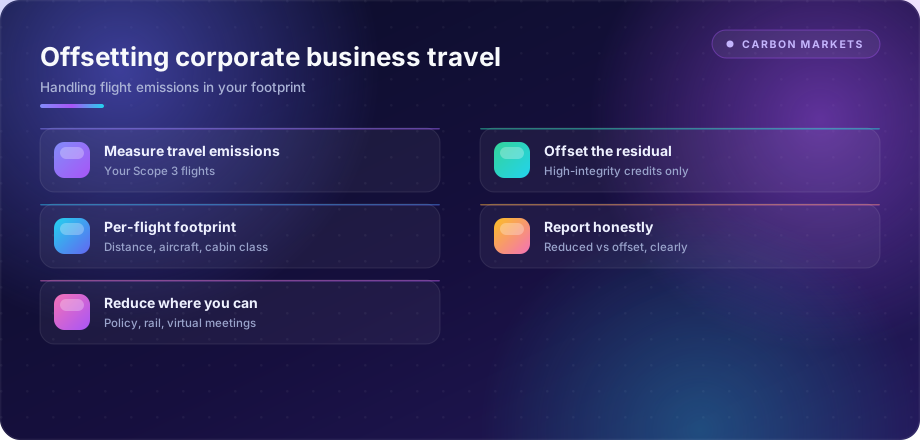
Quick answer: To handle business travel emissions credibly, a company should measure them (they are Scope 3, Category 6), reduce them first through a travel policy, virtual-first meetings, rail and direct economy flights, cut what remains with sustainable aviation fuel where possible, and only then offset the genuine residual with high-quality credits, ideally durable removals for net-zero claims, reporting reductions and offsets separately.
For a lot of companies — consultancies, tech firms, anyone with a sales team on planes — business travel is the emissions line everyone can see. It shows up in ESG reports, in client questionnaires, and in employees' own expectations. Handling it well is less about buying offsets and more about doing five things in the right order.
Business Travel Is Scope 3
First, place it correctly. Flights your staff take are part of your Scope 3 emissions, Category 6 (business travel) under the GHG Protocol — the emissions of your value chain rather than your own buildings or vehicles. That matters because Scope 3 is where most companies' footprints actually sit, and where customers with science-based targets will increasingly ask you to act.
In India, listed companies reporting under SEBI's Business Responsibility and Sustainability Reporting (BRSR) framework disclose Scope 3 emissions as a leadership indicator, and exporters increasingly receive the same question from overseas customers. You cannot manage travel emissions until you count them as yours.
Step 1: Measure
You cannot reduce or offset what you have not measured. Estimate the emissions of your travel from flight data — routes, distances, cabin class — expressed in CO2e. The flight carbon footprint calculator shows how a single trip is estimated; for a company, the same method is applied to every booking.
Practical tips:
- Get booking data from your travel agency or booking tool: origin, destination, cabin class and date for every flight. Most can export it monthly.
- Use the distance-based method with a published factor set and apply it consistently every year.
- Decide on non-CO2 effects and state your choice; including them can nearly double the figure.
- Add hotels and ground travel if you want the full business travel category, not just flights.
Worked example: a 200-person consultancy
A Bengaluru consultancy's travel data for a year shows 1,400 domestic one-way flights averaging 1,300 km, mostly economy, and 120 international return trips, a third of them in business class.
| Travel | Calculation (indicative factors) | CO2 |
|---|---|---|
| Domestic economy | 1,400 × about 120 kg | about 168 tonnes |
| International economy returns | 80 × about 1,000 kg | about 80 tonnes |
| International business returns | 40 × about 2,900 kg | about 116 tonnes |
| Total flights | about 364 tonnes CO2 |
Two findings stand out. International business class is 40 trips but almost a third of the total, and domestic trips under 600 km, which might be replaced by rail or video, are a large share of the domestic count. Those are where the policy should focus.
Step 2: Reduce Before You Offset
Reduction is cheaper and more credible than offsetting. A tonne you never emit is cheaper — and more certain — than a tonne you offset with a credit whose integrity you have to verify, and credible frameworks count reductions, not offsets, toward targets.
A real travel policy
The single biggest lever is a policy that makes travel a decision, not a default. Requiring a short justification for trips, and an approver, quietly eliminates a chunk of low-value travel — the conferences no one remembers, the meetings that could have been calls.
Virtual-first
Not every meeting needs a room. Making video the default for internal and early-stage external meetings, and reserving flights for the moments that genuinely benefit from being there, cuts trips without cutting results.
Rail over short-haul
On routes where rail is competitive, it is dramatically lower-carbon than flying — and often as fast door-to-door once airports are factored in. In India, overnight and fast day trains on routes such as Delhi to Jaipur, Mumbai to Pune or Chennai to Bengaluru are realistic alternatives to short flights.
Fly smarter when you must
For necessary flights: prefer direct routes (connections mean extra take-offs, the most fuel-intensive phase), and travel economy where appropriate (a long-haul business seat can carry around three times the emissions of an economy seat). Combining trips, so one journey covers several meetings, also helps.
A travel policy checklist
- Trips need a stated purpose and an approver above a set distance or cost
- Video is the default for internal meetings and first client meetings
- Rail is the default for routes under a set travel time
- Economy for flights under a set duration; premium cabins by exception
- Direct flights preferred where the fare difference is reasonable
- Quarterly reporting of travel emissions by team, shared with managers
- A target, such as a percentage reduction per employee against a baseline year
Step 3: Cut the Fuel Emission With SAF
For flights you cannot avoid, sustainable aviation fuel — often bought via book-and-claim — reduces the actual aviation emission rather than compensating for it. Under book-and-claim, the company pays for SAF that is used somewhere in the airline network and receives a certificate for the emissions reduction, even though the fuel is not physically in its own employees' flights. It is the closest thing to decarbonising the flight itself, and it counts differently from an offset. See sustainable aviation fuel and CORSIA.
Step 4: Offset the Residual — With Quality
For the travel you cannot avoid, buy high-integrity carbon credits. The temptation is to buy the cheapest available to make the number go away; that is exactly how companies end up with offsets that damage their reputation. A smaller volume of credible, well-rated credits is worth far more than a pile of dubious ones. Use the offset-quality checks before you buy.
For net-zero claims, the expectation is stricter: the residual should be neutralised with durable removals, such as biochar or engineered removals, rather than cheap avoidance credits. This is the carbon neutral vs net zero distinction applied to travel.
In the consultancy example, offsetting 364 tonnes with avoidance credits would cost far less than neutralising it with removals at around US$100 to US$200 a tonne, which is one more reason to reduce the tonnes first.
Step 5: Report Honestly
Finally, say exactly what you did: how much you reduced, how much you addressed with SAF, and how much residual you offset or neutralised, with which credits. Do not fold offsets into your emissions total as if you had cut them — that blurs the line and invites scrutiny. An honest, specific report is a business asset; an inflated claim is a liability.
Why Travel Is "Hard to Abate" in a Net-Zero Plan
Net-zero frameworks distinguish between emissions you can eliminate and those you cannot — yet. Business travel sits firmly in the hard-to-abate camp: there is no clean electric substitute for a long-haul flight today. That does not excuse doing nothing; it changes the order of what you do: reduce, then SAF, then durable removals for the residual.
What Not to Do
The failure mode is skipping straight to cheap offsets and declaring travel "carbon neutral." That is the pattern regulators and customers now challenge. Offsets have a role — for the residual, with high-integrity credits — but they are not a substitute for reducing the trips and cutting the fuel emission.
Frequently Asked Questions
Are business travel emissions Scope 1, 2 or 3? Scope 3, Category 6 — they are part of your value-chain emissions, not your direct operations or purchased energy.
How do companies calculate business travel emissions? From booking data: each flight's distance and cabin class multiplied by published emission factors, added up across the year, with hotels and ground travel included if the full category is reported.
How do companies offset business travel? By measuring flight emissions, reducing where possible, then buying and retiring high-integrity carbon credits (or SAF via book-and-claim) for the residual.
Should we reduce travel or just offset it? Reduce first — it is cheaper and more credible; offset only the emissions you cannot avoid.
What is the biggest lever to cut travel emissions? A travel policy that makes trips a deliberate, justified decision rather than an automatic choice.
Is rail really better than flying? On routes where rail is competitive, it is dramatically lower-carbon and often comparable door-to-door once airport time is included.
What is book-and-claim for sustainable aviation fuel? A way to pay for the emissions benefit of SAF used in the network without the fuel physically being in your specific flight.
Can I just offset business travel to reach net zero? No — credible net zero requires reducing emissions first and neutralising only the residual, ideally with durable removals, not cheap offsets.
How should we report travel offsets? Separately from reductions — state what was cut versus compensated, and with which credits, to avoid greenwashing claims.
Buying carbon credits or measuring travel and freight emissions? DSTechnoverse works on the data and integrity side of carbon — footprint measurement, project screening, registry and eligibility verification, and defensible reporting. See our CORSIA carbon credit services and data analytics. We are based in Indore, Madhya Pradesh and work across India and internationally.
Apply as a carbon credit buyer or seller
Talk to our team, or start with the complete carbon credits guide.