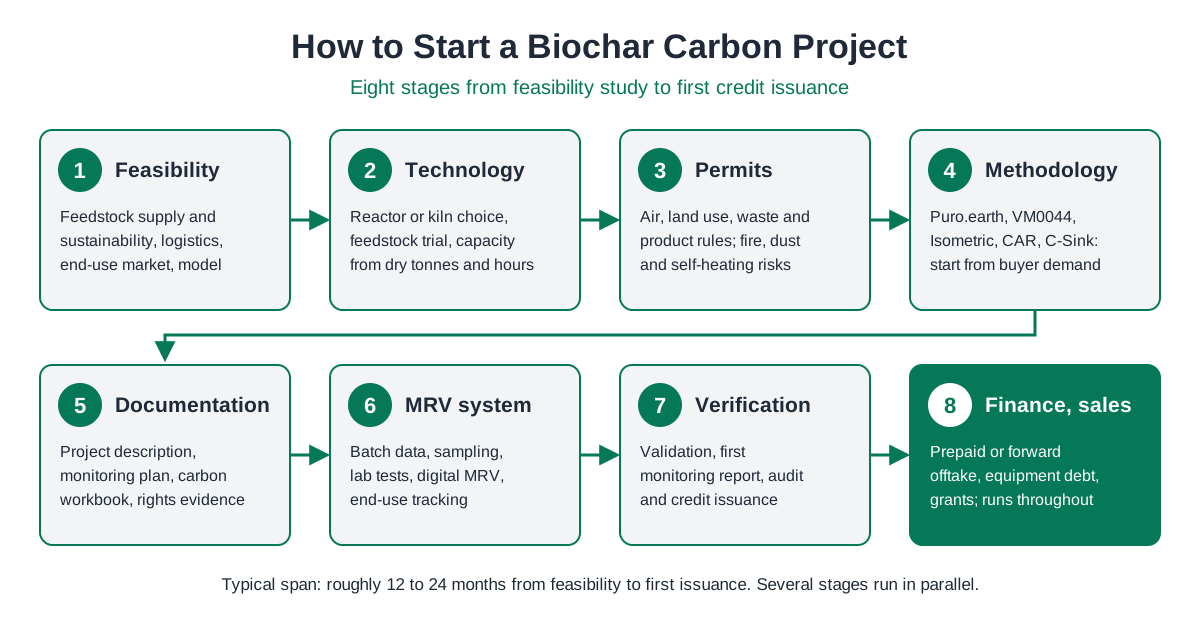
Quick answer: How to start a biochar carbon project comes down to sequence: you prove a sustainable, affordable feedstock supply and a durable end use. Then you size the right pyrolysis technology, secure permits and pick a methodology your buyers accept. You build the MRV system before the first batch, pass validation and verification, and finance the plant with a mix of offtake, equipment debt and grants. Expect roughly 12 to 24 months from feasibility to first issuance.
Knowing how to start a biochar carbon project is mostly about doing the unglamorous work in the right order. Stalled projects rarely fail on the science. They fail because feedstock dries up off-season, the biochar has nowhere credible to go, or the monitoring data cannot be reconstructed for the verifier.
This guide assumes the basics. Biochar is stable carbon made by heating biomass with little oxygen, and a credit represents the share of that carbon expected to persist in soil or materials, net of project emissions. For that background, read our pillar guide to biochar carbon credits and our overview of carbon removal credits.
What follows is a step-by-step playbook for biochar project development, ending with a worked feasibility example and a risk register you can adapt.
How to Start a Biochar Carbon Project: The Roadmap at a Glance
Several stages overlap; the order matters more than the exact duration.
| Stage | Key output | Typical decision gate |
|---|---|---|
| 1. Feasibility study | Feedstock map, end-use plan, credit and revenue model | Is there a bankable project at all? |
| 2. Technology and capacity | Supplier shortlist, mass and energy balance, site layout | Which kiln or reactor, at what throughput? |
| 3. Permits and safety | Air, land use, fire and waste approvals, safety case | Can you legally build and operate? |
| 4. Methodology and registry | Chosen standard, eligibility check, gap list | Which buyers can you sell to? |
| 5. Project documentation | Project design document, monitoring plan, calculation workbook | Ready for listing and validation? |
| 6. MRV system | Data flows, sampling plan, lab contracts, digital tools | Can every tonne be evidenced? |
| 7. Validation, verification, issuance | Validation report, first monitoring report, issued credits | Are credits in your account? |
| 8. Financing and sales | Offtake, debt, grants, sales channels | Is the project funded through to steady state? |
Financing runs alongside everything: developers often negotiate an offtake during stages 2 to 5, because the offtake helps fund the plant.
Step 1: Run a Biochar Feasibility Study That a Buyer Would Accept
A biochar feasibility study answers three questions in order: is there enough sustainable, affordable feedstock, is there a durable end use, and do the numbers work at realistic credit prices? Weak answers to the first two cannot be rescued by the third.
Feedstock Availability
Start with a feedstock map within a realistic collection radius. For bulky crop residues it is usually short; for woody residues and processing by-products such as sawdust, shells and husks, it can be wider.
For each candidate feedstock, record:
- Annual quantity available, on a dry-matter basis, not as-received weight.
- Seasonality: when it is available, and how long it can be stored without degrading or self-heating.
- Current fate and moisture: burned, left to rot, used as fuel or fodder, and how wet it is at collection.
- Competing uses and price, today and in three years.
- Contractability: can you sign multi-year supply agreements?
A feedstock available for three months a year forces large stockpiles or long idle periods, so many projects plan a secondary feedstock from the start.
Feedstock Sustainability
Every serious methodology restricts feedstock. Common themes are no biomass from deforestation or converted natural ecosystems, limits on dedicated crops, and no diversion of residues from uses that already store carbon or displace fossil fuel. Puro.earth, for example, publishes separate Biomass Sourcing Criteria.
Treat sustainability as evidence, not assertion. For each source, plan to hold supplier declarations, origin records, delivery notes with weights, and where relevant, a short assessment of what happened to the residue before your project. Buyers running a carbon credit quality assessment will ask for exactly this.
Logistics
Logistics is where feasibility studies are most often optimistic. Model the full inbound chain (collection, baling or chipping, transport, storage, drying, feeding) and the outbound chain for biochar to farms, blenders or material producers.
Remember that transport emissions are deducted from the removal, so long haulage hurts both cost and credit volume, and that biochar is dusty and can self-heat in large piles, so storage needs proper design.
End-Use Market
A credit depends on evidence that the biochar reached a qualifying sink, so the end-use market is part of the carbon model, not just a sales channel. Options include farm soil application, blending into compost or fertiliser, and incorporation into concrete or other materials.
For each end use, check that your methodology recognises it, that you can trace the biochar to the point of storage, and that customers will accept the tracking burden. A farmer happy to take free biochar may be less happy to sign application declarations. Get letters of intent where you can.
Feasibility Study Contents
A study that buyers and lenders take seriously contains:
- Feedstock inventory with sustainability evidence.
- Site options and a two-way logistics model.
- Technology options with mass and energy balances.
- End-use plan with a tracking approach.
- A preliminary carbon calculation under candidate methodologies.
- A financial model with sensitivities.
- A permitting and safety screen and a first risk register.
Step 2: Choose the Pyrolysis Technology and Capacity
The pillar guide compares continuous industrial reactors, batch kilns and flame-curtain kilns at a high level. For project development, the questions are more specific.
What to Ask a Technology Supplier
| Question | Why it matters |
|---|---|
| Which feedstocks has this unit run on commercially, at what moisture and particle size? | Performance on wood chips says little about rice straw or manure |
| What is the measured biochar yield and carbon content on comparable feedstock? | Drives credit volume directly |
| How are process temperature and residence time measured and logged? | Methodologies and verifiers need continuous or batch-level process data |
| How are pyrolysis gases combusted, and what are measured methane and particulate emissions? | Methane leakage is deducted and can erode a large share of the removal |
| What auxiliary fuel and electricity does start-up and steady operation need? | Project emissions and operating cost |
| What availability (uptime) has been achieved at reference sites? | Annual tonnes depend on hours run, not nameplate capacity |
| Which certified projects already use this unit? | Reduces technical and methodology risk |
Ask for reference site visits and a trial run on your actual feedstock, with lab analysis of the output.
Sizing Capacity
Size the plant from the bottom up. Start from secure dry feedstock tonnes per year, divide by realistic operating hours (allowing for maintenance, feedstock gaps and start-up losses), and you have the required feed rate per hour. Compare that with supplier nameplate figures, and assume you will not reach nameplate in the first year.
Distributed units reduce haulage but multiply operators, sampling points and data streams; a central plant does the reverse. Some methodologies now have modules for distributed and small-scale production, but fixed validation, verification and registry costs still favour large or aggregated projects.
Step 3: Secure Permits and Design for Safety
Permitting is jurisdiction-specific, but the categories are similar almost everywhere:
- Air emissions: a permit or consent covering flue gas, particulates and odour; confirm the source category with the regulator.
- Land use and planning: zoning for an industrial thermal process, traffic and noise.
- Waste status of feedstock: residues classed as waste can trigger waste-handling permits and questions about the biochar's status.
- Product rules for biochar: if you sell biochar as a soil improver or fertilising product, product regulations and contaminant limits apply in addition to carbon methodology requirements.
- Fire, explosion and occupational safety: pyrolysis gas is flammable, biochar dust can be combustible and fresh biochar can self-heat. A safety case covering gas handling, quenching, dust, storage piles and emergency response is standard practice.
- Water: quench water and any condensate need a discharge or disposal route.
Region notes, where verified:
- United States: air permits are generally handled by state agencies. On the demand side, the USDA Natural Resources Conservation Service has a conservation practice standard for soil carbon amendments (Code 336) that covers biochar, implemented state by state. It is a technical standard, not a grant, but it can support farm cost-share applications.
- European Union: the EU Fertilising Products Regulation includes a component category for pyrolysis and gasification materials, relevant if you plan to sell biochar as a CE-marked fertilising product. Separately, the European Commission adopted a certification methodology for biochar carbon removal under the Carbon Removals and Carbon Farming (CRCF) Regulation in February 2026, which certification schemes can apply to have recognised. Check the current status before you design around it.
- India: industrial units typically need consent to establish and consent to operate from the relevant State Pollution Control Board under air and water legislation. Fire safety approvals are separate and are usually handled locally.
- Middle East: requirements differ by emirate and country; confirm environmental permits and civil defence (fire) approvals with the local authorities early, because these can set the critical path.
Start the permitting screen during feasibility; a nine-month permit should shape the schedule, not surprise you after equipment is ordered.
Step 4: Choose a Methodology and Registry
The methodology sets your eligibility rules, calculation, lab regime, end-use evidence and, largely, your buyers. Our guide to biochar carbon credit methodologies compares them in detail; here the focus is on choosing.
| Programme | Biochar methodology (status checked November 2026) | Points for developers |
|---|---|---|
| Puro.earth | Biochar Methodology, Edition 2025 (version 2 listed in its document library) | Moved biochar to a 200+ year durability label (CORC200+). The ICVCM has confirmed Puro.earth as a CCP-eligible programme; assessment of its biochar methodology was still in progress |
| Verra (VCS) | VM0044 Biochar Utilization in Soil and Non-Soil Applications, v1.2 | Approved by the ICVCM as meeting the Core Carbon Principles in August 2025. v1.2 added an investment analysis requirement for additionality and applies to new biochar production facilities |
| Isometric | Biochar Production and Storage protocol | Version 1.0 approved by the ICVCM in 2025, with later versions adding modules including one for distributed and small-scale production. Reported as approved for CORSIA eligibility |
| Climate Action Reserve | U.S. and Canada Biochar Protocol, v1.0 | ICVCM approved. Geographically limited to the United States and Canada |
| Carbon Standards International | Global C-Sink and Global Artisan C-Sink, linked to the European Biochar Certificate | Artisan pathway designed for small kilns and smallholders; Global C-Sink applied to the ICVCM in 2026 |
Versions and approvals change frequently, so confirm the live documents before you commit.
How to choose:
- Start from the buyer. Ask target buyers which programmes they accept. Some large removal buyers have strong preferences; some corporate buyers now ask for the ICVCM CCP label described in our guide to the Core Carbon Principles.
- Check eligibility in detail. Feedstocks, start dates, facility age and permitted end uses differ.
- Check additionality requirements. VM0044 v1.2 requires an investment analysis. Our explainer on additionality covers what that involves.
- Compare the measurement burden. Sampling frequency, lab test lists and end-use evidence vary, and they drive ongoing cost.
- Consider compliance labels. If you hope to sell to airlines under CORSIA, the programme and methodology must be eligible for the relevant compliance period and the units will need host-country authorisation and corresponding adjustments. See our CORSIA carbon credits guide and the corresponding adjustments explainer.
- Compare registry practicalities. Fees, timelines and issuance frequency matter; see our comparison of carbon credit registries and guide to carbon credit standards.
Run the gap analysis against a primary methodology and a fallback, so you know the cost of switching if a buyer asks.
Step 5: Prepare the Biochar Project Registration Documents
Biochar project registration follows a similar pattern across programmes, though templates differ. Expect to prepare:
- Project description: proponent, location, technology, feedstocks, end uses, boundary, start date and crediting period.
- Eligibility and additionality demonstration: evidence that the project meets the methodology's conditions, including any investment analysis or regulatory surplus test.
- Quantification workbook: the full calculation from feedstock to net removals, with every parameter, its source and its unit, and a clear distinction between fixed defaults and monitored values.
- Monitoring plan: what is measured, how, how often, by whom, with what equipment, calibration and QA/QC.
- Feedstock sourcing evidence: supply contracts, sustainability declarations, assessment of previous use.
- Safeguards: stakeholder consultation, permits and a grievance mechanism.
- Ownership and rights: evidence that you hold the right to the removals and that no other party (a feedstock supplier, an end user, or a fertiliser blender) will claim the same carbon.
Write the monitoring plan with the people who will run the plant. Plans written by consultants alone often require readings operators cannot take, which become non-conformities at verification.
Step 6: Design the MRV System Before the First Batch
Monitoring, reporting and verification is where biochar projects win or lose credits. Our pillar guide explains why biochar is comparatively measurable; the developer's job is to make that measurement cheap, complete and auditable.
Data You Need to Capture
| Data stream | Typical evidence | Common failure |
|---|---|---|
| Feedstock inputs | Weighbridge tickets, supplier, origin, moisture | Weights recorded wet, moisture never measured |
| Process conditions | Temperature and residence time logs per batch or continuously | Sensor gaps, unsynchronised clocks |
| Energy and fuel use | Meter readings, fuel purchase records | Start-up fuel omitted |
| Emissions | Stack or kiln emission tests, methane measurements where required | Tests on a different feedstock or operating mode |
| Biochar output | Batch weights, moisture, batch IDs | Batches mixed before sampling |
| Lab results | Organic carbon, H/Corg, contaminants per the product standard | Too few samples, chain of custody unclear |
| Transport | Distances, vehicle type, fuel | Assumed distances with no records |
| End use | Delivery notes, application declarations, GPS, photos, blending records | Biochar disappears into a blending plant with no onward tracking |
Sampling and Laboratory Design
Design sampling to be representative, not convenient: a written procedure, composite samples at defined intervals, retained reference samples, sealed containers and a chain-of-custody record to an approved laboratory.
Agree turnaround times with the lab before production starts, because a slow lab can delay your monitoring report by months. Where production is variable, a short statistical review of early results helps set a sensible sampling frequency; our statistical research and data analysis team does this kind of work.
Digital MRV
Digital MRV platforms record batches, lab results and deliveries with timestamps, photos and GPS, and some connect to reactor controllers, reducing transcription errors. Our guide to digital MRV covers how to evaluate one.
Whatever tool you use, three rules apply:
- Every tonne of credited carbon must trace back to a batch, a lab result and an end-use record.
- Raw data must be kept, not only summaries.
- Someone in the team must own data quality, with a monthly internal check rather than a scramble before verification.
End-Use Tracking in Practice
End-use tracking is often the weakest link, especially when biochar goes through distributors or blenders. Options include signed application declarations, contractual reporting obligations on blenders, site visits and, in some methodologies, soil sampling. Build these into biochar sales contracts from the start.
Step 7: Validation, Verification and First Issuance
Validation checks that your design and monitoring plan conform to the methodology; verification checks that what you monitored happened and was calculated correctly. Some programmes combine them for the first period.
A typical sequence looks like this:
- Listing: submit the project description, which may go to public comment.
- Appoint a validation and verification body (VVB) whose scope covers your methodology.
- Validation audit and registration: document review, site visit, findings and report.
- First monitoring period: produce and monitor under the approved plan.
- Monitoring report and verification: data, lab results, end-use evidence and calculation, audited with a site visit.
- Issuance: credits issued into your account after any deductions.
Before the first verification, run an internal dry-run audit. Pull a random sample of credited batches and try to trace each one from feedstock ticket to end-use record. If you cannot do it in an afternoon, neither can the verifier.
Keep the first monitoring period short but representative. A first issuance proves the project works, which often matters more than volume.
Step 8: Finance the Project
A biochar business plan has to fund equipment, working capital for feedstock stockpiles, the certification process and the period before first issuance. Most projects combine several of the sources below.
| Source | How it works | What the provider will want |
|---|---|---|
| Pre-purchase or prepayment offtake | A buyer pays part of the contract value in advance for future credits | Feasibility study, named methodology, technology references, delivery schedule, security or step-in rights |
| Forward offtake without prepayment | Agreed price and volume, paid on delivery | Same diligence, less security; useful as collateral for lenders |
| Equipment finance or leasing | Lender or supplier finances the reactor against the asset | Supplier track record, offtake, maintenance plan |
| Project debt | Lender finances against projected cash flows | Contracted revenue, insurance, conservative base case |
| Equity | Investors take ownership in exchange for capital | Management team, pipeline, return on risk |
| Grants and public programmes | Non-dilutive funds for innovation, agriculture, waste or climate | Fit with programme objectives, reporting capacity |
Much biochar demand is forward. CDR.fyi's biochar market snapshot published in September 2025 reported about 3.04 million tonnes of biochar removal contracted from 2022 to mid-2025, against roughly 0.66 to 0.68 million tonnes delivered, and noted that the median purchase was small (90 tonnes in 2024). A few large offtakes drive volume while many buyers take small lots; plan for both.
In an offtake, focus on delivery schedules, shortfall remedies, who bears methodology-change and approval risk, and undelivered volumes. Our article on offtake agreement terms was written for CORSIA units but most of its clauses apply directly. For pricing context, see our guide to biochar carbon credit prices; for routes to market, see how to sell carbon credits and our carbon credit marketplace.
Worked Example: A Feasibility Model for a Pyrolysis Plant for Carbon Credits
The figures below are illustrative only. They show the structure of a pyrolysis plant for carbon credits feasibility model, not expected results for any real project. Your methodology will define the exact equations and default factors, and real yields and carbon contents must come from trials and lab data.
Inputs
| Parameter | Illustrative value |
|---|---|
| Feedstock secured (as received) | 12,000 tonnes per year of mixed agricultural and wood residue |
| Moisture at receipt | 25% |
| Dry feedstock | 12,000 × 0.75 = 9,000 dry tonnes per year |
| Operating hours | 7,500 hours per year |
| Required feed rate | 9,000 ÷ 7,500 = 1.2 dry tonnes per hour |
| Biochar yield | 25% of dry feedstock |
| Organic carbon content of biochar | 70% |
| Persistence fraction applied by methodology | 0.80 (illustrative; depends on methodology, H/Corg and soil temperature) |
| Project emissions (energy, transport, kiln methane, application) | 450 tCO2e per year |
| Other deductions required by the programme | 5% (illustrative) |
Calculation
- Biochar produced: 9,000 × 0.25 = 2,250 tonnes per year.
- Organic carbon in biochar: 2,250 × 0.70 = 1,575 tonnes of carbon.
- Converted to CO2: 1,575 × 44 ÷ 12 = 5,775 tCO2.
- Persistent carbon: 5,775 × 0.80 = 4,620 tCO2.
- Less project emissions: 4,620 − 450 = 4,170 tCO2e.
- Less other deductions: 4,170 × 0.95 ≈ 3,960 net credits per year.
In this example, roughly 0.44 credits are generated per dry tonne of feedstock (3,960 ÷ 9,000), or about 1.76 credits per tonne of biochar (3,960 ÷ 2,250). Each ratio is sensitive to yield, carbon content and persistence, which is why trial runs matter.
Revenue Sensitivity
| Credit price scenario (illustrative) | Annual credit revenue at 3,960 credits |
|---|---|
| US$100 per tonne | US$396,000 |
| US$140 per tonne | US$554,400 |
| US$180 per tonne | US$712,800 |
These are not forecasts or quotes; base your case on current buyer conversations. Be cautious adding biochar sales revenue, since many projects give biochar away cheaply to secure the end use.
Break-Even Check
A simple test is the break-even credit price:
Break-even price = (annual operating cost + annual debt service + annual MRV, audit and registry cost − biochar and energy revenue) ÷ net credits per year.
If, purely for illustration, those annual costs net of other revenue came to US$400,000, the break-even price would be US$400,000 ÷ 3,960 ≈ US$101 per credit. If uptime falls to 6,000 hours in year one, output drops by 20% to about 3,170 credits and the break-even rises to about US$126. A plan that only works at high prices and full uptime is not one a lender will fund.
Biochar Project Risk Register
Use a risk register from the feasibility stage onwards and update it at each decision gate. The table below is a starting template.
| Risk | Likelihood | Impact | Mitigation | Owner |
|---|---|---|---|---|
| Feedstock shortfall or price rise | Medium | High | Multi-year supply contracts, secondary feedstock, storage capacity | Supply lead |
| Lower biochar yield or carbon content than modelled | Medium | High | Pre-purchase trial on actual feedstock, conservative base case | Technical lead |
| Kiln methane or other emissions higher than assumed | Medium | Medium to high | Emission testing, gas combustion design, operator training | Plant manager |
| Low plant uptime in first year | High | Medium | Commissioning period in the model, spares, supplier service agreement | Plant manager |
| Permit delays | Medium | High | Early regulator engagement, permit screen in feasibility | Project director |
| Fire, dust or self-heating incident | Low to medium | High | Safety case, quenching, dust control, pile monitoring, insurance | Safety officer |
| Methodology revision or loss of approval | Medium | Medium to high | Track consultations, contract clauses on methodology change, fallback methodology | Carbon lead |
| End-use evidence incomplete | Medium | High | Tracking obligations in sales contracts, digital MRV, spot checks | MRV lead |
| Buyer default or price renegotiation | Low to medium | High | Diversified offtake, credit checks, security on prepayments | Commercial lead |
| Host-country authorisation not granted (compliance sales) | Medium | Medium | Sell voluntary units unless authorisation is secured; price accordingly | Commercial lead |
Review it quarterly and share a summary with lenders and offtakers, who also increasingly consult third-party carbon credit ratings.
How to Start a Biochar Carbon Project Without the Common Mistakes
- Ordering equipment before securing feedstock. The supply chain decides whether the reactor runs.
- Choosing a methodology on credits per tonne alone. It is of little use if your buyers do not accept it.
- Under-budgeting MRV. Lab tests, sampling labour, data management and audits recur every period.
- Signing an offtake without methodology-change and double-counting clauses. Methodologies are revised often, and blenders or soil carbon schemes can claim the same carbon.
For company set-up and commercial structure, our guide on how to start a carbon credit business in India applies well beyond India.
How DSTechnoverse Helps
DSTechnoverse supports biochar developers through the stages in this playbook. We prepare feasibility studies and carbon and revenue models, run methodology gap analyses across the main programmes, and draft project descriptions, monitoring plans and calculation workbooks. We help design MRV systems, sampling plans and data workflows, prepare projects for validation and verification, and connect developers with buyers through our marketplace. For buyers, we carry out due diligence on biochar projects before an offtake is signed. See our carbon credit services, including support for developers in the United States and the UAE and Middle East, or contact us to discuss your project.
Frequently Asked Questions
How long does it take to start a biochar carbon project?
From the start of a feasibility study to first credit issuance, most projects take roughly 12 to 24 months. Feasibility usually takes two to four months, equipment procurement and commissioning several months more, and registration and validation can run in parallel. The first monitoring period and verification add further months. Permits and feedstock contracts are the most common sources of delay, so start both early.
What should a biochar business plan include?
A biochar business plan should cover feedstock supply and cost, technology and capacity, end-use markets and tracking, the chosen methodology and registry, the carbon calculation, capital and operating costs, revenue from credits, biochar and energy, financing structure, permits, the management team and a risk register. Lenders and offtakers will also want sensitivity analysis on yield, uptime and credit price.
What is the minimum viable size for a biochar carbon project?
There is no fixed minimum. Fixed costs for validation, verification, registry fees and MRV systems make very small stand-alone projects hard to justify, which is why small kilns are usually aggregated into one project. Some methodologies now include modules for distributed and small-scale production. Model your fixed certification costs against expected annual credits to find your own threshold.
Which methodology should I use for a biochar project?
Start with the programmes your target buyers accept, then check eligibility for your feedstock, technology, facility age and end use. Common options include Puro.earth's biochar methodology, Verra VM0044, Isometric's Biochar Production and Storage protocol, the Climate Action Reserve protocol for the United States and Canada, and Carbon Standards International's Global C-Sink. Confirm current versions before committing.
Do I need to sign an offtake before building the plant?
It is not mandatory, but it is common. A forward offtake, particularly one with a prepayment, can finance part of the equipment and gives lenders contracted revenue to lend against. Buyers will usually expect a feasibility study, a named methodology, a credible technology supplier and an end-use tracking plan before they commit, so prepare these first.
Can an existing pyrolysis plant generate carbon credits?
Sometimes. Eligibility depends on the methodology. VM0044 v1.2, for example, applies to new biochar production facilities and requires an investment analysis for additionality, while other programmes have their own start-date and additionality rules. An existing plant should run a gap analysis against several methodologies before investing in documentation or MRV upgrades.
What lab tests does a biochar project need?
Most methodologies require tests for organic carbon content, hydrogen to organic carbon ratio (H/Corg), moisture, ash and contaminants such as heavy metals and polycyclic aromatic hydrocarbons, usually against the European Biochar Certificate or a similar product standard. Sampling frequency and laboratory requirements differ between programmes, so design the sampling plan around your chosen methodology.
How is biochar end use tracked for credits?
Developers record where each batch goes: delivery notes, quantities, dates, application declarations from farmers or material producers, GPS coordinates and photographs. Where biochar is blended into compost, fertiliser or construction materials, contracts should oblige the blender to report onward use. Digital MRV platforms make this evidence easier to collect and verify.
Can biochar credits be used for CORSIA?
Only if the programme and methodology are eligible for the relevant CORSIA compliance period and the units carry host-country authorisation with corresponding adjustments. Isometric's biochar protocol has been reported as approved for CORSIA eligibility, but approvals are periodically updated by ICAO, so check the current list of eligible units before planning compliance sales.
Developing a biochar or carbon removal project, or buying removal credits? DSTechnoverse supports project developers with feasibility, methodology selection, MRV design and certification, and helps buyers with due diligence and portfolio decisions. See our carbon market advisory or talk to our team.
Related services
Related articles
- Biochar Carbon Credit Methodologies Compared: Puro.earth, Verra VM0044, Isometric and Global C-Sink
- Biochar Carbon Credit Price: What Drives It, Who Buys and How to Achieve More
- Biochar Carbon Credits: How Biochar Carbon Removal Works
- Carbon Removal Credits Explained: Types, Durability, Net-Zero Use and CORSIA