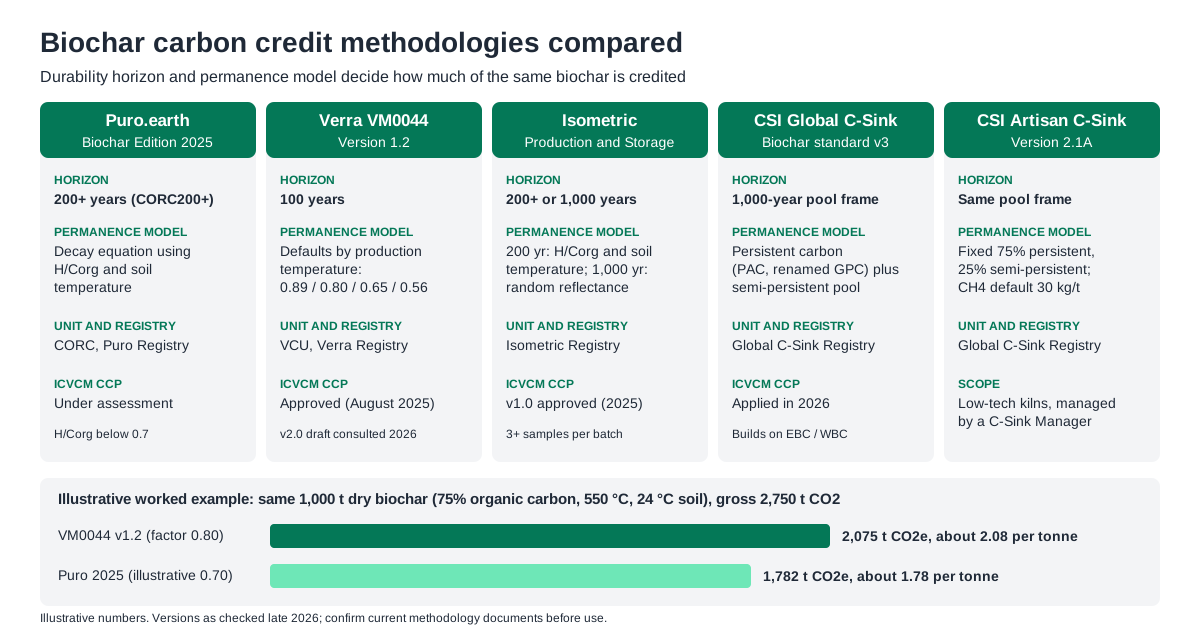
Quick answer: A biochar carbon credit methodology is the rulebook that decides which biochar counts, how its stored carbon is measured and how much of it is credited. The main options in 2026 are Puro.earth's Biochar Methodology (Edition 2025, credited as CORC200+), Verra's VM0044 (v1.2, 100-year permanence), Isometric's Biochar Production and Storage Protocol (200-year and 1,000-year pathways), and Carbon Standards International's Global Biochar C-Sink and Global Artisan C-Sink standards. They differ most in how they model permanence, so the same tonne of biochar can earn noticeably different credit volumes depending on which one you use.
The biochar carbon credit methodology you register under shapes your credit volume, monitoring cost, buyer pool and timeline. Biochar credits pay for biomass carbon locked into a stable char and stored in soil or materials, calculated as stored carbon times a persistence factor minus emissions; our pillar guide to biochar carbon credits covers those basics. This article answers one narrower question: how do the methodologies differ, and which fits your project?
Why the Biochar Carbon Credit Methodology Choice Matters
Every biochar standard starts from the same physics. Where they part company is in the judgement calls physics cannot settle on its own:
- How long is "durable"? One standard credits carbon expected to remain after 100 years, another after 200 years, another offers a 1,000-year pathway. A longer horizon credits a smaller fraction but makes a stronger claim.
- How is persistence estimated? Default tables by production temperature, an equation driven by the measured hydrogen to organic carbon (H/Corg) ratio and soil temperature, or laboratory proxies such as random reflectance or hydropyrolysis.
- What counts as an emission? Transport, kiln methane, energy use, embodied emissions and displaced feedstock uses are treated differently.
- Who verifies, and on which registry? This affects cost, cash flow and which buyers accept the credits.
The wrong choice can leave a project with fewer credits than its business plan assumed, a monitoring system the verifier will not accept, or credits its target buyer excludes. For how removals differ from avoidance credits, see carbon removal credits explained.
The Biochar Methodologies in Scope
Several methodologies were revised or in consultation during 2026. These are the versions we checked against programme publications; confirm the current version before designing a project.
| Programme | Methodology and current version | Status notes (as checked, late 2026) |
|---|---|---|
| Puro.earth (Puro Standard) | Biochar Methodology, Edition 2025 (now at version 2) | Approved 12 June 2025; CORC200+ label; version 2 allows retail use under conditions |
| Verra (Verified Carbon Standard) | VM0044 Methodology for Biochar Utilization in Soil and Non-Soil Applications, v1.2 (27 June 2025) | Draft v2.0 consulted 15 July to 17 August 2026; v1.2 applies until replaced |
| Isometric | Biochar Production and Storage Protocol (v1.4 on the registry), with separate storage modules | Reviewed at least every two years; modules for soil, shallow burial and built materials |
| Carbon Standards International (CSI) | Global Biochar C-Sink Standard (v3 current) | Version 4 went to public consultation until 30 April 2026 |
| Carbon Standards International (CSI) | Global Artisan C-Sink Standard (v2.1A) | For low-tech producers in low, lower-middle and upper-middle income countries |
| Climate Action Reserve | U.S. and Canada Biochar Protocol (v1.0) | Regional, North America only |
The European Biochar Certificate (EBC) and World Biochar Certificate (WBC) are product certification schemes, not crediting methodologies; see below.
Biochar Methodology Comparison: The Full Side-by-Side Table
This is the core of the biochar methodology comparison. It summarises how the four most widely used crediting methodologies handle each design question. Detail is paraphrased from programme documents and independent summaries, so treat it as a map rather than a substitute for the current text.
| Dimension | Puro.earth Biochar (Edition 2025) | Verra VM0044 v1.2 | Isometric Biochar Production and Storage | CSI Global Biochar C-Sink (v3) | CSI Global Artisan C-Sink (v2.1A) |
|---|---|---|---|---|---|
| Scope | Industrial and commercial biochar production with soil and non-soil end uses | Pyrolysis, gasification or biomass boiler producing biochar used in soil or non-soil applications; torrefaction and hydrothermal carbonisation excluded | Biochar production plus a storage module (soil, shallow subsurface burial or built materials) | Industrial biochar producers, processors and users, with C-sinks tracked to final application | Smallholder and artisanal producers using low-tech kilns, organised by an accredited C-Sink Manager |
| Eligible feedstocks | Sustainably sourced biomass meeting the methodology's sustainability criteria | Biogenic waste biomass only, not purpose-grown, domestically sourced; agricultural residue removal capped at 50 percent without supporting evidence; forestry feedstock needs deforestation-free evidence | Must meet Isometric's Biomass Feedstock Accounting Module, including counterfactual fate of the biomass | Biomass meeting EBC or WBC feedstock lists | Locally available residues and woody biomass within the artisan rules |
| Production technology | Facility audited to show it can make biochar meeting the H/Corg limit; emissions accounted in a life-cycle assessment | "High-tech" needs gas recovery or combustion, at least 70 percent heat use, pollution controls and electronic temperature recording; low-tech allowed for soil use only | Batches under one month; emissions by direct continuous measurement or regular emissions testing | EBC or WBC-compliant production; methane per system default for endorsed system providers or measured | Flame-curtain (Kon-Tiki type) or similar low-tech units; size caps of 100 m³ a year per C-Sink Farmer and 1,500 m³ a year per Artisan Pro |
| Durability horizon | 200 years and more, labelled CORC200+ | 100 years | More than 200 years; a 1,000-year pathway is also offered | Persistent carbon framed over a 1,000-year frame, split into persistent and semi-persistent pools | Same pool logic as Global C-Sink |
| Permanence method | Revised decay equation driven by H/Corg and soil temperature; random reflectance reporting encouraged but not yet used in quantification | Default permanence factor by production temperature class (0.89, 0.80, 0.65, or 0.56 for low-tech with unknown temperature) | 200-year: conservative reading of Woolf et al. (2021) using H/Corg and soil temperature; 1,000-year: random reflectance against an inertinite benchmark, credited at one standard deviation below the mean | Persistent aromatic carbon (PAC, more than 1,000 years) and semi-persistent carbon (SPC); v4 renames PAC as geologically persistent carbon (GPC) | Registered with fixed fractions (75 percent PAC, 25 percent SPC for certified artisan biochar) |
| Key lab parameters | Organic carbon, H/Corg below 0.7, plus product quality tests | Dry mass, moisture each batch, organic carbon at least annually, H/Corg at or below 0.7 each batch for soil use; non-soil requires at least 50 percent carbon | At least three independent samples per batch; H/Corg, organic carbon, and reflectance for the 1,000-year pathway | EBC or WBC analytical methods; hydropyrolysis for PAC | Simplified sampling under the artisan rules, organised by the C-Sink Manager |
| Project emissions | Full cradle-to-grave life-cycle assessment | Production and application emissions; methane default of 0.049 t CH4 per tonne biochar for unlisted or unknown kilns | Measured or tested production emissions plus supply chain and storage emissions | Producers and processors account for and offset their own emissions | Default kiln methane of 30 kg CH4 per tonne of dry biochar for Kon-Tiki and soil-pit kilns |
| Leakage | Assessed within sustainability and LCA rules | Activity-shifting leakage set to zero; transport round trips over 200 km quantified as leakage | Activity-shifting, market and ecological leakage, with market leakage from biomass required | Handled through feedstock rules and emissions accounting | Handled through feedstock rules |
| Uncertainty and buffer | Confidence thresholds built into the persistence equation | No buffer pool; reversal risk treated as negligible after verified application | Conservative estimates and sensitivity analysis; 5 percent materiality | Built into pool fractions | Built into fixed fractions |
| Verification and issuance | Third-party facility audit, then output audits; CO2 Removal Certificates (CORCs) | Validation and verification by a Verra-approved body; Verified Carbon Units (VCUs) | Ex-post issuance after storage is verified; site visit at least at first validation or verification | Validation (with public consultation) and verification, with CERES-CERT endorsed as auditor | C-Sink Manager registers producers and batches; certifier verifies the Manager's training and monitoring |
| Registry | Puro Registry | Verra Registry | Isometric Registry | Global C-Sink Registry, with endorsed traders such as Carbonfuture | Global C-Sink Registry |
| ICVCM status | 2022 v3.0 and 2025 v2.0 under assessment | v1.2 CCP-approved (August 2025) | v1.0 CCP-approved (August 2025); later versions under assessment | Applied for assessment in 2026 | Covered by the CSI application |
| Typical project size | Single industrial plants, often hundreds to thousands of tonnes of biochar a year | Industrial plants; low-tech facilities possible for soil use | Industrial plants with strong measurement capacity | Industrial plants and processors | Many small kilns aggregated under one manager |
Three things stand out: the durability horizon ranges from 100 to 1,000 years; VM0044 v1.2 alone sets permanence from temperature-class defaults rather than measured H/Corg; and Isometric is the most measurement-heavy, which suits large, well-instrumented plants.
How Each Methodology Handles Permanence
Permanence is where the money is: a 0.1 change in the permanence factor moves credited volume by 10 percent of gross carbon.
The H/Corg Ratio as the Common Starting Point
The molar H/Corg ratio measures how fully the biomass was carbonised. Lower values mean more condensed aromatic carbon and slower decay. Every methodology here sets an eligibility ceiling of 0.7 for soil use, following the long-standing EBC limit. Beyond that gate, the methods diverge.
Verra VM0044 v1.2: Temperature-Class Defaults Over 100 Years
VM0044 v1.2 assigns a default permanence factor based on production temperature for soil applications, using a 100-year accounting horizon:
| Production condition (VM0044 v1.2, soil use) | Permanence factor |
|---|---|
| Above 600 °C | 0.89 |
| 450 to 600 °C | 0.80 |
| 350 to 450 °C | 0.65 |
| Low-tech, temperature unknown | 0.56 |
H/Corg works as a pass or fail gate (at or below 0.7 every batch), not as a multiplier. This is simple and predictable, but it does not reward an H/Corg of 0.2 over 0.6 within a class, and it does not penalise warm soils.
The draft v2.0 published for consultation in July 2026 would change this significantly. According to independent summaries of the draft, permanence would become a function of measured H/Corg for each production lot and the mean annual soil temperature at the application site, based on the Woolf et al. (2021) regression, with default values ranging from about 0.94 in soils below 7.5 °C to about 0.54 in soils above 22.5 °C. If adopted in that form, projects applying biochar in hot climates (much of India, the Middle East and the southern United States) would see lower factors than under v1.2. The draft may change, but do not assume v1.2 factors will last a full crediting period.
Puro.earth Edition 2025: A 200-Year Decay Equation
Puro's Edition 2022 credited biochar as CORC100+ following Woolf et al. (2021). Edition 2025 moved to a 200-year horizon and labels biochar removals as CORC200+, which Puro describes as removal for "several centuries". Quantification uses a revised, open-source decomposition equation in which H/Corg and soil temperature are the main inputs, with confidence thresholds intended to be conservative for the voluntary market.
Puro has chosen not to claim millennial durability yet. It encourages reporting of random reflectance, but those measurements do not currently change the credited quantity, and it has said Edition 2025 may receive minor revisions as the science develops.
Isometric: Two Pathways, 200 Years and 1,000 Years
Isometric requires long-duration storage of more than 200 years. Its 200-year option combines H/Corg and soil temperature using a conservative interpretation of Woolf et al. (2021). Its 1,000-year option uses the random reflectance of the biochar, compared with inertinite as a proxy for geologically stable carbon, based on Sanei et al. (2024), and credits that portion at one standard deviation below the mean. In both cases only the highly durable fraction of the organic carbon generates credits.
Random reflectance measures how strongly polished biochar particles reflect light; particles above about 2 percent behave like inertinite, a coal component stable over geological timescales. The method is promising but still debated.
CSI Global C-Sink: Persistent and Semi-Persistent Pools
Carbon Standards International takes a different conceptual route. Rather than one decay curve, it splits biochar carbon into a persistent aromatic carbon (PAC) pool, measured by hydropyrolysis as carbon in clusters of more than seven aromatic rings and expected to last more than 1,000 years, and a semi-persistent carbon (SPC) pool expected to decay within the first 1,000 years. The less persistent fraction can serve as a temporary sink, for example to compensate methane emissions. Version 4 renames PAC as geologically persistent carbon (GPC) and adds an upper persistence class with a 90 percent GPC pool for highly condensed biochar.
For artisan biochar, CSI simplifies this: certified artisan biochar is registered with a 75 percent PAC fraction and a 25 percent SPC fraction, which avoids the cost of hydropyrolysis on every batch.
Where the European Biochar Certificate Fits
The European Biochar Certificate, with the World Biochar Certificate for producers outside Europe, certifies the biochar product and production process: feedstock lists, production requirements, sampling rules and limits for contaminants such as polycyclic aromatic hydrocarbons and heavy metals. The latest guideline we found is version 10.5E, dated 14 August 2025. From version 10.1 it uses certification classes (version 10.2 lists EBC-FeedPlus, EBC-Feed, EBC-AgroOrganic, EBC-Agro, EBC-Urban, EBC-ConsumerMaterials and EBC-BasicMaterials). The 9.x guidelines set H/Corg below 0.7 and O/Corg below 0.4, and version 10.2 tightened H/Corg to below 0.4 for the feed classes.
In a credit project the EBC or WBC certificate proves the product is safe for its end use, supplies accepted laboratory methods and, for CSI's standards, forms the production foundation. Crediting programmes reference product standards rather than replacing them, so budget for both.
Project Emissions, Methane and Leakage Compared
After permanence, the second biggest source of difference between methodologies is what gets deducted.
Methane From the Kiln
Pyrolysis can release methane if gases are not fully combusted. This is the single largest risk for low-tech production.
- VM0044 v1.2 applies a default of 0.049 tonnes of CH4 per tonne of biochar for unlisted or unknown kiln types. At the global warming potential used in the methodology, that equals about 1.37 tonnes of CO2e per tonne of biochar, which can wipe out most of the credit for a low-tech kiln. High-tech systems that combust pyrolysis gases avoid this default.
- Global Artisan C-Sink uses a default of 30 kg CH4 per tonne of dry biochar for Kon-Tiki and soil-pit kilns, and the methane must be compensated by carbon sinks that deliver a net cooling effect within 20 years. Improved kiln designs with measured lower emissions can document a lower figure.
- Isometric requires direct continuous measurement or regular emissions testing.
- Puro includes methane and other process emissions in its life-cycle assessment.
Transport and Energy
VM0044 v1.2 treats feedstock and biochar transport through a leakage test: round trips under 200 km count as zero, longer trips must be quantified using the CDM transport tool. The v2.0 draft would reclassify feedstock transport as a project emission. Puro and Isometric include transport in life-cycle or supply chain accounting from the start.
Feedstock Leakage
Leakage asks whether using a feedstock causes emissions elsewhere, for example if a residue used for animal bedding or fuel must now be replaced by something more carbon intensive. VM0044 v1.2 sets activity-shifting leakage at zero and treats biomass diversion as negligible, relying on its waste-only feedstock rule. Isometric requires market leakage from biomass to be assessed explicitly. Additionality rules also differ: the VM0044 v2.0 draft would drop the positive list and make investment analysis mandatory (see additionality in carbon credits).
How Net Removal Is Computed Under Each Methodology
All methodologies share one skeleton:
Net removal (t CO2e) = dry biochar mass × organic carbon fraction × 44/12 × permanence or persistence factor − project emissions − leakage − any uncertainty deduction
What differs is how each term is filled. VM0044 v1.2 takes the permanence factor from a temperature-class table, deducts production and application emissions, and treats transport over a 200 km round trip as leakage. Puro Edition 2025 applies its 200-year equation and deducts cradle-to-grave life-cycle emissions. Isometric uses its 200-year or 1,000-year pathway with batch-level sampling and measured emissions. CSI registers persistent and semi-persistent pools separately, with producer emissions offset.
Worked Example: One Biochar, Two Methodologies
To show how much the choice matters, here is the same year of production run through VM0044 v1.2 and Puro.earth Edition 2025. All numbers are illustrative. A real project would use measured data and the exact current equations. In particular, the Puro factor below is an illustrative value of the kind a 200-year equation gives for this biochar in warm soil, not an output of Puro's published equation.
The Project
- 1,000 tonnes of dry biochar in the year, from forestry and sawmill residues
- Continuous pyrolysis at about 550 °C, gases combusted, heat used for drying (qualifies as high-tech under VM0044 v1.2)
- Organic carbon content 75 percent, H/Corg 0.35 (passes the 0.7 gate under both)
- Applied to cropland with a mean annual soil temperature of about 24 °C, typical of central India
- Feedstock collected within a 60 km radius (120 km round trip); biochar delivered to farms an average of 150 km away (300 km round trip)
Step 1: Gross Carbon as CO2
1,000 t × 0.75 × 44/12 = 2,750 t CO2 before any permanence factor. This is identical under both methodologies.
Step 2: Apply Each Methodology
| Step | VM0044 v1.2 | Puro Edition 2025 (illustrative) |
|---|---|---|
| Permanence or persistence factor | 0.80 (450 to 600 °C class, 100 years) | 0.70 (illustrative 200-year factor for H/Corg 0.35 in 24 °C soil) |
| Credited stored carbon | 2,750 × 0.80 = 2,200 t | 2,750 × 0.70 = 1,925 t |
| Production energy and process emissions | −60 t | −60 t |
| Kiln methane (measured, gases combusted) | −30 t | −30 t |
| Feedstock transport | 0 (round trip under 200 km, treated as zero leakage) | −8 t (in life-cycle assessment) |
| Biochar transport | −15 t (round trip over 200 km, quantified as leakage) | −15 t |
| Application emissions | −20 t | −20 t |
| Amortised embodied emissions of plant (where required) | Not included in this example | −10 t |
| Net removal | 2,075 t CO2e | 1,782 t CO2e |
| Credits per tonne of biochar | about 2.08 | about 1.78 |
Why the Results Differ
The gap is about 293 tonnes, or 14 percent. Almost all of it comes from permanence: VM0044 v1.2 uses a 100-year horizon with no soil temperature adjustment, while Puro Edition 2025 uses 200 years and adjusts for warm soil. Emissions differences add only about 18 tonnes.
This does not mean VM0044 "pays more". A CORC200+ claims at least two centuries of storage; a VM0044 VCU claims 100-year permanence. Buyers who want the longer claim may pay more per tonne, which can outweigh a 14 percent volume difference. See biochar carbon credit prices.
What If the Inputs Change?
| Change | Effect under VM0044 v1.2 | Effect under Puro Edition 2025 |
|---|---|---|
| Same biochar applied in a 10 °C soil (northern Europe, Canada) | No change: factor stays 0.80 | Factor rises because decay is slower in cool soil, narrowing or closing the gap |
| Pyrolysis temperature raised above 600 °C, H/Corg falls to 0.2 | Factor rises to 0.89 (+247 t) | Factor rises as H/Corg falls |
| Same plant registered under the VM0044 v2.0 draft as consulted | Factor would follow measured H/Corg and soil temperature; draft defaults for soils above 22.5 °C are around 0.54 | Not applicable |
| Low-tech kiln, temperature not recorded | Factor 0.56 and, if kiln type is unlisted, methane default of about 1.37 t CO2e per tonne of biochar | Life-cycle assessment would capture measured methane; kiln must still meet facility requirements |
The last row matters for small producers: 1,000 × 0.75 × 44/12 × 0.56 = 1,540 t gross, less about 1,372 t of default methane, leaves very little. Artisan projects therefore usually choose the Global Artisan C-Sink, which registers biochar with fixed 75 percent persistent and 25 percent semi-persistent fractions and a 30 kg CH4 per tonne kiln default, or invest in measured emission factors.
Verification, Registries and Buyer Labels
The registry and labels attached to a credit affect who will buy it as much as the quantification does.
ICVCM Core Carbon Principles
In August 2025 the Integrity Council for the Voluntary Carbon Market approved three biochar methodologies for the CCP label: Verra VM0044 v1.2, Isometric Biochar Production and Storage v1.0, and Climate Action Reserve's U.S. and Canada Biochar Protocol v1.0. Puro's 2022 and 2025 biochar methodologies and later Isometric versions were still under assessment when we checked, and CSI submitted an application in 2026. Approval is version-specific, so check the ICVCM Core Carbon Principles status of your exact version before signing offtakes.
CORSIA and Article 6
CORSIA demand depends on which programmes ICAO lists as eligible for each compliance period, plus host-country authorisation and corresponding adjustments. ICAO's Technical Advisory Body assessed applications in 2026 for the 2027 to 2029 period, so check the current ICAO list, our explainer on CORSIA eligible emissions units and the complete CORSIA carbon credits guide. Article 6 authorisation is a host-country decision; see Article 6 of the Paris Agreement.
Registries
Each programme issues on its own registry (Puro, Verra, Isometric and Global C-Sink), with different data depth and retirement mechanics; see our carbon credit registries comparison. Batch-level data from digital MRV makes any of them easier.
How to Choose a Biochar Carbon Credit Methodology
There is no universally best methodology. Match your production technology, end use, geography and buyers:
- Define your production profile. Industrial plant or many small kilns? Can you record temperature electronically and combust pyrolysis gases? Artisanal kilns usually fit the Global Artisan C-Sink.
- Map your end use. Soil is covered everywhere. Concrete and building materials are covered by VM0044 (high-tech only, at least 50 percent carbon), Isometric's built-environment module and CSI's construction standard.
- Check feedstock against each rulebook. VM0044 v1.2 requires domestic waste biomass; Isometric requires counterfactual and market leakage analysis.
- Estimate credits under each candidate, using your organic carbon, H/Corg and local soil temperature. Warm-climate projects should model the VM0044 v2.0 draft as a downside.
- Price your monitoring. Batch sampling, life-cycle assessments and verification can eat a large share of revenue for small projects.
- Talk to target buyers early about the registries, durability claims and labels (CCP, CORSIA, Article 6) they require.
- Check timing, including registration, validation and verifier availability.
- Keep options open by designing data systems that could satisfy the stricter methodology.
Quick Decision Guide
| Project profile | Methodologies usually shortlisted | Why |
|---|---|---|
| Industrial plant, buyers want CCP-labelled credits | VM0044 v1.2, Isometric v1.0 | CCP-approved versions as of late 2025 |
| Industrial plant, buyers want multi-century durability claims | Puro Edition 2025, Isometric | 200-year and 1,000-year claims |
| Warm-climate soil application | Compare all; model the VM0044 v2.0 draft | Soil temperature affects most newer methods |
| Many smallholder kilns in a lower or middle income country | Global Artisan C-Sink | Designed for low-tech production and aggregation |
| Biochar into concrete or building materials | VM0044 high-tech, Isometric built-environment module, CSI construction standard | Non-soil pathways with specific rules |
| North American project | Add Climate Action Reserve U.S. and Canada Biochar Protocol | Regional protocol with CCP approval |
Next comes feasibility and a project plan: see how to start a biochar carbon project. Buyers can apply the same lens through our carbon credit quality assessment and carbon credit standards guides; sellers can read how to sell carbon credits or use our carbon credit marketplace. For other engineered removals, see direct air capture.
How DSTechnoverse Helps
We support biochar developers and buyers on the technical and data side of methodology choice. For developers, that means modelling credit volumes under each candidate methodology using your lab data and local soil temperatures, checking feedstock and production against applicability rules, designing MRV and sampling plans a verifier can follow, and preparing documentation for validation. For buyers, we review methodology versions, permanence assumptions, lab evidence and registry records before purchase. See our carbon credit services, our data analytics support for monitoring data, or contact us to discuss a project.
Frequently Asked Questions
What is a biochar carbon credit methodology?
It is the rulebook a crediting programme uses to decide which biochar projects qualify and how many credits they earn. It sets eligible feedstocks, production requirements, laboratory tests, the permanence model, which emissions and leakage must be deducted, and how monitoring and verification work. Puro.earth, Verra VM0044, Isometric and Carbon Standards International each publish their own, and they are revised regularly.
Which biochar methodology gives the most credits per tonne?
There is no fixed answer, because it depends on your biochar and soil temperature. Methods with a 100-year horizon and temperature-class defaults, such as VM0044 v1.2, often credit a larger fraction than 200-year methods for warm-climate projects. But the units make different durability claims, and a smaller volume of longer-durability credits may sell for more. Model your own data under each candidate.
What is the difference between Puro.earth and Verra VM0044 for biochar?
Puro Edition 2025 credits biochar over 200 years (CORC200+) using a decay equation based on H/Corg and soil temperature, with life-cycle emissions accounting. VM0044 v1.2 uses a 100-year horizon with default permanence factors by production temperature and a leakage test for transport over 200 km. VM0044 v1.2 holds the ICVCM CCP label; Puro's methodologies were under assessment when we checked.
What is the biochar permanence factor?
It is the fraction of the biochar's organic carbon that a methodology expects to remain stored over its chosen time horizon. It is multiplied by the carbon content to give credited carbon. Depending on the methodology it comes from production temperature defaults, an equation using the H/Corg ratio and soil temperature, random reflectance measurements, or fixed pool fractions.
Why does the H/Corg ratio matter so much?
The molar ratio of hydrogen to organic carbon shows how fully the biomass was carbonised. A lower ratio means more stable, condensed carbon that decays more slowly. Most standards require H/Corg below 0.7 for soil use, and newer methodologies use the measured value directly in the persistence equation, so a better-carbonised biochar earns more credits per tonne.
Can small artisanal kilns earn biochar carbon credits?
Yes, mainly through Carbon Standards International's Global Artisan C-Sink standard, which is designed for low-tech producers in low and middle income countries. Producers are registered and monitored by an accredited C-Sink Manager, production is capped per producer, and a default methane value applies to flame-curtain kilns. Other methodologies are possible, but their methane defaults and measurement requirements are harder for small kilns.
Is the European Biochar Certificate a carbon credit standard?
No. The European Biochar Certificate, and its sister World Biochar Certificate, certify the biochar product and production process, including feedstock, contaminant limits and laboratory methods. Crediting programmes rely on these product standards for quality, and CSI's Global C-Sink standards build directly on them, but the EBC itself does not issue carbon removal credits.
Which biochar methodologies have the ICVCM CCP label?
In August 2025 the ICVCM approved Verra VM0044 v1.2, Isometric Biochar Production and Storage v1.0 and Climate Action Reserve's U.S. and Canada Biochar Protocol v1.0. Puro.earth's biochar methodologies and later Isometric versions were still under assessment when we checked, and Carbon Standards International applied in 2026. Approval is version-specific, so confirm the status on the ICVCM website before contracting.
Can I switch methodologies later?
Usually only with effort. Switching normally means a new registration or validation under the new programme, and you cannot claim the same tonne twice. Credits already issued stay on their original registry. If you expect to switch, design your data system from the start to capture everything the stricter methodology needs, such as batch-level sampling, measured emissions and application geolocation.
Developing a biochar or carbon removal project, or buying removal credits? DSTechnoverse supports project developers with feasibility, methodology selection, MRV design and certification, and helps buyers with due diligence and portfolio decisions. See our carbon market advisory or talk to our team.