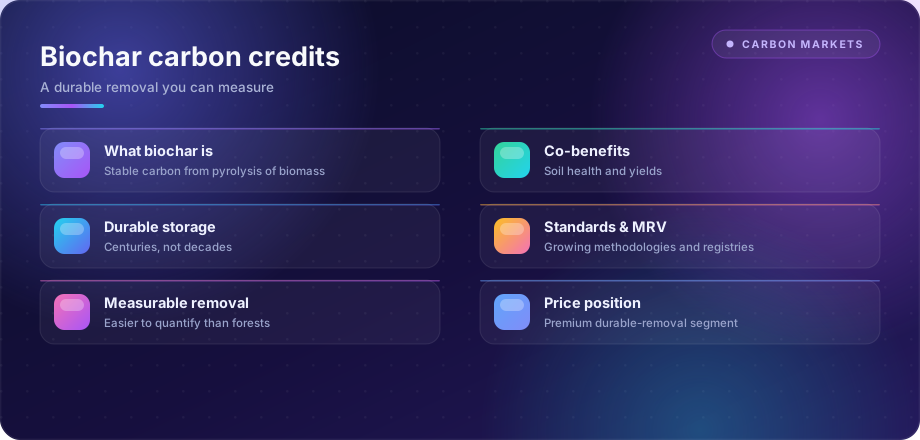
Quick answer: Biochar carbon credits, also called biochar carbon removal (BCR) credits, are issued for carbon that is locked into biochar, a stable charcoal made by heating biomass without oxygen, and kept out of the atmosphere for a long time, usually by mixing it into soil or durable materials. One credit equals one tonne of CO2 removed. A tonne of biochar typically yields somewhere around 1.5 to 2.5 credits after deducting project emissions, depending on its carbon content and stability.
As buyers shift from avoidance credits toward genuine removals, one option keeps rising up the shortlist: biochar. It sits in a sweet spot — more durable than a forest, far cheaper than direct air capture, and available at scale today. This guide explains how biochar carbon credits work, how they are calculated, which standards issue them, what they sell for, and what it takes to develop a biochar project in India.
What Biochar Actually Is
Biochar is a stable, charcoal-like solid made by heating biomass — crop residues, forestry waste, other organic matter — in a low-oxygen process called pyrolysis, typically at 350 to 700 °C. Left to decompose or burned in the field, that biomass would release its carbon back to the atmosphere within a few years. Converted to biochar, a large part of the carbon is locked into aromatic ring structures that soil microbes break down only very slowly.
Biochar is not the same as ordinary charcoal used as fuel. The product is made to a specification, tested in a laboratory and, for carbon credits, must be used in a way that does not burn it. Charcoal sold as fuel releases its carbon and earns no credit.
How Biochar Removes Carbon
The removal logic has three steps:
- Plants absorb CO2 from the atmosphere as they grow, storing the carbon in biomass.
- Pyrolysis converts that biomass into biochar (stable carbon), plus gases and oils (often burned to provide the process heat, or captured as energy).
- The biochar is stored durably, usually by applying it to agricultural soil, or by using it in concrete, asphalt or other long-lived materials.
The credit is for the carbon that ends up in step 3 and stays there. Biochar is a removal, not avoidance: it takes carbon that was already in the natural short cycle and moves part of it into a long-lived store.
Why Durability Is the Headline
The defining question for any removal is permanence — how long the carbon stays out of the atmosphere. This is where biochar shines:
| Removal type | Typical durability | Relative cost |
|---|---|---|
| Forestry (avoidance/ARR) | Decades, reversible | Low–mid |
| Biochar | Centuries | Mid |
| Direct air capture + storage | Millennia | High |
A forest can burn; biochar, once in the ground or in a durable use, does not simply reverse. That century-scale durability is why biochar is treated as a serious removal rather than a temporary store — and why it commands a premium over avoidance credits.
Durability is not identical for every biochar, though. It depends mainly on how fully the biomass was carbonised, measured by the molar hydrogen to organic carbon ratio (H/Corg). A lower ratio means more stable, ring-shaped carbon. Most standards require H/Corg below 0.7, and better-carbonised chars made at higher temperatures reach 0.3 or lower. Soil temperature also matters: biochar decays faster in warm soils, so the same char is credited slightly less in a hot climate such as most of India than in northern Europe.
How Biochar Carbon Credits Are Calculated
Every standard uses the same basic logic, with its own parameters:
Net removal = carbon stored × persistence − project emissions − leakage
- Carbon stored: dry mass of biochar delivered to its end use × organic carbon content × 44/12 (to convert carbon to CO2).
- Persistence factor: the share of that carbon expected to remain after a set time horizon, usually 100 years, calculated from H/Corg and soil temperature. Some standards also offer longer horizons using more detailed lab analysis.
- Project emissions: fuel and electricity for collecting and transporting feedstock, running the pyrolysis unit, and transporting and applying the biochar, plus any methane or other gases released by the kiln.
- Leakage: emissions caused elsewhere by the project, for example if the feedstock was previously used for something else and now has to be replaced.
Worked Example
A project produces 1,000 tonnes of dry biochar in a year from rice husk and cotton stalk and applies it to farmland.
| Step | Calculation | Result |
|---|---|---|
| Organic carbon content | Lab analysis | 70% |
| Carbon in biochar | 1,000 t × 0.70 | 700 t C |
| Persistence factor (100 years, warm soils, H/Corg about 0.4) | From the standard's formula | 0.75 |
| Persistent carbon | 700 × 0.75 | 525 t C |
| Converted to CO2 | 525 × 44/12 | 1,925 t CO2 |
| Project emissions | Feedstock transport 40, pyrolysis and kiln gases 60, biochar transport and application 25 | −125 t CO2e |
| Leakage | Feedstock was burned in the field, so no displaced use | 0 |
| Net removal | 1,800 t CO2e, about 1.8 credits per tonne of biochar |
The numbers are illustrative. Real projects use measured values for every term, and some standards deduct a buffer or uncertainty discount. The two levers that matter most are carbon content and the H/Corg ratio, which is why kiln control and consistent feedstock pay off directly in credits.
Standards and Methodologies for Biochar Credits
For a detailed side-by-side comparison of Puro.earth, Verra VM0044, Isometric and the C-Sink standards, see biochar carbon credit methodologies compared.
Several crediting programmes issue biochar removal credits. They differ in the time horizon, the lab tests required, how end use is tracked and which buyers prefer them.
| Programme | Biochar methodology | Notes |
|---|---|---|
| Puro.earth | Puro Standard biochar methodology | Issues CO2 Removal Certificates (CORCs); one of the most established biochar registries |
| Verra (VCS) | VM0044, biochar utilisation in soil and non-soil applications | Large registry; units can carry CORSIA or Article 6 labels where the conditions are met |
| Isometric | Biochar production and storage protocol | Detailed, science-led protocol with emphasis on measurement |
| Carbon Standards International | Global C-Sink and Global Artisan C-Sink, linked to the European Biochar Certificate | Includes a pathway for small artisanal kilns and smallholder producers |
Most programmes rely on the European Biochar Certificate (EBC) or the World Biochar Certificate product standards for lab testing and quality limits. Methodologies are revised regularly, so check the current version before designing a project. Our guide to carbon credit standards compares the main registries more broadly.
What Biochar Carbon Credits Sell For
For dated, sourced price points and contract structures, see our biochar carbon credit price guide.
Biochar credits trade far above avoidance credits such as renewable energy or cookstoves, because they are durable removals. In recent years, published market data and offtake announcements have commonly put biochar removal credits somewhere around US$100 to US$200 per tonne, with wide variation.
What moves the price:
- Standard and registry: some buyers will only buy from particular programmes.
- Durability claim: a longer, well-evidenced persistence horizon supports a higher price.
- Volume and contract type: multi-year offtake agreements often trade below spot but give the developer certainty.
- Co-benefits and story: smallholder income, residue-burning reduction and soil benefits attract some buyers.
- Labels: units with host-country authorisation for Article 6 or CORSIA can command a further premium where demand exists.
For how prices are formed more generally, see carbon credit prices explained and carbon credit price in India.
Biochar Carbon Credits in India
India has unusual potential for biochar. Large volumes of crop residue are burned in the field every year, most visibly paddy straw in Punjab and Haryana, contributing to winter air pollution in north India. Converting surplus residue into biochar addresses both the carbon and the air quality problem.
Common Indian feedstocks include:
- Rice straw and rice husk
- Cotton stalks and mustard stalks
- Maize cobs and stalks
- Coconut shells and coir waste
- Sugarcane trash, and bagasse where it is surplus to boiler fuel
- Invasive woody species cleared in restoration work, such as Prosopis juliflora or Lantana camara
Three questions decide whether a feedstock qualifies. Is it genuinely a residue or waste, not grown for the purpose on land that should stay in food production or forest? Is it surplus, or will using it force someone else to burn coal or cut wood instead? Can its collection and origin be documented? Standards exclude feedstock from deforestation or primary forest.
Projects intended for international buyers that want Article 6 or CORSIA labels need host-country authorisation and corresponding adjustments. See Article 6 of the Paris Agreement and CORSIA-eligible projects in India. Developers should also follow how the Indian Carbon Market and CCTS treat removal activities, since domestic rules are still developing.
Biochar End Uses and How Each Is Credited
Where the biochar ends up decides whether it earns credits and how many.
| End use | Credited? | What must be shown |
|---|---|---|
| Applied to agricultural soil | Yes, the most common route | Quantity, location and date of application for each lot |
| Blended into compost or organic fertiliser, then applied | Yes, if the final application is tracked | The blend ratio and where the blended product was applied |
| Mixed into concrete, mortar or asphalt | Yes, under methodologies that cover non-soil uses | The product, quantity and that the material will not be burned or landfilled with combustion |
| Used in animal feed or bedding, then spread with manure | Sometimes, depending on the standard | That the char ends up in soil, not burned with the manure |
| Filtration or water treatment media | Only if the spent material is then stored durably | The fate of the spent media |
| Burned as fuel, including as "charcoal briquettes" | No | — |
Soil application is the simplest to evidence. Construction uses are attractive because the biochar is locked into a material for decades, but the volumes and supply chains take longer to set up.
Pyrolysis Technologies Compared
| Technology | Scale | Biochar quality | Emissions control | Typical use |
|---|---|---|---|---|
| Continuous industrial pyrolysis reactor | Hundreds to thousands of tonnes a year | High and consistent | Gases burned for heat; good control | Commercial projects selling to international buyers |
| Batch retort kiln | Tens to hundreds of tonnes a year | Good if well operated | Moderate; gases can be flared | Small enterprises, cooperatives |
| Flame-curtain (open cone) kiln | A few tonnes per kiln per year, many kilns | Variable, depends on the operator | Low-cost; methane risk if poorly run | Artisanal and smallholder projects |
| Gasifier producing char as a by-product | Varies | Often lower carbon content, higher ash | Good | Energy-first projects with char as a side stream |
The choice is a trade-off between capital cost and credit quality. Industrial units cost more but produce consistent biochar with a low H/Corg ratio, capture the energy and make monitoring easier. Artisanal programmes reach many farmers at low cost but need training, procedures and spot checks on every kiln.
Laboratory Tests for Biochar Credits
Every lot, or a statistically defined sample of production, is tested to confirm both the carbon claim and product safety. The exact limits come from the product standard used, such as the European Biochar Certificate.
| Parameter | Why it is tested |
|---|---|
| Organic carbon content | The main input to the credit calculation |
| H/Corg molar ratio | Measures carbonisation and sets the persistence factor; usually must be below 0.7 |
| O/Corg molar ratio | A second stability check, commonly required below 0.4 |
| Ash and moisture | Needed to calculate dry mass and carbon correctly |
| Polycyclic aromatic hydrocarbons (PAHs) | Contaminants formed in poor pyrolysis; limited for soil use |
| Heavy metals (lead, cadmium, chromium, nickel, mercury and others) | Soil safety; feedstock-dependent |
| pH, nutrients and other agronomic properties | For product labelling and agronomic claims |
Samples must be taken and handled according to the standard's sampling plan, and tested by a qualified laboratory. A single "certificate of analysis" from the kiln supplier is not enough.
Economics of a Biochar Project
A biochar project usually has three possible revenue streams:
- Carbon credits, the largest for most projects selling to removal buyers.
- Biochar sales as a soil amendment or input to compost and fertiliser, although many credit projects give the biochar to farmers at low or no cost to secure the end use.
- Energy from the process heat or gases, used on site or for drying.
The main costs are feedstock collection and transport, the pyrolysis equipment and its operation, labour, laboratory testing, monitoring and record-keeping, validation and verification, registry fees, and the cost of getting biochar to farms. Feedstock logistics is often the cost that decides viability, because crop residues are bulky and seasonal. Projects close to concentrated residue sources, such as rice mills, cotton ginning areas or sugar mills, start with an advantage.
Fixed certification and verification costs make very small projects hard to justify on their own. Aggregating several kilns, villages or production sites into one project is the usual answer.
Biochar Compared With Other Carbon Removal Methods
For the wider market, see carbon removal credits explained.
| Method | How carbon is stored | Durability | Measurability | Maturity |
|---|---|---|---|---|
| Afforestation and reforestation | Trees and soils | Decades, at risk from fire and land-use change | Moderate, modelled from sampling | Mature, large supply |
| Soil carbon management | Soil organic matter | Years to decades, reversible | Hard and costly to measure | Developing |
| Biochar | Stable carbon in soil or materials | Centuries | Good: measured in the lab per batch | Commercial, growing fast |
| Enhanced rock weathering | Carbonate minerals and dissolved bicarbonate | Very long | Difficult: measured in soils and water over time | Early commercial |
| Bioenergy with carbon capture and storage (BECCS) | CO2 injected underground | Very long | Good: metered injection | Early, few projects |
| Direct air capture with storage | CO2 injected underground | Very long | Good | Early, expensive |
Biochar's advantage is that it combines long durability with a removal that is measured batch by batch at a moderate cost, and it can be built at many scales, from village kilns to industrial plants. Its limits are feedstock supply, the logistics of getting biochar into soils, and a durability that, while long, is modelled rather than geological.
From Idea to First Credits: A Typical Timeline
| Stage | Typical duration |
|---|---|
| Feedstock study, technology choice and business plan | 2 to 4 months |
| Equipment procurement, installation and commissioning | 3 to 9 months, depending on technology |
| Project documentation, registration and validation | 3 to 6 months, partly in parallel with construction |
| First production period with full monitoring | Often 6 to 12 months |
| First verification and issuance | 2 to 4 months after the monitoring period |
Many developers sign an offtake agreement, sometimes with an advance payment, before the plant is built, because it helps finance the equipment. Buyers usually expect a feasibility study, a named standard, an experienced technology supplier and a credible plan for end-use tracking before committing.
How to Develop a Biochar Carbon Project
The full developer playbook, with a feasibility example and risk register, is in how to start a biochar carbon project.
- Feedstock assessment. Map available residues, their current fate, seasonality, collection costs and sustainability. Seasonal residues need storage or a mix of feedstocks to keep a kiln running all year.
- Technology choice. Continuous industrial pyrolysis units give consistent biochar, capture process energy and control emissions. Batch kilns are cheaper but need careful operation. Flame-curtain kilns used by artisanal producers are low cost but need strict procedures to keep methane and quality under control.
- Standard selection. Choose the programme your target buyers prefer and whose methodology fits your scale and end use.
- Project design. Write the project description, the monitoring plan and the calculation, then register the project and have it validated by an accredited validation and verification body.
- Production with monitoring. Record feedstock quantities and origin, kiln temperatures or operating logs, and biochar output for every batch.
- Sampling and lab testing. Test representative samples for carbon content, H/Corg and O/Corg ratios, ash, moisture, polycyclic aromatic hydrocarbons and heavy metals against the product standard's limits.
- End-use tracking. Record where every lot goes: the farm or plant, quantity, date, method of application, with GPS points and photographs. Mixing biochar into compost or fertiliser before application is common and must also be tracked.
- Verification and issuance. The verifier checks production, lab results, end use and the calculation before the registry issues credits.
- Sales. Sell through offtake agreements, brokers, marketplaces or directly to buyers building removal portfolios.
Our guide on how to start a carbon credit business in India covers the business side, and how to sell carbon credits in India covers the buyer side.
Integrity and MRV
Biochar's integrity case is comparatively strong because the removal is measurable. Unlike below-ground forest carbon, the quantity of carbon in a batch of biochar can be characterised in the lab, and the process is a discrete, verifiable industrial step. The main diligence questions are:
- Feedstock sustainability: is it a genuine residue, and is its origin documented?
- Durability of the end use: is the biochar really applied to soil or locked into a material, and never burned?
- Kiln emissions: especially methane from simple kilns, which can erode a large share of the removal if not controlled.
- Conservative quantification: measured carbon content and H/Corg, realistic soil temperature, complete project emissions.
- No double counting: the same tonne must not also be claimed by a fertiliser company, a farmer's soil carbon project or a construction product declaration.
Digital monitoring tools, such as app-based logging of batches and end uses with photos and GPS, are increasingly used to make this evidence cheaper to collect and easier to verify. For the wider quality framework, see how to evaluate carbon offset quality and carbon credit ratings.
Due Diligence Checklist for Biochar Credit Buyers
Before buying biochar credits, a buyer should be able to answer:
- Which programme and methodology version issued the credits, and is the project registered and verified?
- What is the feedstock, where does it come from, and what would have happened to it otherwise?
- What pyrolysis technology was used, and how were kiln emissions measured or estimated?
- What were the lab results for carbon content, H/Corg and contaminants, and how were samples taken?
- Where was the biochar applied or stored, and how is that evidenced?
- Which persistence horizon and soil temperature were used in the calculation?
- Have any of the same tonnes been claimed by another party, such as a fertiliser or construction product?
- Does the unit carry any Article 6 authorisation or CORSIA label you need, and is the corresponding adjustment evidenced?
A seller who can provide this as a documented package is a seller whose credits are likely to stand up to scrutiny later.
The Co-Benefits Buyers Like
Biochar is unusual in that the removal often comes with a productive use. Applied to soil, it can improve water retention, reduce the need for fertiliser, and lift yields — so the same tonne of stored carbon also delivers agricultural benefit. Results vary with soil type and crop, and are usually strongest on poor, acidic or sandy soils. In India, reducing open burning of crop residues brings an air quality benefit as well. These co-benefits strengthen the development story behind the credit and make biochar attractive to buyers who want more than a number.
Common Mistakes in Biochar Projects
- Treating biochar as charcoal: selling some output as fuel while claiming credits for all of it.
- Inconsistent feedstock: changing feedstock without re-testing, so the lab results no longer represent the product.
- Poor end-use records: bags handed to farmers with no record of where they were applied.
- Ignoring kiln methane: especially in artisanal production, where a poorly run batch can emit enough methane to cancel much of the removal.
- Overstating persistence: using a temperate-climate soil temperature for an Indian project.
- Underestimating fixed costs: validation, verification and registry fees weigh heavily on small projects; aggregating several kilns or sites under one project spreads them.
Where Biochar Sits in a Portfolio
For a buyer building a credible removal portfolio, biochar is often the workhorse: durable enough to count as a real removal, measurable enough to defend, and affordable enough to buy at volume — a practical middle ground between cheap-but-reversible forestry and expensive-but-permanent direct air capture.
How DSTechnoverse Helps Biochar Developers and Buyers
We work on the data, monitoring and integrity side of biochar projects, from Indore, for developers across India and buyers internationally:
- Feasibility and feedstock studies: residue availability, seasonality, current fate and sustainability evidence for a project area.
- Credit modelling: estimating credits per tonne from lab data, persistence factors and project emissions, so the business case uses realistic numbers.
- MRV system design: batch logs, sampling plans, end-use tracking and data checks that a verifier can follow.
- Monitoring data analysis and reporting: reconciling production, lab and end-use records before verification.
- Buyer due diligence: reviewing registry records, methodology versions, lab results and end-use evidence before a purchase.
Talk to our carbon team about a biochar project, or see our carbon credit services.
Frequently Asked Questions
What are biochar carbon credits? Credits representing carbon durably stored as biochar — a stable solid made by heating biomass — which would otherwise have decomposed and released its carbon. One credit equals one tonne of CO2 removed.
What is biochar carbon removal? The process of growing biomass, converting it to biochar by pyrolysis and storing the biochar in soil or durable materials, so that part of the carbon the plants absorbed stays out of the atmosphere for centuries. Credits for it are often called BCR or CORC credits.
How many carbon credits does one tonne of biochar generate? Typically somewhere around 1.5 to 2.5 credits per tonne of dry biochar, depending on carbon content, the H/Corg ratio, the persistence model, soil temperature and project emissions.
How long does biochar store carbon? Typically centuries, making it far more durable than forestry and one of the more permanent removals available at scale today.
Are biochar credits removals or avoidance? Removals — they represent carbon taken out of the natural cycle and stored durably, not an avoided future emission.
Which standards issue biochar carbon credits? The main programmes include Puro.earth, Verra (VM0044), Isometric and Carbon Standards International, usually alongside the European Biochar Certificate or World Biochar Certificate for product quality.
What is the price of biochar carbon credits? Commonly around US$100 to US$200 per tonne in recent years, varying with the standard, durability claim, volume, contract length and any Article 6 or CORSIA label.
Can biochar projects be developed in India? Yes. India has large volumes of crop residue, much of it burned in the field, and several biochar projects already operate. Feedstock sustainability, kiln emissions and end-use tracking are the main things to get right.
What are the co-benefits of biochar? Applied to soil it can improve water retention, reduce fertiliser needs and increase yields, adding agricultural value to the carbon removal.
What is the H/Corg ratio in biochar? The molar ratio of hydrogen to organic carbon. It shows how fully the biomass was carbonised: a lower ratio means more stable carbon. Most standards require it to be below 0.7, and it is used to calculate the persistence factor.
Can biochar credits be used for CORSIA? Only if the units are issued by a programme approved by ICAO for the relevant compliance period and meet the unit-level conditions, including host-country authorisation and a corresponding adjustment for the first phase.
Why are biochar credits considered high integrity? The stored carbon is measurable, the process is a discrete verifiable step, and durability is high — though feedstock sustainability and conservative quantification still matter.
Navigating carbon credits and climate claims? DSTechnoverse works on the data and integrity side of carbon — project screening, registry and eligibility verification, MRV and monitoring-data analysis, reconciliation and defensible reporting. See our CORSIA carbon credit services and data analytics. We are based in Indore, Madhya Pradesh and work across India and internationally.
Apply as a carbon credit buyer or seller
Talk to our team, or start with the complete carbon credits guide.
Related services
Related articles
- Biochar Carbon Credit Methodologies Compared: Puro.earth, Verra VM0044, Isometric and Global C-Sink
- Biochar Carbon Credit Price: What Drives It, Who Buys and How to Achieve More
- Carbon Removal Credits Explained: Types, Durability, Net-Zero Use and CORSIA
- Direct Air Capture (DAC) and Engineered Carbon Removals