"Carbon credit business" describes at least four different businesses, with different capital requirements, different skills and very different risk profiles. Deciding which one you are actually starting is the first real step, and skipping it is why most entrants spend a year on the wrong problem.
This guide covers what each model involves in India, how a project actually reaches revenue, what it costs, and the eligibility tests that quietly disqualify most ideas.
The Four Business Models
| Model | What you do | Capital needed | Revenue |
|---|---|---|---|
| Project developer | Own or co-own the emission-reducing activity and the credits it generates | High — the underlying asset | Credit sales, over a crediting period of years |
| Consultant / MRV advisor | Prepare project documents, baselines, monitoring plans and verification support | Low — expertise and people | Fees per project, retainer |
| Aggregator | Bundle many small activities into one registerable project | Medium — working capital and field network | Margin on credits, or a share |
| Broker / trader | Match buyers and sellers, hold inventory, manage contracts | Medium to high — working capital | Trading margin |
Most people asking "how do I start a carbon credit business" have the second or third in mind and describe the first. The distinction matters because the developer takes the project risk and waits years for revenue, while the consultant is paid regardless of whether the project ever issues a credit.
If you have no existing emission-reducing asset, the realistic entry points are consulting and aggregation. Both build the domain knowledge and the client relationships that make later development work possible.
What a Carbon Credit Actually Is
One carbon credit represents one tonne of CO₂-equivalent either prevented from being emitted, or removed from the atmosphere, relative to what would have happened otherwise.
The phrase carrying all the weight is what would have happened otherwise. A credit is not a measurement of an emission; it is a measurement of a difference between reality and a counterfactual baseline that by definition never occurred. Everything difficult about this industry follows from that:
- The baseline must be estimated, defended and independently verified.
- The reduction must be additional — it would not have happened without the carbon revenue.
- The reduction must be permanent, or the risk of reversal must be managed.
- It must not be double counted by another party or another scheme.
A buyer paying for a credit is paying for a claim about a counterfactual. That is why verification, methodology and registry infrastructure exist, and why credits from weak projects trade at a fraction of the price of strong ones.
The Two Tracks in India
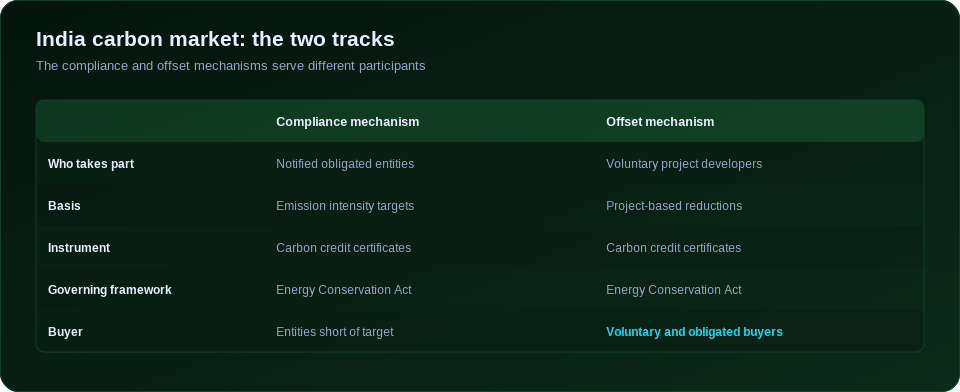
India's domestic framework is the Carbon Credit Trading Scheme (CCTS), established under the Energy Conservation Act as amended in 2022 and administered by the Bureau of Energy Efficiency under the Ministry of Power. It has two distinct mechanisms:
| Compliance mechanism | Offset mechanism | |
|---|---|---|
| Who takes part | Notified obligated entities in energy-intensive sectors | Voluntary project developers, non-obligated entities |
| Basis | Greenhouse gas emission intensity targets | Project-based emission reductions or removals |
| Instrument | Carbon Credit Certificates | Carbon Credit Certificates |
| Buyers | Entities short of their target | Obligated entities and voluntary buyers |
| Trading | Through notified power exchanges | Same |
Alongside this sits the international voluntary carbon market — Verra's VCS, the Gold Standard and similar programmes — where Indian projects have historically been among the world's largest suppliers, first under the CDM and later under voluntary standards.
A third route, Article 6 of the Paris Agreement, allows credits to be transferred between countries with corresponding adjustments. India has signalled a cautious approach here, since credits exported with a corresponding adjustment cannot count towards India's own NDC.
The practical implication for a new entrant: decide early whether you are building for the domestic compliance market, for international voluntary buyers, or for both. The methodology, the registry, the documentation and the buyer are different in each case, and retrofitting a project from one track to another is expensive.
Because the CCTS is still being built out — sectoral targets, procedures and trading arrangements have been issued in stages — check the current position directly with the Bureau of Energy Efficiency and the Ministry of Power rather than relying on any summary, including this one.
Setting Up the Business: Company, Registrations and Accounts
There is no special "carbon credit licence" in India for developers, consultants or aggregators. You need an ordinary business structure, the right registrations, and accounts on the registries you will use.
- Legal entity. A private limited company or LLP is usual, because buyers, investors and registries prefer contracting with a company, and project assets and credit revenue sit more cleanly in one. Sole proprietors can work as consultants but rarely as developers.
- Tax registrations. PAN and GST registration. Credits are intangible, so no Import Export Code is needed to sell them abroad, but foreign currency receipts go through normal banking channels with the correct purpose codes. Take advice on the GST treatment of credit sales and services, as it depends on the transaction.
- Registry accounts. International programmes such as Verra and Gold Standard require an account holder application with know-your-customer checks and annual fees. For India's Carbon Credit Trading Scheme, the Bureau of Energy Efficiency is the administrator, Grid Controller of India acts as the registry, and Carbon Credit Certificates are traded through the notified power exchanges, so participants register through those channels.
- Host-country authorisation. If you plan to sell credits for Article 6 or CORSIA use, the project needs authorisation from India's national designated authority for Article 6 under the Ministry of Environment, Forest and Climate Change, and must fall within the activities India has opened for international transfer.
- Contracts. A standard set of agreements: with landowners or communities (for land-based projects), with technology suppliers, with consultants and verifiers, and with buyers (emission reduction purchase agreements).
Domestic or International Standard?
One of the first strategic choices is where the credits will be issued. The decision depends on who you expect to buy them.
| Question | Indian CCTS offset mechanism | International programmes (for example Verra, Gold Standard) |
|---|---|---|
| Main buyers | Obligated Indian entities short of their targets, and domestic voluntary buyers | International corporate buyers, airlines under CORSIA, Article 6 buyers |
| Currency of sale | Rupees, through Indian power exchanges | Usually US dollars, through brokers or direct contracts |
| Methodologies | A defined list notified for the Indian scheme, growing over time | Large catalogues covering most project types |
| Host-country authorisation | Not needed for domestic use | Needed for Article 6 and CORSIA first-phase use |
| Market maturity | New; prices and liquidity still forming | Established, but prices vary widely by project type |
Some developers keep both options open by choosing a project type with methodologies in both systems and deciding later, but a project cannot sell the same tonne twice. See the Indian carbon market and CCTS and carbon credit standards.
The Project Lifecycle
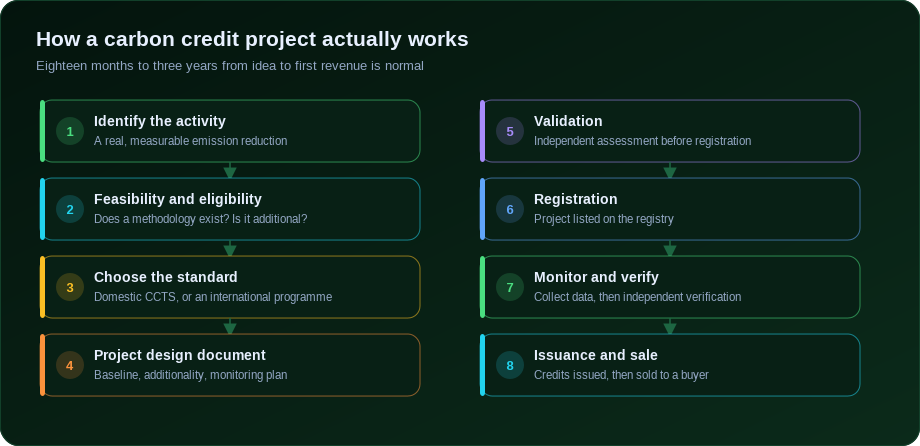
| Stage | What happens | Typical duration |
|---|---|---|
| 1. Identify the activity | A real, measurable emission reduction | Weeks |
| 2. Feasibility and eligibility | Does a methodology exist? Is it additional? Is the volume viable? | 1-2 months |
| 3. Choose the standard | Domestic CCTS offset mechanism, or an international programme | Weeks |
| 4. Project design document | Baseline, additionality argument, monitoring plan | 2-4 months |
| 5. Validation | Independent third-party assessment before registration | 2-4 months |
| 6. Registration | Project listed on the registry | 1-3 months |
| 7. Monitor and verify | Collect data, then independent verification | Ongoing; first cycle 6-12 months |
| 8. Issuance and sale | Credits issued to your registry account, then sold | 1-3 months after verification |
Eighteen months to three years from idea to first revenue is normal. Anyone promising credits in six months is describing a project already well into stage 4, or is describing something that will not survive validation.
That timeline is the single most important planning fact in this business. It determines your working capital requirement, and it is why aggregators and consultants — who are paid earlier — are more common than pure developers among new entrants.
The Eligibility Tests That Stop Most Ideas
Before spending anything, run the activity through five tests. Failing any one of them usually ends the project.
1. Is there an approved methodology? You cannot invent your own accounting. An approved methodology under the chosen standard must cover your activity type. Developing a new methodology takes years and substantial money.
2. Is it additional? Would this have happened anyway? If the activity is already the cheapest option, already mandated by law, or already common practice in your sector, it is not additional. This is where grid-scale solar and wind projects in India now generally fail — they are commercially viable without carbon revenue.
3. Is the volume material? Transaction costs are largely fixed. Validation, verification and registry fees do not scale down. A project generating 2,000 credits a year rarely covers its own compliance cost — which is exactly the gap aggregation exists to fill.
4. Can you measure it defensibly? Monitoring must be continuous, documented and auditable for the whole crediting period. "We will estimate it annually" does not survive verification.
5. Do you have clear rights to the credits? Who owns the reduction — the landowner, the equipment owner, the operator, the financier? Get this in writing before validation, not after. Unclear title is a common reason for transactions collapsing at the diligence stage.
What It Costs
Indicative ranges for a mid-size project. Actual figures vary widely with type, scale and standard.
| Cost item | Indicative range | Frequency |
|---|---|---|
| Feasibility study | ₹2-8 lakh | One-off |
| Project design document | ₹5-20 lakh | One-off |
| Validation | ₹8-25 lakh | One-off |
| Registration fee | Varies by programme | One-off |
| Monitoring systems and data collection | ₹3-15 lakh setup, plus ongoing | Continuous |
| Verification | ₹6-20 lakh | Per verification cycle |
| Registry and issuance levies | Per-credit charge | Per issuance |
| Broker or aggregator margin | 10-30% of gross | Per sale |
Two structural points follow. First, costs are front-loaded and revenue is back-loaded — you spend for 18-36 months before the first credit is sold. Second, fixed costs dominate, which is why small projects are uneconomic on their own and why the sub-scale segment is served by aggregators.
Where the Money Actually Goes
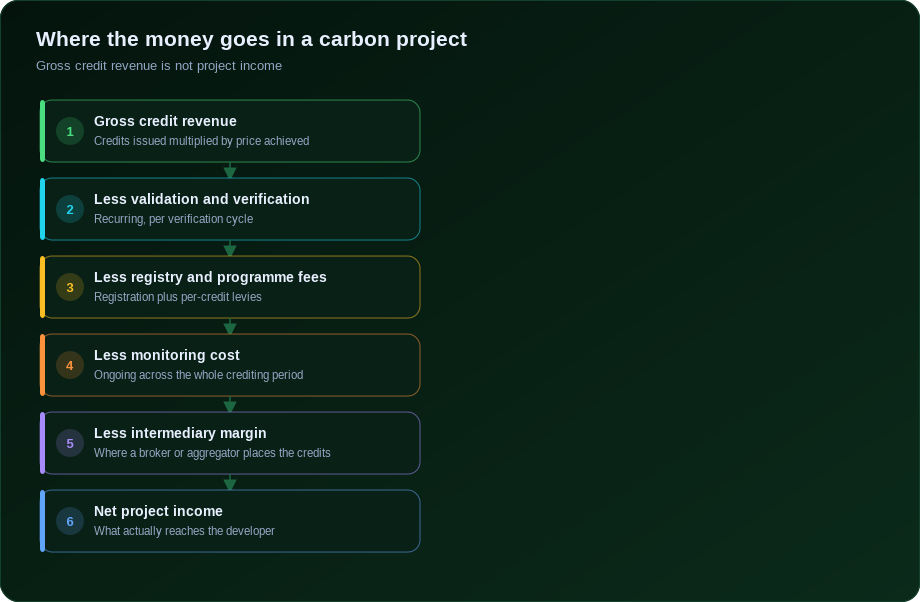
Gross credit revenue is not project income:
Gross revenue (credits issued × price achieved) less validation and verification costs, recurring per cycle less registry and programme fees, including per-credit levies less monitoring costs across the whole crediting period less intermediary margin where a broker or aggregator places the credits equals net project income.
Model this before committing. Projects that look attractive at a headline price frequently do not clear once verification cycles and intermediary margin are included — particularly at lower price points, where fixed costs consume most of the gross.
Price is the other half of that equation, and it varies enormously by project type and quality. See carbon credit prices in India.
Worked Example: The Economics of a First Project
Consider a developer setting up a biogas project at a group of dairy farms and a food processing unit, capturing methane that would otherwise escape from manure and wastewater. Assume, for illustration, that the methodology estimates 20,000 tonnes CO2e of reductions a year.
One-time development costs (from the cost table above):
| Item | Illustrative amount |
|---|---|
| Feasibility study | ₹5 lakh |
| Project design document | ₹12 lakh |
| Validation | ₹15 lakh |
| Monitoring system set-up | ₹8 lakh |
| Subtotal before the first verification | ₹40 lakh |
Recurring costs per verification cycle: verification about ₹12 lakh, monitoring and data management about ₹5 lakh a year, plus registry and issuance charges per credit.
Revenue: at an assumed net price of US$6 per credit, 20,000 credits a year bring about US$120,000, roughly ₹1 crore at ₹84 to the dollar, before broker margins and registry levies.
On these assumptions the carbon revenue pays back the development cost within the first issuance, which is why methane projects are attractive. But the example carries the risks in the rest of this guide: the price is an assumption, not a quote; the first credits arrive 18 to 30 months after starting; volumes depend on real monitored data, which often comes in below design estimates; and the biogas plant itself, its capital cost and its operation are a separate business case. Model a pessimistic case with 30% lower volume and a lower price before committing.
Which Project Types Work in India
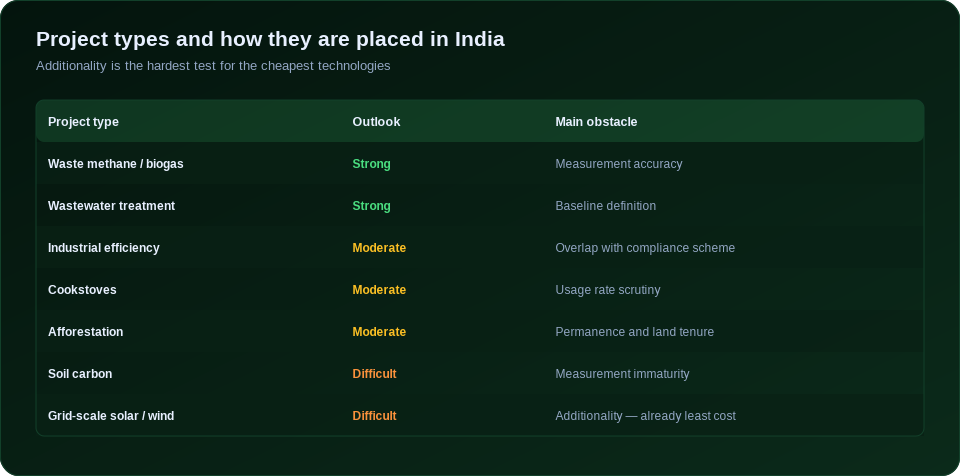
| Project type | Outlook | Main obstacle |
|---|---|---|
| Waste methane capture / biogas | Strong | Measurement accuracy |
| Wastewater treatment | Strong | Baseline definition |
| Industrial energy efficiency | Moderate | Overlap with the compliance scheme |
| Improved cookstoves | Moderate | Usage rate scrutiny |
| Biochar from crop residues | Strong, sold as durable removals | Feedstock sustainability and end-use tracking; see biochar carbon credits |
| Afforestation and reforestation | Moderate | Permanence, land tenure |
| Soil carbon | Difficult | Measurement immaturity |
| Grid-scale solar and wind | Difficult | Additionality — already least-cost |
The uncomfortable pattern: the cheapest technologies have the hardest additionality argument. Renewable energy in India is now commercially competitive, which is good for the country and bad for the carbon-credit case. Methane-related projects hold up best because methane capture is rarely the least-cost option for the operator, making additionality straightforward to argue.
Full treatment in carbon credit project types in India.
Starting as a Consultant or Aggregator
If you do not own an emission-reducing asset, this is the realistic entry.
As a consultant, the sellable capabilities are: eligibility screening, baseline and additionality argumentation, monitoring plan design, data systems, verification support, and buyer-side due diligence. The barrier is credibility — you need a demonstrable track record, and the fastest route is usually working under an established developer or validation body first.
As an aggregator, the model is to bundle many small activities into one registerable project. Cookstoves, small biogas units, and smallholder land-use projects only work this way. It requires a field network, household-level data collection, and enough working capital to fund 18-36 months of costs before revenue. The margin comes from the gap between the small operators' individual uneconomic position and the aggregated project's viability.
For both, the durable competitive advantage is data discipline. Verification failures are overwhelmingly data failures — missing records, unexplained gaps, uncalibrated meters, undocumented assumptions. A developer or aggregator with genuinely audit-ready systems commands both better pricing and lower verification costs.
The Team You Need
A small carbon business can start with three or four people, but it needs these skills covered, in-house or through partners:
| Role | What they do |
|---|---|
| Methodology and MRV specialist | Applies the methodology, writes the baseline and monitoring plan, manages verification |
| Field and data lead | Runs data collection, sampling and monitoring systems, keeps records verifiable |
| Commercial and contracts lead | Finds buyers, negotiates purchase agreements, manages registry accounts |
| Finance and compliance | Project finance, tax, foreign exchange and legal agreements |
| Sector specialist | Knows the underlying technology, whether biogas, cookstoves, forestry or industry |
The most common gap in new ventures is the MRV specialist. Projects fail validation or lose credits at verification far more often because of weak monitoring than because of a flawed idea.
Finding Buyers and Selling Credits
There are four main routes to market:
- Forward offtake agreements with corporate buyers or traders, signed before or during project development, sometimes with an advance payment that helps finance the project.
- Spot sales of issued credits through brokers, exchanges or marketplaces.
- Direct sales to companies with net-zero or CORSIA obligations, which gives better prices but needs a stronger sales effort.
- Domestic sales under the CCTS to obligated entities, once offset credits are issued under the Indian scheme.
Buyers increasingly ask for third-party ratings, evidence of co-benefits, and clarity on whether the credits carry a corresponding adjustment. Our guides on how to sell carbon credits in India and carbon credit ratings cover what they look for.
Carbon Credit Business Ideas for Small Companies and Startups
Not every carbon business needs to own a large project. These are realistic entry points for a small team in India:
| Idea | What it involves | Why it can work |
|---|---|---|
| MRV and monitoring services | Data collection, sampling, digital record-keeping and monitoring reports for existing projects | Every project needs it every year; low capital |
| Programme aggregator for small activities | Bundling cookstoves, biogas units, rooftop solar for institutions, or water filters under one programme | Small activities cannot register alone; the aggregator earns a share |
| Biochar from local crop residues | Small kilns or a pyrolysis unit near rice mills, cotton areas or sugar mills, selling durable removal credits | High-value removal credits and a real residue-burning problem to solve |
| Methane capture at dairies, piggeries or food plants | Biogas systems with methane destruction or use | Robust additionality and measurable reductions |
| Carbon accounting and footprinting for SMEs | Measuring emissions for exporters facing customer or EU requirements | Growing demand from supply chains; recurring work |
| Buyer due diligence | Checking credits, registries and documentation for companies and airlines before they buy | Buyers need independent checks; expertise-based |
| Training and capacity building | Courses for project staff, auditors and corporate sustainability teams | Low capital, builds reputation |
The service businesses, MRV, accounting and due diligence, can start earning within months. Developer businesses take longer but build an asset.
Common Mistakes New Carbon Businesses Make
- Starting from the credit, not the activity. A carbon business is only as good as the real emission reduction underneath it. If the activity does not stand up without the credit story, it will not survive validation.
- Choosing a project type the market has turned away from. Grid renewables and some older cookstove approaches now sell poorly or struggle with additionality.
- Underestimating monitoring. Many projects lose a large share of credits at verification because records are incomplete.
- Assuming a price. Using a headline price from a news article rather than a quote for that project type, vintage and standard.
- Signing exclusive deals too early. Giving a broker exclusive rights to all future credits at a fixed low price before the project's quality is known.
- Ignoring host-country rules. Planning international sales without checking authorisation requirements under Article 6.
- Running out of cash before issuance. Costs start immediately; revenue comes 18 to 36 months later.
Risks to Underwrite Honestly
- Regulatory change. India's framework is actively evolving, including on the export of credits. A business model that depends on selling internationally carries policy risk that is not in your control.
- Price volatility. Voluntary market prices have moved sharply in both directions. Long-term offtake agreements transfer this risk but cap the upside.
- Verification failure. Credits are issued only after successful verification. Data problems can delay issuance by a full cycle.
- Reputational scrutiny. Investigative journalism into over-crediting has damaged whole project categories, notably some avoided-deforestation programmes. Buyers now conduct real diligence — see carbon credit due diligence.
- Double counting and corresponding adjustments. If a credit is used towards another country's target, it cannot also count towards India's. This is the single most consequential accounting question in the market — see corresponding adjustments explained.
A Realistic First Ninety Days
- Choose your model — developer, consultant, aggregator, or broker.
- Pick one project type and learn its methodology in depth. Breadth is worth nothing here; depth in one methodology is sellable.
- Read three registered project design documents for that type on a public registry such as Verra or the Gold Standard. This teaches more than any course.
- Map the current CCTS position for your sector directly from BEE publications.
- Build a financial model with realistic timelines — first revenue at month 24, not month 6.
- Find one real activity and run the five eligibility tests against it.
- Talk to a validation body early. What they will and will not accept is the actual constraint.
Step 3 is the highest-value hour you will spend. Registered PDDs are public, detailed, and show exactly what a successful additionality argument and monitoring plan look like in practice.
Frequently Asked Questions
How do I start a carbon credit business in India? Decide whether you are a project developer, consultant, aggregator or trader; select a project type with an approved methodology; test additionality and volume; then follow the design, validation, registration, monitoring, verification and issuance sequence.
Is a carbon credit business profitable in India? It can be, but revenue arrives 18-36 months after costs begin and depends on credit price, project scale and verification success. Fixed costs mean small projects are usually uneconomic without aggregation.
How much investment is needed? For a mid-size project, tens of lakhs before first revenue — feasibility, design documents, validation, monitoring systems and the first verification cycle. Consulting requires expertise rather than capital.
Do I need a licence? Not a licence as such, but participation in the CCTS offset mechanism requires registration with the designated authorities, and international programmes require registry accounts and adherence to their rules.
How long until first revenue? Typically 18 to 36 months from project start to first credit sale.
What is the CCTS? India's Carbon Credit Trading Scheme, established under the Energy Conservation Act as amended in 2022, with a compliance mechanism for obligated entities and an offset mechanism for voluntary projects, administered by the Bureau of Energy Efficiency.
Can I sell Indian carbon credits internationally? It depends on the programme, the credit type and the prevailing policy on exports and corresponding adjustments. This is the area of greatest regulatory uncertainty — take current advice before building a business model on it.
What is the best carbon credit project type in India? Methane-related projects — waste and wastewater — have the most robust additionality arguments. Grid-connected renewables are now difficult to credit.
Do I need a technical background? For consulting and MRV, yes: the work is measurement, engineering and documentation. For brokerage, commercial and contractual skills matter more.
Can an individual start a carbon credit business? An individual can work as a consultant or field partner, but developing projects, holding registry accounts and signing purchase agreements is easier through a company or LLP, which buyers and registries expect.
Can farmers earn money from carbon credits in India? Yes, usually through an aggregator or developer running an agroforestry, biochar, soil carbon or biogas programme, who pays farmers a share of credit revenue or a fixed payment. Read the contract carefully for the share, the term and who owns the credits.
What is additionality? The requirement that the emission reduction would not have occurred without the carbon revenue. It is the most common reason projects are rejected.
Planning a carbon credit project in India? DSTechnoverse supports feasibility screening, baseline and additionality assessment, monitoring plan design, data systems and MRV documentation — and works with buyers on credit due diligence. We are based in Indore, Madhya Pradesh and work with developers across India. See our carbon credit services, or talk to our team about your project.
This article is general information, not legal, financial or regulatory advice. India's carbon market rules are still being built out — verify the current position with the Bureau of Energy Efficiency and your legal advisers before committing capital.