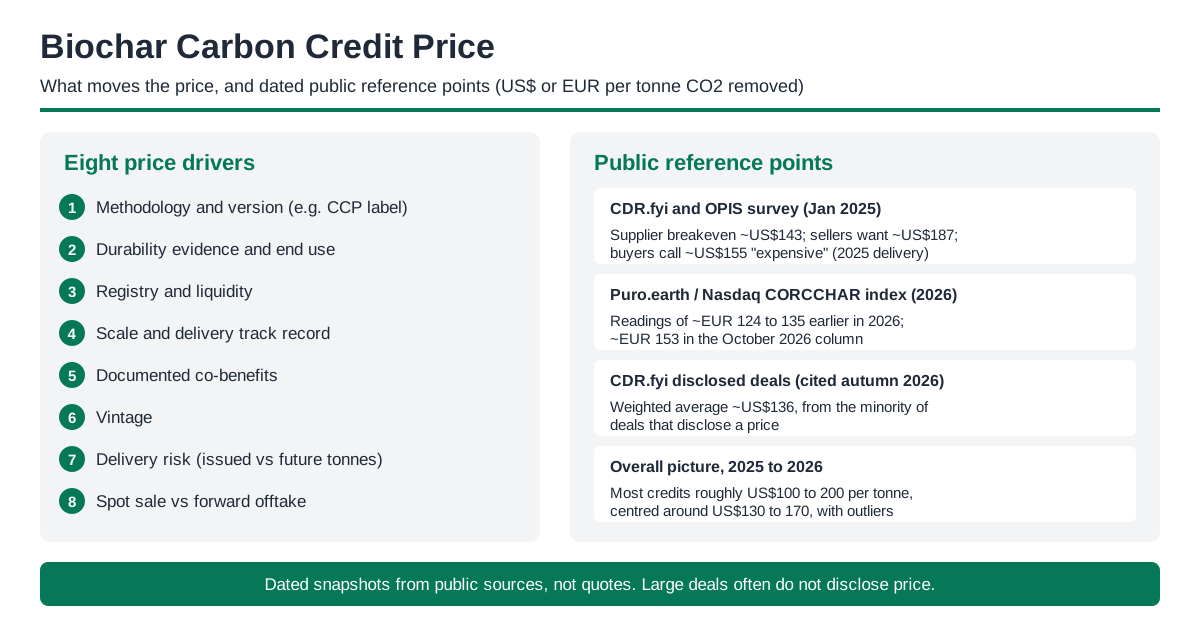
Quick answer: The biochar carbon credit price in 2025 and 2026 has mostly sat somewhere between about US$100 and US$200 per tonne of CO2 removed, according to public sources such as CDR.fyi and the Puro.earth CORC Biochar Price Index. Where a credit lands in that range depends on the methodology and registry, how well its durability is evidenced, the size and track record of the producer, co-benefits, vintage, delivery risk and whether it is sold on the spot market or through a multi-year offtake. Treat any single number as a snapshot, not a quote.
This guide is about the biochar carbon credit price: what it is, what drives it, who pays it and how a developer can achieve a better one. It deliberately skips the basics. In short, biochar is a charcoal-like material made by heating biomass with little oxygen, and a biochar credit represents one tonne of CO2 kept out of the atmosphere for a long period because stable carbon from that biomass ends up in soil or another durable use. If you need the full background on production, calculation, lab tests and project steps, start with our pillar guide to biochar carbon removal credits and come back here.
Prices in this market move quickly and many deals are private, so we attribute every market number to a named source and date, and label our own example numbers as illustrative.
Biochar Carbon Credit Price: What the Public Data Shows
There is no exchange price for biochar credits. What exists is a patchwork of indices, surveys and disclosed deals, each measuring something slightly different.
| Source | Date | Figure reported | What it actually measures |
|---|---|---|---|
| CDR.fyi and OPIS supplier and buyer survey | Published 21 January 2025 | Average supplier breakeven of about US$143 per tonne for 2025 delivery; sellers said they needed about US$187 for a reasonable profit; buyers called about US$155 "expensive" | Stated expectations of survey respondents, not transaction prices |
| Puro.earth and Nasdaq CORC Biochar Price Index (CORCCHAR) | Values published during 2026 | Readings of roughly EUR 124 to EUR 135 per tonne earlier in 2026, and about EUR 153 in the October 2026 column when we checked in November 2026 | An index of prices for CO2 Removal Certificates under Puro.earth biochar methodologies |
| CDR.fyi disclosed deal data, as cited by third-party analysts | Reported in autumn 2026 | A weighted average of roughly US$136 per tonne for biochar deals with disclosed prices | Only the minority of deals where a price was made public |
| Supercritical market report, as summarised in trade press | September 2026 | Distributed biochar around US$150 per tonne and industrial-scale supply around US$165 per tonne, with one project reported moving from US$155 to US$185 within 2025 | A marketplace's view of its own and observed transactions |
| S&P Global commodity reporting, as cited in trade press | October 2025 | US biochar credits for near-term delivery around US$150 per tonne | Assessed price for a specific delivery window |
Three cautions apply to every row in that table.
First, most large deals do not disclose a price. Microsoft's 2025 agreement with Exomad Green, the largest biochar purchase reported so far, did not publish financial terms. The disclosed-price average is therefore drawn from smaller deals and may not represent large offtakes.
Second, survey figures are opinions. A breakeven reported by suppliers tells you about cost expectations, not what a buyer will pay. The CDR.fyi and OPIS survey itself reported individual biochar breakevens ranging from roughly US$50 to US$600 per tonne, with most between US$100 and US$200.
Third, currencies and units differ. The Puro.earth index is in euros, most deal reporting is in US dollars, and some sellers quote per tonne of biochar rather than per tonne of CO2. Always confirm the unit before comparing.
Taken together, the public record supports a cautious statement: during 2025 and 2026, most biochar removal credits from established registries appear to have traded somewhere between about US$100 and US$200 per tonne of CO2, with a central tendency in the US$130 to US$170 area and meaningful outliers on both sides. For how carbon prices are formed across all credit types, see carbon credit prices explained and what drives carbon credit cost.
Why Biochar Credits Sit Where They Do
Biochar credits cost far more than avoidance credits such as renewable energy or cookstoves, yet far less than direct air capture. That middle position explains a lot of buyer behaviour.
Buyers pay a premium over avoidance because biochar is a measured removal with a durability claim of centuries for the stable fraction. Compared with direct air capture and other engineered removals, commonly contracted at several hundred dollars per tonne, biochar is cheaper because the technology is mature, plants are small and quick to build, and the feedstock is a residue.
CDR.fyi's September 2025 biochar market snapshot gives a sense of why this matters. It reported that biochar accounted for around 86% of all durable carbon removal tonnes delivered since 2022 and around 92% of durable tonnes retired. In other words, biochar is the removal that buyers can actually receive today, and that availability is priced in. For a wider comparison of removal types and how they are valued, see our guide to carbon removal credits.
The Eight Factors That Drive Biochar Credit Price
Buyers price a bundle of attributes, not just the tonne. These eight explain most price differences between credits issued in the same year.
1. Methodology and Version
The methodology decides what is counted, how durability is calculated and which deductions apply. Buyers increasingly ask not just which programme a credit comes from but which version of the methodology was used. Since 2025, the Integrity Council for the Voluntary Carbon Market (ICVCM) has approved three biochar methodologies as eligible for its Core Carbon Principles (CCP) label: Verra VM0044 version 1.2, Isometric Biochar Production and Storage version 1.0, and the Climate Action Reserve U.S. and Canada Biochar Protocol version 1.0. At the time of writing, ICVCM's own tracker listed Puro.earth's biochar methodologies as still under assessment, and older VM0044 versions as withdrawn.
A CCP-labelled credit does not automatically fetch a higher price, but it widens the buyer pool, particularly among companies that have written ICVCM alignment into their procurement policy. Our guide to the ICVCM Core Carbon Principles explains what the label covers. For a detailed comparison of the methodologies themselves, see biochar carbon credit methodologies.
2. Durability Evidence
Biochar does not store all of its carbon forever. Methodologies estimate the fraction that remains over a defined horizon, usually using lab indicators such as the hydrogen to organic carbon ratio, and some newer approaches use measurements that support a claim of much longer persistence for the most stable fraction. A credit backed by stronger, better documented durability evidence is easier to sell to buyers who are building a portfolio for long-term net-zero claims.
Conservative, well-documented lab results attract fewer objections in due diligence, and end use matters: biochar applied to farmland with traceable records, or locked into concrete or asphalt, is easier to defend than biochar whose fate after sale is poorly documented.
3. Registry and Market Infrastructure
The main biochar registries are Puro.earth, which issues CO2 Removal Certificates (CORCs), Verra, Isometric, and Carbon Standards International through its Global C-Sink and Global Artisan C-Sink registries linked to the European Biochar Certificate. Some buyers have preferences built into procurement policy. Others rely on the registry's reputation with their auditors or their own stakeholders.
Registry choice also affects liquidity. Puro.earth's own reporting has shown the time between issuance and first transfer or retirement shortening sharply in recent years, which suggests an active buyer base for its units. Our carbon credit registries compared guide covers fees, account rules and transfer mechanics.
4. Scale and Track Record
Large, industrial producers with a history of delivering on time are valued for reliability. Small producers can command a premium from buyers who want community or smallholder stories, but they often face higher per-tonne costs for verification. Trade reporting of the September 2026 Supercritical market report suggested industrial supply had been selling at a modest premium to distributed supply.
Track record is where new developers lose the most. A first-time project with no issued credits will usually be priced below an otherwise identical project that has already delivered several issuance cycles.
5. Co-Benefits and Story
Biochar projects can reduce open burning of crop residues, improve soil water retention, provide income to farmers, clear invasive species or support waste management. Some buyers pay for these benefits, especially when they are documented with data and, where relevant, aligned with recognised co-benefit frameworks. Others pay nothing extra for them. The uplift is real but uneven and depends on matching the story to the buyer.
6. Vintage
Vintage is the year in which the removal happened. Biochar is less vintage-sensitive than avoidance markets because most credits are recent, but buyers still prefer recent vintages produced under the current methodology version. Credits issued under a version that has since been withdrawn or revised can be harder to sell at full price.
7. Delivery Risk
A credit that already exists in a registry account is worth more today than a promise to deliver a credit in three years. CDR.fyi's 2025 snapshot reported that only about 22% of biochar tonnes contracted since 2022 had been delivered by mid-2025. Much of that gap reflects long-dated offtakes, not failure, but it shows that buyers are mostly paying for future tonnes and must price the risk that some never arrive. Plants that are already operating, with credible feedstock contracts and a verification history, carry less delivery risk than plants still at the design stage.
8. Spot Versus Forward Offtake
This is the single largest structural factor in achieved price, and it gets its own section below. Broadly, spot credits that are issued and ready to retire can earn a higher per-tonne price at moments of scarcity, while forward offtakes trade price for certainty.
| Driver | Pushes price up when | Pushes price down when |
|---|---|---|
| Methodology | Current version, CCP-approved or widely accepted | Withdrawn or outdated version |
| Durability | Conservative, well-evidenced persistence; traceable durable end use | Weak lab data; unclear end use |
| Registry | Buyer's preferred registry; liquid market | Niche registry buyers do not recognise |
| Scale and record | Multiple successful issuances; reliable volumes | First-time project; history of delays |
| Co-benefits | Documented, matched to a buyer who values them | Claimed but not evidenced |
| Vintage | Recent, current methodology | Older, superseded methodology |
| Delivery risk | Operating plant, issued credits | Pre-construction, untested feedstock |
| Contract | Spot sale in a tight market | Long offtake with heavy volume commitment |
Spot Versus Forward Offtake: How Contract Type Changes Price
Biochar credits are sold in two main ways.
Spot sales involve credits that have already been issued. The buyer pays and the credits are transferred or retired on their behalf, often within days. Spot buyers include smaller companies, intermediaries and platforms building portfolios for many customers. Spot prices respond quickly to supply and demand.
Forward offtakes are agreements to buy credits that will be produced in the future, often over five to ten years. The price is usually agreed up front, sometimes with indexation, and payment is typically on delivery, although some contracts include prepayments that help finance the plant.
Market reporting through 2026 suggests that large buyers have been locking in a growing share of high-quality biochar supply through offtakes. A trade summary of Supercritical's September 2026 report claimed that around 81% of the high-quality biochar supply it tracks had been committed by mid-2026, and that spot purchases had fallen as a share of total demand. Treat those numbers as one marketplace's analysis, but the direction is consistent with what large disclosed deals show.
For a developer, the trade-off looks like this:
| Feature | Spot sale | Forward offtake |
|---|---|---|
| Price per tonne | Can be higher when supply is tight; exposed to downturns | Often at or below prevailing spot, sometimes with escalation |
| Revenue certainty | Low | High, subject to delivery |
| Financing value | Little | Strong: lenders and equipment suppliers value contracted revenue |
| Delivery obligation | None beyond the sale | Volume commitments, possible make-good or penalty clauses |
| Buyer due diligence | Lighter, per transaction | Heavy, one-off but detailed |
| Best suited to | Operating plants with issued credits | Projects needing capital to build or expand |
Many developers end up with a blend: a core offtake that covers debt service and operating costs, plus a spot tranche that captures upside.
Who Buys Biochar Credits
The buyer landscape is concentrated at the top and fragmented underneath.
CDR.fyi's September 2025 snapshot counted around 290 unique purchasers of biochar removal credits since 2022, many more than for any other durable removal method. It also found that over half of those purchasers had bought fewer than 100 tonnes, and that the four largest buyers accounted for 57% of contracted biochar volume, with Microsoft alone at about 46%.
Publicly reported biochar purchases by named buyers include:
- Microsoft, which announced in May 2025 an agreement with Exomad Green in Bolivia for about 1.24 million tonnes of removal over roughly ten years, certified under the Puro.earth biochar methodology. Financial terms were not disclosed.
- Google, which announced in January 2025 an agreement to buy 100,000 tonnes of biochar removal credits from Varaha's project in Gujarat, India, using invasive Prosopis juliflora as feedstock, with credits issued by Puro.earth.
- Swiss Re, which signed multi-year biochar offtakes with Carbonfuture, including a 2024 agreement covering at least 70,000 tonnes of biochar removal sourced from Exomad Green.
- Boston Consulting Group and JPMorgan Chase, named by CDR.fyi among the four largest biochar buyers by volume.
One notable absence is worth knowing. Frontier, the advance market commitment backed by several large technology and financial companies, states on its biomass pathway page that biochar is a sub-pathway it is not considering for purchase at this time. Frontier's focus on very long-duration storage and early-stage technologies therefore does not create direct demand for biochar.
Beyond the named buyers, demand comes from several broad groups:
- Technology and data centre companies with large, growing emissions and public removal targets.
- Financial services and insurers, some of which hold portfolios dominated by biochar because it is deliverable now.
- Consulting and professional services firms offsetting business travel.
- Mid-sized companies and SMEs buying small volumes through platforms and marketplaces.
- Aggregators and portfolio builders that buy from many projects and resell bundles to corporate clients.
- Compliance-adjacent buyers preparing for regimes that may recognise permanent removals, such as the EU Carbon Removal Certification Framework, whose first delegated act covering biochar, direct air capture and bioenergy with carbon capture was adopted in February 2026.
Aviation buyers under CORSIA form a separate case. Removal credits can only be used for CORSIA if they are issued by a programme and methodology that ICAO has approved for the relevant compliance phase, and if they carry the required host-country authorisation and corresponding adjustment. Check the current ICAO eligible emissions units document before assuming any biochar credit qualifies. Our CORSIA carbon credits complete guide and the knowledge-base note on corresponding adjustments under Article 6 explain the conditions.
Biochar Offtake Agreements: Contract Structures and Terms
Biochar offtakes resemble other carbon offtakes, but some clauses matter more because production depends on seasonal feedstock and lab results.
Common Pricing Structures
| Structure | How it works | Who it suits |
|---|---|---|
| Fixed price | One price per tonne for the whole term | Developers who value certainty; buyers who want budget clarity |
| Fixed with escalation | Price rises by an agreed percentage or index each year | Long contracts where costs will rise |
| Floor and ceiling | Price floats with a reference index between agreed limits | Parties who want shared exposure to market movement |
| Prepayment plus delivery price | Buyer advances part of the value to fund the plant; remaining price paid on delivery | Projects that need construction capital |
| Volume tiers | Lower unit price for larger committed volumes | Large buyers locking in supply |
Key Clauses to Negotiate
- Volume and tolerance. A fixed annual volume with a tolerance band, for example plus or minus a percentage, gives the developer room for feedstock and weather variation.
- Methodology and quality specification. Name the registry, methodology and version, and agree what happens if the methodology is revised mid-contract.
- Delivery and make-good. Define what happens if the developer under-delivers: carry-forward to the next year, replacement credits from another project, price reduction or termination.
- Reversal and buffer. Clarify how buffer pool contributions are handled and who bears the risk if issued credits are later cancelled.
- Labels and authorisations. If the buyer wants a CCP label, Article 6 authorisation or CORSIA eligibility, state who obtains it and what happens if it is not granted.
- Retirement and claims. Specify whether credits are transferred or retired on the buyer's behalf, and what public claims each party may make.
- Prepayment security. Where money moves early, agree on security such as step-in rights, escrow or repayment terms.
- Data and MRV access. Many buyers now ask for access to digital monitoring data, lab certificates and end-use records.
Our guide to CORSIA offtake agreement terms covers many of these clauses in more detail. Most apply equally to voluntary biochar contracts.
Price Per Tonne of Biochar Removal Versus Price Per Tonne of Biochar
A frequent source of confusion is the difference between the price per tonne of CO2 removed and the price per tonne of biochar produced. Credits are priced per tonne of CO2 equivalent. A tonne of dry biochar typically yields fewer than its theoretical maximum because of carbon content, the durability factor, project emissions from collection and processing, and leakage deductions.
The relationship is simple:
Revenue per tonne of biochar = credit price per tonne of CO2 × net credits per tonne of biochar
Net credits per tonne of biochar vary widely with feedstock and process. Woody feedstocks with high fixed carbon usually produce more credits per tonne of biochar than ash-rich crop residues. Varaha, for example, has publicly stated that each tonne of its biochar generates about 2.5 credits, but that figure is specific to its feedstock, process and methodology. Treat any yield figure as project-specific until your own lab results and methodology calculations confirm it.
Improving yield per tonne of biochar can therefore matter as much as negotiating a higher credit price.
Worked Example: Project Revenue at Illustrative Prices
The following example uses illustrative numbers only. They are chosen to show the arithmetic, not to forecast prices or represent any real project. Your own figures will depend on feedstock, methodology, buyer and market conditions at the time.
Assumptions (illustrative):
- Dry biochar output: 3,000 tonnes per year
- Net credits after durability factor, project emissions and leakage: 2.2 tonnes CO2 per tonne of biochar
- Gross removals: 6,600 tonnes CO2 per year
- Registry buffer or deduction: none assumed here, for simplicity
- Sales split: 60% forward offtake, 30% spot, 10% held and sold later
- Offtake price: US$130 per tonne (illustrative)
- Spot price: US$160 per tonne (illustrative), less a 10% intermediary or platform fee
- Later sale price for held credits: US$140 per tonne (illustrative)
Calculation:
| Tranche | Tonnes | Illustrative price (US$/t) | Fee | Net revenue (US$) |
|---|---|---|---|---|
| Forward offtake | 3,960 | 130 | None | 514,800 |
| Spot | 1,980 | 160 | 10% | 285,120 |
| Held and sold later | 660 | 140 | None | 92,400 |
| Total | 6,600 | 892,320 |
That works out to an average achieved price of about US$135 per tonne of CO2, or roughly US$297 per tonne of biochar produced.
Now consider the same project after three improvements, again with illustrative numbers:
- Better feedstock selection and process control raise net credits from 2.2 to 2.35 tonnes CO2 per tonne of biochar, giving 7,050 tonnes.
- A stronger documentation package and a methodology version accepted by more buyers lift the illustrative offtake price from US$130 to US$140.
- Selling the spot tranche through a direct buyer relationship, rather than an intermediary, removes the 10% fee.
| Tranche | Tonnes | Illustrative price (US$/t) | Fee | Net revenue (US$) |
|---|---|---|---|---|
| Forward offtake | 4,230 | 140 | None | 592,200 |
| Spot | 2,115 | 160 | None | 338,400 |
| Held and sold later | 705 | 140 | None | 98,700 |
| Total | 7,050 | 1,029,300 |
Revenue rises by about US$137,000, or around 15%, without any change to the headline market price. The average achieved price becomes about US$146 per tonne of CO2. The point of the example is that achieved price is partly within the developer's control. Yield, documentation, buyer fit and sales channel all move it.
Revenue is not profit: feedstock, operations, testing, verification and logistics all come out of it. The pillar's economics section lists the main cost lines, and our guide on how to start a biochar carbon project covers budgeting and timelines.
How Developers Can Improve Their Biochar Carbon Credit Price
Most price drivers can be influenced before a single credit is issued. These steps, roughly in order, help.
- Choose the methodology with the buyer in mind. Decide early which buyer groups you are targeting and which registries and methodology versions they accept. Switching later is expensive.
- Invest in feedstock quality and consistency. Stable, documented feedstock gives more consistent lab results, higher net credits per tonne and fewer verification findings.
- Over-document durability and end use. Keep lab certificates, sampling records, delivery notes and field application evidence in a form a buyer's auditor can review quickly. Digital MRV tools help here.
- Get your first issuance done cleanly. The first issued batch turns a promise into a track record. Delays at this stage are the most damaging to future price.
- Prepare a buyer-ready data room. Include the project design document, validation and verification reports, feedstock sustainability evidence, lab results, end-use records, co-benefit data and corporate documents.
- Seek independent ratings where buyers expect them. Several carbon rating agencies cover biochar. A good rating can widen the buyer pool. See carbon credit ratings explained.
- Blend contract types. A core offtake for bankability plus a spot tranche for upside usually outperforms either alone.
- Match co-benefits to buyers. Do not market soil health to a buyer who only cares about tonnes, or tonnes alone to a buyer whose sustainability report leads with communities.
- Reduce intermediary layers where you can. Brokers and platforms add value in reaching buyers, but each layer takes a share. Direct relationships often improve net price once you have a track record.
- Keep up with methodology revisions. Plan for version updates so your credits stay eligible for the labels buyers want.
A buyer's view of quality is the other side of the same coin. Our carbon credit quality assessment guide shows the checks most professional buyers run, and the additionality guide explains one of the questions they will ask about your project.
Where the Biochar Credit Market Appears to Be Heading
No one can forecast biochar credit prices with confidence, and we do not try. Four public signals are worth watching. Demand concentration: a few very large buyers dominate contracted volume, so their decisions can move the whole market. Supply growth: biochar is the easiest durable removal to scale, which tends to cap sustained price spikes. Quality differentiation: with ICVCM approvals for some methodologies and the EU certification framework now covering biochar, the gap between well-documented and poorly documented credits may widen. Policy links: whether permanent removals enter compliance systems such as the EU Emissions Trading System, how the Science Based Targets initiative treats removals, and how host countries handle authorisation under Article 6 of the Paris Agreement could all change demand. Each remains under discussion, so treat confident claims about outcomes with caution.
How DSTechnoverse Helps
DSTechnoverse supports biochar project developers and buyers on the commercial side of carbon removal. For developers, we help assess feasibility, compare methodologies against target buyers, design MRV and documentation so it stands up to due diligence, prepare data rooms, and identify potential buyers and offtake structures. For buyers, we review projects, methodologies and contract terms, and help build removal portfolios that match your claims and budget. Learn more about our carbon market advisory services, browse credits on our carbon credit marketplace, or contact us to discuss your project or procurement plans.
Frequently Asked Questions
What is the current biochar carbon credit price?
Public sources during 2025 and 2026 put most biochar removal credits roughly between US$100 and US$200 per tonne of CO2. CDR.fyi disclosed-deal data reportedly averaged about US$136, and the Puro.earth CORC Biochar Price Index was around EUR 153 in its October 2026 column. These are snapshots that move over time. Confirm current prices with the index publisher or a broker before relying on any number.
What is the biochar CORC price?
A CORC is a CO2 Removal Certificate issued by Puro.earth. The Puro.earth and Nasdaq CORC Biochar Price Index, known as CORCCHAR, tracks prices for biochar CORCs and is published on Puro.earth's website in euros. Readings during 2026 ranged from the EUR 120s and 130s to around EUR 153 in October. Individual transactions can sit well above or below the index.
Why are biochar credits more expensive than avoidance credits?
Biochar credits represent carbon physically removed from the atmosphere and stored in a stable form for a long time, measured from samples of each batch. Avoidance credits represent emissions that did not happen, which are harder to verify and do not reverse past emissions. Buyers with net-zero targets increasingly need removals, and they pay a premium for that durability and measurability.
Who buys biochar credits?
Buyers include large technology companies, financial services firms, insurers, consultancies, mid-sized companies and portfolio aggregators. CDR.fyi counted about 290 unique biochar buyers by mid-2025. Publicly reported biochar purchasers include Microsoft, Google and Swiss Re, with Boston Consulting Group and JPMorgan Chase also named among the largest buyers. Many smaller buyers purchase under 100 tonnes through platforms.
Are offtake prices lower than spot prices?
Often, but not always. Forward offtakes give developers revenue certainty and help with financing, so they frequently trade at or slightly below prevailing spot prices. In a tight market, buyers may pay more to secure future supply. The right comparison is the whole package: price, volume flexibility, prepayment, penalties and escalation, not the headline price alone.
How much revenue does one tonne of biochar generate?
Revenue per tonne of biochar equals the credit price multiplied by the net credits generated per tonne of biochar. Net credits depend on feedstock, carbon content, durability factor and deductions. At an illustrative US$135 per tonne of CO2 and 2.2 net credits per tonne, a tonne of biochar would earn about US$297 in credit revenue before costs. Your own figures may differ widely.
Does an ICVCM CCP label raise the biochar credit price?
It can widen the pool of buyers, particularly companies whose procurement policies require CCP-labelled credits. Since 2025, ICVCM has approved Verra VM0044 version 1.2, Isometric's Biochar Production and Storage version 1.0 and the Climate Action Reserve biochar protocol. A label alone does not guarantee a higher price, but it removes an objection in due diligence.
Can biochar credits be used for CORSIA?
Only if the credits come from a programme and methodology ICAO has approved for the relevant CORSIA compliance phase, and only if they carry host-country authorisation with a corresponding adjustment. Not every biochar credit meets these conditions. Check the latest ICAO eligible emissions units document and the credit's registry labels before buying for CORSIA compliance.
How can a new developer get a better price?
Choose a methodology your target buyers accept, keep feedstock and lab data consistent, document durability and end use thoroughly, and complete a clean first issuance to build a track record. Combine a core offtake with a spot tranche, prepare a buyer-ready data room, and match your co-benefits to buyers who value them. Each step reduces perceived risk.
Developing a biochar or carbon removal project, or buying removal credits? DSTechnoverse supports project developers with feasibility, methodology selection, MRV design and certification, and helps buyers with due diligence and portfolio decisions. See our carbon market advisory or talk to our team.