Surface testing answers a question that matters more than most manufacturers acknowledge: did the cleaning actually work? Cleaning procedures are validated once, often years ago, then executed thousands of times by people under time pressure on equipment that has aged. Surface testing is the routine evidence that the procedure still achieves what it was validated to achieve.
Validation and Verification Are Different Things
Cleaning validation demonstrates, under worst-case conditions and with statistical rigour, that a cleaning procedure is capable. It is a one-off exercise repeated on change.
Routine verification confirms on an ongoing basis that the validated procedure is still being executed effectively. It samples a subset of the validation locations at defined frequency.
Conflating the two produces a common failure: a facility with an excellent validation report and a routine programme that samples three easy locations monthly, which demonstrates nothing about the equipment as a whole.
Choosing the Right Sampling Method
The method must match the surface. A contact plate used on a valve body or conveyor chain gives a comfortable low result reflecting the tool's inability to reach contamination, not the cleanliness of the equipment.
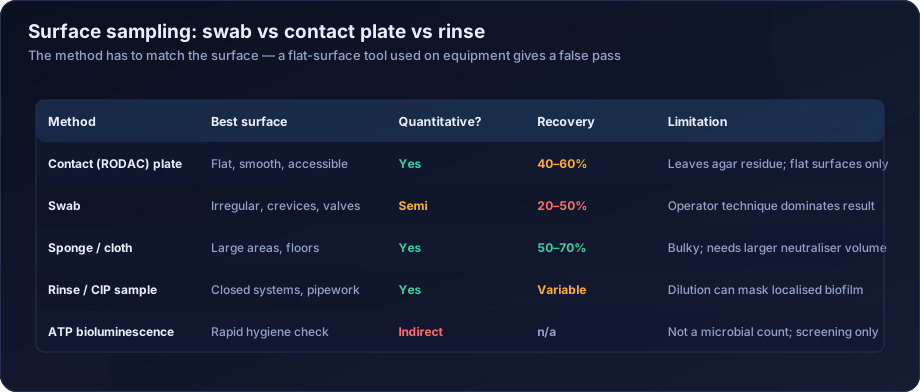
| Method | Best surface | Quantitative | Typical recovery | Main limitation |
|---|---|---|---|---|
| Contact plate (RODAC) | Flat, smooth, accessible | Yes | 40–60% | Flat surfaces only; leaves agar residue |
| Swab | Irregular, crevices, valves | Semi | 20–50% | Operator technique dominates |
| Sponge / cloth | Large areas, floors | Yes | 50–70% | Bulky; needs larger neutraliser volume |
| Rinse / CIP sample | Closed systems, pipework | Yes | Variable | Dilution can mask localised biofilm |
| ATP bioluminescence | Rapid hygiene screen | Indirect | n/a | Not a microbial count |
Most facilities need several methods assigned per location, not one method applied everywhere.
Neutralisation: The Most Common Silent Failure
Surfaces are sampled after cleaning and disinfection, which means the swab almost always picks up residual disinfectant along with any surviving organisms. Without an effective neutraliser, that disinfectant continues killing during transport and in the plating medium, and the laboratory reports a clean surface that was not clean.
This is the most common reason a facility with excellent swab results experiences product contamination. The results were never measuring the surface — they were measuring the disinfectant.
Neutralisation must be validated for the specific disinfectant in use:
- Lecithin and polysorbate 80 for quaternary ammonium compounds and phenolics.
- Sodium thiosulphate for chlorine and iodine.
- Histidine or glycine for aldehydes.
- Catalase for peroxides.
- Combined neutralisers where a rotation uses several classes.
The validation must demonstrate both that the neutraliser inactivates the disinfectant and that the neutraliser itself is not toxic to the organisms being recovered. Both halves are required, and the second is frequently omitted.
Identifying Worst-Case Locations
A frequent regulatory finding is that a cleaning validation sampled the easy locations. If worst-case sites were not identified through a documented rationale and included in the validation, the validation does not support the claim being made from it.
- Hardest to clean by geometry — threads, blind holes, hinges, gasket grooves, welds, internal corners.
- Hardest to reach — equipment undersides, interiors, points requiring dismantling.
- Where product residue accumulates — filler nozzles, hopper corners, transfer chutes, discharge points.
- Where cleaning solution flow is weakest — the far end of a CIP circuit, shadowed areas behind baffles.
- Materials that hold residue — porous gaskets, degraded silicone, scratched or pitted surfaces.
- Points with a positive history, which by definition are the ones where cleaning has failed before.
The selection rationale matters as much as the selection. A documented assessment naming each site and why it is worst case is what makes the validation defensible.
Setting Acceptance Limits
Surface limits should reflect the criticality of the surface and the capability the facility can actually achieve, capped by any regulatory requirement.
| Surface | Typical limit |
|---|---|
| Grade A/B product contact (aseptic) | No growth recovered |
| Grade C surfaces | 25 CFU per contact plate |
| Grade D and general production | 50 CFU per contact plate |
| Food contact surfaces | 10 CFU/cm² or fewer, plus absence of Enterobacteriaceae |
| Ready-to-eat food lines | Above, plus Listeria absence |
| Personnel gloves, aseptic zone | No growth on five-finger print |
| Non-contact surfaces (floors, walls) | Higher; monitored for trend |
As with environmental monitoring, borrowed limits that never trigger provide false assurance. Derive from your own capability data and cap at the regulatory maximum.
Executing a Cleaning Validation
- Define the worst case — maximum soil load, maximum dirty hold time, minimum cleaning parameters (shortest time, lowest temperature, lowest concentration within the procedure range).
- Identify and justify sampling locations, including the hardest-to-clean sites.
- Establish recovery efficiency per surface material, covered in recovery efficiency in surface sampling.
- Validate neutralisation for the disinfectant in use.
- Run three consecutive successful cleaning cycles under worst-case conditions.
- Sample all identified locations on each cycle, applying the recovery correction.
- Assess against the acceptance criterion statistically, not by eye.
- Document dirty and clean hold times validated during the exercise, since these define how long equipment may stand before and after cleaning.
- Define the routine verification programme derived from the validation — which subset of sites, at what frequency.
- Set revalidation triggers — procedure change, disinfectant change, equipment modification, new product, or a verification failure.
Dirty and Clean Hold Times
These are validated during cleaning validation and then widely ignored in practice, which undoes the validation.
Dirty hold time is the maximum period equipment may stand soiled before cleaning. Beyond it, residue dries and biofilm establishes, and the validated procedure may no longer be adequate.
Clean hold time is the maximum period cleaned equipment may stand before use. Beyond it, environmental deposition and any residual moisture allow recolonisation. Equipment cleaned on Friday and used on Monday has stood for three days, and unless that period was validated, it is operating outside the validation.
Both should be enforced through the production schedule, not left to circumstance.
Drying Is Part of Cleaning
Equipment that is cleaned but left wet is a growth environment, and this is one of the most common findings in contamination investigations.
Water pools in hollow rollers, equipment legs, gasket grooves and blind holes. A surface sampled immediately after cleaning gives a good result; the same surface after twelve hours standing damp can carry a substantial population, particularly of Pseudomonas and related water organisms.
Where possible, sample at the end of the clean hold time rather than immediately after cleaning. That is the state the equipment is in when production starts.
Routine Verification Programme
- Sample a rotating subset of validation locations, so all are covered over a defined cycle.
- Include worst-case sites more frequently than routine ones.
- Sample at end of clean hold time where the question is readiness for production.
- Trend per location rather than aggregating, so a specific failing site is visible.
- Increase frequency after any failure and maintain until corrective action is verified.
- Review annually, reassessing whether the site list still matches the equipment and the products run on it.
Rinse and CIP Sampling for Closed Systems
Where equipment cannot be dismantled or reached, rinse sampling is the only practical option, and it has characteristics worth understanding before relying on it.
A rinse sample covers the entire wetted surface, which is its main advantage over swabbing a few accessible points. Its main weakness is dilution: organisms from a localised biofilm patch are distributed through the whole rinse volume, so a genuinely contaminated square metre of pipework can produce an unremarkable count in fifty litres of rinse water.
- Use the final rinse, not an intermediate one, since that is the water in contact with the surface at the end of the cleaning cycle.
- Filter a large volume rather than plating a small aliquot, or the limit of detection will be far above anything meaningful.
- Record the rinse volume and the surface area it contacted, so results can be expressed per unit area and compared with swab data.
- Sample at the point of discharge, capturing water that has traversed the whole circuit rather than water drawn from a convenient port.
- Combine with swabbing at any accessible point in the circuit, since a swab detects localised contamination that rinse dilution masks.
- Watch for the recontamination case where the rinse water itself carries organisms — a rinse result reflects the water quality as much as the surface, so water microbiology results must be reviewed alongside.
For CIP circuits specifically, the most informative single addition to a programme is usually a swab of one dismantled component per quarter. It is disruptive, and it repeatedly finds what the rinse sampling has been missing.
Common Failures
- Neutralisation never validated, so results measure the disinfectant.
- Recovery efficiency never established, so numbers understate reality by an unknown factor.
- Contact plates used on surfaces they cannot reach into.
- Worst-case locations not identified or not sampled.
- Sampling immediately after cleaning only, missing recolonisation during clean hold.
- Undefined swab area, so results cannot be expressed per unit area or trended.
- Untrained swabbing technique, producing variability larger than the differences being measured.
- ATP results reported as microbiological compliance.
How DSTechnoverse Helps
We run cleaning validation and routine verification, and the parts most often missing from an existing programme are the two that determine whether the numbers mean anything — neutralisation validation and recovery efficiency.
That covers sampling method selection per surface type, recovery studies on coupons of your actual materials, neutraliser validation for your specific disinfectant rotation, worst-case site identification with documented rationale, three-cycle validation execution and reporting, routine verification programme design with per-site trending, and ATP programme setup with correlation against microbiological results.
Our teams work from Indore and travel to client sites across India for validation campaigns, then train client staff to run the routine verification themselves.
Frequently Asked Questions
Swab or contact plate — which is better?
Neither in general; they suit different surfaces. Contact plates give better quantitative recovery on flat accessible surfaces. Swabs reach geometry that plates cannot. Most facilities need both, assigned per location.
When should surfaces be sampled?
For cleaning verification, at the end of the clean hold time rather than immediately after cleaning, because that reflects the state at production start. For contamination investigation, during or at the end of production when the resident population is highest.
What area should be swabbed?
Typically 25 cm² using a template, or 100 cm² for sponge sampling. Results without a defined area cannot be expressed per unit area and cannot be trended meaningfully.
How many cycles does cleaning validation require?
Three consecutive successful cycles under worst-case conditions is the standard expectation. Fewer does not demonstrate reproducibility.
Do surface limits need to be in a regulation?
Not always, but they must be documented, justified and consistently applied. A limit derived from your own capability data and applied rigorously is more defensible than a regulatory maximum that never triggers.
How does cleaning validation differ for dedicated versus shared equipment?
Dedicated equipment only needs to demonstrate that residue and organisms are reduced to a level that does not compromise the next batch of the same product. Shared equipment carries the far harder burden of cross-contamination control, and the acceptance criteria must be derived from the most sensitive product that follows on the line. In practice this means the validation is driven by the worst-case product pair rather than by the equipment, and adding a new product to a shared line triggers reassessment even though nothing about the equipment changed.
Should cleaning validation cover manual and automated cleaning differently?
Yes, and manual cleaning is the harder case. An automated CIP cycle delivers the same parameters every time, so three consecutive successful runs genuinely demonstrate reproducibility. Manual cleaning varies with the operator, which means the validation must cover multiple operators and the routine verification frequency should be higher. Facilities that validate manual cleaning with one skilled person and then roll it out across a shift have validated the wrong thing.
Why do our swabs always come back clean?
The first two things to check are neutralisation and recovery efficiency. Unneutralised disinfectant on the swab and an unmeasured recovery rate both produce consistently reassuring results regardless of the true surface state.
Are your swab results clean because the surface is clean, or because the neutraliser failed? DSTechnoverse provides surface and swab testing with recovery efficiency studies, neutralisation validation and cleaning validation support. Based in Indore, Madhya Pradesh, with on-site sampling across India. Talk to our microbiology team.
Related services
Related articles
- Cleaning Validation for Shared Equipment: Cross-Contamination, Worst Case and MACO
- Method Suitability and Neutralisation: The Validation That Makes a Result Real
- ATP Testing vs Microbiological Swabbing: What Each Measures and Where ATP Misleads
- Recovery Efficiency in Surface Sampling: Why Your Swab Results Understate the Truth