
Every microbiological problem in a finished product has an origin, and more often than not it arrived through goods-inwards. Raw material testing is the cheapest interception point in the entire manufacturing chain — and the one most commonly misallocated, spending heavily on inert synthetic chemicals while under-testing the botanicals that carry the actual hazard.
Why Incoming Control Beats End-Product Testing
The economics are decisive. A rejected drum costs the price of the drum. A contaminated finished batch costs the raw materials, the processing, the packaging, the testing, the disposal, the investigation and — if it reached the market — the recall.
The statistics are equally decisive. Contamination entering at raw material stage is diluted and distributed through the batch, which makes it harder to detect by sampling the finished product. Intercepting it while it is still concentrated in one container is both cheaper and far more reliable.
Classify Materials by Risk First
Testing every material at the same intensity is the default in many facilities and it is wasteful in both directions.
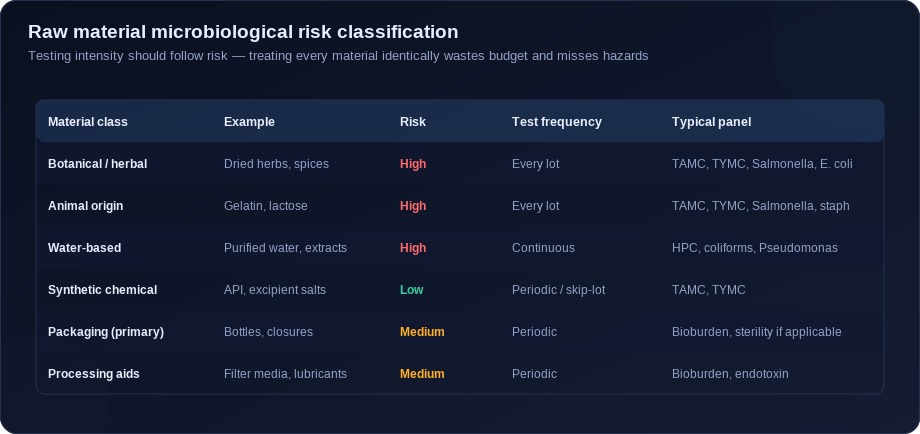
High risk — test every lot
- Botanical and herbal materials. Dried herbs, spices, plant extracts and powders. Harvested from soil, often sun-dried in open conditions, and routinely carrying high spore counts. The single most common source of Salmonella and elevated mould counts.
- Animal-origin materials. Gelatin, lactose, enzymes, collagen, dairy derivatives. Salmonella, staphylococci and enterobacteria risk.
- Water and aqueous materials. Purified water, liquid extracts, aqueous carriers. Support Pseudomonas, Burkholderia and biofilm organisms.
Medium risk — periodic testing
- Starches, gums and thickeners, which are hygroscopic and support growth if humidity is uncontrolled.
- Primary packaging in direct product contact, contributing bioburden to the product surface.
- Processing aids — filter media, lubricants, cleaning agents, compressed gases — frequently omitted from programmes entirely.
Low risk — skip-lot or certificate review
- Synthetic APIs, mineral salts, solvents. Genuinely inert, appropriate candidates for reduced testing once history supports it.
Tests to Apply
| Test | Applies to | Typical requirement |
|---|---|---|
| TAMC | All | Category-dependent limit |
| TYMC | Botanicals, starches, hygroscopic | Category-dependent limit |
| Escherichia coli | Oral, botanical, animal origin | Absent in 1 g or 10 g |
| Salmonella | Botanical, animal origin | Absent in 10 g or 25 g |
| Staphylococcus aureus | Heavily handled, animal origin | Absent in 1 g |
| Pseudomonas aeruginosa | Aqueous, high water activity | Absent in 1 g |
| Bile-tolerant Gram-negatives | Plant origin | Quantified or absent |
| Water activity | Hygroscopic materials | Below growth threshold |
| Aflatoxigenic mould ID | High-risk botanicals | Species identification |
Water Activity: The Parameter That Predicts Storage Behaviour
A count taken at receipt describes the material on the day it arrived. What matters is the count on the day it is used, and water activity governs the difference.
Below 0.60 essentially nothing grows. Most bacteria need above 0.90, most yeasts above 0.85, and xerophilic moulds can grow down to 0.65. A botanical powder received at 0.55 and stored through a humid monsoon can drift above 0.65 and begin supporting mould growth with nobody testing it again.
Material that passed at receipt and failed at use has usually not been contaminated. It has been allowed to grow what it already carried. This is why storage condition monitoring belongs inside the microbiological programme rather than being treated as a warehouse matter.
Method Suitability for Raw Materials
Many raw materials inhibit the very organisms the test is trying to recover — preservatives, essential oils, antimicrobial actives, high-salt and high-sugar matrices, alcohols and certain botanicals.
Method suitability spikes the material with fewer than 100 CFU of reference organisms and confirms recovery within an acceptable factor of a product-free control. Where recovery fails, the method is modified through increased rinse volume, membrane filtration, or validated neutralisers such as lecithin, polysorbate 80, sodium thiosulphate or histidine.
A raw material result reported without a documented suitability study is not a valid result, and it is among the most frequently cited inspection deficiencies.
Supplier Qualification and Certificate Reliance
Relying on a supplier certificate of analysis is legitimate and frequently done badly. A certificate means something only if you know the method, the limit of detection, whether suitability was demonstrated for that matrix, and whether the issuing laboratory is competent.
Qualified reliance looks like this:
- Initial full testing across at least three to five consecutive lots, independent of the supplier's own results.
- Correlation analysis — do their numbers track yours, or are theirs systematically lower?
- Documented criteria for entering certificate reliance, based on that correlation.
- Periodic verification testing at a defined frequency, typically one lot in ten to twenty.
- Defined criteria for withdrawing reliance when correlation breaks down or a failure occurs.
- Automatic reversion to full testing on any supplier change, process change or excursion.
The most common failure mode is a certificate stating "conforms to specification" with no numerical result. That statement is unverifiable and worth nothing in an audit. Require numerical results, method references and limits of detection as a condition of supply.
Building a Defensible Skip-Lot Programme
Skip-lot testing is legitimate, cost-effective and frequently indefensible as implemented, because the justification was never documented.
- Entry criteria. A defined number of consecutive compliant lots — twenty is a common threshold for medium-risk materials — with no excursions.
- Frequency. Stated explicitly, such as one lot in five or one in twenty, not left to judgement.
- Sampling within skip-lot. The lots tested should be selected systematically or randomly, not chosen by the person doing the testing.
- Exit criteria. Automatic reversion to every-lot testing on any failure, supplier change, process change, or extended supply gap.
- Periodic review. At least annually, reassessing whether the history still supports the reduction.
- Documentation. The rationale written down before the reduction starts, not reconstructed when an auditor asks.
Packaging and Processing Aids: The Forgotten Materials
Almost every raw material programme covers ingredients and almost none covers everything else that touches the product. These omissions account for a disproportionate share of unexplained contamination.
Primary packaging
Bottles, closures, tubes, films, blister foil and droppers contact the product directly and contribute bioburden to the product surface. For sterile, aqueous or preservative-free products this contribution is material.
- Bioburden per container or per unit area, established at qualification and monitored periodically.
- Particular attention to closures and droppers, which have complex geometry, are frequently handled, and are often stored uncovered.
- Storage conditions at the supplier and in your own warehouse — cardboard outers in a humid store are a mould source.
- Sterility where the packaging is supplied sterile, with certificate verification and periodic independent confirmation.
Processing aids
- Filter media — cartridges stored damp between uses become net microbial contributors rather than removers.
- Lubricants and mould release agents — frequently water-based and preserved, and capable of supporting growth once diluted or contaminated.
- Compressed air and process gases in direct product contact, which require both viable and particulate testing and are omitted from most programmes entirely.
- Cleaning agents and disinfectants — dilute working solutions of some disinfectants support growth of tolerant organisms, and contaminated disinfectant distributes contamination rather than removing it.
- Cooling and heat transfer fluids where a leak would reach product.
- Cleaning equipment — mops, brushes, buckets and hoses, which are among the most common vectors we find in contamination investigations.
Water used as an ingredient versus water used for cleaning
Both matter, and the second is frequently unspecified. Rinse water contacting product-contact surfaces after cleaning determines the microbiological state of those surfaces at the start of the next run. Testing the ingredient water while ignoring the final rinse water is a common and consequential gap, covered further in water and wastewater microbiology.
When a Raw Material Fails
- Confirm the result from the retained sample using the same validated method, ruling out laboratory error through a documented checklist.
- Identify the organism. The species names the source type — Salmonella points to animal or faecal origin, Pseudomonas to water, Bacillus spores to soil and botanicals, Staphylococcus to human handling.
- Quarantine and trace forward. Determine whether any of the lot entered production and which batches were made from it.
- Assess finished product impact. Consider whether downstream processing — heat, pH, preservation, water activity — would inactivate the organism.
- Engage the supplier with the identification, requesting their investigation, batch records and environmental data for the production period.
- Decide disposition — reject, return, reprocess where validated, or accept under documented concession only where risk assessment supports it.
- Revert to full testing for that material and supplier until confidence is re-established.
Decontamination for High-Load Botanicals
Some botanicals cannot be sourced within specification at any realistic price. For these the practical answer is a validated decontamination step rather than an endless rejection cycle.
| Method | Effectiveness | Trade-off |
|---|---|---|
| Saturated steam | High, sporicidal | Degrades volatile oils and heat-labile actives |
| Ethylene oxide | High | Restricted in several export markets; residue testing required |
| Gamma irradiation | High, minimal heat | Labelling and market acceptance vary by jurisdiction |
| Superheated dry steam | Moderate–high | Gentler on flavour; slower |
| Supercritical CO₂ | Moderate | Residue-free but capital intensive |
| Ozone / VHP | Surface only | Ineffective on powder interiors |
Whichever is chosen, the reduction claimed must be validated on the actual material rather than a surrogate, and the specification must state clearly whether it applies before or after treatment.
How DSTechnoverse Helps
We build raw material programmes that are proportionate to risk and defensible under audit, then run them. Clients usually arrive either because the current programme costs more than what it detects, or because a failure revealed it was never detecting much.
That work covers material risk classification across the full bill of materials, specification setting, method suitability per matrix, routine incoming testing, supplier qualification with correlation analysis, skip-lot programme design with documented entry and exit criteria, failure investigation with organism identification, and supplier-level trending so a deteriorating supplier is visible before they ship a failing lot.
Frequently Asked Questions
Can we rely on supplier certificates instead of testing?
Yes, if reliance is qualified — initial multi-lot verification, documented correlation, periodic re-verification and clear withdrawal criteria. Unqualified reliance is an audit finding waiting to happen.
How much sample should be tested?
Pharmacopoeial methods specify 10 g or 25 g depending on organism and market. The more important question is how many containers from the consignment are sampled — a single grab from one drum tells you about that drum.
Why do botanicals fail so often?
Because they are agricultural products. High spore counts and occasional Salmonella are inherent, not exceptional. Programmes should expect this and specify accordingly, often with a validated decontamination step.
Should packaging be tested microbiologically?
Primary packaging in direct product contact should be, particularly for sterile, aqueous or preservative-free products. It contributes bioburden directly and is routinely overlooked.
Does a high count always mean rejection?
Not necessarily. It depends on the limit, the organism and whether downstream processing inactivates it reliably. The decision should follow a documented risk assessment rather than a reflex.
Should in-process intermediates be tested as well as incoming materials?
Where there is a hold step, yes. An intermediate held wet and warm between processing stages can multiply a modest incoming load into a substantial one, and that growth happens after the raw material test has already passed. Any hold longer than a few hours in a growth-permissive condition deserves a defined limit and periodic verification.
How do we handle a material supplied by multiple vendors?
Treat each vendor as a separate material for qualification and trending purposes, even under a single material code. Vendors differ in origin, process and hygiene, and a combined trend hides a deteriorating supplier behind a compliant one. Skip-lot status should be earned per vendor, never inherited across them.
How long does raw material testing take?
Three to five days for counts, four to seven including pathogen confirmation. Where release speed matters, validated rapid methods can reduce this substantially.
Need a microbiological testing programme built around your actual risk? DSTechnoverse provides industrial microbiological testing and raw material testing from our laboratory in Indore, serving manufacturers throughout Madhya Pradesh and across India. Talk to our microbiology team about your materials and specifications.
Sources and Further Reading
Official and primary sources for the standards, rules and data discussed on this page.
- United States Pharmacopeia (USP): the compendial microbiology chapters such as <61>, <62>, <71> and <1116>.
- ISO 14644-1:2015 Cleanroom classification: the international standard for cleanroom particle classes.
- EudraLex Volume 4: EU GMP Guidelines: includes Annex 1 (2022) on the manufacture of sterile medicinal products.
- US FDA: Sterile Drug Products Produced by Aseptic Processing: FDA guidance on aseptic processing, media fills and monitoring.
Related services
Related articles
- Supplier Qualification for Microbiological Quality: Beyond the Certificate of Analysis
- Anaerobic Microbiological Testing: The Organisms Standard Methods Never See
- ATP Bioluminescence Testing: What It Measures and Where It Belongs
- Botanical Raw Materials: Why Microbial Counts Are High and What to Do About It