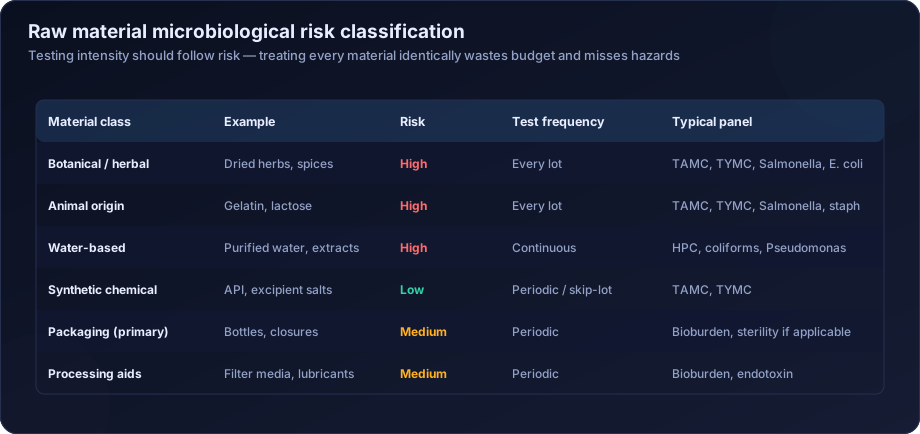
Botanical raw materials fail microbiological specifications more often than any other material class, and manufacturers new to the sector frequently treat each failure as an incident. It is not an incident. It is the predictable consequence of an agricultural supply chain, and it needs a structural response rather than a series of rejections.
Why Botanical Counts Are Inherently High
Every step of a botanical supply chain adds microbial load, and almost none of it removes any.
- Soil contact. Roots, rhizomes and low-growing herbs are harvested in direct contact with soil, which carries 10⁶ to 10⁹ organisms per gram, dominated by spore-forming Bacillus and Clostridium species and environmental moulds.
- Open-air drying. Sun-drying on ground sheets or platforms exposes material to dust, birds, insects and rodents for days.
- Manual handling. Harvesting, sorting and packing are labour-intensive, adding staphylococci and other human flora at multiple points.
- Ambient storage and transport. Frequently uncontrolled for temperature and humidity, allowing growth during transit.
- Moisture cycling. Hygroscopic plant material absorbs and releases moisture with ambient humidity, and each wet phase permits growth.
- Grinding. Reduces particle size and distributes surface contamination through the bulk, while generating heat and moisture that can favour growth.
The result is that a total aerobic count of 10⁵ to 10⁷ CFU/g in an untreated dried botanical is normal rather than exceptional, and spore formers typically dominate.
What the Pharmacopoeias Actually Require
Because botanical reality differs from synthetic reality, the compendia apply separate criteria — and they distinguish by whether boiling water is added before use, since that step itself provides a reduction.
| Category | TAMC | TYMC | Specified organisms |
|---|---|---|---|
| Herbal products with boiling water added before use | 10⁷ CFU/g | 10⁵ CFU/g | E. coli limit; Salmonella absent |
| Herbal products used without boiling water | 10⁵ CFU/g | 10⁴ CFU/g | E. coli, Salmonella; bile-tolerant Gram-negative limits |
| Herbal materials for further processing | Set by the downstream process | Set by process | Risk-based |
Two practical points follow. First, a specification must state clearly whether it applies before or after any decontamination step — the two differ by orders of magnitude and confusing them causes avoidable rejections. Second, the specification must match the intended use; applying an inhalation-product limit to a herbal tea ingredient is a self-inflicted problem.
Which Organisms Matter and Which Do Not
Not every organism in a botanical is a hazard, and treating them as equivalent leads to poor decisions.
Usually not a direct hazard:
- Aerobic spore formers such as Bacillus subtilis and B. licheniformis, ubiquitous in soil and generally harmless in the quantities present.
- Environmental moulds without toxigenic potential.
- Common soil actinomycetes.
Genuinely important:
- Salmonella — never acceptable, always a full investigation, and the most common serious finding in botanicals.
- Escherichia coli — indicates faecal contamination, either through irrigation water or handling.
- Bacillus cereus — a spore former that is also a toxin producer, so unlike its harmless relatives it warrants species-level attention.
- Toxigenic Aspergillus and Penicillium — the aflatoxin and ochratoxin producers, discussed below.
- Clostridium perfringens — soil-derived and relevant where the downstream process creates anaerobic conditions.
This is precisely why organism identification matters more for botanicals than for almost any other material class. A TYMC of 10⁴ composed of Cladosporium is a very different situation from the same count composed of Aspergillus flavus.
Aflatoxin: The Risk Behind the Mould Count
A fungal count in a botanical should not be treated as a microbiological result alone. Certain Aspergillus species produce aflatoxins B1, B2, G1 and G2, and Penicillium and Aspergillus species produce ochratoxin A. These are potent hepatotoxins and carcinogens, they are heat-stable, and — critically — they persist after the mould that produced them has been killed.
This has an important consequence: decontamination reduces the microbial count but does not remove the toxin. A material sterilised after mould has already grown may pass every microbiological test while remaining unsafe.
The correct approach couples the two:
- Enumerate TYMC as standard.
- Identify moulds to species where counts are elevated, distinguishing toxigenic from benign species.
- Test for aflatoxin and ochratoxin A directly on high-risk materials — chilli, nutmeg, groundnut-associated botanicals, dried figs, certain roots — regardless of the mould count.
- Treat a high historical mould count as a toxin risk indicator even if the current count is low after treatment.
Choosing a Decontamination Method
For many botanicals, a validated decontamination step is the only economically viable route to specification.
| Method | Log reduction | Sporicidal | Impact on actives | Market acceptance |
|---|---|---|---|---|
| Saturated steam | 3–5 | Yes | Degrades volatile oils significantly | Broad |
| Superheated dry steam | 2–4 | Partial | Moderate; better flavour retention | Broad |
| Ethylene oxide | 4–6 | Yes | Minimal | Restricted in EU and several markets |
| Gamma irradiation | 4–6 | Yes | Minimal thermal impact | Varies; labelling obligations |
| Supercritical CO₂ | 2–4 | Partial | Very low | Broad but capital intensive |
| Ozone | 1–3 | No | Low; surface only | Limited on powders |
Selection depends on three things: the reduction required to reach specification, the sensitivity of the actives, and the export markets involved. Ethylene oxide in particular has narrowed considerably as an option because of residue restrictions in the EU and elsewhere.
Whatever is chosen, the reduction must be validated on the actual material. A method achieving 5-log on a surrogate may achieve considerably less on a dense powder where penetration is limited.
Controlling Load at Source
Decontamination treats the symptom. The suppliers who consistently deliver lower counts do specific things differently, and it is worth building these into supply agreements.
- Raised drying platforms rather than ground sheets, eliminating direct soil contact during the longest exposure period.
- Covered or solar-tunnel drying, excluding birds, insects and dust while accelerating moisture removal.
- Rapid drying to below 0.6 water activity, since the total time spent in the growth-permissive moisture range determines the final count more than any other variable.
- Potable irrigation water — irrigation with contaminated surface water is a leading cause of E. coli and Salmonella in botanicals.
- Controlled storage humidity, preventing the moisture cycling that allows growth after drying.
- Hygiene standards for manual handling, including hand washing facilities at sorting and packing points.
- Segregated storage preventing cross-contamination between untreated botanicals and treated or finished material.
The Regulatory Landscape for Botanicals
Botanical materials sit across several regulatory frameworks in India, and which one applies depends on how the finished product is presented rather than on the material itself. The same dried herb can be a food ingredient, a nutraceutical component, an Ayurvedic drug substance or a cosmetic input, with different microbiological expectations in each case.
- FSSAI governs botanicals used as food or in nutraceuticals, with category-specific microbiological criteria and mycotoxin limits under the Food Safety and Standards Regulations.
- AYUSH requirements apply to Ayurvedic, Siddha and Unani medicines, referencing the Ayurvedic Pharmacopoeia of India for identity, purity and microbial limits.
- Indian Pharmacopoeia herbal monographs apply where the botanical is a pharmaceutical drug substance.
- BIS standards cover several specific commodities including spices.
- Export markets add their own layer. The USP herbal medicines compendium, Ph. Eur. herbal drug monographs and the EU's ethylene oxide restrictions all bear on material that will leave India.
Two practical consequences follow. First, a single botanical supplied into multiple product streams may need to meet the strictest applicable specification, or be segregated by intended use. Second, the decontamination method chosen can itself close export markets — ethylene oxide residues in particular have caused substantial recall activity in the EU for spices and botanical ingredients, and a treatment that is acceptable domestically may not be for an export line.
We recommend clients map each botanical against every product stream it feeds and every market those products reach, then set the specification and treatment accordingly. That mapping is usually a short exercise and it prevents the expensive discovery that a treated lot cannot be used for the export batch.
Testing Programme for Botanicals
- Test every lot — botanicals do not qualify for skip-lot programmes without exceptional and documented justification.
- Run TAMC, TYMC, E. coli, Salmonella and bile-tolerant Gram-negatives as the standard panel.
- Measure water activity at receipt and set storage conditions from it.
- Identify moulds to species where TYMC is elevated.
- Test mycotoxins on high-risk species regardless of mould count.
- Test before and after decontamination where a treatment step exists, so the reduction achieved is documented per lot rather than assumed from validation.
- Trend by supplier and by season — botanical counts vary predictably with harvest timing and monsoon, and a supplier whose counts rise outside that pattern is worth investigating.
How DSTechnoverse Helps
Botanical materials need a programme designed for agricultural variability rather than one borrowed from synthetic chemistry. We build that programme and run the testing behind it.
Our work here covers full botanical panels, water activity determination, mould speciation to distinguish toxigenic from benign species, mycotoxin risk assessment alongside microbiological testing, decontamination validation on the actual material, supplier-level and seasonal trending, and specification setting that matches the intended use rather than defaulting to the strictest available limit.
We also help clients tell the difference between a supplier problem and a botanical reality — a distinction that determines whether the right response is a supplier change or a process step.
Frequently Asked Questions
Are high counts in botanicals a supplier failure?
Usually not by themselves. High spore counts are inherent to open-field agriculture. What indicates a supplier problem is E. coli or Salmonella, counts well outside the seasonal norm, or a rising trend against their own history.
Does sterilisation solve the problem?
It solves the microbiological count. It does not remove mycotoxins already produced, which are heat-stable and survive every practical decontamination method. Toxin risk must be managed separately.
Which decontamination method is best?
There is no universal answer. Steam is effective and broadly accepted but damages volatile oils. Irradiation preserves actives but carries labelling implications. The choice depends on the material, the actives and the export markets.
Do Ayurvedic and traditional medicine materials follow the same limits?
They follow the herbal product categories in the pharmacopoeias, with AYUSH requirements applying additionally in India. The distinction between products taken with and without boiling water is particularly relevant to traditional preparations.
Should we test every lot of botanical material?
Yes. The lot-to-lot variability in botanicals is far greater than in synthetic materials, and a skip-lot programme built on a handful of compliant lots does not reflect that variability.
Can organic certification and low microbial counts coexist?
Yes, but the levers differ. Organic status restricts certain fumigants and treatments, which narrows the decontamination options — irradiation in particular is excluded under most organic standards. The workable route is upstream control: raised drying platforms, rapid drying to low water activity, potable irrigation water and controlled storage. Suppliers achieving consistently low counts on organic botanicals almost always do it through drying practice rather than treatment.
Should botanical extracts be tested differently from whole or powdered material?
Yes. Extraction changes the microbiological picture substantially in both directions. Solvent extraction with ethanol reduces counts considerably and leaves a residue that inhibits recovery, so method suitability becomes essential. Aqueous extracts, by contrast, frequently have higher water activity than the source material and can support growth that the dried botanical never could. Treat the extract as a distinct material with its own specification rather than inheriting the raw botanical's limits.
How much seasonal variation should we expect?
Considerable, and it should be built into the trend baseline rather than treated as a series of excursions. Monsoon-harvested and monsoon-stored material routinely shows counts an order of magnitude above dry-season equivalents. A supplier whose counts rise in step with the season is behaving normally; one whose counts rise outside that pattern is worth investigating.
Why do counts rise during storage?
Because water activity drifted above the growth threshold, usually through humid ambient storage. The material was not recontaminated; it grew what it already carried. Storage humidity control is the fix.
Need a microbiological testing programme built around your actual risk? DSTechnoverse provides industrial microbiological testing and raw material testing from our laboratory in Indore, serving manufacturers throughout Madhya Pradesh and across India. Talk to our microbiology team about your materials and specifications.
Related services
Related articles
- Herbal and Nutraceutical Finished Products: Setting Microbial Specifications
- Anaerobic Microbiological Testing: The Organisms Standard Methods Never See
- ATP Bioluminescence Testing: What It Measures and Where It Belongs
- Finished Product Microbiological Release Testing: Specifications, Sampling and What It Proves