Industrial microbiological testing is the evidence base behind a claim every manufacturer makes implicitly: that the product leaving the factory will not harm the person who uses it, spoil before its stated shelf life, or breach the specification a regulator approved. This guide covers what that testing actually involves, which tests apply to which products, what the standards require, and — more usefully — where testing programmes commonly fail while appearing to work.
What Is Industrial Microbiological Testing?
Industrial microbiological testing is the systematic detection, enumeration and identification of microorganisms in and around a manufacturing process. It spans incoming raw materials, process water, the production environment, equipment surfaces, personnel, in-process intermediates and finished product.
It is not a single test. It is a programme of related tests, each answering a different question at a different point in the process. Treating it as a checkbox at the end of production is the single most common structural mistake, because end-product testing is statistically the weakest point at which to look for contamination.
Which Industries Require It
The regulatory driver differs by sector but the underlying risk does not.
| Sector | Primary regulator / standard | Typical core tests |
|---|---|---|
| Pharmaceuticals | CDSCO, Schedule M, IP / USP / Ph. Eur. | Microbial limits, sterility, bioburden, endotoxin |
| Food & beverage | FSSAI microbiological criteria | TPC, coliforms, E. coli, Salmonella, Listeria, yeasts & moulds |
| Cosmetics & personal care | BIS, IS 4011 and international equivalents | Microbial limits, specified organisms, preservative efficacy |
| Nutraceuticals | FSSAI, AYUSH where applicable | TAMC, TYMC, Salmonella, E. coli, aflatoxin risk |
| Medical devices | ISO 11737 series, notified body | Bioburden, sterility, endotoxin |
| Packaged water | IS 10500, IS 14543 | Coliforms, E. coli, Pseudomonas, HPC |
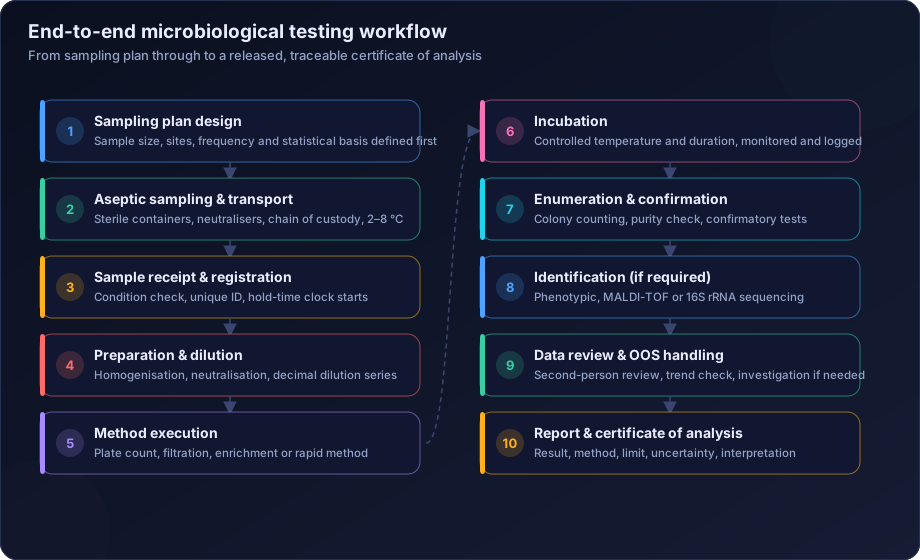
The Full Testing Chain
A complete programme covers the process rather than only its output.
- Raw material screening — the cheapest interception point in the chain. Contamination stopped at goods-inwards costs a fraction of contamination found in finished product.
- Water testing — the most common single source of contamination in manufacturing, and the most under-monitored utility in most plants.
- Environmental monitoring — measuring the microbiological quality of the space the product is made in, which gives weeks of early warning before a batch fails.
- Surface and personnel verification — evidence that cleaning and gowning procedures are still achieving what they were validated to achieve.
- In-process testing — bioburden at defined control points, particularly before a sterilisation or filtration step.
- Finished product release — verification that a controlled process performed as expected.
- Stability and shelf-life — confirmation that the product still meets specification at the end of its claimed life.
The Core Tests Explained
Total Aerobic Microbial Count (TAMC)
The general indicator of microbiological quality. Culturable aerobic bacteria enumerated on Soybean Casein Digest Agar at 30–35 °C for three to five days, reported as CFU per gram or millilitre. A rising TAMC across batches is one of the earliest signals that process hygiene is deteriorating.
Total Yeast and Mould Count (TYMC)
Fungal enumeration on Sabouraud Dextrose Agar at 20–25 °C for five to seven days. Critical for botanicals, starches, and any hygroscopic material. Note that TYMC is a combined figure — yeasts and moulds are not reported separately.
Specified Organism Testing
Absence tests for organisms that must not be present at all: E. coli, Salmonella, Staphylococcus aureus, Pseudomonas aeruginosa, bile-tolerant Gram-negatives and Candida albicans, depending on product category. Every absence requirement is tied to a sample quantity — "absence of Salmonella" is not a specification, "absence of Salmonella in 25 g" is.
Sterility Testing
A binary test for products required to contain no viable organisms, under a 14-day incubation. Covered in depth in our sterility testing service.
Bioburden
Pre-sterilisation microbial load, used to validate and control the sterilisation process. See bioburden testing.
Acceptance Criteria by Route of Administration
Limits scale with how directly a product reaches vulnerable tissue and how well it supports growth.
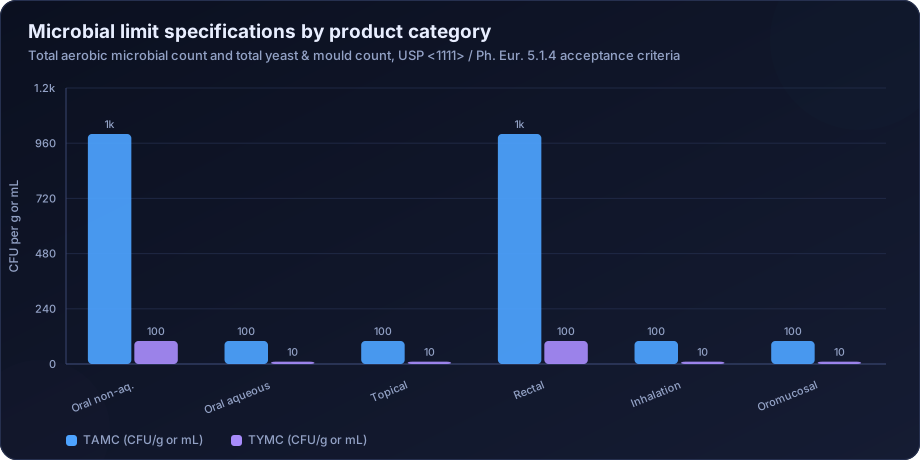
A non-aqueous oral tablet has a water activity too low to support growth at all, which is why its limits are relatively permissive at TAMC 1000 CFU/g. An aqueous inhalation product delivered directly to lung tissue sits at the opposite extreme.
One detail is widely misapplied: compendial count limits carry a 2x interpretation factor because plate counting is inherently variable. A TAMC limit of 1000 CFU/g is exceeded at results above 2000 CFU/g. This applies to counts only — never to specified organism absence, which is absolute.
Standards and Methods
Testing should never use an invented method. The recognised references are:
- Indian Pharmacopoeia (IP) — the primary reference for the Indian regulatory pathway.
- USP — chapters <61>, <62>, <71>, <51>, <1111> and <1116>.
- European Pharmacopoeia — 2.6.12, 2.6.13, 2.6.1 and 5.1.4 as harmonised equivalents.
- ISO 11737-1 and -2 — bioburden and sterility for medical devices.
- FDA Bacteriological Analytical Manual — food pathogen reference methods.
- FSSAI microbiological criteria — Indian food category limits.
- BIS IS 10500 and IS 14543 — drinking and packaged water.
Sampling Plans Determine What Testing Can Prove
This is the part of industrial microbiology that is least discussed and most consequential.
Testing five units from a batch of fifty thousand and concluding the batch is free of Salmonella is a mathematically limited statement. If contamination is present in one per cent of units, a five-unit sample has roughly a 95 per cent probability of missing it entirely.
That is not an argument against testing. It is an argument for two things: designing the plan around the consumer risk you are prepared to accept, and recognising that testing verifies a controlled process rather than substituting for one.
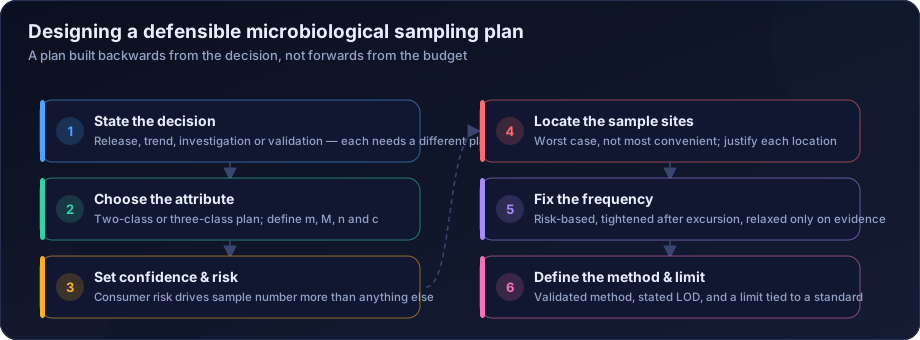
A manufacturer relying on end-product testing to catch contamination has already lost. A manufacturer using testing to confirm that validated controls remain effective is using it correctly. We cover this in detail in how to design a microbiological sampling plan.
Method Suitability: The Step Most Programmes Skip
Before any result can be trusted, the method must be shown to work in that specific product. Many products — preservatives, essential oils, antimicrobial actives, high-salt or high-sugar matrices, alcohols, certain botanicals — actively inhibit the growth of the organisms the test is trying to recover.
Method suitability spikes the product with a defined low inoculum of reference organisms and confirms recovery within an acceptable factor. Where recovery fails, the method must be modified: increased dilution, membrane filtration with rinsing, or specific neutralisers such as lecithin, polysorbate 80, sodium thiosulphate or histidine.
A result reported without a documented suitability study is not a valid result. This is among the most frequently cited deficiencies in regulatory inspection, and it is the first thing we check when reviewing an existing programme.
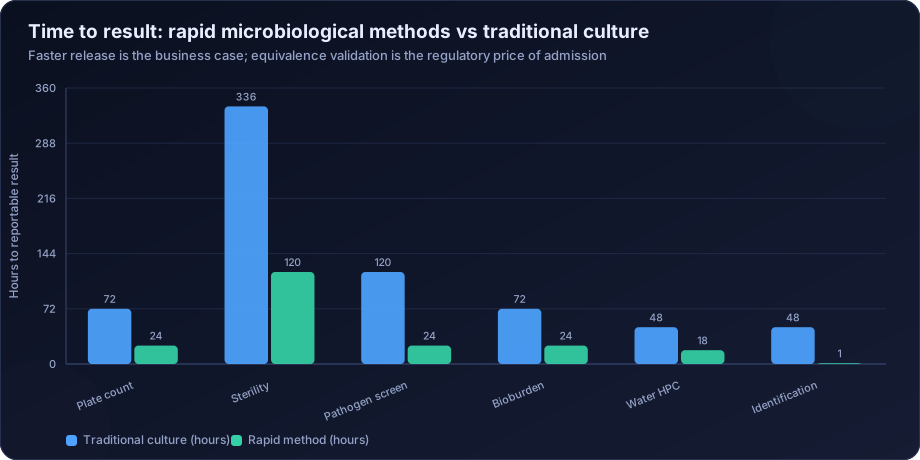
Turnaround Times and What Drives Them
Microbiological turnaround is governed by biology. Organisms grow at the rate they grow.
| Test | Typical turnaround | Driver |
|---|---|---|
| TAMC / TYMC | 3–5 days | Incubation period |
| Specified organisms | 4–7 days | Enrichment plus confirmation |
| Sterility | 14 days | Compendial requirement, not reducible |
| Bioburden | 3–7 days | Extraction plus incubation |
| Water coliforms | 18–24 hours | Enzyme substrate methods |
| Identification (MALDI-TOF) | Under 1 hour | Instrument based |
| Preservative efficacy | 28 days | Protocol duration |
Validated rapid methods can compress several of these considerably, at the cost of an equivalence validation. See rapid microbiological methods for whether that trade is worth making.
Where Testing Programmes Quietly Fail
Most laboratories are engaged after something has gone wrong. These are the recurring causes, and every one is preventable.
- No method suitability — antimicrobial residue suppressing growth, producing a false clean result that survives until an external laboratory disagrees.
- Recovery efficiency never established — surface and bioburden results reported as absolute when only 40 per cent of organisms were ever extracted.
- Convenient sampling sites — environmental locations chosen because they are easy to reach rather than because organisms are likely to be there.
- Borrowed limits — alert and action levels copied from a guidance table rather than derived from the facility's own data, so they never trigger until a real breach.
- Assumed incubator temperature — never mapped, systematically under-recovering one organism group.
- Isolates discarded — destroying the only evidence that would have identified a contamination source months earlier.
- OOS invalidated without investigation — the single most common serious audit finding.
- Trend data collected but never analysed — a slow twelve-week drift noticed only when it crosses the limit.
Trending Matters More Than Pass or Fail
A binary result against a specification discards most of the information a programme generates. The batches that matter are frequently the ones that passed — with a count three times the historical average.
Statistical process control on log-transformed counts, run rules to detect drift, and capability analysis against the specification convert a compliance record into an early warning system. A process drifting toward its limit typically gives eight to twelve weeks of warning in the data. Manufacturers who track only pass or fail discover the problem at the failure.
Building a Programme: Practical Sequence
- Classify every material, utility and area by microbiological risk, with documented rationale.
- Set specifications from the applicable pharmacopoeia or regulation, stating limit, sample quantity, method and limit of detection.
- Establish method suitability for every product matrix before routine testing begins.
- Design sampling plans around the decision each test supports, and state their limitations honestly.
- Derive alert and action limits from your own historical data, capped at regulatory maxima.
- Execute with controlled media, mapped incubators and documented analyst competence.
- Identify isolates and build a facility flora library.
- Trend everything statistically and review formally at defined intervals.
- Investigate excursions with a structured protocol and verify effectiveness before closing.
How DSTechnoverse Helps
We work as a specialist microbiological testing and data partner — running the programme end to end, or strengthening the parts of an in-house laboratory that are weakest, which is usually sampling design, method validation, trending and investigation.
Our differentiator is analytical. We come from a data analysis background, so the control charting, capability analysis and investigation logic behind a programme get the same rigour as the plating technique. Most contract laboratories return numbers. We return numbers with an interpretation you can act on.
Services span raw material testing, finished product release, environmental monitoring, water microbiology, surface testing, sterility, bioburden, identification and contamination investigation.
Frequently Asked Questions
How often should microbiological testing be performed?
Risk-based and documented. High-risk materials such as botanicals, animal-derived ingredients and water are typically tested every lot or continuously. Low-risk synthetic materials can move to periodic or skip-lot testing once supplier history justifies it. Frequency should tighten automatically after any excursion.
Can testing prove a batch is safe?
No, and any laboratory claiming otherwise is misleading you. Testing provides statistical confidence proportional to the sampling plan. Safety comes from a validated process, with testing verifying that controls remain effective.
Do we need NABL-accredited results?
For most regulatory submissions, customer audits and export documentation, accredited results carry materially more weight. For internal process monitoring they often add cost without adding acceptance.
What is the difference between microbial limit testing and sterility testing?
Microbial limit testing enumerates how many organisms are present and screens for specified pathogens in a non-sterile product. Sterility testing asks a binary question about a product required to contain none at all, under 14-day incubation. They are not interchangeable.
What happens when a result is out of specification?
A documented OOS investigation: confirm the result, rule out laboratory error through a defined checklist, identify the organism, assess batch impact, investigate the source. Results are never invalidated without documented justification.
How quickly can a testing programme start?
Routine testing can usually begin within a week of agreeing the specification and sampling plan. Where method suitability or neutralisation validation is needed for a new matrix, allow two to three weeks before the first reportable result.
Need microbiological testing backed by a defensible sampling plan? DSTechnoverse provides industrial microbiological testing for pharmaceutical, food, cosmetic and manufacturing operations. We are based in Indore, Madhya Pradesh and serve clients across India — raw materials, in-process, water, environment and finished product against pharmacopoeial and ISO methods. Talk to our microbiology team about your product and specification.
Related services
Related articles
- Food Microbiology Testing Under FSSAI: Criteria, Pathogens and Shelf-Life Substantiation
- Microbial Limit Testing Under USP <61> and <62>: A Complete Practical Guide
- Anaerobic Microbiological Testing: The Organisms Standard Methods Never See
- ATP Bioluminescence Testing: What It Measures and Where It Belongs