For many Indian founders, a Dubai company is as much about residence as about business: a UAE residence visa lets you live in Dubai, open personal bank accounts, sponsor your family and travel easily across the region. For the business, visas decide who can work in the UAE — the founders, the managers and the staff.
The UAE's visa system has changed a great deal in recent years, with new long-term and self-sponsored options alongside the traditional company-sponsored visas. This guide explains the visas Indian business owners and their teams actually use, how the company's licence and office determine how many visas it can sponsor, the step-by-step process, family sponsorship, the Golden and Green visas, the employer's obligations, and what moving to Dubai changes on the Indian side.
The Visas at a Glance
| Visa | For | Sponsored by | Typical use |
|---|---|---|---|
| Visit visa | Short visits for meetings and setup | Self (e-visa or on arrival where eligible) or a host | Setting up the company, meeting banks and clients |
| Investor or partner residence visa | Shareholders of a UAE company | The company (through the owner's shareholding) | Founders who live in or regularly work from Dubai |
| Employment residence visa | Employees | The company | Managers and staff |
| Family residence visa | Spouse, children, sometimes parents | The resident family member | Moving the family to Dubai |
| Golden visa (10 years) | Investors, entrepreneurs, skilled professionals, exceptional talents meeting criteria | Self | Long-term residence not tied to employment |
| Green visa (5 years) | Skilled employees, freelancers, investors meeting criteria | Self | Self-sponsored residence |
| Freelance permit with residence | Independent professionals in listed fields | A free zone authority | Self-employed individuals |
| Remote work visa | Employees of companies outside the UAE | Self | Living in Dubai while working for an employer abroad |
Criteria, durations and fees are set by the immigration authorities — the federal Authority for Identity, Citizenship, Customs and Port Security (ICP) and, in Dubai, the General Directorate of Residency and Foreigners Affairs (GDRFA) — and they change from time to time. Check the current rules for your case.
While You Set Up: Visit Visas
Most of the setup can be done from India, but you will usually need to visit Dubai for bank meetings, office viewings and, later, the residence visa medical test and biometrics.
- Indian passport holders can apply for a UAE visit visa online for short stays, usually for 30 or 60 days.
- Indian nationals who hold a valid US visa or green card, or a residence permit of the UK or an EU country, can generally obtain a visa on arrival for a short stay, subject to the current conditions.
- A visit visa does not allow you to work in the UAE. It is for visiting, meeting and setting up. Once the company is licensed, the residence visa process can usually be started from inside the UAE through a change of status, or from outside with an entry permit.
Investor and Partner Residence Visas
A shareholder of a UAE company can obtain a residence visa sponsored through the company — usually called an investor visa for shareholders of a limited liability or free zone company, or a partner visa in some forms. Typical points:
- The visa is linked to the shareholding: the company must be licensed, have an establishment card and have visa quota available.
- Some authorities set minimum shareholding or capital conditions for investor visas; free zones set their own rules.
- Investor visas are usually issued for two or three years and renewed with the licence.
- An investor visa holder can sponsor family members, subject to the income and accommodation conditions.
- Being a shareholder does not by itself require you to live in the UAE, but banks and the Indian tax position (see below) make residence an important decision.
Employment Visas and Work Permits
Employees of a Dubai company need an employment residence visa and a work permit:
- On the mainland, work permits are issued through the Ministry of Human Resources and Emiratisation (MOHRE), with a registered employment contract, and the residence visa through the immigration authorities.
- In free zones, the free zone authority issues the employment documents and processes the residence visa with the immigration authorities.
- Employment visas are generally issued for two years and renewed.
- The employer pays the visa costs and must provide health insurance where it is mandatory.
- Salaries must be paid through the Wage Protection System on the mainland and in many free zones.
Hiring staff from India follows the same process; the employee needs an entry permit, then the medical test, Emirates ID biometrics and the residence visa once in the UAE.
How Many Visas Can the Company Sponsor?
The visa quota — the number of residence visas a company can sponsor — is one of the most practical reasons to choose a particular jurisdiction and office.
- On the mainland, the quota is linked mainly to the size of the registered office: a larger office allows more visas.
- In free zones, the quota depends on the package or the space leased in the zone; a flexi-desk may allow only one or two visas, an office more, a warehouse more still.
- Some activities or legal forms have their own rules.
If you plan to bring several family members, managers and staff in the first two years, count the visas you need before you choose the office. Upgrading space later is usually possible, but not always in the same building or package.
The Residence Visa Process, Step by Step
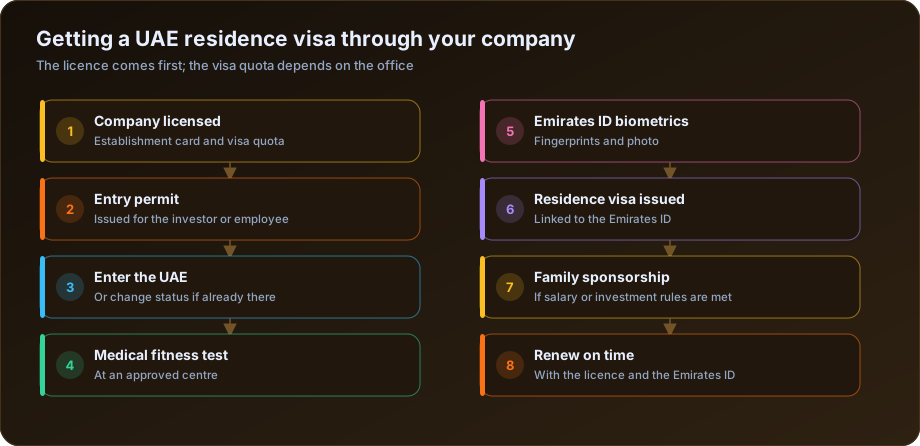
- Company licensed and registered with immigration. The establishment card (immigration registration) is issued after the licence.
- Entry permit. The company applies for an entry permit for the investor or employee; if the person is already in the UAE on a visit visa, a change of status can often be done instead.
- Entry or change of status. The person enters the UAE on the entry permit, or changes status inside the country.
- Medical fitness test at an approved health centre.
- Emirates ID biometrics — fingerprints and photograph.
- Residence visa issued. The UAE now issues residence electronically, linked to the Emirates ID, rather than as a sticker in the passport.
- Health insurance in place for the visa holder.
- Family sponsorship next, if required.
The whole process typically takes a few weeks once the company is licensed, depending on the authority and on how quickly the medical and biometrics appointments are completed.
Documents for an Investor Visa
Requirements vary by authority, but founders are usually asked for:
- passport (valid for at least six months) and passport-size photographs with the specified background;
- the company's trade licence, establishment card, memorandum of association or share certificate showing the shareholding;
- the current visa page or entry stamp if already in the UAE;
- the medical fitness certificate and Emirates ID application once in the UAE;
- health insurance details;
- for some categories, proof of the company's capital or the investor's contribution.
Attesting Indian Documents for the UAE
Documents issued in India — degree certificates for skilled categories, marriage and birth certificates for family visas, company documents for corporate shareholders — usually have to be attested before UAE authorities accept them. The typical chain for personal documents is:
- State-level verification of the document by the issuing state's designated department (for educational and personal documents).
- Attestation by the Ministry of External Affairs of India.
- Attestation by the UAE Embassy in New Delhi or a UAE consulate in India.
- Attestation by the UAE Ministry of Foreign Affairs once the document is in the UAE.
Commercial documents follow a similar route through the appropriate chambers and authorities. The steps take time, so start attesting the documents you will need — especially marriage and birth certificates for the family and degree certificates for long-term visa applications — while the company is being set up, not after the investor visa is issued.
A Realistic First Ninety Days
| Period | Company | Founder | Family |
|---|---|---|---|
| Weeks 1–3 | Jurisdiction, activities and office chosen; licence applied for | Visit Dubai on a visit visa for meetings and office viewing | Start attesting marriage and birth certificates in India |
| Weeks 3–6 | Licence issued; establishment card; bank file submitted | Entry permit or change of status; medical test; Emirates ID biometrics | Choose schools, housing areas |
| Weeks 6–9 | Bank account opened; corporate tax registration | Residence visa issued; personal bank account; tenancy contract | Family entry permits once the tenancy and income documents are ready |
| Weeks 9–13 | First staff visas; payroll set up | — | Family medicals and Emirates IDs; residence visas issued |
Actual timelines depend on the authority, the activities and how quickly documents and appointments are completed; regulated activities and corporate shareholders add time.
What Drives Visa Costs
We do not publish fees, which change, but the cost of each residence visa is made up of:
- government fees for the entry permit, change of status and residence;
- the medical fitness test and Emirates ID;
- health insurance, which varies with age and cover;
- any establishment card and quota-related fees for the company;
- typing and processing charges, and any fast-track services;
- attestation costs for family and qualification documents.
For budgeting, count every person — founders, family and staff — and include renewals every two or three years.
Sponsoring Your Family
A UAE resident can sponsor a spouse and children, and in some cases parents, if they meet the income and accommodation requirements set by the authorities. Typical documents:
- marriage certificate and children's birth certificates, attested for use in the UAE (Indian documents usually need attestation through the Indian and UAE authorities);
- proof of income — salary certificate or employment contract for employees, or evidence of the company and income for investors;
- a registered tenancy contract for accommodation suitable for the family;
- health insurance for each family member.
Each family member goes through the medical test (adults) and Emirates ID biometrics. Planning the family's move alongside the company setup avoids long gaps between the founder's visa and the family's. School admissions in Dubai also run on their own calendar, so families with children should check admission timelines early.
Long-Term Visas: Golden and Green
Golden Visa (10 years)
The UAE Golden Visa is a renewable ten-year residence visa that does not depend on an employer. It is available in several categories, each with criteria set by the authorities, including:
- real estate investors who own property above a set value;
- investors in UAE companies or funds meeting capital or investment conditions;
- entrepreneurs with an approved or qualifying business project;
- skilled professionals meeting salary, qualification and occupation criteria;
- exceptional talents, researchers, outstanding students and some other categories.
Golden Visa holders can sponsor family members, including adult children in some cases, and the visa remains valid even if the holder spends long periods outside the UAE.
Green Visa (5 years)
The Green Visa is a five-year self-sponsored residence visa for, among others, skilled employees meeting salary and qualification criteria, freelancers and self-employed people, and investors or partners meeting the conditions. It removes the need for an employer or a company to sponsor the visa.
For a founder, the practical question is whether a long-term visa is worth pursuing in addition to the investor visa through the company. If you qualify, a Golden Visa gives continuity even if the company is restructured or closed. Check the current criteria; thresholds and categories are revised from time to time.
Freelance and Remote Work Options
- Freelance permits in some free zones allow independent professionals in listed fields to work for themselves with a residence visa, without forming a company.
- The remote work visa allows employees of companies outside the UAE to live in Dubai while continuing to work for their foreign employer, subject to income and other conditions.
Neither is a substitute for a company if you plan to trade, hire staff or invoice UAE clients at scale. They can, however, be useful stepping stones: a professional can test the market on a freelance permit, then form a company once the client base justifies it, and a remote worker can explore Dubai before committing a business there.
Golden Visa or Investor Visa: Which Should a Founder Hold?
The two are not exclusive. An investor visa through your own company is quick to obtain once the company exists and lasts as long as the company and your shareholding. A Golden Visa takes more effort and requires meeting a category's criteria, but it lasts ten years, does not depend on the company and is not affected by long stays outside the UAE. Founders who qualify often start with the investor visa and apply for the Golden Visa once they meet the criteria — for example after investing in property or once the business qualifies under an investor or entrepreneur category.
Health Insurance and the Emirates ID
- Health insurance is mandatory for residents in Dubai, and the requirement has been extended across the UAE; employers must provide it for employees, and sponsors for their dependants.
- The Emirates ID is the key identity document for residents. It is needed for banking, tenancy registration, utilities, mobile phone contracts and government services, and it must be renewed with the visa.
Renewals, Cancellations and Grace Periods
- Residence visas are renewed before expiry, together with the Emirates ID, the medical test where required, and the health insurance. The company's licence and establishment card must be valid for its sponsored visas to be renewed.
- When an employee leaves, the employer cancels the work permit and visa. The person then has a grace period to leave the UAE or change status; the length depends on the visa category and has been extended under recent reforms.
- Overstaying after a visa expires attracts daily fines.
- If the company closes, its sponsored visas must be cancelled before the licence is cancelled.
Employer Obligations You Take On
Sponsoring employees makes the company an employer under UAE labour law (or the free zone's employment regulations). The obligations include:
- written employment contracts registered with MOHRE on the mainland;
- salary payment through the Wage Protection System;
- working hours, leave and overtime rules;
- end-of-service gratuity for employees who complete the qualifying period;
- health insurance;
- for larger mainland companies, Emiratisation targets for hiring UAE nationals.
Small Indian-owned companies with a handful of staff can manage these with a good payroll provider, but they should be budgeted from the start, including the gratuity that accrues for each year of service.
Hiring Locally or Bringing Staff From India
Indian-owned companies often bring trusted people from the Indian business. It works well, but compare it with hiring in the UAE:
- Bringing staff from India keeps knowledge and culture in the team. The company pays for entry permits, visas, insurance and often relocation and housing support; the employees' Indian tax residence and provident fund position change; and their Indian employment needs to be ended or restructured properly.
- Hiring in the UAE gives access to people who already hold residence, know the market and the language of local customers, and can start quickly. Employees already on another sponsor's visa need a transfer of sponsorship, and the new employer takes on the usual obligations.
- Mixed teams are common: a manager from the Indian business plus locally hired sales and operations staff.
Whatever the mix, every employee needs a work permit and residence visa from the company that employs them; people cannot work for one company on another company's visa.
Glossary
- ICP: the federal Authority for Identity, Citizenship, Customs and Port Security.
- GDRFA: Dubai's General Directorate of Residency and Foreigners Affairs.
- MOHRE: the Ministry of Human Resources and Emiratisation, which issues mainland work permits.
- Establishment card: the company's registration with the immigration authorities, required to sponsor visas.
- Entry permit: the permit that allows a person to enter the UAE to complete residence formalities.
- Change of status: converting a visit visa to residence without leaving the country.
- Emirates ID: the resident identity card, linked to the residence visa.
- Visa quota: the number of residence visas a company may sponsor.
- Grace period: the time allowed to leave or change status after a visa is cancelled or expires.
- Wage Protection System (WPS): the electronic salary payment system for employees.
What Moving to Dubai Changes in India
Taking up residence in Dubai has Indian consequences that founders should plan before they move:
- Tax residence. Your Indian tax residence is decided each year by your days in India and your Indian income. An Indian citizen whose Indian income exceeds ₹15 lakh can remain resident with fewer days in India, and one who is not liable to tax in any country can be deemed resident. Because the UAE has no personal income tax, this rule deserves attention. Our tax guide covers it in more detail.
- Bank accounts. When you become a non-resident under Indian foreign exchange rules, your Indian savings accounts should be redesignated as non-resident (NRO) accounts, and you can open NRE accounts for funds earned abroad.
- Investments and insurance. Inform your brokers, mutual funds and insurers of your change of residential status.
- Running the Indian business. If you remain a director of an Indian company, consider how board meetings and decisions are handled, and whether the Dubai company's management is genuinely in Dubai.
- Documents. Keep your Indian PAN, Aadhaar and address records up to date, and keep evidence of your days in and out of India.
Four Scenarios
A founder moving with family
Arjun sets up a mainland trading company with an office large enough for four visas. He obtains an investor visa, then sponsors his wife and two children once the tenancy contract and health insurance are in place. Within a year he checks whether he qualifies for a Golden Visa as an investor, for continuity.
A founder who stays in India
Meera owns a free zone consultancy and visits Dubai every month for client meetings. She holds an investor visa to sign for the bank account and to enter easily, but keeps her residence in India. She needs to consider the bank's expectations and the Indian tax questions of managing the company from India, and appoints a UAE-resident manager with real authority.
A company bringing a team from India
An Indian IT company's Dubai subsidiary hires three developers from its Indian team. Each receives an employment visa through the free zone, with health insurance and salaries paid through the payroll system; their Indian employment is ended or adjusted, and their Indian tax residence follows their days in India.
A professional working independently
Rohan, a designer, does not want a company. A freelance permit with residence from a free zone lets him work for clients in his licensed field, and later a Green Visa as a freelancer may suit him.
A Visa Planning Checklist
Before you choose the jurisdiction and office, write down:
- every person who will need UAE residence in the first two years — founders, family members, managers, staff — and when;
- which of them are shareholders, and which will be employees;
- whether any founder qualifies, or may soon qualify, for a Golden or Green visa;
- the documents each person will need, and which must be attested in India;
- where each person will live, and whether a tenancy contract will be in place in time for family sponsorship;
- how long each founder expects to spend in India each year, for the visa rules and for Indian tax residence;
- the health insurance cover each person will need;
- the annual cost of visas, insurance and renewals in your budget.
This list, more than any package brochure, tells you which office and visa quota you need.
Common Mistakes
- Working on a visit visa. Visit visas do not permit work; employing someone on one exposes the company to penalties.
- Choosing an office with too small a visa quota for the family and team you plan to bring.
- Letting the licence lapse, which blocks visa renewals and new visas.
- Unattested documents for family sponsorship, causing delays.
- Forgetting health insurance, which is a condition of residence.
- Ignoring the Indian side — tax residence, bank account redesignation and the management of Indian and Dubai companies.
- Not cancelling visas when employees leave or the company closes.
How DS Technoverse Helps
We plan the visas together with the company: the jurisdiction and office that give you the quota you need, the investor visa for the founders, employment visas for the team, family sponsorship and, where you qualify, long-term visas. Our branch office in Dubai handles the immigration steps and appointments on the ground, and our team in India helps with attestation and the Indian-side checklist. The first consultation is free.
Frequently Asked Questions
Can I get a UAE residence visa by setting up a company in Dubai?
Yes. Shareholders of a UAE company can usually obtain an investor or partner residence visa sponsored through the company, provided the company is licensed, registered with immigration and has visa quota available.
How many visas can my Dubai company sponsor?
It depends mainly on the office: on the mainland, the size of the registered office; in free zones, the package or space you lease. Plan the quota before you choose the office.
Can I work in Dubai on a visit visa while setting up?
You can visit, meet banks and clients and handle the setup, but you cannot work as an employee on a visit visa. Once the company is licensed, you can apply for residence.
How do I qualify for the UAE Golden Visa?
Through one of its categories — such as property investment above a set value, investment in a business, an approved entrepreneurial project, or skilled professional status meeting salary and qualification criteria. The criteria are set and revised by the authorities; check the current thresholds for your category.
Can I sponsor my parents?
Sponsoring parents is possible for residents who meet higher income and accommodation requirements, with additional conditions. Spouses and children are more straightforward.
Do I lose my Indian residence when I move to Dubai?
Not automatically. Indian tax residence depends on your days in India and your Indian income each year, with special rules for Indian citizens. Track your days and take advice before and after the move.
What happens to my UAE visa if my company closes?
The company's sponsored visas, including your investor visa, must be cancelled before the licence is cancelled. You then have a grace period to leave or change status — for example to a new company, an employer or a long-term visa.
Do I need to stay in the UAE to keep my investor visa?
A standard residence visa can lapse if the holder stays outside the UAE beyond the permitted period, unless an exemption applies. Golden Visa holders are not subject to the same limit. If you will spend long periods in India, check the rule for your visa and keep your travel records.
Can my employee in India work for my Dubai company without a UAE visa?
An employee who works from India for the Dubai company is not working in the UAE and does not need a UAE work permit, but the arrangement has Indian employment, tax and possibly permanent-establishment implications for the Dubai company. If the person will work in the UAE, even for part of the time, they need the proper UAE visa and permit.
Is health insurance required for a UAE residence visa?
Yes. Health insurance is mandatory for residents in Dubai and is required across the UAE; employers provide it for employees and sponsors for their dependants.
Planning a Dubai company from India? DS Technoverse helps Indian founders, traders and professionals set up and run a company in Dubai — jurisdiction and licence choice, documents, approvals, visas, bank account and ongoing compliance — with our team in India and our branch office in Dubai. The first consultation is free and you get a written quote that separates government fees from our standard nominal service charge. See Dubai Business Setup or message us on WhatsApp from this page.
This guide is general information, not legal or tax advice. UAE and Indian rules change; confirm the current position with the issuing authority or a qualified adviser before you act.