"What licence do I need?" is usually the first question an Indian founder asks about Dubai — and the answer is really two answers. The licence type (commercial, professional, industrial and so on) sets the broad category of business. The activities listed on the licence decide exactly what the company may do. Getting the activities right matters more than the label, because a company that does something its licence does not list is operating outside it, with consequences for customs, banking, visas and penalties.
This guide explains the main licence types on the Dubai mainland and in the free zones, what each allows, how activities are chosen and combined, which activities need approval from another authority, how the licence connects to your office, visas and bank account, and the mistakes that cause trouble later.
Licence Type Versus Activities
A Dubai trade licence is issued by a licensing authority — the Department of Economy and Tourism (DET) for the mainland, or a free zone authority — and lists:
- the legal form of the business (for example a limited liability company, a sole establishment or a free zone company);
- the licence category (for example commercial or professional);
- the activities the business is allowed to carry on, chosen from the authority's activity list;
- the owners and managers, and the registered address.
Each authority keeps a detailed list of activities, often hundreds or thousands of them, each with its own code and description. The wording of an activity matters: two activities that sound similar can differ in what they allow, in the approvals they need and in the premises they require, so read the full description in the authority's list rather than relying on the short title. When people say "a trading licence" or "a consultancy licence", they mean a licence of the relevant category whose activities cover that business.
The Main Licence Types at a Glance
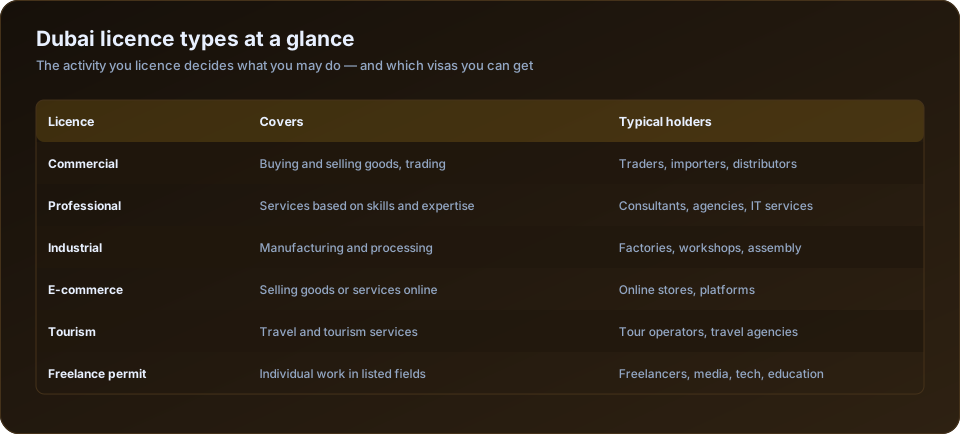
| Licence | Covers | Typical holders |
|---|---|---|
| Commercial | Buying, selling, importing, exporting and distributing goods | Traders, importers, distributors, retailers |
| Professional | Services based on qualifications, skills or expertise | Consultants, agencies, IT services, designers, engineers |
| Industrial | Manufacturing, processing, assembly and packaging | Factories, workshops, assembly units |
| Tourism | Travel and tourism services | Travel agencies, tour operators, holiday homes operators |
| E-commerce | Selling goods or services online | Online stores, platforms, social-media sellers |
| Freelance permit | Individual self-employment in listed fields | Freelancers in media, technology, education and similar fields |
The categories are similar on the mainland and in the free zones, although free zones sometimes use different names (for example "trading", "service" or "manufacturing" licences).
Commercial Licence
A commercial licence is for businesses that trade in goods: importing, exporting, wholesale, distribution and retail, and some commercial services.
Specific trading versus general trading
- A specific trading licence lists particular goods or product groups — for example "trading in industrial valves and fittings" or "trading in textiles and garments". It suits a business with a clear product focus and tends to be simpler for banks and customs.
- A general trading licence allows trading in a wide range of unrelated goods. It suits traders whose product range changes often. It usually costs more, and banks look more closely at general traders because the activity says little about what the company actually does.
Some goods — such as food, medicines, chemicals, weapons, alcohol and certain electronics — need approvals or permits on top of the trading activity, whichever type of trading licence you hold.
What a commercial licence does not cover
Trading goods does not cover installing them, repairing them or providing consultancy about them. If you sell air-conditioning units and also install and maintain them, you need the service activities as well. Describe the whole business when choosing activities.
Professional Licence
A professional licence covers services that rely on the skills of the people providing them: consultancy, IT and software services, marketing and design, engineering consultancy, training, and many others.
On the mainland, professional activities can be licensed under several legal forms:
- a limited liability company, the usual choice for an agency or firm with staff;
- a sole establishment, owned by one individual;
- a civil company, a partnership of professionals.
For some forms, foreign owners still need a local service agent — a UAE national who handles certain government formalities but has no ownership or say in the business. Whether you need one depends on the legal form and activity; check before you choose.
Some professional activities are regulated: engineering consultancy, legal services, auditing, healthcare and education services all need approval or registration with the relevant authority, sometimes including the professionals' qualifications.
Industrial Licence
An industrial licence is for manufacturing and processing: turning raw materials into products, assembling, processing or packaging goods. It requires suitable premises — usually in an industrial area or a free zone with industrial land — and typically approvals relating to the site, safety, the environment and, depending on the product, the regulator for that sector.
Industrial licences take longer to obtain than commercial or professional ones because of the premises and approvals, and they are usually part of a larger investment. Indian manufacturers looking at a UAE plant often start with a commercial licence for distribution and add manufacturing later.
Tourism Licence
Tourism licences cover travel agencies, tour operators, hotel and holiday-home operators and related services, and are licensed together with the tourism authorities. Holiday-home operation, for example, has its own registration and standards.
E-Commerce and Online Selling
Selling online is its own category in Dubai:
- E-commerce activities can be added to mainland and free zone licences for businesses that sell goods or services through their own websites or marketplaces.
- Dubai CommerCity is a free zone dedicated to e-commerce, with logistics facilities for online retailers.
- DET's e-Trader licence allows UAE residents to run small home-based online businesses through social media and websites, with limits on the scope of activity.
The important point for traders is that the online channel does not change the product rules: goods sold online still need the same product approvals, and an online store that imports goods still needs customs registration.
Freelance Permits
Several free zones — for example those operated by the Dubai Development Authority — offer freelance permits that allow individuals to work for themselves in listed fields such as media, technology, design, consulting and education, often with a residence visa. A freelance permit is not a company: it is individual and limited in scope, and it suits independent professionals rather than businesses that plan to hire staff or trade goods.
Holding and Investment Activities
Holding shares in other companies, managing investments or acting as a regional headquarters are separate activities, offered by some free zones and on the mainland. They have particular implications for UAE corporate tax (for example the participation exemption and the free zone regime) and, for Indian owners, for India's overseas investment rules, which restrict some structures. Take advice on both sides before licensing a holding activity.
Activities That Need Another Authority's Approval
Many activities need approval from a sector regulator before or after the licence is issued. A non-exhaustive list:
| Sector | Typical approving body |
|---|---|
| Healthcare, clinics, pharmacies | Dubai Health Authority (or the free zone's health regulator) |
| Schools, training institutes | Knowledge and Human Development Authority |
| Food trading, restaurants, catering | Dubai Municipality food safety department |
| Real estate brokerage and development | Dubai Land Department and its real estate regulator |
| Financial services on the mainland | Central Bank of the UAE or the Securities and Commodities Authority |
| Financial services in DIFC | Dubai Financial Services Authority |
| Media, publishing, advertising | UAE Media Council |
| Transport and logistics activities | Roads and Transport Authority (for some activities) |
| Legal services | Dubai's legal affairs authority |
| Products such as cosmetics, electrical goods, toys | Product registration or conformity schemes |
Approval requirements change and depend on the precise activity, so check them for your case at the start; they can take longer than the licence itself.
How to Choose Your Activities
A practical method we use with every client:
- Write down everything the company will actually do in the first two years — products, services, channels, customers. Be specific.
- Map each item to the authority's activity list, choosing the narrowest activity that covers it. Narrow activities are clearer to banks and customs.
- Check for approvals that each activity needs.
- Check the combination: some authorities limit how many activities a licence can carry or which activities can be combined, and some combinations require a particular legal form or premises.
- Check the effect on cost: fees often depend on the number and type of activities.
- Check the effect on visas and office: some activities need particular premises, which in turn affect the visa quota.
- Keep the list for the bank: the business profile you give the bank should describe the same activities in plain language.
Combining Activities
Most businesses need more than one activity — for example trading in a product and providing its installation and maintenance, or IT consultancy and software trading. Authorities usually allow several activities on one licence, within limits:
- activities generally need to belong to related groups, or the licence type has to accommodate all of them;
- mixing commercial and professional activities is possible in some cases and not in others, depending on the authority and the legal form;
- some activities cannot be combined with any others because of regulatory requirements.
If the activities you need cannot sit on one licence, the options are a different legal form, a different jurisdiction, or a second licence.
Changing or Adding Activities Later
Activities can usually be added or removed by amending the licence, with the authority's approval and any new approvals the activity needs. Changing the licence type — for example from professional to commercial — or moving from a free zone to the mainland is more involved and can require a new licence. Plan the activities for the next two years at the start, not just the first month. Adding an obviously related activity later is routine; restructuring because the original choice did not fit is not.
Business Changes That Need a Licence Amendment
Companies often change in ways that their licence has to follow. Register these with the licensing authority before, or as soon as, they happen:
- New products or services outside the current activities — for example a trader starting to install what it sells, or a consultancy starting to resell software.
- New or departing shareholders, changes in shareholding percentages, or a change of the ultimate beneficial owner.
- A new manager or a change in who is authorised to act for the company.
- A new address or a move to larger premises, which also affects the visa quota.
- A change of trade name.
- Opening a branch in another emirate or another free zone.
Each change also has knock-on effects: the bank will want the amended licence and updated KYC, the immigration file may need updating, and the beneficial owner register must reflect the new position. Doing the amendment first, and then updating the bank and the authorities, keeps everything consistent.
How the Licence Connects to Everything Else
- Office: some activities need particular premises (a warehouse, a showroom, a clinic, a factory); the office in turn determines the visa quota.
- Visas: the company's ability to sponsor residence visas depends on its licence, office and immigration registration (see our guide to UAE visas for business owners).
- Bank account: banks compare the licence activities with the business profile and the expected transactions (see our guide to opening a Dubai business bank account).
- Customs: the goods a company imports should be within its licensed trading activities.
- Tax: activities matter for VAT, and for free zone companies they decide whether income can be qualifying income for the 0% corporate tax regime (see our tax guide).
The Licence Application, Step by Step
On the mainland
- Choose the legal form and activities from DET's activity list.
- Reserve the trade name (see the naming rules below).
- Obtain initial approval, which confirms that the authority has no objection to the company being set up with those owners and activities.
- Request external approvals where the activities need them.
- Prepare and sign the memorandum of association (and, where required, notarise it), and any local service agent agreement.
- Secure premises and register the tenancy contract.
- Pay the fees and receive the licence, then register the company with the immigration authorities to obtain an establishment card.
In a free zone
- Choose the zone, licence type, activities and office package.
- Submit the application with the shareholders' and managers' documents and, in some zones, a business plan.
- Receive pre-approval, sign the lease or desk agreement and the company documents.
- Pay the fees and receive the licence, certificate of incorporation and share certificates, followed by the establishment card.
Free zones are generally faster because the authority handles most steps itself and the office comes as part of the package.
Documents Indian Applicants Usually Need
- Passport copies of all shareholders and managers, with photographs.
- For applicants already resident in the UAE: residence visa and Emirates ID, and sometimes a no-objection letter from the current sponsor.
- For applicants outside the UAE: an entry stamp or visit visa page for some steps.
- A short business plan or activity description for some free zones and activities.
- Specimen signatures of the managers.
- For an Indian company as shareholder: certificate of incorporation, memorandum and articles of association, a board resolution approving the investment and appointing a representative, a certificate of good standing or recent filings, and the list of directors and shareholders. These documents normally need to be legalised (attested) for use in the UAE, which adds time.
- Qualification certificates for professionals where the activity is regulated, often also attested.
Trade Name Rules
Dubai's licensing authorities apply naming rules, and a name that breaks them is simply rejected. In outline:
- no words that are offensive or against public order or morality;
- no religious or political references, or names of governments and official bodies;
- no names of well-known groups or brands that you do not own;
- personal names only if they belong to a shareholder;
- the legal form must be part of the name where required (for example "LLC");
- abbreviations and some foreign-language terms may be restricted.
Have two or three alternatives ready when you reserve the name, and check that the name works in your target markets and as a website domain.
What Drives the Cost of a Licence
We do not publish fees because they change and depend on many choices, but the main drivers are predictable:
- the authority — DET or the particular free zone;
- the number and type of activities, and whether any is regulated;
- the office: a mainland office with a tenancy contract, or a free zone desk, office, warehouse or land;
- external approvals and their own fees;
- the legal form, including any local service agent fee;
- visas, each with its own government fees, medical test and Emirates ID;
- annual renewals of the licence, the lease and the immigration registration.
Compare options by the total cost over the first three years, for the activities and visas you actually need.
Renewal and Compliance
A trade licence is valid for one year (some authorities offer longer terms) and must be renewed before it expires, usually together with the office lease or tenancy registration. An expired licence blocks visa processing, can freeze the bank account and attracts penalties. Changes to the shareholders, managers, address or activities must be registered with the authority.
The Same Activity, Mainland or Free Zone
The licence type and activities are only half the decision; the other half is the jurisdiction. The same activity can be licensed on the mainland and in several free zones, with different consequences:
- A trading activity in a free zone near a port suits re-export; on the mainland it suits selling to UAE customers. Our guide to free zone vs mainland explains the trade-offs.
- A consultancy activity in a free zone suits clients abroad and in other free zones; on the mainland it allows working directly for mainland clients and government entities.
- An e-commerce activity in an e-commerce free zone comes with logistics facilities; on the mainland it combines easily with physical retail.
- Some activities are offered only by particular authorities — for example certain financial activities in DIFC, or commodity trading in zones built around it.
Check the activity list of each candidate authority, not just its brochure, before you decide.
Licences for Common Indian Business Types
| Business | Licence category and activities | Points to check |
|---|---|---|
| Garment or textile exporter | Commercial: specific trading in textiles and garments | Customs registration; CEPA origin for goods from India |
| Pharmaceutical exporter | Commercial: trading in medicines or medical products | Product registration and drug-store requirements with the health authorities |
| Jewellery or gold trader | Commercial: trading in gold, jewellery or precious stones | Enhanced bank due diligence; sector-specific compliance |
| IT services or software company | Professional or technology activities | Free zone or mainland depending on clients; media rules for some activities |
| Restaurant | Commercial or tourism-related food activities | Food safety approvals, premises, mainland jurisdiction |
| Engineering consultancy | Professional: engineering consultancy | Professional registration and qualifications |
| Accounting or audit practice | Professional: accounting or auditing | Auditing is regulated; registration requirements apply |
| Industrial products distributor | Commercial trading plus installation and maintenance | Service activities for work on site |
Five Scenarios
An Indian spice exporter
Exports spices to its Dubai company, which supplies supermarkets and restaurants in the UAE. Licence: commercial, with specific trading activities for spices and food products; approvals: food product registration and food safety requirements; jurisdiction: often the mainland, because the customers are in the UAE.
A digital marketing agency from Bengaluru
Serves clients in the Gulf. Licence: professional, with marketing, advertising and digital services activities; approvals: media-related activities may need media regulator approval; jurisdiction: a free zone if clients are mainly outside the mainland, the mainland if it serves mainland companies directly.
An HVAC distributor
Sells and installs air-conditioning equipment. Licence: commercial trading activities for HVAC equipment plus installation and maintenance activities; jurisdiction: mainland, to work on clients' sites across the UAE.
A software product company
Sells software subscriptions to businesses worldwide. Licence: professional or technology activities in a free zone, with software development and software trading or e-commerce activities.
A garment manufacturer
Plans an assembly unit in the UAE for regional customers. Licence: industrial, with suitable industrial premises and approvals; possibly starting with a commercial licence for distribution while the plant is set up.
Common Mistakes
- Choosing a broad "general trading" activity for a focused business, making banking harder without any benefit.
- Leaving out service activities that the business actually performs (installation, maintenance, consultancy).
- Ignoring approvals for regulated products or services until after the licence is issued.
- Choosing activities for the first month only, then having to amend the licence repeatedly.
- A business profile that does not match the licence, which banks and customs notice.
- Letting the licence lapse, with knock-on effects on visas and the bank account.
Glossary
- Licensing authority: the body that issues the licence — DET on the mainland, or the free zone authority.
- Activity: an item from the authority's activity list that the company may carry on; every licence lists its activities.
- Initial approval: the authority's confirmation that it has no objection to the proposed company, before the licence is issued.
- Trade name reservation: the registration of the company's name while the application is processed.
- Local service agent: a UAE national who handles certain formalities for some professional legal forms on the mainland, without ownership.
- External approval: approval from a sector regulator (health, education, food, media, finance and others) for a regulated activity.
- Establishment card: the company's immigration registration, needed to sponsor visas.
- Licence amendment: a change to the activities, owners, managers, name or address registered with the authority.
How DS Technoverse Helps
We start every Dubai setup by mapping what the business will really do to the right licence type and activities, checking the approvals each activity needs, and choosing the jurisdiction that licences the combination. Our branch office in Dubai handles the applications and approvals on the ground, and we keep the licence, the bank profile and the visa plan consistent with each other. The first consultation is free.
Frequently Asked Questions
What is the difference between a commercial and a professional licence in Dubai?
A commercial licence covers trading in goods — importing, exporting, distributing and selling. A professional licence covers services based on skills and expertise, such as consultancy, IT and design. Many businesses need activities from both, which affects the legal form and jurisdiction.
Is a general trading licence better than a specific trading licence?
Only if you genuinely trade a wide and changing range of unrelated goods. For a focused business, a specific trading licence is clearer to banks and customs and usually cheaper.
Can I sell online with a normal trade licence?
You need e-commerce activities on the licence for online sales, or a licence designed for online selling. The product rules — approvals and customs — still apply to goods sold online.
How many activities can one licence have?
It depends on the authority and the licence type. Several related activities are usually allowed; unrelated or regulated activities may require a different legal form, a different jurisdiction or a second licence.
Do I need a local partner for a professional licence?
Foreign owners no longer need a local shareholder for most activities, but some professional legal forms on the mainland still require a local service agent, who has no ownership in the business. Check the requirement for your legal form and activity.
Can I add activities after the licence is issued?
Usually yes, by amending the licence with the authority's approval and any approvals the new activity needs. Changing the licence type or the jurisdiction is more involved.
What is a freelance permit?
An individual permit offered by some free zones that allows a person to work for themselves in listed fields, often with a residence visa. It is not a company and is limited in scope.
Which licence do I need to import goods from India and sell them in Dubai?
A commercial licence with trading activities that cover the goods, usually on the mainland if the customers are in the UAE, together with Dubai Customs registration and any product approvals. Our CEPA trade guide covers the shipping and duty side.
Can one company hold both a mainland and a free zone licence?
Not as a single licence. A business that needs both usually sets up two entities — for example a free zone company for exports and a mainland company for local sales — or a branch of one in the other jurisdiction, where the rules allow. Each has its own licence, renewal and compliance.
Do I need an approval before the licence is issued?
For many regulated activities, yes: some approvals are required before the licence is issued and others after, but before trading starts. Check the sequence for your activity at the beginning, because approvals can take longer than the licence.
Does the licence type affect how many visas I can get?
Indirectly. The visa quota depends mainly on the company's office or premises and the authority's rules, and some licence types require particular premises. Plan the activities, the office and the visa needs together.
How long is a Dubai trade licence valid?
Usually one year, renewable; some authorities offer multi-year terms. Renew it before it expires to avoid penalties, visa problems and banking issues.
Planning a Dubai company from India? DS Technoverse helps Indian founders, traders and professionals set up and run a company in Dubai — jurisdiction and licence choice, documents, approvals, visas, bank account and ongoing compliance — with our team in India and our branch office in Dubai. The first consultation is free and you get a written quote that separates government fees from our standard nominal service charge. See Dubai Business Setup or message us on WhatsApp from this page.
This guide is general information, not legal or tax advice. UAE and Indian rules change; confirm the current position with the issuing authority or a qualified adviser before you act.