Every Dubai company starts with one choice that shapes everything after it: will it be licensed on the mainland by Dubai's Department of Economy and Tourism (DET), or in one of Dubai's free zones, each run by its own authority?
The choice decides where you can sell, what kind of office you need, how many visas you can sponsor, how your goods clear customs and, in some cases, how much tax you pay. Changing your mind later usually means a new licence, so it is worth getting right at the start.
This guide explains the difference in practical terms for Indian founders, traders, manufacturers and professionals: what each option allows, what it costs you in effort, and which fits which kind of business. It ends with five worked scenarios and the mistakes we see most often.
The Short Answer
- Choose the mainland if you will sell goods or services directly to customers inside the UAE — retail, on-site services, contracts with UAE companies or government bodies — or if you want the widest freedom to operate anywhere in the country.
- Choose a free zone if your business is mainly export, re-export, trading through a port or airport, or services to clients outside the UAE, or if you want a simpler incorporation with a flexible office.
- If you will do both, compare a mainland licence with a free zone licence plus a UAE distributor; the answer depends on volumes, visas and cost.
If you are still unsure after reading the rest of this guide, that is normal: many businesses sit between the two, and the deciding factor is often a detail — one large mainland customer, a visa for a family member, an activity that only some zones licence. Write the details down and compare the options against them, rather than comparing packages.
The rest of this guide explains why.
What "Mainland" Means
A mainland company is licensed by the Department of Economy and Tourism (formerly the Department of Economic Development) and can trade anywhere in the UAE: it can open shops and offices for walk-in customers, provide services at clients' premises, sell to UAE companies directly and bid for government contracts.
Two changes over the past few years made the mainland far more attractive to foreign founders:
- Full foreign ownership. Since amendments to the UAE Commercial Companies Law took effect in 2021, most commercial and industrial activities can be 100% owned by foreign shareholders, without the local partner that used to hold 51%. A limited list of activities with "strategic impact" still has conditions, and some regulated professions need approvals from a specific authority.
- Simpler processes. Most applications are now made online, with approvals from other authorities (for example for food, health or education activities) requested through the same channel.
A mainland company needs a physical office with a registered tenancy contract, and the size of the office normally determines how many residence visas the company can sponsor.
What a Free Zone Is
A free zone is a designated area with its own licensing authority, rules and facilities. Dubai has more than two dozen, many specialised by sector — for example Jebel Ali Free Zone (JAFZA) next to the Jebel Ali port, the Dubai Multi Commodities Centre (DMCC), the Dubai Airport Free Zone (DAFZA), Dubai South near Al Maktoum airport, Dubai Silicon Oasis for technology, Dubai CommerCity for e-commerce, and Meydan Free Zone. The Dubai International Financial Centre (DIFC) is a special case with its own civil and commercial laws for financial services.
What free zones offer:
- Full foreign ownership — always the case in free zones.
- Simpler incorporation, often with standard packages and quick approvals.
- Flexible offices: flexi-desks, shared offices and small units, as well as warehouses and land in logistics zones.
- Customs advantages: goods stored or processed in a free zone are outside the UAE customs territory until they enter the mainland.
- Sector ecosystems: commodities in DMCC, logistics in JAFZA and Dubai South, technology in Dubai Silicon Oasis.
The main limitation is direct trade with the mainland. A free zone company is set up to do business within its zone and outside the UAE. Selling to customers on the UAE mainland traditionally requires a mainland distributor or agent, or a separate mainland presence. The rules on what free zone companies may do on the mainland have been relaxing; check the current position for your zone and your activity before you rely on it.
Side-by-Side Comparison
| Consideration | Mainland (DET) | Free zone |
|---|---|---|
| Licensing authority | Department of Economy and Tourism | The free zone's own authority |
| Foreign ownership | 100% for most activities; conditions for a few | 100% |
| Trading in the UAE market | Anywhere, directly | Within the zone and abroad; mainland sales usually via a distributor or agent |
| Government contracts | Eligible | Generally not directly |
| Office | Physical office with a registered tenancy contract | Flexi-desk to warehouse, depending on the zone |
| Visa quota | Linked mainly to office size | Linked to the package or office in the zone |
| Customs | Goods enter UAE customs territory on import | Goods in the zone are outside customs territory until they enter the mainland |
| Activities available | Very wide list | Limited to the activities each zone licenses |
| Corporate tax | Standard UAE corporate tax | Same, but qualifying free zone income can be taxed at 0% if conditions are met |
| Audit | Required for corporate tax purposes in many cases | Many zones require annual audited accounts |
| Setting up | Office and approvals take longer | Usually faster, more standardised |
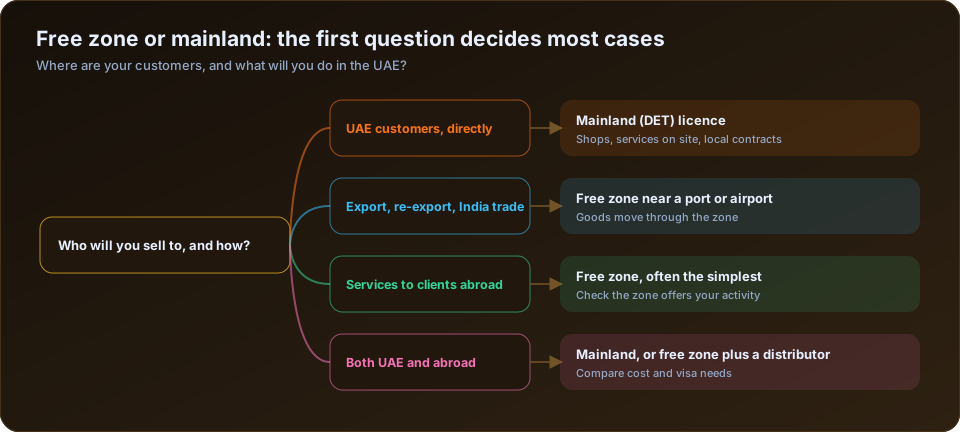
The Six Questions That Decide It
1. Where are your customers?
This is the question that decides most cases. If your customers are businesses and consumers in the UAE, and you need to invoice them directly, deliver to them, or work on their premises, the mainland is usually the right answer. If your customers are outside the UAE — in India, Africa, the rest of the Gulf, Europe — a free zone often does everything you need at lower effort.
2. Do you move physical goods?
Traders and manufacturers should look closely at logistics. A free zone next to a port or airport lets you import, store, re-pack and re-export without paying UAE customs duty on goods that never enter the mainland. If most of your goods will be sold inside the UAE, duty is payable when they enter the mainland in either case, and the mainland may be simpler.
3. Is your activity offered — and does it need extra approvals?
Every licence lists specific activities. Not every free zone offers every activity, and some activities on the mainland need a further approval (for example from health, education or food safety authorities). Start with a precise description of what the company will do, then check which jurisdictions licence it.
4. How many visas will you need?
If you plan to move several family members or employees to Dubai, the visa quota matters. On the mainland it is mostly linked to the size of the office; in free zones it is linked to the package or the space you lease. A flexi-desk may allow only one or two visas.
5. Will you bid for government or large local contracts?
Government entities and many large UAE companies contract with mainland-licensed suppliers. If that is your market, the mainland is effectively required.
6. What does the tax position look like?
Both jurisdictions are within UAE corporate tax. A free zone company that meets the conditions of a Qualifying Free Zone Person can be taxed at 0% on its qualifying income — broadly, income from activities with other free zone companies and from certain qualifying activities, with substance in the zone and audited accounts. Income from the mainland is generally taxed at the standard rate. Our guide to tax for an Indian-owned Dubai company explains the rules and the Indian side.
Cost: What Drives It
Prices change and vary widely between zones and activities, so we do not publish them. What determines the cost of either option:
- Licence and registration fees, which depend on the authority and the number and type of activities.
- Office: rent for a mainland office versus a flexi-desk or unit in a free zone.
- Visas: each residence visa carries government fees, a medical test and an Emirates ID.
- Approvals from other authorities for regulated activities.
- Ongoing costs: annual renewal, accounting, audit where required, corporate tax and VAT compliance.
A free zone package often looks cheaper in the first year. The comparison that matters is the total over three years, including the visas, office and renewal costs — and including what it costs you if the jurisdiction later turns out not to fit the business.
Five Scenarios From Indian Founders
A textile exporter in Surat
The business: an exporter wants a Dubai hub to hold stock and ship to buyers in the Gulf and Africa.
The fit: a free zone with port access — goods move through the zone without entering UAE customs territory, and the company invoices buyers abroad. If UAE retailers later become important customers, a mainland distributor or a separate mainland presence can be added. The India side needs an Importer-Exporter Code and attention to CEPA rules for goods that do enter the UAE (see our guide to India–UAE trade under CEPA).
An IT services company in Pune
The business: software development and support for clients in the GCC and Europe, with a small team in Dubai for client meetings.
The fit: usually a free zone with a professional or technology licence, which allows contracts with clients abroad and in other free zones and offers flexible offices. If the target clients are UAE government entities or the work must be done at mainland clients' premises, a mainland licence is the better fit.
A restaurant chain from Mumbai
The business: opening outlets in Dubai.
The fit: mainland. Restaurants serve walk-in customers across the city, need premises approvals and food safety permits, and cannot operate as free zone businesses selling to the public.
An engineering consultant from Hyderabad
The business: consultancy for UAE construction projects, working on site with UAE contractors.
The fit: mainland, with the relevant professional licence and any approvals required for the specific engineering activity.
A family holding investments
The business: an Indian family wants a UAE company to hold investments.
The fit: often a free zone, though it depends on the investments, the substance needed for UAE tax purposes and — critically — the Indian rules on overseas investment and tax residence. This scenario needs advice on both sides before anything is incorporated.
Legal Forms Within Each Jurisdiction
Choosing the mainland or a free zone is the first step; the second is the legal form of the company. The names differ, but the options are similar.
On the mainland
- Limited Liability Company (LLC): the usual choice for a trading or service business with one or more shareholders. Liability is limited to the share capital, and the company is a separate legal person.
- Sole establishment: a business owned by one individual, with no separate legal personality — the owner is personally liable. It suits some professional activities.
- Civil company: a partnership of professionals (for example consultants) for certain professional activities, with personal liability of the partners.
- Branch: a branch of a foreign company (such as your Indian company) or of another UAE company, carrying on the parent's activities.
In a free zone
- Free zone establishment (often called FZE): a company with a single shareholder, which can be an individual or a company.
- Free zone company (FZCO or FZ-LLC, depending on the zone): a company with two or more shareholders.
- Branch of a foreign or UAE company.
Names and minimum requirements vary from zone to zone, so read each zone's rules rather than assuming one zone works like another.
For most Indian founders, the practical choice is between a mainland LLC and a free zone company, held either by the founders personally or by their Indian company. Which shareholder holds the shares has consequences on the Indian side — for overseas investment rules, for tax and for how profits come back to India — so decide it together with the jurisdiction.
Your First Year: A Compliance Calendar
Whichever jurisdiction you choose, a Dubai company carries recurring obligations. Planning them from the start avoids penalties and blocked visas.
| When | Mainland | Free zone |
|---|---|---|
| At incorporation | Licence, tenancy registration, establishment card | Licence, lease or desk agreement, establishment card |
| First months | Corporate tax registration; VAT registration if over the threshold; beneficial-owner register | The same |
| Each quarter (if VAT-registered) | VAT return and payment | The same, for taxable supplies |
| Every year | Licence renewal; office tenancy renewal | Licence renewal; lease or package renewal |
| Every year | Financial statements; corporate tax return within nine months of the year-end | The same; many zones also require audited accounts |
| With each visa cycle | Visa and Emirates ID renewals for owners and staff | The same |
Small businesses can claim relief from corporate tax on low revenue for a limited period, and a Qualifying Free Zone Person must keep its conditions every year. Our tax guide for Indian-owned Dubai companies covers both.
Questions to Ask Before You Sign With a Free Zone
Free zone packages are marketed hard, and their brochures look alike. These questions reveal the differences that matter:
- Is my exact activity licensed here, and does it need any external approval?
- How many visas does this package allow, and what does each additional visa require (more space, a different package)?
- What may I do on the mainland with this licence, and what would I need for sales to mainland customers?
- What are the renewal costs, not just the first-year price? Are there annual fees for the establishment card, the lease or the registry?
- Are audited accounts required, and by when after the year-end?
- Can I upgrade from a flexi-desk to an office or warehouse in the same zone without a new licence?
- How do I add or change shareholders and activities later, and at what cost?
- What substance do I need if I want the 0% rate for qualifying free zone income?
- Which banks regularly open accounts for companies in this zone and activity?
- How long do approvals take for my activity and nationality, in practice rather than in the brochure?
Questions to Ask Before a Mainland Setup
- Does my activity need an approval from another authority (health, education, food, real estate, transport)?
- What office do I need for the number of visas I plan, and is the property suitable for commercial registration?
- Do I need a local service agent for my legal form (some professional forms still require one)?
- Will customers or tenders require specific registrations, such as supplier registration with government entities?
- What is the total annual cost of the licence, the office and the visas together?
Branch or New Company?
An Indian company can either register a branch of itself in Dubai or set up a new subsidiary.
- A branch is the same legal entity as the Indian parent. It is simpler in some respects, but the parent is directly liable for the branch, and the branch's results flow into the parent's accounts and tax.
- A subsidiary is a separate company, which ring-fences liability and is usually cleaner for banking, contracts and growth.
Both are possible on the mainland and in many free zones. For most Indian businesses we see, a subsidiary is the more flexible choice. On the Indian side, either route is an overseas investment and must follow India's overseas investment rules through an authorised dealer bank.
Common Mistakes
- Choosing on first-year price alone. A cheap package that cannot sponsor the visas you need, or cannot sell to your customers, is the most expensive mistake.
- Licensing too few activities. If your licence says "general trading" but you also provide installation services, you are operating outside your licence. Describe the business precisely.
- Assuming a free zone company can trade freely on the mainland. Check the rules for your zone and activity, and plan for a distributor or a mainland presence if needed.
- Ignoring the India side. Funding the company, transferring money and running it from India all have Indian regulatory and tax consequences. Plan them together with the UAE structure.
- Underestimating banking. UAE banks look closely at new companies, their owners and the source of funds. Prepare for it; see our guide to opening a Dubai business bank account.
- Forgetting renewals and compliance. Licences, visas and Emirates IDs must be renewed on time, and corporate tax and VAT have their own registration and filing obligations.
Changing Jurisdiction Later
It is possible to move from a free zone to the mainland, or from one free zone to another, but it is rarely a simple transfer: in most cases it means a new licence, new visas and new bank documentation, and sometimes winding up the old company. Some businesses add a second entity instead — for example a free zone company for exports and a mainland company for local sales. That works, but doubles the compliance. Choosing well at the start is cheaper than restructuring.
How the Setup Process Differs
| Step | Mainland | Free zone |
|---|---|---|
| Activity selection | From the DET activity list | From the zone's activity list |
| Name reservation | Through DET | Through the zone authority |
| Initial approval | DET, plus other authorities for regulated activities | Zone authority |
| Office | Lease and register the tenancy | Choose a package, desk or unit |
| Licence issued | By DET | By the zone |
| Establishment card and visas | Through the immigration authorities | Through the zone and immigration authorities |
| Bank account | With a UAE bank | With a UAE bank |
The documents Indian applicants usually need — passports, photographs, sometimes attested documents for corporate shareholders, a business plan for some zones — are listed on our Dubai business setup page.
A Decision Checklist
Before you choose, write down the answers to these. If you can answer them, the right jurisdiction usually becomes obvious.
- My customers are mainly in: the UAE / abroad / both.
- I will move physical goods: yes / no; through which port or airport.
- My activities, described precisely (not just "trading" or "consulting").
- Residence visas needed in the first two years, for owners, family and staff.
- Office I actually need: desk, office, showroom, warehouse, factory.
- Government or large local contracts: yes / no.
- Shareholders: individuals, my Indian company, or both.
- How I will fund the company from India, and how profits will come back.
- Who will manage the company day to day, and where they will live.
- Budget for the first year and for each following year, including renewals.
Glossary of Terms You Will Meet
- DET (Department of Economy and Tourism): Dubai's authority for mainland business licences, formerly the Department of Economic Development (DED).
- Free zone authority: the body that licenses and regulates companies in a particular free zone.
- Trade licence: the document that allows a company to carry on its listed activities; it is renewed every year.
- Memorandum of Association (MoA): the company's constitutional document, setting out shareholders, capital and management.
- Ejari: Dubai's system for registering tenancy contracts, required for mainland offices.
- Establishment card: the immigration registration of the company, needed before it can sponsor visas.
- Emirates ID: the identity card issued to every UAE resident, linked to the residence visa.
- GDRFA and ICP: the immigration authorities — Dubai's General Directorate of Residency and Foreigners Affairs and the federal Authority for Identity, Citizenship, Customs and Port Security.
- Qualifying Free Zone Person (QFZP): a free zone company that meets the conditions for the 0% corporate tax rate on qualifying income.
- Beneficial owner register: the record of the individuals who ultimately own or control the company, which UAE companies must keep and file.
- Customs code: the registration a company needs with Dubai Customs to import or export goods.
How DS Technoverse Helps
We start from your business, not from a package. In a free first consultation we ask where your customers are, what you will do in the UAE, how many visas you need and how you will fund and run the company from India, and then recommend a jurisdiction and activities with the reasons written down. Our team in India prepares the documents with you; our branch office in Dubai handles the applications, approvals, visas and bank meetings on the ground. You receive a written quote that shows government and free zone fees separately from our standard nominal service charge.
Frequently Asked Questions
Can an Indian own 100% of a mainland company in Dubai?
Yes, for most commercial and industrial activities, following the 2021 amendments to the UAE Commercial Companies Law. A limited number of strategic or regulated activities still have conditions, which should be checked for your activity before you apply.
Is a free zone company cheaper than a mainland company?
Often in the first year, because of flexible offices and standard packages. Over several years the difference depends on the visas, office space and renewals you need, and on whether the free zone suits your customers. Compare the total cost of the structure that actually fits your business.
Can a free zone company sell to customers in Dubai?
It can sell within its free zone and abroad. Selling to customers on the UAE mainland traditionally requires a mainland distributor or agent or a separate mainland presence; the rules have been relaxing, so check the current position for your zone and activity.
Which is better for import and export between India and the UAE?
For goods that are re-exported or held for customers abroad, a free zone near a port or airport is usually efficient. For goods sold inside the UAE, the mainland may be simpler. Our CEPA trade guide covers the documents on both sides.
Do free zone companies pay corporate tax?
They are within the UAE corporate tax regime. A free zone company that meets the conditions of a Qualifying Free Zone Person can pay 0% on qualifying income; other income is taxed at the standard rate.
Do I need a physical office?
A mainland company needs a physical office with a registered tenancy contract. Free zones offer flexi-desks and shared offices as well as dedicated space. The office type affects how many visas you can sponsor.
How long does it take to set up?
Free zone licences are often issued within days to a few weeks once documents are complete; mainland licences can take longer when other approvals are needed. Visas and the bank account follow the licence.
Can I run a Dubai company while living in India?
Legally, a UAE company does not require its owner to live in the UAE. In practice, banks prefer signatories with a UAE residence visa, and running the company entirely from India can create Indian tax questions: a company whose key management and commercial decisions are made in India may be treated as resident in India under the place-of-effective-management test. Plan who manages the company, and from where, before you incorporate.
What is a flexi-desk?
A flexi-desk is a shared or hot-desk workspace that some free zones offer as the minimum office for a licence. It keeps costs low, but it usually allows only a small number of visas and may not satisfy banks or customers who expect a dedicated office. Check whether you can upgrade within the same zone as the business grows.
Can I change from a free zone to the mainland later?
Usually only by setting up a new licence (and often winding up or keeping the old one), so it is better to choose the right jurisdiction at the start.
Planning a Dubai company from India? DS Technoverse helps Indian founders, traders and professionals set up and run a company in Dubai — jurisdiction and licence choice, documents, approvals, visas, bank account and ongoing compliance — with our team in India and our branch office in Dubai. The first consultation is free and you get a written quote that separates government fees from our standard nominal service charge. See Dubai Business Setup or message us on WhatsApp from this page.
This guide is general information, not legal or tax advice. UAE and Indian rules change; confirm the current position with the issuing authority or a qualified adviser before you act.