For most new Dubai companies, the trade licence is the easy part. The hard part — the step that adds weeks to the timeline and causes the most frustration — is opening the corporate bank account. Founders who opened accounts in India in a day are surprised to find UAE banks asking for business plans, contracts, bank statements, explanations of where every rupee came from, and an interview before they decide.
The good news is that the process is predictable. Banks ask broadly the same questions of every new company, and a founder who knows what they are can prepare a file that answers them in one go. Most of the delays we see come from documents that arrive one at a time, in response to questions that could have been anticipated.
It is not personal. UAE banks operate under strict anti-money-laundering rules and a risk-based approach that the Central Bank of the UAE enforces closely, and a new company with foreign owners and no trading history is, by definition, a customer they know nothing about. The founders who get accounts opened quickly are the ones who answer the bank's questions before they are asked.
This guide explains what UAE banks look for, the documents Indian founders usually need, how to present the source of funds and the business model, what happens in the interview, the special points for Indian corporate shareholders and non-resident founders, and what to do if an application is refused.
Why It Takes Longer Than in India
A UAE bank opening an account for a new company must understand, document and be comfortable with:
- who owns and controls the company — every shareholder and ultimate beneficial owner, and anyone with signing authority;
- what the company does — its activities, its customers and suppliers, the countries it deals with, and the transactions it expects;
- where the money comes from — the source of the funds that will go into the account and the wealth of the owners behind them;
- whether the profile makes sense — whether the expected transactions fit the activities, the owners' background and the company's resources.
The bank must also keep that understanding up to date for as long as the account is open. A new company with no history gives it little to go on, so it relies on documents and on the founders' explanations. That is why preparation, not persistence, is what speeds the process up.
When to Apply
Banks open accounts for licensed companies, so the application starts after the trade licence is issued. Many banks also prefer — some require — that at least one shareholder or authorised signatory holds a UAE residence visa and Emirates ID, and they often want to meet the signatory in person in the UAE. Plan the sequence:
- Licence issued, with the memorandum of association and share register.
- Establishment card and residence visa for the main shareholder or manager (where needed).
- Bank application, with the documents below prepared in advance.
- Interview or meeting with the bank.
- Compliance review and account opening.
Preparing the bank documents while the licence and visa are being processed saves weeks.
The Documents Indian Founders Usually Need
Requirements differ between banks and depend on the company and its activities, but most banks ask for a similar set.
Company documents
- Trade licence (and the free zone or DET registration certificate).
- Memorandum and articles of association, and any amendments.
- Share certificate or share register; the register of beneficial owners.
- Board resolution or shareholder resolution to open the account and appoint signatories.
- Establishment card (immigration registration), where issued.
- Office tenancy contract or free zone lease, and sometimes photographs of the premises.
Shareholder and signatory documents
- Passports, UAE residence visas and Emirates IDs.
- Proof of residential address (in the UAE and/or India).
- A CV or professional profile for each shareholder and signatory, showing their experience in the business.
- Personal bank statements, often for the last six to twelve months.
- Evidence of source of wealth and source of funds (see below).
Business documents
- A business profile or plan: activities, products or services, customers, suppliers, countries, expected monthly turnover and number of transactions.
- Contracts, purchase orders, invoices or letters of intent with customers and suppliers, if available.
- The company's website and marketing material, if any.
- For an existing Indian business behind the new company: its financial statements and bank statements, and its GST and other registrations.
For corporate shareholders
If an Indian company holds the shares, the bank will also want the Indian company's constitutional documents, a group structure chart down to the individual owners, the board resolution authorising the investment, and its recent financial statements. Documents issued in India normally have to be legalised (attested) through the Indian and UAE authorities before UAE banks and authorities accept them; plan time for this.
Source of Funds and Source of Wealth
These two terms cause more delays than anything else, so it is worth being precise:
- Source of funds is where the money that will be deposited in the account comes from — for example "share capital remitted from the shareholder's personal account at an Indian bank" or "advance payments from customers under these contracts".
- Source of wealth is how the owners came to have that money in the first place — for example "twelve years of profits from the shareholder's manufacturing business in India" or "sale of property in 2024".
The bank wants both, with evidence: bank statements showing the funds, financial statements or tax returns showing the income, sale deeds for property, and so on. For Indian founders, the cleanest evidence is usually the Indian income tax returns and financial statements of the business that generated the wealth, together with the bank statements that show the money moving.
When the capital comes from India, the remittance itself must also follow India's rules: individuals invest through their bank under the Liberalised Remittance Scheme and the overseas investment rules, and Indian companies through the overseas direct investment route. A UAE bank that sees an orderly remittance from an Indian bank with the right documentation has an easy question answered.
The Business Profile That Gets Accounts Opened
A two- or three-page business profile, written for the bank, answers most of its questions in one place. Include:
- The company: name, licence number, jurisdiction, activities as licensed.
- The owners: who they are, their experience in this business, and how the company fits their wider business (for example "the UAE distribution arm of our manufacturing business in Ludhiana").
- What the company will do: products or services, in plain language.
- Customers: who they are, in which countries, and how they will pay.
- Suppliers: who they are, in which countries, and how the company will pay them.
- Expected activity: monthly incoming and outgoing amounts, number of transactions, currencies, and whether any cash is involved.
- Source of funds and wealth for the initial capital.
- Premises and staff in the UAE.
- Other banks the owners and the group use.
Consistency is what banks check. If the profile says the company will trade industrial valves with buyers in Saudi Arabia, but the licence lists general trading and the expected transactions are many small payments from individuals in other countries, the bank will ask why.
An Illustrative Business Profile
To show what "consistent and specific" looks like, here is a shortened example for a fictional company. Yours should reflect your real business and be supported by documents.
Company: Narmada Valves Trading FZCO, licensed in a Dubai free zone for trading in valves, pipes and fittings.
Owners: Amit Sharma (60%) and Neha Sharma (40%), directors of Narmada Engineering Pvt Ltd, Vadodara, which has manufactured industrial valves since 2011 and exports to the Gulf. Amit holds a UAE investor visa and lives in Dubai; he is the authorised signatory.
Activity: the Dubai company buys valves from Narmada Engineering and two other Indian manufacturers, holds stock in a leased warehouse unit in the free zone, and sells to EPC contractors and distributors in Saudi Arabia, Oman and Qatar, re-exporting from the free zone.
Customers: three distributors already buying from the Indian company (letters of intent attached); EPC contractors through tenders. Payment by bank transfer and letters of credit, 30–60 days.
Suppliers: Narmada Engineering (related party, priced at arm's length) and two unrelated Indian manufacturers. Payment by bank transfer to India within 60 days.
Expected activity: incoming USD 150,000–250,000 a month from 8–15 customer payments; outgoing USD 120,000–200,000 a month to 3 suppliers in India, plus rent, salaries for two staff and logistics. No cash.
Source of funds: share capital and working capital remitted by Amit and Neha from their personal accounts at an Indian bank under the Liberalised Remittance Scheme; bank statements and remittance documents attached.
Source of wealth: salary and dividends from Narmada Engineering over 14 years; the company's audited financial statements and the owners' income tax returns for the last three years attached.
Premises and staff: warehouse unit with office in the free zone; a sales manager and a logistics coordinator, both UAE residents.
A bank reading this knows who it is dealing with, what will move through the account, and why — and has documents for each claim.
Choosing a Bank
The UAE has large local banks, Islamic banks, branches of international banks and newer digital banks. They differ in their appetite for new companies, foreign owners and particular activities, in their minimum balance requirements and fees, and in their services.
| Consider | Why it matters |
|---|---|
| Appetite for your activity | Some banks avoid certain activities or countries altogether |
| Requirements for residence | Some require a UAE-resident signatory; others accept non-residents for some account types |
| Minimum balance and fees | Vary widely; check the total monthly cost |
| Trade finance | Letters of credit, guarantees and trade loans matter for traders |
| Currencies | Dirham, dollar, euro and other accounts |
| Online banking and payments | Bulk payments, payroll (the UAE wage protection system), integration with accounting |
| Branch access | Some services still need a branch visit |
| Relationship with your free zone | Some banks have desks or arrangements in particular free zones |
Digital banks and payment institutions can be faster for simple service businesses, but may not offer trade finance or suit businesses with large international flows. Many companies end up with one main bank and one secondary account.
The Process, Step by Step
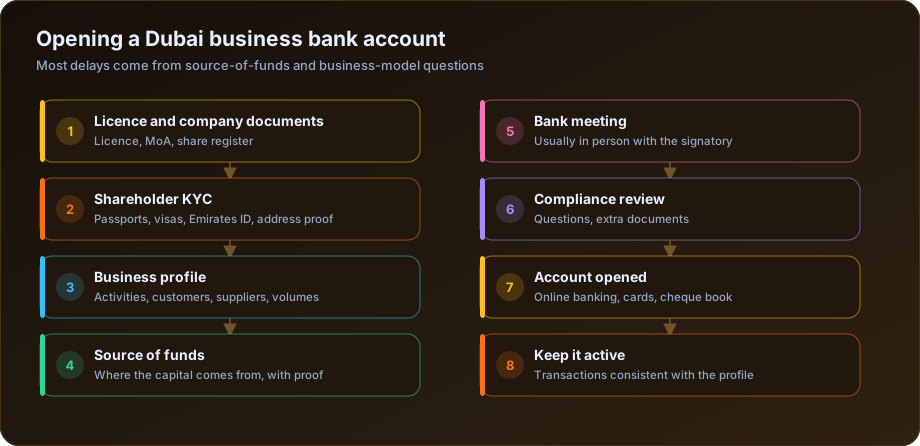
- Pre-assessment. Many banks first review a short summary of the company and owners to decide whether they will accept the application at all. This is where the business profile helps.
- Application and documents. The full set of documents is submitted, often through a relationship manager or online.
- Meeting. The bank meets the signatory, usually in person in the UAE, sometimes at the company's premises.
- Compliance review. The bank's compliance team checks the owners, the counterparties and the countries, and often asks follow-up questions or for more documents.
- Approval and activation. The account is opened, online banking is activated, and cards and cheque books are issued.
- Initial deposit. The capital or first funds are deposited, consistent with the declared source of funds.
Timelines vary from a couple of weeks to a few months, depending on the bank, the activity, the owners' profile and how complete the documents are.
The Bank Interview: What You Will Be Asked
The meeting is a conversation, not an exam, but it decides many applications. Expect questions like:
- What exactly will the company do, and why in the UAE?
- Who are your first customers and suppliers? Can you show contracts or correspondence?
- How did you build your business in India, and what is your role in it?
- How much money will flow through the account each month, in which currencies, to and from which countries?
- Where does the initial capital come from?
- Will the company handle cash?
- Who else is involved in the business, and who will operate the account?
- Do you have accounts with other banks in the UAE?
Answer consistently with the documents, in plain language, and say so when something is not yet known. Bring copies of the key documents to the meeting. Vague or inconsistent answers cause more refusals than difficult facts.
Activities and Countries That Get Extra Scrutiny
Banks apply enhanced checks to activities and flows with higher money-laundering or sanctions risk. Founders in these areas should expect more questions and prepare more evidence:
- general trading with no clear product focus;
- trade in gold, precious stones and jewellery;
- virtual assets and crypto-related activities;
- used vehicles, electronics resale and other high-volume trading of easily resold goods;
- money services, payment intermediation and similar financial activities;
- business with countries subject to sanctions or high-risk designations;
- businesses with large cash receipts.
None of these is automatically refused, but each needs a clear, well-documented business model and, often, a bank with experience in the sector.
Non-Resident Founders
Founders who do not plan to live in the UAE face a narrower choice of banks. Some banks open accounts only when a signatory is UAE-resident; others accept non-resident shareholders with a UAE-resident manager as signatory; a few offer accounts to non-resident companies with additional requirements. Options include appointing a UAE-resident manager with signing authority, obtaining an investor or partner visa for the founder (see our guide to UAE visas for business owners), or accepting the stricter conditions of the banks that open non-resident accounts. Remember too that running the company entirely from India has Indian tax implications, covered in our tax guide.
After the Account Is Open: Keeping It Healthy
Opening the account is not the end of the bank's review. To avoid account freezes or closures:
- Keep transactions consistent with the declared profile. If the business changes — new products, new countries, much larger volumes — tell the bank before the transactions start.
- Respond promptly to KYC updates. Banks periodically ask for renewed licences, visas, Emirates IDs and updated information.
- Avoid unexplained cash and third-party payments. Payments from or to parties unrelated to the business are a common trigger for questions.
- Screen your counterparties for sanctions exposure, especially in trade.
- Keep the account active. Dormant accounts can be restricted or closed.
- Renew the licence on time. An expired licence can lead to the account being frozen.
Payroll and the Wage Protection System
If the company employs staff, salaries must usually be paid through the UAE's Wage Protection System (WPS), an electronic salary transfer system that lets the authorities confirm that employees are paid on time. Mainland companies are generally required to use it, and many free zones apply similar rules. The bank or an approved exchange house runs the WPS payments; set it up with the account, before the first salary is due.
Trade Finance: Why History Matters
Traders often need more than a current account: letters of credit to pay suppliers, guarantees for tenders and contracts, and short-term trade loans. Banks are cautious about offering trade finance to a company with no history in the UAE. They usually start with fully secured facilities (for example against a cash deposit) and widen them as the account builds a track record. If trade finance is central to your business, say so at the start, choose a bank active in trade finance, and keep the account's activity clean and consistent from the first month.
Questions to Ask the Bank
Before you commit to a bank, ask:
- What is the minimum balance, and what are the charges if the balance falls below it?
- What are the monthly, transaction and international transfer fees?
- Which currencies can the company hold, and at what exchange margins?
- Does the bank support payroll through the Wage Protection System?
- What trade finance can a new company obtain, and on what security?
- Which services need a branch visit, and which can be done online?
- How often will KYC documents need to be refreshed?
- Is there a dedicated relationship manager for the account?
A Personal Account in the UAE
Founders who move to Dubai will also want a personal account, usually opened once the residence visa and Emirates ID are issued, often with proof of salary or income. A personal account is useful for receiving salary and dividends from the company and for daily life; keep company and personal money strictly separate.
The India Side
- Capital from India must be remitted through an authorised dealer bank under the Liberalised Remittance Scheme or the overseas direct investment route, with the reporting those rules require.
- Foreign bank accounts — including a UAE company account on which an Indian resident has signing authority, and any personal UAE account — must be disclosed in the foreign assets schedule of the Indian income tax return by residents.
- Remittances under the Liberalised Remittance Scheme above a threshold can attract tax collected at source in India, which is credited against your income tax.
- Money coming back to India (dividends, salary, repayment of loans) should come through the banking channel with documents that show what it is.
What an Introducer Can and Cannot Do
Setup consultants and corporate service providers often introduce founders to banks. A good introducer knows which banks currently accept which activities and owner profiles, helps you prepare a complete and consistent file, and gets the application in front of the right relationship manager. That saves time and avoids refusals that come from simply applying to the wrong bank.
What no introducer can do is guarantee an account, or make an unclear business model or an unevidenced source of wealth acceptable. Be wary of anyone who promises guaranteed approval, suggests presenting the business differently from what it really is, or offers to route money through third-party accounts while the application is pending. Those shortcuts cause frozen accounts and closed relationships later — and in the UAE's regulatory environment they can create far bigger problems than a delayed account.
If Your Application Is Refused
A refusal is rarely explained in detail, but it is usually one of a few things: the activity is outside the bank's appetite, the source of funds or wealth was not evidenced well enough, the business model was unclear or inconsistent, or a counterparty or country raised a concern. What to do:
- Ask what can be clarified. Some banks will say what was missing.
- Strengthen the file: a clearer business profile, contracts, better evidence of source of wealth.
- Choose a bank with appetite for your sector, rather than reapplying to many banks at once with the same file.
- Check the licence activities — a licence that describes the business precisely helps.
- Use an introducer who knows which banks accept which profiles.
Applying to many banks at once with an incomplete file is a mistake: it wastes time and does not improve the odds. Banks commonly ask whether you have applied elsewhere and why it did not succeed, so a string of quick refusals makes the next conversation harder, not easier.
A Checklist You Can Print
| Item | Ready? |
|---|---|
| Trade licence, memorandum of association, share register, beneficial owner register | |
| Board or shareholder resolution to open the account and name the signatories | |
| Establishment card and office or free zone lease | |
| Passports, visas and Emirates IDs of shareholders and signatories | |
| Proof of address and CVs for each shareholder and signatory | |
| Personal bank statements (six to twelve months) | |
| Two- to three-page business profile | |
| Contracts, purchase orders or letters of intent with customers and suppliers | |
| Evidence of source of funds (remittance records, statements) | |
| Evidence of source of wealth (tax returns, financial statements, sale deeds) | |
| For a corporate shareholder: legalised company documents, structure chart, board resolution, financial statements | |
| Expected monthly transactions: amounts, numbers, currencies, countries |
Common Mistakes
- Applying before the documents are ready, then answering follow-up questions piecemeal.
- A business profile that does not match the licence, the expected transactions or the owners' background.
- Unexplained source of wealth — "family savings" without documents.
- Remitting capital informally, or from accounts the bank cannot connect to the owners.
- Choosing a bank on minimum balance alone, ignoring its appetite for the activity.
- Allowing the licence or visas to expire.
- Using the corporate account for personal expenses, or a personal account for company receipts.
How DS Technoverse Helps
We prepare the bank file as part of every Dubai company setup: the business profile, the source-of-funds and source-of-wealth evidence, the structure chart, and the legalised documents for corporate shareholders. Our branch office in Dubai introduces founders to banks with appetite for their activity and accompanies them to the meetings. The first consultation is free.
Frequently Asked Questions
How long does it take to open a business bank account in Dubai?
Anything from a couple of weeks to a few months, depending on the bank, the activity, the owners and how complete the documents are. A well-prepared file with a clear business profile and evidenced source of funds is the biggest factor you control.
Can I open a Dubai corporate account without a UAE residence visa?
Some banks require at least one UAE-resident signatory; others accept non-resident shareholders or offer non-resident accounts with extra conditions. A UAE-resident manager or an investor visa for the founder widens the choice.
What is the minimum balance for a Dubai business account?
It varies by bank and account type, and banks change their requirements. Compare the minimum balance, the fees for falling below it and the other monthly charges.
What documents prove source of funds for an Indian founder?
Typically Indian bank statements showing the funds, income tax returns and financial statements of the business or employment that generated them, and documents for any asset sales. The remittance to the UAE should come through the banking channel with the reporting India requires.
Why do UAE banks ask for contracts and invoices?
To understand the business model and check that the expected transactions are real and consistent with the activities and the owners' background. Letters of intent or correspondence can help for a new business.
Can my Indian company be the shareholder of the Dubai company that opens the account?
Yes. The bank will ask for the Indian company's documents, legalised for use in the UAE, a group structure chart down to the individual owners, and the board resolution authorising the investment.
Do I need to report my Dubai bank account in India?
If you are resident in India, yes: foreign accounts you hold or on which you have signing authority must be disclosed in the foreign assets schedule of your income tax return.
Is a free zone company treated differently from a mainland company by banks?
Not as a rule; banks assess the activity, owners and transactions rather than the jurisdiction. Some banks have closer relationships with particular free zones, and some activities common in certain zones (such as commodities) receive closer scrutiny.
Can I use a digital bank instead of a traditional bank?
For simple service businesses, a digital bank can be faster and cheaper. Traders who need letters of credit, guarantees or large international payments usually also need a traditional bank. Many companies use both.
What can cause a Dubai business account to be frozen?
Transactions inconsistent with the declared profile, unexplained third-party or cash payments, sanctions concerns, an expired licence, or failure to respond to KYC updates. Telling the bank in advance about changes in the business prevents most problems.
Planning a Dubai company from India? DS Technoverse helps Indian founders, traders and professionals set up and run a company in Dubai — jurisdiction and licence choice, documents, approvals, visas, bank account and ongoing compliance — with our team in India and our branch office in Dubai. The first consultation is free and you get a written quote that separates government fees from our standard nominal service charge. See Dubai Business Setup or message us on WhatsApp from this page.
This guide is general information, not legal or tax advice. UAE and Indian rules change; confirm the current position with the issuing authority or a qualified adviser before you act.