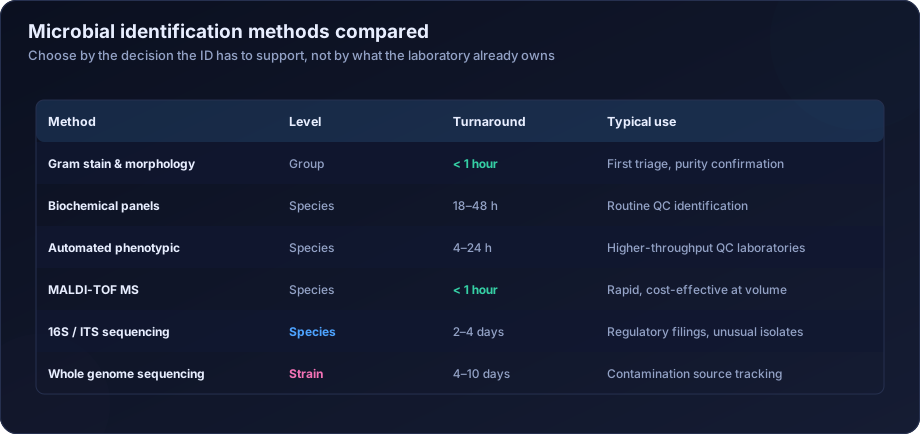
Species-level identification tells you that a product isolate and a drain isolate are both Pseudomonas fluorescens. It does not tell you they are the same organism — and in a facility where that species is common, they may well not be. Strain typing resolves the question, and it is the step that separates an evidenced investigation from a plausible story.
Why Species Is Not Enough
Consider a realistic case. A product batch yields Pseudomonas fluorescens. The facility samples the water system and finds Pseudomonas fluorescens. The obvious conclusion is that the water system contaminated the product.
That conclusion may be wrong. P. fluorescens is one of the most widespread environmental organisms there is. It can be in the water system, on a damp surface, in a raw material and on an operator's hands simultaneously — as four genetically distinct strains. Sanitising the water system on that evidence has perhaps a one-in-four chance of addressing the actual route.
Strain typing compares the isolates at a resolution fine enough to establish identity or difference. If the product isolate and the water isolate are indistinguishable, you have a route. If they differ, the water system is exonerated and the investigation looks elsewhere — which is just as valuable and considerably cheaper than a wasted remediation.
The Resolution Ladder
| Level | Method | What it answers |
|---|---|---|
| Group | Gram stain, morphology | Broad category only |
| Genus | Biochemical panels | Which family of organism |
| Species | MALDI-TOF, 16S/ITS sequencing | What kind of organism |
| Strain | WGS, PFGE, ribotyping, MLST | Whether two isolates are the same organism |
Only the bottom row supports a source-tracking conclusion. Everything above it narrows the field.
Typing Methods Compared
Whole genome sequencing (WGS) — the current reference standard. Sequences the entire genome and compares isolates by single nucleotide polymorphism differences. Highest resolution available, distinguishes strains that every other method calls identical, and produces data that remains useful as the reference set grows. Four to ten days, highest cost.
Pulsed-field gel electrophoresis (PFGE) — the long-established method. Restriction digestion produces a banding pattern compared between isolates. Well validated with decades of literature, lower resolution than WGS, labour-intensive and slow, but still valuable where a historical PFGE comparison set exists.
Multi-locus sequence typing (MLST) — sequences a defined set of housekeeping genes and assigns a sequence type. Good reproducibility and portable between laboratories, resolution below WGS but adequate for many investigations.
Ribotyping — restriction pattern of ribosomal RNA genes. Automated systems make it fast and reproducible. Moderate resolution, useful for routine facility flora comparison.
RAPD and rep-PCR — fingerprinting by arbitrary or repetitive-element primers. Fast and inexpensive, but reproducibility between runs and laboratories is poor, so results are best used within a single comparison batch rather than against a historical library.
Interpreting a Typing Result
The output is a similarity measure, not a yes or no, and interpreting it requires knowing the organism.
For WGS, isolates differing by only a handful of SNPs are usually considered the same strain, while dozens or hundreds indicate distinct strains. The exact threshold is species-dependent, because mutation rates differ — an organism that accumulates changes quickly will show more SNPs between genuinely related isolates than a slowly evolving one.
For PFGE, the widely used Tenover criteria classify isolates as indistinguishable, closely related, possibly related, or unrelated based on band differences.
Two practical cautions. First, isolates can be genuinely related and not identical, because a population resident in a facility for years accumulates variation. A small number of differences does not exclude a common source. Second, identical isolates prove a relationship, not a direction — typing shows the drain and the product carry the same strain, not which one contaminated the other. Direction comes from the timeline and the material flow map.
When Typing Justifies Its Cost
Justified:
- Any recurring contamination where previous corrective action failed.
- Before committing to an expensive remediation — equipment replacement, facility modification, supplier change.
- Listeria monocytogenes in a food facility, where persistent strains are the norm and regulators expect strain-level evidence.
- Sterility test positives, where the disposition decision carries very high consequence.
- Distinguishing a resident facility strain from an incoming raw material strain, which points to entirely different corrective actions.
- Regulatory or customer investigations where evidence quality will be scrutinised.
Not justified:
- Routine environmental monitoring recoveries within limits.
- A one-off event with an obvious and already-corrected cause.
- Where the corrective action would be the same regardless of the answer.
That last test is the useful one. If you would do the same thing whichever way the typing came out, do not pay for it.
The Comparison Set Is Everything
Typing an isolate on its own tells you nothing. The result is a comparison, which means the value depends entirely on what you compare against.
This is why a facility flora library matters so much. A facility with several years of archived, identified and cryopreserved isolates can compare a new product isolate against its own history within days. A facility without one has to start a fresh sampling campaign, and the organism it is looking for may not be shedding at that moment.
The library also answers a question typing alone cannot: how long has this strain been here? A strain matching an isolate archived three years ago tells you the niche is long-established and that the corrective actions taken since have all missed it.
What Typing Cannot Do
Being clear about the limits prevents over-reading a result, which is its own failure mode.
It cannot establish direction. Identical isolates in a drain and in product prove a relationship. Which contaminated which comes from the timeline and the material flow map, not the sequence data.
It cannot prove absence. Failing to find a matching strain in the facility does not prove the organism came from elsewhere — it may be present in a location nobody sampled, or shedding intermittently and absent on the day.
It cannot substitute for a comparison set. A typed isolate with nothing to compare against yields a data file and no conclusion.
It cannot resolve every organism equally. Species with low genetic diversity, or highly clonal populations, produce isolates that look identical by any method despite unrelated origins. Interpretation has to account for the population structure of the specific organism.
It cannot replace the physical investigation. Typing narrows the search dramatically; someone still has to open the equipment and find the cracked gasket.
Relatedness is a spectrum, not a verdict. A population resident in a facility for years accumulates variation, so genuinely related isolates may differ by more than a naive threshold allows. Reporting a typing result as a simple match or no-match discards the nuance that makes it defensible.
Practical Sequence for an Investigation
- Archive the product isolate immediately under cryopreservation.
- Identify to species by MALDI-TOF, confirming by sequencing where the result carries weight.
- Retrieve candidate isolates of the same species from the facility flora library.
- Sample the hypothesised route to generate fresh candidate isolates.
- Type the product isolate and all candidates in the same batch, since inter-run reproducibility is a weakness of several methods.
- Interpret against species-appropriate thresholds.
- Combine the typing result with the timeline and material flow to establish direction, not just relationship.
- Retain all isolates and the raw typing data for future comparison.
A Note on Listeria in Food Facilities
Listeria monocytogenes deserves separate mention because strain typing is effectively mandatory rather than optional.
Listeria establishes persistent facility niches — cool, wet, hard-to-clean locations such as drains, floor joints, refrigeration units and conveyor bearings. A facility can carry the same strain for years, shedding intermittently into product. Distinguishing a persistent resident strain from repeated incoming contamination determines whether the response is a facility remediation or a supplier problem, and only typing answers it.
Regulators in most markets expect strain-level evidence in Listeria investigations, and a food facility without an archived isolate collection is starting each investigation from zero.
How DSTechnoverse Helps
Typing is only as useful as the comparison set and the interpretation, so we treat it as part of an investigation rather than as a standalone test.
That covers whole genome sequencing and strain comparison, facility flora library establishment with cryopreservation and cataloguing, batch-matched typing so inter-run variability does not confound the comparison, species-appropriate threshold interpretation, integration with timeline and material flow analysis to establish direction, and retention of isolates and raw data for future investigations.
Our laboratory is in Indore, Madhya Pradesh, and cultures travel well — clients across India get the same turnaround as local ones, which is an advantage typing has over most microbiological services.
Frequently Asked Questions
What is the difference between identification and typing?
Identification determines what species an organism is. Typing determines whether two isolates of the same species are the same strain. Source tracking requires the second.
How different do two isolates have to be to rule out a link?
It depends on the organism and the method. For WGS, a handful of SNPs suggests the same strain and dozens or hundreds suggests distinct strains, with species-specific thresholds. Interpretation should be done by someone familiar with the organism.
Can typing tell us which direction contamination travelled?
No. It establishes that two isolates share a strain. Direction comes from the timeline, the material flow map and which location was positive first.
Do we need to archive isolates to make typing useful?
Effectively yes. Typing is a comparison, and without archived candidates the comparison set has to be generated from scratch, which delays the investigation by weeks and may miss an intermittently shedding source.
Is WGS always the right method?
Not always. It has the highest resolution and the highest cost. MLST or ribotyping is adequate for many routine facility comparisons, and PFGE remains valuable where a historical comparison set is in that format.
Can typing be done retrospectively on old isolates?
Only if they were preserved properly. Cryopreserved isolates at minus seventy degrees remain typeable for years, which is the entire argument for a facility flora library. Isolates maintained on agar slopes and repeatedly subcultured accumulate changes and may no longer represent the original organism, which undermines the comparison you are trying to make.
How does typing fit into a Listeria environmental monitoring programme?
It becomes the backbone of it rather than an occasional extra. In a ready-to-eat food facility, the practical question is never simply whether Listeria is present but whether the same strain keeps reappearing. A programme that identifies to species and stops cannot distinguish a persistent resident strain from repeated fresh ingress, and those two situations call for completely different responses — a facility remediation in the first case, a supplier or raw material investigation in the second. Facilities running aggressive Listeria programmes type every isolate as a matter of routine and maintain the collection specifically for that comparison.
Is there a cheaper first-pass alternative before committing to sequencing?
Ribotyping or rep-PCR can serve as an inexpensive screen where you have many candidate isolates and want to narrow the field before paying for whole genome sequencing on the survivors. The caution is that both have lower resolution, so they are reliable for excluding candidates rather than for confirming a match. Use them to eliminate the isolates that are clearly unrelated, then sequence the handful that remain plausible.
Do we need an external laboratory for typing?
Almost always, unless the facility runs sequencing in-house, which few manufacturers do. What matters more than location is that all isolates in a comparison are typed in the same batch by the same laboratory. Several typing methods have poor reproducibility between runs, so isolates typed months apart at different providers may appear different purely as an artefact of the method.
How long does typing take?
Four to ten days for WGS including analysis, two to four days for MLST, and roughly a week for PFGE. Faster where isolates are already pure and archived rather than needing recovery from a fresh sample.
If contamination has recurred despite corrective action, the source has not been found yet. DSTechnoverse runs structured contamination investigations with organism identification, strain typing and harbourage location. Based in Indore, Madhya Pradesh, deploying to client facilities across India. Talk to our microbiology team.