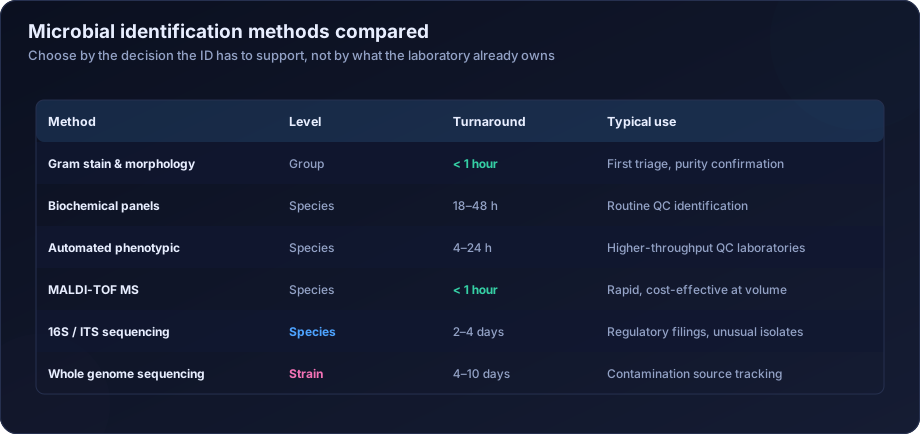
An identification used for routine trending and an identification used in a recall decision are the same laboratory procedure judged by very different standards. When the result carries regulatory weight, it is no longer enough that the laboratory believes the answer — the report must demonstrate why the answer is reliable.
Why Inspectors Examine Identifications
Identifications get scrutiny in contamination investigations specifically, because a weak identification undermines everything built on top of it.
If the species was wrong, the source attribution was wrong. If the source attribution was wrong, the corrective action addressed something that was never the problem — and the recurrence three months later is now on record alongside an investigation that appeared thorough. Inspectors have seen that sequence enough times to look for it.
The examination is usually not of the technique. It is of whether the report supports the conclusion drawn from it.
What a Defensible Report Contains
| Element | Why it is needed |
|---|---|
| Method and instrument | Determines the resolution achievable |
| Database name, version and date | Results change as databases grow; reproducibility depends on this |
| Percentage identity (sequencing) | The actual measure of match quality |
| Query coverage and sequence length | A 99% match over 200 bases is weaker than over 1,400 |
| Next-closest match with its identity | Reveals ambiguity that a single name conceals |
| Score value and threshold (MALDI-TOF) | Distinguishes species-level from genus-level confidence |
| Stated confidence level | Species, genus, or explicitly unresolved |
| Analyst and reviewer with dates | Traceability |
| Isolate storage reference | Allows re-examination years later |
The database version is the element most often omitted and the one that matters most over time. Reference databases grow continuously. An isolate reported as species X in 2024 might return a different closest match in 2027 simply because a better reference entry was added. Without the version recorded, that discrepancy is unexplainable.
Reporting Ambiguity Honestly
The most common data integrity weakness in identification reporting is not fabrication. It is over-precision — reporting a species name where the data supports only a genus.
Conventional 16S thresholds are approximately 99 per cent identity for species and 97 per cent for genus. At 98.2 per cent, the honest report is a genus assignment with the nearest species noted, not a species name.
Similarly, where the top two matches are different species separated by 0.1 per cent identity, the result is genuinely ambiguous. Reporting "Bacillus species, not resolved to species level by 16S; closest matches B. cereus and B. thuringiensis at 99.8% and 99.7%" is defensible. Picking one is not.
Documented ambiguity is far stronger than false confidence. An inspector reading the first response understands the limits of the method; reading the second, they have no way to know the limits existed.
Confirming by an Independent Method
For identifications that will appear in a submission, a deviation report or a recall decision, confirmation by a methodologically independent technique is the expectation.
Repeating the same MALDI-TOF run is not confirmation — it reproduces the same systematic error if one exists. Confirming a MALDI-TOF result by 16S sequencing is confirmation, because the two interrogate different molecular properties.
Where the two disagree, that disagreement is itself important information and should be documented rather than resolved by preferring the answer that fits the narrative.
Retention: Data and Organism
Two things must survive, and the second is discarded far more often.
Raw data — chromatograms, spectra, sequence files — retained so the identification can be re-examined against an updated database. A summary report alone cannot be re-analysed.
The viable isolate, cryopreserved. This is the one that matters most and the one laboratories routinely discard after reporting. A question raised two years later about whether an organism matches a new contamination can only be answered if the culture still exists.
Retention periods should align to product shelf life plus regulatory record retention, and considerably longer for facility flora library entries where historical comparison is the whole point.
Where a contract laboratory holds the isolates, ownership should be contractual. The collection represents years of accumulated facility knowledge and cannot be reconstructed.
Chain of Custody From Plate to Report
A regulatory-grade identification needs traceability back to the sample, not just forward from the pure culture.
- The originating sample record — location, date, sample type, production context, count at recovery.
- The subculture history, including passage number, since repeated transfer causes drift.
- Purity confirmation before identification, documented rather than assumed.
- The identification result with its metrics.
- The storage location of the archived isolate.
A common gap is the link between the plate and the isolate. An environmental plate showing three colony types yields three isolates, and if the record does not distinguish which came from which plate position, a later investigation cannot reconstruct what was where.
Where Identifications Come Apart at Audit
- No database version recorded, so the result cannot be reproduced or explained.
- Species reported from genus-level data, which an inspector detects by checking the identity figure against the threshold.
- Confirmation by repeating the same method, which is not independent.
- Isolate discarded, so the identification cannot be revisited.
- Purity not confirmed, leaving open whether the result came from a mixed culture.
- Clinical database used for an environmental isolate, returning a plausible but wrong nearest relative.
- Disagreement between methods resolved silently in favour of the convenient answer.
- No link from isolate back to the specific plate and location, breaking the investigation chain.
Reference Cultures and Traceability
Identifications are only as good as the reference organisms the laboratory uses to demonstrate its methods work, and traceability of those cultures is itself an inspection topic.
Compendial methods specify reference strains by culture collection number — ATCC, NCTC, MTCC and equivalents. The expectation is that strains are traceable to the named collection and are used within a limited number of passages from the reference stock, commonly five. Beyond that, phenotypic drift makes the strain arguably no longer the reference organism.
- Purchase from a recognised collection or from a supplier providing documented traceability back to one.
- Record passage number on every working stock and discard at the defined limit rather than maintaining indefinitely.
- Prepare and cryopreserve working stocks from the original vial rather than subculturing serially from the working plate.
- Verify identity and purity of each new working stock batch before use.
- Use reference strains for growth promotion, method suitability and identification system verification, and record which strain lot was used for each.
- Keep the certificates of analysis from the collection, since these are what demonstrate traceability.
A laboratory that cannot show where its S. aureus ATCC 6538 came from, or how many passages it is from the reference stock, has a gap that undermines the growth promotion and suitability records that depend on it — and by extension the routine results those records support.
Using Identifications in a Deviation Report
The identification usually appears in a deviation as a single line, and how that line is written determines how much weight the rest of the report can carry.
A weak version reads: "The organism was identified as Pseudomonas aeruginosa." It asserts a conclusion with no basis, and everything built on it — the source attribution, the corrective action, the impact assessment — inherits that weakness.
A defensible version reads: "The isolate was identified as Pseudomonas aeruginosa by MALDI-TOF (score 2.31, above the 2.00 species threshold), confirmed by 16S rRNA sequencing at 99.7% identity over 1,412 bases against database version X dated Y. The next-closest match was Pseudomonas fluorescens at 97.2%. Isolate archived as reference ENV-2026-0148."
The second version is four sentences longer and it survives scrutiny. It states the methods, shows they were independent, gives the metrics against their thresholds, demonstrates the result was unambiguous by reporting the gap to the next match, and confirms the organism still exists for re-examination.
Where the data does not support that level of confidence, the report should say so with equal precision. "Identified to genus level as Bacillus species; 16S identity 98.4% did not meet the 99% species threshold, and the closest matches B. cereus and B. thuringiensis are not separable by this locus" is a stronger statement than a confident species name that an inspector can undercut by checking the identity figure.
How DSTechnoverse Helps
We report identifications with the metrics that make them defensible, and we report ambiguity as ambiguity.
That covers MALDI-TOF and sequence-based identification with full confidence reporting, independent-method confirmation for regulatory-critical results, raw data and viable isolate retention under cryopreservation, chain of custody from originating sample through to archived culture, contractual clarity that the isolate collection belongs to the client, and support during inspections where an identification is questioned.
Our laboratory is in Indore, Madhya Pradesh, and we retain client isolate collections under monitored cryogenic storage for manufacturers across India.
Frequently Asked Questions
What percentage identity is needed for a species-level call?
Around 99 per cent for 16S, with 97 per cent for genus. Below the species threshold, report the genus with the nearest species noted rather than assigning a species name.
Is repeating the test a valid confirmation?
No. Repeating the same method reproduces any systematic error. Confirmation requires a methodologically independent technique — sequencing to confirm MALDI-TOF, for instance.
How long should raw sequencing data be kept?
At least as long as the associated product record, and longer where the isolate forms part of a facility flora library. Databases improve, and re-analysis is only possible if the raw data survives.
What if two methods disagree?
Document the disagreement and investigate it rather than selecting the preferred answer. Disagreement usually indicates an organism in a poorly resolved group, a database gap, or a purity problem — all of which are worth knowing.
Do we need to keep the actual culture?
Yes, cryopreserved, for anything that might be revisited. It is the single most commonly discarded item and the one whose absence most often stalls a later investigation.
Does the identification need to be repeated if the database is updated?
Not routinely, and it is worth revisiting for specific cases. Where an original identification was ambiguous or returned a poor match, re-running the stored sequence against a current database can resolve it, because reference collections have grown substantially and many environmental organisms that had no good match five years ago now do. This is only possible if both the raw sequence data and the isolate were retained, which is the practical argument for retaining both. Where the original identification was unambiguous, there is no reason to revisit it.
How should identifications be handled during a technology transfer or site change?
Treat the flora library as part of the transfer package rather than as laboratory housekeeping. When production moves between sites, the receiving site inherits a different environmental population, and the sending site's identification history is the reference against which the new site's flora should be compared. Transferring the archived isolates, the identification records and the database versions used lets the receiving site distinguish organisms it has inherited with the process from organisms native to its own building. Without that, the first contamination event at the new site starts from nothing, and a year of otherwise avoidable investigation follows.
Do identifications need to be included in the annual product quality review?
They add substantial value there even where not strictly mandated. An annual review that reports only counts and pass rates says whether the year was compliant. One that reports the organisms recovered, by area and by product, says whether the microbiological picture is changing — a shift in the resident flora, a new species appearing repeatedly, or a genus disappearing after a corrective action are all findings that pass-rate data cannot surface. Facilities that include the flora summary tend to catch developing problems a review cycle earlier than those that do not.
What should we do if an inspector challenges an identification?
Produce the metrics rather than defending the name. The percentage identity, the coverage, the database version, the next-closest match and the confirmatory method are what answer the challenge, and if the archived isolate still exists you can offer re-analysis. An identification that was reported honestly, including any ambiguity, is straightforward to defend. One that asserted a species name the data did not support is not, and the right response there is to acknowledge it and reassess anything that depended on it.
Who owns isolates held by a contract laboratory?
You should, and it should be written into the agreement along with the obligation to transfer the collection with its metadata on request. Without that clause, a change of provider can lose years of facility knowledge.
A count tells you how much. The identity tells you where it came from. DSTechnoverse provides microbial identification from rapid MALDI-TOF through 16S and ITS sequencing to whole genome strain typing, with facility flora library development. Based in Indore, Madhya Pradesh — cultures travel well, so clients across India get the same turnaround. Talk to our microbiology team.
Related services
Related articles
- Data Integrity in the Microbiology Laboratory: Why Plate Counts Are the Hard Case
- Microbial Contamination Investigation: A Structured Route to the Actual Root Cause
- Out-of-Specification Microbiology Results: How to Investigate Without Creating a Finding
- Fungal Identification: Why Mould Speciation Matters More Than the Count