When an organism appears where it should not, the cost of a wrong conclusion is enormous. An investigation that blames the wrong source produces corrective actions that change nothing, a recurrence three months later, and a regulatory history that becomes progressively harder to defend.
Why Investigations Fail
Almost every failed investigation we are asked to pick up shares one characteristic: a hypothesis was formed within the first day and the remaining weeks were spent gathering support for it.
That is the opposite of how this should work. The organism identity, the timeline and the material flow map should all be established before any hypothesis is committed to, because each of them eliminates possibilities rather than confirming one.
The second most common failure is stopping at a plausible source rather than a proven one. "It was probably the water system" leads to sanitising the water system. If the actual harbourage was a cracked gasket on the filler, the contamination returns.
When to Launch a Formal Investigation
- Any sterility test positive, without exception.
- Recovery of a specified or objectionable organism in finished product.
- Any microbial recovery in a Grade A or Grade B zone.
- An environmental result above the action limit, or a sustained adverse trend below it.
- A finished product OOS where laboratory error has been ruled out.
- Repeated recovery of the same organism at the same location, even within limits — persistence indicates a niche.
- Consumer complaints indicating spoilage, off-odour, visible growth or pack swelling.
- Water system results above action limits or trending upward.
- A media fill or aseptic process simulation failure.
The Investigation Sequence
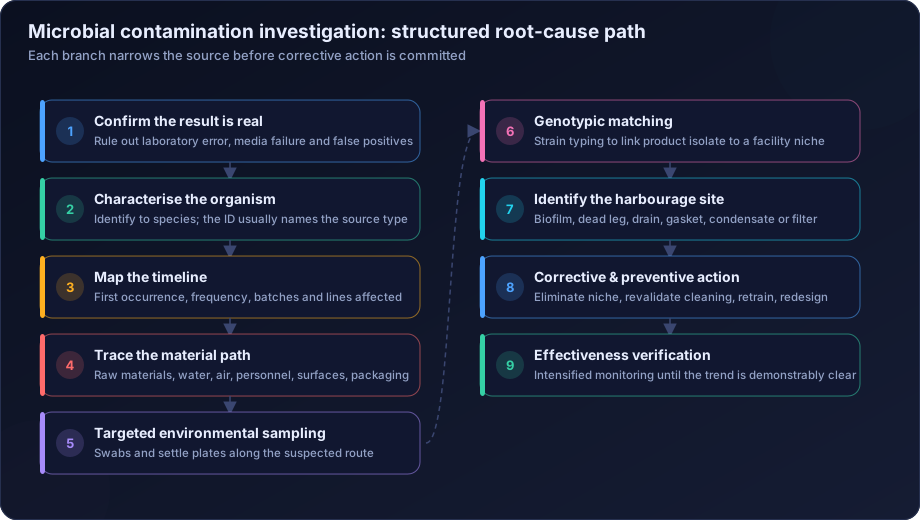
1. Confirm the finding is real
Rule out laboratory error through a defined checklist — media growth promotion and sterility records, negative controls, analyst technique, incubator performance, cross-contamination potential within the laboratory itself.
A meaningful proportion of "contamination events" are laboratory artefacts. Concluding this requires evidence, not assumption, and the standard for that evidence is set out in out-of-specification investigation.
2. Identify the organism to species
This single step directs the entire investigation. Most organisms are strongly associated with a particular source type, so the identity usually eliminates the majority of possibilities within an hour.
Use MALDI-TOF for speed, confirmed by 16S rRNA or ITS sequencing where the result carries regulatory weight. See microbial identification.
3. Reconstruct the timeline
First occurrence, subsequent frequency, which batches, which lines, which shifts, which operators, which raw material lots.
Contamination correlating with a shift pattern is a different problem from contamination correlating with a raw material lot, and the timeline separates them before any sampling is done.
4. Map the material and personnel flow
Every route by which the organism could physically have reached the product — raw materials, water, compressed gases, air, packaging, equipment, personnel, cleaning equipment, maintenance activity.
Draw it. A written list misses adjacencies that a diagram makes obvious.
5. Review existing data before generating new data
Environmental monitoring history, water results, cleaning records, maintenance logs, HVAC performance and batch records for the affected period frequently contain the answer already. This step costs nothing and is skipped constantly.
6. Sample the suspected route deliberately
Swabs, settle plates, water samples and raw material retains along the hypothesised path — including locations that would only be positive if the hypothesis is correct. A campaign that samples broadly and hopes is far less informative than one designed to test a specific proposition.
7. Type the isolates genotypically
Strain-level typing determines whether the product isolate and a facility isolate are the same organism. This converts circumstantial association into evidence, and it is the step most investigations omit. Covered in strain typing for source tracking.
8. Locate the harbourage
Persistent contamination almost always lives in a physical niche. Finding it is the objective; everything before this step exists to narrow the search.
9. Corrective and preventive action
Eliminate the niche physically where possible, revalidate cleaning, redesign equipment, retrain personnel, change the material. Sanitisation alone is rarely sufficient for an established niche.
10. Verify effectiveness
Intensified monitoring at the affected locations for a defined period, with a documented criterion for closure. A single clean result is not effectiveness verification.
What the Organism Tells You
| Organism recovered | Almost always indicates |
|---|---|
| Pseudomonas, Burkholderia, Ralstonia, Sphingomonas | Water — system, wet surface, condensate, damp component |
| Bacillus, Paenibacillus, Geobacillus | Soil, dust, botanical raw materials |
| Staphylococcus aureus, coagulase-negative staph | Human contact, gowning or glove failure |
| Micrococcus, Kocuria, Corynebacterium | Human skin flora, often airflow or gowning |
| E. coli, Enterobacter, Klebsiella | Faecal contamination via water or animal-origin material |
| Aspergillus, Penicillium, Cladosporium | Airborne mould — HVAC, damp building fabric, water ingress |
| Candida, other yeasts | Human origin or sugar-rich residue |
| Listeria monocytogenes | Persistent cool wet facility niche, rarely an incoming event |
| Clostridium and other anaerobes | Soil, animal material, anaerobic pocket in the process |
Where Contamination Actually Hides
After enough investigations these become predictable, and they are the places we sample first.
- Dead legs in water and product pipework, where biofilm establishes undisturbed.
- Worn, cracked or wrongly sized gaskets, O-rings and seals. A compressed gasket with a hairline split is a near-perfect protected niche.
- Hollow rollers, conveyor chains and equipment legs that fill during cleaning and never dry.
- Drains and floor joints, particularly in cool wet areas, and the aerosol generated when they are cleaned with a hose.
- Condensate on ceilings, pipework and refrigeration units above open lines.
- Filler nozzles, dosing needles and internal surfaces of equipment rarely fully dismantled.
- Cleaning equipment itself — mops, brushes, buckets and hoses distributing organisms rather than removing them.
- HVAC components — damp filter media, drain pans, duct interiors after water ingress.
- Damaged wall and floor surfaces, silicone sealant joints, cable entry points.
- People — hands, hair, clothing and, in persistent cases, an asymptomatic carrier.
The Investigation Team
Investigations led by the department whose performance is in question have a structural problem inspectors recognise immediately. Quality should lead, with technical input from microbiology, production, engineering and maintenance.
Engineering involvement is more important than most facilities assume. A large share of harbourages are equipment design or condition problems — a worn seal, an undrained cavity, a poorly specified gasket material — and microbiologists rarely identify those without someone who knows the machine.
Impact Assessment: Establishing the Scope
Deciding how far the problem reaches is a separate exercise from finding the cause, and it is routinely scoped too narrowly. The instinct is to consider only the batch that failed.
- Which other batches used the same raw material lots? If the source was incoming, every batch from that lot is implicated.
- Which batches ran on the same equipment before cleaning? Carryover across a campaign is a common route.
- Which batches were produced in the same area during the same period? An airborne or environmental source affects everything made in that window.
- Which batches shared the same water system state? A water excursion affects everything using that water, including cleaning.
- Which batches shared personnel or a shift pattern? Relevant where the organism is human-derived.
- Is any affected product already distributed? This changes the decision from quarantine to potential recall and brings in regulatory notification timelines.
- Does the organism present a health hazard at the level found, for the actual patient or consumer population? This determines whether it is a quality event or a safety event.
That final question should be answered by someone qualified to make the judgement rather than assumed. The same organism at the same count can be trivial in an oral tablet and serious in an inhalation product, and the assessment must be documented with its reasoning.
The scoping decision is also where commercial pressure bites hardest, which is exactly why the criteria should be written into the procedure in advance rather than debated during the event.
Documenting It So It Survives Inspection
An investigation is judged twice: on whether it found the cause, and on whether the documentation shows it was capable of finding the cause.
- State the hypotheses considered, including those rejected, with the evidence that excluded each.
- Record the laboratory error assessment explicitly, with the controls reviewed.
- Include the identification method, database and confidence metrics.
- Document the sampling rationale — why those locations, at that time, in that production state.
- Link every corrective action to a specific finding. An action with no corresponding finding suggests the cause was not established.
- Define the effectiveness criterion in advance.
- Record the batch impact assessment, including batches considered and cleared.
- Where no root cause is found, say so plainly and describe the enhanced monitoring that continues.
Recurrence Means the Source Was Never Found
If contamination returns after corrective action, one of two things is true: the harbourage was not found, or it was found and not eliminated.
Sanitisation kills what it reaches. A biofilm inside a dead leg, a cracked gasket, or the inside of a hollow roller survives and reseeds. Facilities caught in this cycle often increase sanitisation frequency, which defers the problem at increasing cost rather than resolving it.
The diagnostic question is how quickly it returns. Recurrence within two to three weeks of sanitisation indicates a substantial surviving reservoir — see biofilm in water systems for the same logic applied to distribution loops.
How DSTechnoverse Helps
We are usually engaged either at the start of a serious event or after a facility has already tried and failed to resolve one. The second is more common and usually requires unpicking conclusions reached too early.
Our work covers investigation leadership with a structured protocol through to effectiveness verification, organism identification and strain typing, facility flora library development, targeted sampling campaigns designed to test a specific hypothesis, retrospective statistical review to locate when the problem began, CAPA aimed at the niche rather than the symptom, and investigation reports written to withstand regulatory review.
Our team works from Indore and deploys to client facilities across India. Contamination investigations need someone physically in the plant — we build travel into the engagement rather than attempting to diagnose a facility remotely.
Frequently Asked Questions
How long does an investigation take?
A straightforward one with a clear organism and an obvious route concludes in two to three weeks. A persistent recurring contamination with an unlocated niche commonly takes two to three months, most of which is targeted sampling and typing.
Can a sterility positive be dismissed as laboratory contamination?
Only with documented evidence of a specific laboratory error. The organism identity is central — a classic laboratory contaminant alongside a failed control is a different case from a water organism with all controls valid.
Why does the same contamination keep coming back?
Because the corrective action addressed the symptom rather than a physical harbourage. If it recurs after sanitisation, there is a niche that has not been found.
Is strain typing worth the cost?
When the corrective action under consideration is expensive or disruptive, decisively yes. Typing costs a fraction of a wrongly targeted equipment replacement.
What if no root cause is found?
Document that honestly and continue enhanced monitoring. Regulators accept a rigorous investigation reaching no definitive conclusion far better than a superficial one naming a convenient cause.
Who should be on the investigation team?
Quality leads, with microbiology, production, engineering and maintenance contributing. Engineering involvement matters more than most facilities assume, because a large share of harbourages are equipment condition or design problems — a worn seal, an undrained cavity, the wrong gasket material — and microbiologists rarely identify those without someone who knows the machine. An investigation staffed entirely by the quality department tends to find procedural causes, because those are the ones it can see.
What if the investigation points at a supplier rather than our facility?
Type the isolates before acting on it. A raw material and a facility niche can carry the same species entirely coincidentally, and blaming a supplier on species-level evidence damages a commercial relationship without fixing anything. Where typing does confirm the material as the route, share the identification with the supplier and request their own investigation, batch records and environmental data for the relevant production period.
Should production continue during an investigation?
A risk decision for quality management based on the organism, area and product. It must be documented with a rationale and not made by production alone.
If contamination has recurred despite corrective action, the source has not been found yet. DSTechnoverse runs structured contamination investigations with organism identification, strain typing and harbourage location. Based in Indore, Madhya Pradesh, deploying to client facilities across India. Talk to our microbiology team.