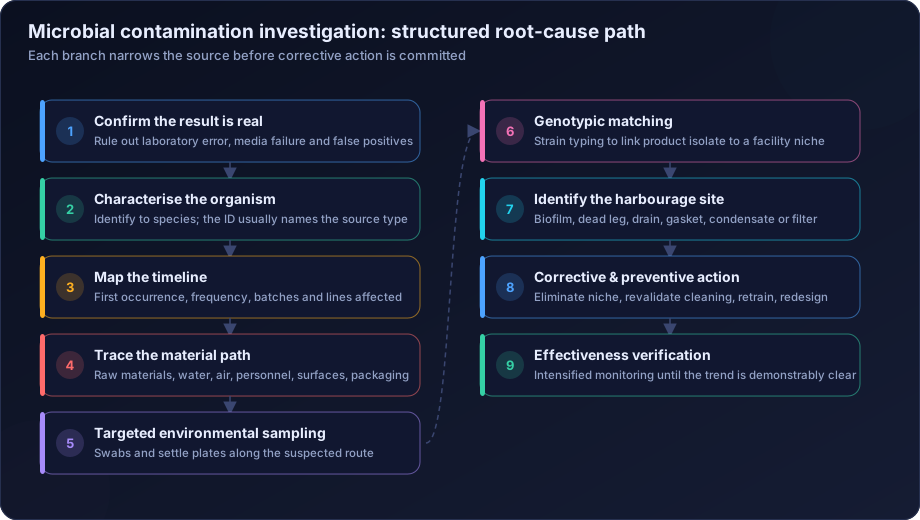
The handling of an out-of-specification microbiological result is scrutinised more closely than almost any other area in a regulatory inspection. The reason is straightforward: it is the point at which commercial pressure and technical integrity collide most directly, and the paperwork records which one won.
The Rule That Governs Everything
A result may not be invalidated without documented evidence of a specific, identified laboratory error.
That is the whole principle, and almost every serious finding in this area comes from breaching it. "Probable laboratory contamination" is not evidence. "The analyst may have touched the plate" is not evidence. A confirmed media sterility failure, a documented technique deviation recorded at the time, a positive result on a negative control, or a demonstrated instrument malfunction — these are evidence.
Retesting until a passing result appears, then releasing on the passing result, is falsification. Inspectors look for the pattern specifically, and it is visible in the data long before anyone admits to it.
Phase One: The Laboratory Investigation
Phase one asks a single question: did the laboratory cause this result?
It must be completed, documented and concluded before any manufacturing investigation begins, and before any retest is considered.
- Preserve everything. The plates, the isolate, the remaining sample, the media lot records. Discarding the plate destroys the evidence the entire investigation depends on.
- Interview the analyst promptly, while the session is fresh, using a structured checklist rather than an open question. Ask what was done, not whether anything went wrong.
- Review the media records — growth promotion testing for that lot, sterility of uninoculated controls, expiry, storage conditions.
- Review the controls from the same session. A contaminated negative control is direct evidence of a laboratory cause; a valid negative control substantially weakens the laboratory-error hypothesis.
- Review the environmental monitoring of the testing area for that session, particularly for sterility testing.
- Check incubator records — temperature throughout the incubation, any door openings, any deviation.
- Identify the organism. This is the most informative single step, discussed below.
- Review the analyst's recent history. A pattern of positives associated with one analyst suggests technique; positives distributed across analysts suggest something else.
- Assess sample handling — condition on receipt, temperature, hold time, container integrity.
- Conclude explicitly. Either a specific laboratory cause is identified and documented, or it is not. There is no third option.
What the Organism Tells You in an OOS
Species identification frequently settles the phase one question on its own, because organisms are ecologically specific.
| Organism recovered | Typical implication |
|---|---|
| Staphylococcus epidermidis, Micrococcus | Human contact — could be analyst or production personnel |
| Bacillus subtilis, other aerobic spore formers | Environment, dust, raw material — rarely a laboratory artefact |
| Pseudomonas, Burkholderia, Ralstonia | Water — laboratory water or process water, distinguishable by strain typing |
| Aspergillus, Penicillium | Airborne mould — laboratory environment or production environment |
| Escherichia coli, Salmonella | Faecal contamination — almost never a laboratory artefact, treat as real |
| Candida, other yeasts | Human origin or sugar-rich residue |
The critical inference is this: a classic skin organism recovered alongside a failed operator glove print in the testing session is a plausible laboratory contamination case. The same organism with all controls valid is not. And a water organism or an enteric pathogen should never be attributed to the laboratory without exceptional evidence.
When Retesting Is Legitimate
Retesting has a narrow and specific role, and it is not to obtain a different answer.
Legitimate: a specific laboratory error has been identified in phase one, and the retest is performed to obtain a valid result in place of an invalid one. The original result is documented, the error is documented, and the retest is performed on the retained original sample by a different analyst where possible.
Not legitimate: testing additional samples because the first result was unwelcome, and averaging or disregarding the original. Testing until a passing result appears. Discarding the original result without a documented cause.
Resampling — taking a new sample from the batch — is a different and more restricted matter. It is only justified where the original sample is demonstrably not representative, for instance where sampling error is documented. Resampling because the first sample failed is not defensible.
Phase Two: The Manufacturing Investigation
If phase one identifies no laboratory cause, the result stands and the investigation extends into manufacturing.
- Batch record review — deviations, interventions, hold times, equipment changes, unusual events during the production window.
- Environmental monitoring data for the production area across the relevant period, looking for excursions or adverse trends that coincide.
- Water system results for the period, since water is the most common source.
- Raw material history — which lots were used, their test results, whether other batches share them.
- Personnel — who was working, gowning records, any training gaps or new staff.
- Cleaning and changeover records for the equipment used.
- Previous product on the same line, for cross-contamination potential.
- Maintenance activity in or near the area, which frequently correlates with contamination events.
Strain typing against the facility flora library is what converts circumstantial correlation into evidence. Without it, a Pseudomonas in the product and a Pseudomonas in the water system are only suggestively related.
Impact Assessment
Establishing the scope is a separate step and is frequently done too narrowly.
- Which other batches used the same raw material lots?
- Which batches ran on the same equipment before cleaning?
- Which batches were produced in the same area during the same period?
- Which batches shared the same water system state, personnel or campaign?
- Is any affected product already distributed?
- Does the organism present a health hazard at the level found, for the intended patient or consumer population?
The last question determines whether this is a quality event or a safety event, and it should be answered by someone qualified to assess it rather than assumed.
Disposition
The decision to reject, reprocess or release must be made by quality, documented with a scientific rationale, and must follow from the investigation rather than preceding it.
Release following a genuine out-of-specification result is possible in narrow circumstances — for example where the result is confirmed as a laboratory artefact with evidence, or where a risk assessment demonstrates the finding has no bearing on product quality — but it requires substantially more justification than rejection, and it is examined closely at inspection.
Trending as OOS Prevention
The most effective OOS strategy is to have fewer of them, and the mechanism is statistical trending rather than tighter testing.
A binary comparison against a specification discards most of the information a testing programme generates. A result of 400 CFU/g against a limit of 1000 is compliant — and if every prior batch ran below 50, it is also a signal that something has changed. Programmes that only check pass or fail see nothing until the limit is crossed.
- Control charts on log-transformed counts. Microbiological data is log-normally distributed, so charting raw counts produces misleading control limits.
- Run rules rather than limit breaches. Seven consecutive results above the median, or a run of increases, indicates a shift long before any single result fails.
- Capability analysis against the specification, which quantifies how much margin the process actually has rather than whether the last batch passed.
- Per-site and per-product charting. Aggregated data hides the one line or product that is deteriorating.
- Positive-rate tracking in low-count environments, where the proportion of samples showing any growth is more sensitive than the magnitude.
- Seasonality decomposition, since monsoon humidity and summer temperature drive predictable variation that should not be mistaken for drift.
A process moving toward its limit typically gives eight to twelve weeks of warning in the data. That is enough time to investigate and correct while it is still inexpensive, and it converts an OOS investigation into a routine adjustment.
The Patterns Inspectors Look For
- A high proportion of OOS results invalidated as laboratory error, particularly without identified specific causes.
- Retests performed before phase one was concluded.
- More retests on failing results than on passing ones.
- Investigations closed within implausibly short periods.
- Conclusions that do not follow from the evidence presented.
- Corrective actions unrelated to the stated root cause.
- Effectiveness checks consisting of a single clean result.
- Trending that would have shown the problem developing, but was not performed.
- Isolates not identified, so source attribution was impossible.
Documentation That Survives Scrutiny
State the hypotheses considered including those rejected, with the evidence that excluded each. Record the laboratory error assessment explicitly with the controls reviewed and their outcomes. Include the organism identification with method and confidence metrics. Link every corrective action to a specific finding. Define the effectiveness criterion in advance. And where no root cause is found, say so plainly — a rigorous investigation reaching no definitive conclusion is far more defensible than a superficial one naming a convenient cause.
How DSTechnoverse Helps
We support OOS investigations both as the testing laboratory and as an independent technical resource where the client's own laboratory generated the result.
That covers structured phase one and phase two protocols, organism identification and strain typing to establish or exclude a route, retrospective trend analysis to locate when the problem actually began, impact assessment support, CAPA development aimed at the cause rather than the symptom, and investigation reports written to withstand inspection. Where the evidence does not support invalidation, we say so — that position protects the client far more than a convenient conclusion would.
Frequently Asked Questions
Can we retest immediately if we suspect laboratory error?
Not before phase one is documented. Suspicion is not a finding. Complete the laboratory investigation, identify the specific error if one exists, and only then retest on the retained sample.
How long should an OOS investigation take?
Phase one within a few days. The full investigation commonly runs 30 days, extended with documented justification where identification or typing takes longer. Implausibly fast closures attract scrutiny.
What if we genuinely cannot find a cause?
Document that honestly and continue enhanced monitoring. An unresolved investigation with rigorous methodology is defensible; a speculative cause presented as a conclusion is not.
Should production stop during an investigation?
A risk decision for quality management based on the organism, area and product. It must be documented with a rationale, and it should not be made by production alone.
Does a single high count require full investigation?
If it exceeds the specification, yes. If it is within specification but well outside the historical distribution, it warrants at least a documented review — that is precisely the early warning a trending programme exists to provide.
How should OOS handling differ between sterile and non-sterile products?
Substantially. A non-sterile count exceeding a limit is a quantitative deviation with a range of possible dispositions. A sterility test positive is binary and carries an inherently higher regulatory bar for invalidation, because the consequence of wrongly releasing is severe and because the test has such limited statistical power that a positive is unlikely to be a false alarm. Sterility positives should be treated as real until specific evidence proves otherwise, and the investigation should begin with the assumption that the batch is affected.
What records should be retained from an investigation?
Everything generated, including the raw plate counts, the analyst interview record, the media and incubator records reviewed, the isolate identification data with its confidence metrics, and the viable isolate itself. The isolate matters most and is discarded most often. A question raised two years later about whether that organism matches a new contamination can only be answered if the culture still exists.
Who should lead the investigation?
Quality, with technical input from microbiology and production. Investigations led by the department whose performance is in question have an obvious structural problem that inspectors recognise immediately.
Need release testing and trend analysis you can defend at audit? DSTechnoverse provides finished product microbiological testing and raw material testing with statistical trending, not just pass-or-fail reporting. Based in Indore, serving clients across India. Talk to our microbiology team.
Related services
Related articles
- Data Integrity in the Microbiology Laboratory: Why Plate Counts Are the Hard Case
- Microbial Identification in a Regulatory Context: Making the Result Defensible
- Anaerobic Microbiological Testing: The Organisms Standard Methods Never See
- ATP Bioluminescence Testing: What It Measures and Where It Belongs