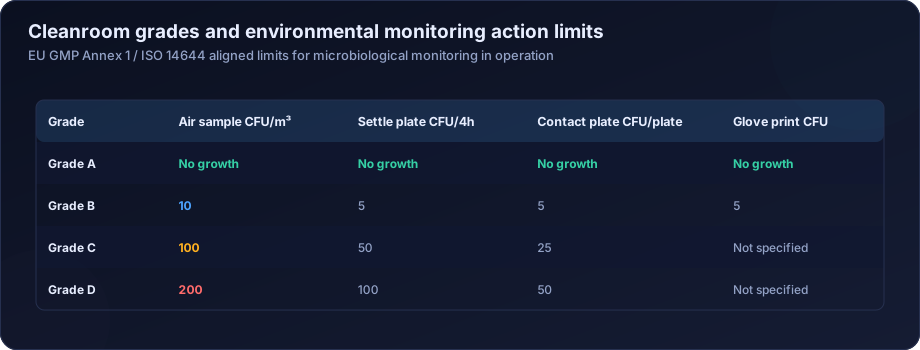
Cleanroom grades and their monitoring limits are widely quoted and frequently misapplied. The confusion usually comes from mixing two different systems — ISO 14644 particle classification and GMP grade designation — which are related but not interchangeable. This article sets out what each means, how they map, and where the mapping breaks.
Two Systems, Different Purposes
ISO 14644 classifies cleanrooms by airborne particle concentration. It is a physical measurement, says nothing about microorganisms, and assigns a class number from ISO 1 (cleanest) to ISO 9.
GMP grades — A, B, C and D under EU GMP Annex 1 and equivalents — define what operations may be performed in an area, and specify both particle limits and microbiological limits.
A room can be ISO 7 classified and still fail Grade B requirements, because Grade B carries microbiological limits that ISO 14644 does not address at all. Facilities that treat an ISO certificate as evidence of GMP grade compliance are making a category error that inspectors identify quickly.
The Grades and What Happens In Them
| Grade | Typical operations | ISO class at rest | ISO class in operation |
|---|---|---|---|
| A | Aseptic filling, open product exposure, sterile connections | ISO 5 | ISO 5 |
| B | Background to Grade A in aseptic processing | ISO 5 | ISO 7 |
| C | Preparation of solutions to be filtered, less critical stages | ISO 7 | ISO 8 |
| D | Component handling, support operations | ISO 8 | Not defined |
The key structural point is that Grade A must maintain ISO 5 both at rest and in operation. Every other grade is permitted to degrade by one or two classes once people and equipment are working. Grade A does not get that allowance, which is why it requires unidirectional airflow and why interventions into it are so tightly controlled.
Microbiological Limits
These are the values that ISO 14644 does not provide and that define the grade microbiologically.
| Grade | Air sample CFU/m³ | Settle plate CFU/4h (90 mm) | Contact plate CFU/plate (55 mm) | Glove print CFU (5 fingers) |
|---|---|---|---|---|
| A | No growth | No growth | No growth | No growth |
| B | 10 | 5 | 5 | 5 |
| C | 100 | 50 | 25 | Not specified |
| D | 200 | 100 | 50 | Not specified |
Three points are worth drawing out.
Grade A permits no recovered growth at all. Not a low number — none. Any recovery in Grade A is an investigation, and treating a single colony as within tolerance is a misreading with real consequences.
These are action limits, not targets. A facility routinely running at 90 CFU/m³ in Grade C is technically compliant and practically in poor shape. Alert limits derived from your own capability should sit well below these.
Settle plates are specified per four hours. Longer exposures require validation, because agar dehydrates and recovery falls through the exposure period. A plate left out for a full eight-hour shift without validated media is under-reporting.
At Rest Versus In Operation
The distinction is fundamental and often glossed over.
At rest means the installation is complete, equipment is installed and running, but no personnel are present. It demonstrates that the room and its air handling are capable.
In operation means the facility is functioning in the defined mode with the specified number of personnel working. It demonstrates what the room actually delivers during production.
Classification is normally performed in both states. Routine microbiological monitoring should be performed in operation, because that is the condition product experiences. A monitoring programme sampling at rest produces excellent data describing a state in which no product is ever made.
Non-Viable Particle Monitoring
Particle counting sits alongside microbiological monitoring and answers a different question — whether the physical cleanliness of the air is being maintained.
| Grade | ≥0.5 µm at rest (per m³) | ≥0.5 µm in operation | ≥5.0 µm in operation |
|---|---|---|---|
| A | 3,520 | 3,520 | 20 |
| B | 3,520 | 352,000 | 2,900 |
| C | 352,000 | 3,520,000 | 29,000 |
| D | 3,520,000 | Not defined | Not defined |
The two datasets are most useful read together. A microbiological excursion accompanied by a particle count rise points to a physical failure — filter breach, pressure cascade loss, door integrity. A microbiological excursion with normal particle counts points to personnel, procedure or a surface source. That single comparison resolves a large proportion of investigations quickly.
Pressure Cascades and Air Changes
Grades are maintained by airflow, and monitoring data that ignores the physical parameters is missing the explanation for most excursions.
- Differential pressure — typically 10 to 15 Pa between adjacent grades, with the cleaner area positive. Loss of cascade is a leading cause of sudden excursions.
- Air change rates — commonly 20 or more per hour for Grade C and D, with Grade A achieved by unidirectional flow at 0.36 to 0.54 m/s rather than by change rate.
- Recovery time — how long the room takes to return to its classified state after a disturbance, typically required to be 15 to 20 minutes.
- Airflow visualisation — smoke studies demonstrating that unidirectional flow over the critical zone is not disrupted by equipment or operators.
- Temperature and humidity, both of which affect microbial survival and operator comfort, and therefore gowning discipline.
Controlled Not Classified Areas
Food, cosmetic, nutraceutical and many device facilities operate areas that are hygienically controlled without formal cleanroom classification. The GMP grade limits do not apply, and borrowing them wholesale usually produces limits that are either meaninglessly loose or unachievably tight.
For these areas, derive limits from your own capability data as described in environmental monitoring programme design, and set them against what the operation actually requires — a ready-to-eat food line needs tighter control than a raw material handling area, regardless of what any pharmaceutical table says.
Where Facilities Get the Mapping Wrong
- Treating an ISO 14644 certificate as GMP grade compliance. It covers particles only, and the microbiological requirement is separate.
- Classifying at rest and monitoring at rest. Product is made in operation; that is the state that matters.
- Reading Grade A "no growth" as "a low count is acceptable." It is not.
- Applying pharmaceutical grade limits to a food or cosmetic area without asking whether they are achievable or relevant.
- Ignoring the ≥5.0 µm particle limit in Grade A, which is far more sensitive to disturbance than the 0.5 µm count.
- Monitoring microbiology without recording differential pressure, so excursions have no available explanation.
- Requalifying annually as a formality without reviewing whether the classification still matches how the room is used.
Qualification and Requalification
Initial qualification establishes that the room meets its grade in both states. Requalification confirms it still does — normally every six months for Grade A and B, and annually for Grade C and D, plus after any significant change.
Significant change includes HVAC modification, layout change, new equipment introduced into the space, a change in the number of personnel, a change in the operations performed, and any construction work nearby. Requalification after change is where facilities most often fall behind, because the change was made by engineering and quality was not informed.
Airflow Visualisation and Why It Matters Microbiologically
Smoke studies are usually treated as an engineering deliverable and filed with the qualification package. They are also one of the most useful microbiological documents a facility has, because they show where contamination will actually go.
Unidirectional airflow over a Grade A zone only protects product if it reaches the product without being disrupted. Equipment placed in the flow path, an operator's arm, a stopper bowl, or a poorly positioned Restricted Access Barrier System panel can all create turbulence, dead zones or reverse flow that carries particles from a less clean area directly onto exposed product.
- Study the flow in operation, with equipment running and operators performing real interventions, not an empty room.
- Cover every routine intervention, since the intervention is precisely when the flow is disturbed and the product is exposed.
- Look for recirculation around equipment, which draws air from below the critical zone back up over it.
- Check the operator position relative to product for every task — an operator working over an open vial in unidirectional flow is upstream of it.
- Repeat after any equipment or layout change, which is where the studies most often become obsolete.
- Correlate with monitoring data. A site that is repeatedly positive despite good cleaning frequently sits in a flow dead zone, and the smoke study explains it immediately.
When a Grade A site shows recurring recoveries with no obvious cause, reviewing the airflow visualisation before launching further sampling is usually the faster route to an answer.
How DSTechnoverse Helps
We support cleanroom microbiological programmes rather than the physical qualification itself, and the two need to connect properly.
That covers microbiological limit derivation appropriate to each grade and to your demonstrated capability, monitoring programme design in the operating state, correlation of viable results against particle and differential pressure data so excursions have explanations, isolate identification and flora library development, trend analysis per site, and support for requalification documentation from the microbiological side.
Frequently Asked Questions
Is ISO 5 the same as Grade A?
Not quite. Grade A requires ISO 5 particle levels in both at-rest and in-operation states, plus microbiological limits of no recovered growth, plus unidirectional airflow. ISO 5 alone is a particle specification.
Why does Grade B have different in-operation particle limits from Grade A?
Because Grade B is the background environment, not the critical zone. It is permitted to degrade to ISO 7 in operation, while Grade A must hold ISO 5 throughout, since that is where product is exposed.
What does "no growth" in Grade A mean in practice?
Exactly what it says. Any colony recovered from a Grade A air sample, settle plate, contact plate or glove print is an excursion requiring investigation, regardless of how few.
Can we monitor at rest instead of in operation?
For classification, both states are normally assessed. For routine microbiological monitoring, in operation is the meaningful state, because that is when product is at risk.
Do these limits apply to food and cosmetic facilities?
Not directly. Those are usually controlled but not classified areas, and limits should be derived from facility capability and the operation's actual requirements rather than borrowed from pharmaceutical grades.
What is recovery time and why does it matter?
Recovery time is how long a room takes to return to its classified particle state after a deliberate disturbance, typically required to be 15 to 20 minutes for a hundred-fold reduction. It matters microbiologically because it tells you how quickly the room recovers after a door opening, a material transfer or a spill. A room with a long recovery time spends a meaningful proportion of each production day outside its classified state, and the monitoring data will show it as apparently random excursions with no attributable cause.
Do isolators and RABS change the grade requirements?
They change how the grade is achieved rather than what it must be. The interior of an isolator or a closed Restricted Access Barrier System is still Grade A and still permits no recovered growth. What changes is the background: an isolator can sit in a Grade C or even Grade D background because the barrier itself provides the separation, whereas conventional open Grade A requires a Grade B background. That difference is the main commercial argument for barrier technology.
How often should a cleanroom be requalified?
Typically every six months for Grade A and B and annually for Grade C and D, plus after any HVAC, layout, equipment or operational change. Change-triggered requalification is the one most often missed.
Need an environmental monitoring programme that warns you early? DSTechnoverse designs and runs environmental monitoring programmes with risk-based site selection, limits derived from your own data, and statistical trending rather than filed paperwork. Our teams work from Indore and travel to client facilities across India. Talk to our microbiology team.
Related articles
- Cleanroom Classification as per ISO 14644-1: ISO Classes, Particle Limits and GMP Grades
- Compressed Air and Process Gas Testing: The Utility Most Programmes Forget
- Environmental Monitoring Programme Design: Sites, Frequency and Limits That Actually Work
- Gowning Qualification: Proving an Operator Can Enter the Cleanroom