
Cleanroom classification and microbiological grading are frequently spoken about as one thing and are not. Classification counts particles regardless of whether they are alive. Grading sets microbiological limits. Both are required, they are measured differently, and confusing them produces qualification packages that satisfy neither.
ISO 14644-1 Cleanroom Classes: Particle Limits Table
ISO 14644-1:2015 defines nine cleanroom classes, from ISO Class 1 (the cleanest) to ISO Class 9. Each class sets the maximum number of airborne particles allowed per cubic metre of air, at or above a given particle size. The lower the ISO class number, the cleaner the room.
| ISO class | ≥0.1 µm | ≥0.2 µm | ≥0.3 µm | ≥0.5 µm | ≥1 µm | ≥5 µm |
|---|---|---|---|---|---|---|
| ISO 1 | 10 | — | — | — | — | — |
| ISO 2 | 100 | 24 | 10 | — | — | — |
| ISO 3 | 1,000 | 237 | 102 | 35 | — | — |
| ISO 4 | 10,000 | 2,370 | 1,020 | 352 | 83 | — |
| ISO 5 | 100,000 | 23,700 | 10,200 | 3,520 | 832 | — |
| ISO 6 | 1,000,000 | 237,000 | 102,000 | 35,200 | 8,320 | 293 |
| ISO 7 | — | — | — | 352,000 | 83,200 | 2,930 |
| ISO 8 | — | — | — | 3,520,000 | 832,000 | 29,300 |
| ISO 9 | — | — | — | 35,200,000 | 8,320,000 | 293,000 |
Values are maximum particles per m³. A dash means the standard does not apply that size to that class, usually because the counts would be too low or too high to measure reliably.
A room is classified at one or more chosen particle sizes, agreed in advance. Most pharmaceutical and medical device rooms are classified at 0.5 µm, often with 5 µm as well. Semiconductor and optics rooms classified at ISO 3 or ISO 4 typically use 0.1 µm or 0.2 µm.
The Classification Formula
The table comes from one formula. The maximum concentration Cn for ISO class N at particle size D (in µm) is:
Cn = 10^N × (0.1 / D)^2.08
For example, for ISO 7 at 0.5 µm: 10^7 × (0.1 / 0.5)^2.08 = 10,000,000 × 0.0352 = about 352,000 particles per m³, which matches the table. The formula is useful when a room must be classified at a size not listed, as long as it falls within the range the standard allows for that class.
ISO Classes vs the Old FED-STD-209E Classes
Many people, drawings and older SOPs in India still use the US Federal Standard 209E names, such as "Class 100" or "Class 10,000". FED-STD-209E was cancelled in 2001 and replaced by ISO 14644-1, but the old names counted particles of 0.5 µm and larger per cubic foot, so they map directly onto ISO classes:
| FED-STD-209E class | ISO 14644-1 class | ≥0.5 µm per ft³ | ≥0.5 µm per m³ |
|---|---|---|---|
| Class 1 | ISO 3 | 1 | 35 |
| Class 10 | ISO 4 | 10 | 352 |
| Class 100 | ISO 5 | 100 | 3,520 |
| Class 1,000 | ISO 6 | 1,000 | 35,200 |
| Class 10,000 | ISO 7 | 10,000 | 352,000 |
| Class 100,000 | ISO 8 | 100,000 | 3,520,000 |
So a "Class 100 cleanroom" is an ISO 5 cleanroom, and a "Class 10,000" room is ISO 7. New specifications, validation documents and tenders should use the ISO class.
Which ISO Class Do Different Industries Use?
| Application | Typical ISO class |
|---|---|
| Semiconductor lithography, advanced electronics | ISO 3 to ISO 5 |
| Aseptic filling zone, laminar airflow workstations, biosafety cabinets | ISO 5 |
| Background room for aseptic processing (EU GMP Grade B) | ISO 5 at rest, ISO 7 in operation |
| Sterile compounding buffer rooms, cell and gene therapy suites | ISO 7 |
| Medical device assembly, sterile packaging | ISO 7 or ISO 8 |
| Oral solid dosage, non-sterile manufacturing support areas | ISO 8 or controlled not classified |
| Food and beverage high-care zones | ISO 7 to ISO 8, by customer or scheme requirement |
| Hospital operating theatres | Often specified to ISO 7, with ISO 5 over the operating table where ultra-clean ventilation is used |
The required class should come from a risk assessment of the product and process, not from what the room was built to.
How Many Sample Locations: ISO 14644-1 Table A.1
ISO 14644-1:2015 replaced the old square-root formula with a lookup table. The minimum number of sampling locations depends on the cleanroom floor area:
| Area of the cleanroom (m²), up to | Minimum sample locations |
|---|---|
| 2 | 1 |
| 4 | 2 |
| 6 | 3 |
| 8 | 4 |
| 10 | 5 |
| 24 | 6 |
| 36 | 9 |
| 52 | 10 |
| 76 | 15 |
| 104 | 16 |
| 156 | 20 |
| 232 | 22 |
| 352 | 24 |
| 636 | 26 |
| 1,000 | 27 |
Above 1,000 m², the number is 27 × (area ÷ 1,000), rounded up. The full table in the standard has intermediate steps; use it for exact areas. Locations are spread evenly across the room, and additional locations are added at points of risk.
At each location, the sample volume must be large enough that at least 20 particles would be counted if the room were exactly at the class limit for the largest particle size considered, with a minimum of 2 litres and a sampling time of at least one minute. The room passes when the average concentration at every location is at or below the class limit. Under the 2015 edition there is no longer a 95% upper confidence limit calculation for rooms with fewer than ten locations.
The Parts of ISO 14644
ISO 14644 is a family of standards, not a single document. The parts most often cited in pharmaceutical, device and electronics projects are:
| Part | Subject |
|---|---|
| ISO 14644-1 | Classification of air cleanliness by particle concentration |
| ISO 14644-2 | Monitoring to provide evidence of cleanroom performance |
| ISO 14644-3 | Test methods: airflow, filter leak, pressure, recovery and others |
| ISO 14644-4 | Design, construction and start-up |
| ISO 14644-5 | Operations: gowning, cleaning, materials and people |
| ISO 14644-7 | Separative devices: isolators, glove boxes, mini-environments |
| ISO 14644-8 | Air cleanliness by chemical concentration |
| ISO 14644-9 | Surface cleanliness by particle concentration |
| ISO 14644-15 | Suitability of equipment and materials by airborne chemical concentration |
| ISO 14644-16 | Energy efficiency in cleanrooms |
| ISO 14644-17 | Particle deposition rate applications |
Microbiological contamination control is covered separately by ISO 14698 and, for pharmaceuticals, by EU GMP Annex 1, WHO GMP and the Indian Schedule M requirements.
Common Mistakes in ISO Classification
- Quoting an ISO class without the particle sizes and the occupancy state. "ISO 7" alone is incomplete; the certificate should state, for example, "ISO Class 7 in operation at 0.5 µm and 5 µm".
- Using too few locations because the room was measured with the pre-2015 formula.
- Sample volumes too small for the 5 µm limit, so a single particle can push a location over the limit by chance.
- Particle counters out of calibration. Counters must be calibrated to ISO 21501-4.
- Treating classification as monitoring. Classification is a periodic test; ISO 14644-2 expects an ongoing monitoring plan between classifications.
Worked Example: Classifying a 40 m² ISO 7 Room
A sterile products plant needs to classify a 40 m² preparation room as ISO 7 at rest, at 0.5 µm and 5 µm.
- Number of locations. 40 m² falls in the "up to 52 m²" band of Table A.1, so at least 10 locations are needed, spread evenly over the floor on a grid, at working height.
- Class limits. From the table, ISO 7 allows 352,000 particles per m³ at 0.5 µm and 2,930 per m³ at 5 µm.
- Sample volume. The larger size, 5 µm, sets the volume: 20 ÷ 2,930 × 1,000 = about 6.8 litres per sample. A counter sampling 28.3 litres per minute collects well over that in the one-minute minimum, so one minute per location is enough.
- Measure. Each location is sampled at least once, with the room complete, equipment running and no personnel present.
- Assess. Every location's average must be at or below both limits. Say the worst location reads 118,000 per m³ at 0.5 µm and 640 per m³ at 5 µm: the room passes as ISO 7 at rest. If one location had read 3,400 at 5 µm, the room fails, even if the other nine were very clean, and the cause must be found and the room retested.
If the same room is EU GMP Grade C, it must also meet ISO 8 in operation, so the test is repeated with the routine maximum number of people working, against the ISO 8 limits of 3,520,000 and 29,300 per m³.
What a Classification Report Should Contain
A classification certificate that an auditor will accept usually states:
- The room identity, area, drawing with numbered sample locations and the ISO class claimed
- The occupancy state (as built, at rest or in operation) and, for in operation, the number of people present
- The particle sizes considered and the class limits applied
- The particle counter make, serial number, flow rate and calibration certificate to ISO 21501-4
- Sample volume and time per location, and the raw counts for every sample
- The average per location, the pass or fail result for each, and the overall conclusion
- Any deviations, retests and their justification, with the tester's name, date and signature
Reports missing the raw data or the counter calibration are among the most common findings in qualification audits.
Cleanroom Requirements in India
For pharmaceutical manufacturing in India, cleanroom grades are set by the revised Schedule M of the Drugs Rules, which was notified at the end of 2023 and phased in through 2024 and 2025. It aligns Indian requirements closely with WHO GMP, including Grade A to D clean areas for sterile products, with airborne particle limits that correspond to the ISO classes above, plus microbiological limits. CDSCO and state licensing authorities inspect against it, and export-oriented sites are also inspected against EU GMP Annex 1, WHO prequalification or US FDA expectations.
Medical device manufacturers work to the cleanliness levels in their quality system and product standards, usually ISO 7 or ISO 8 for assembly and packaging of sterile devices. Electronics, optics and space applications specify the ISO class in the customer contract. In every case, ISO 14644-1 is the method used to demonstrate the class.
Two Separate Measurements
ISO 14644-1 classification counts airborne particles at defined size thresholds and assigns an ISO class from 1 to 9. It says nothing about viability — a particle is a particle whether it is a skin flake carrying bacteria or an inert fibre.
EU GMP Annex 1 grading assigns Grade A, B, C or D, combining a particle requirement with microbiological limits for air, settle plates, contact plates and personnel.
The relationship between them is the source of most confusion.
| GMP Grade | ISO class at rest | ISO class in operation | Typical use |
|---|---|---|---|
| A | ISO 5 | ISO 5 | Critical zone, open product exposure |
| B | ISO 5 | ISO 7 | Background to Grade A in aseptic processing |
| C | ISO 7 | ISO 8 | Less critical stages |
| D | ISO 8 | Not defined | Support areas, component handling |
Note that Grade A holds ISO 5 in both states — the critical zone must not degrade when work begins, which is what unidirectional airflow exists to achieve. Grade B degrades by two ISO classes in operation because people are present.
At Rest and In Operation
These states are defined and are frequently measured incorrectly.
At rest means the installation is complete, equipment is installed and running, and no personnel are present. It characterises the room and its air handling.
In operation means the installation is functioning in the defined mode with the specified number of personnel present, working. It characterises the room as it is actually used.
A qualification that only measured at rest has characterised an empty room. The in-operation state is the one that matters for product, and the difference between the two is largely the people — a single gowned operator sheds enough particles to shift a Grade B room by an ISO class.
What Qualification Must Demonstrate
ISO 14644-3 sets out the tests. A full qualification covers considerably more than particle counting.
- Airborne particle count at defined sample locations, with the number of locations derived from room area by the standard's formula rather than chosen.
- Airflow velocity and uniformity for unidirectional zones, confirming the air actually sweeps the critical area.
- Air changes per hour for non-unidirectional rooms, typically 20 or more for Grade C and D.
- Filter integrity by DOP or PAO challenge, testing the installed filter and its seal rather than the filter as supplied.
- Room pressure differentials and their direction, confirming the cascade holds and that doors do not reverse it.
- Recovery test — how long the room takes to return to its classified state after a deliberate particle challenge. Commonly required to be under 20 minutes.
- Airflow visualisation (smoke studies) demonstrating that air moves from clean to less clean and that turbulence does not carry contamination toward exposed product.
- Containment leakage where the room must prevent egress rather than ingress.
- Temperature and humidity, which affect both comfort and microbiological performance.
The recovery test and the smoke study are the two most informative and the two most often treated as formalities. A room that passes particle counting but takes 45 minutes to recover has a real problem that the particle count did not reveal.
Microbiological Limits
Classification does not cover viable monitoring. The limits below are the Annex 1 in-operation expectations.
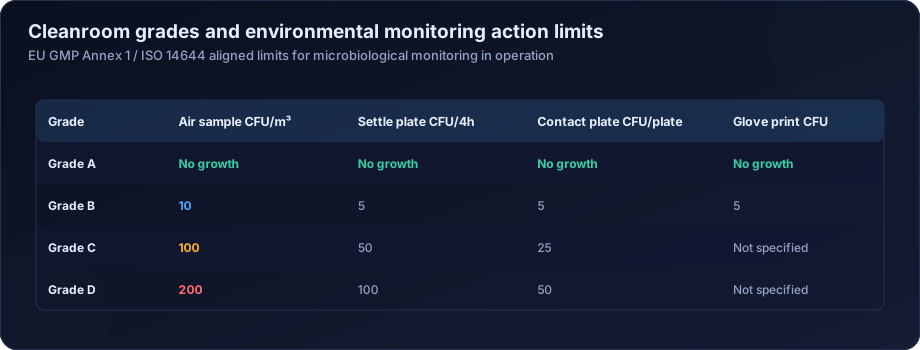
| Grade | Air sample CFU/m³ | Settle plate CFU/4h | Contact plate CFU | Glove print CFU |
|---|---|---|---|---|
| A | No growth | No growth | No growth | No growth |
| B | 10 | 5 | 5 | 5 |
| C | 100 | 50 | 25 | Not specified |
| D | 200 | 100 | 50 | Not specified |
Grade A permitting no recovered growth is an absolute rather than a numerical limit, and any recovery in Grade A is an investigation rather than a data point.
Requalification
Classification is not permanent. Requalification intervals are defined and are commonly misapplied.
- Grade A and B — every six months.
- Grade C and D — every twelve months.
- After any change to the room, the air handling, the layout, the equipment or the process, regardless of when the last requalification occurred.
- After extended shutdown, since filters, seals and pressure cascades can degrade unused.
- After a contamination event implicating the environment.
A common gap is treating requalification as a repeat of particle counting alone. Filter integrity, pressure differentials and recovery should be included, because those are the parameters that degrade with time and use.
Pressure Cascades and Why They Fail
The pressure differential between adjacent rooms is what stops contamination moving toward the critical zone, and it is the parameter most likely to be out of specification without anyone noticing.
Conventional design maintains 10 to 15 pascals between adjacent grades, with air flowing from cleaner to less clean. For a containment application the cascade runs the other way, and rooms handling potent compounds may need negative pressure relative to their surroundings while still protecting the product — which is a genuinely difficult design problem usually solved with a pressurised airlock between them.
Cascades fail in predictable ways:
- Doors held open during material transfer, collapsing the differential entirely for as long as the door is open. Interlocked airlocks exist precisely to prevent this and are frequently defeated.
- Filter loading raising resistance over time, so supply volume falls and the differential drifts down.
- Return path obstruction — a blocked return grille or furniture placed against one changes the balance in a way nothing in the supply side reveals.
- Adjacent room changes. A cascade is a system, so re-balancing one room shifts the differentials of everything connected to it. A change control that considers only the room being modified misses this.
- Building envelope effects. Wind pressure on an external wall and stack effect in a multi-storey building both shift differentials, and a cascade balanced on a still day may not hold in monsoon wind.
Continuous monitoring with alarms is the control, and the alarm limits should sit inside the specification rather than at it, so a drift is visible before it becomes a breach.
Where Classification and Reality Diverge
- Sample locations chosen for access rather than by the ISO formula and by risk. The formula gives a minimum number; risk determines where they go.
- At-rest data used to characterise an operating room, which describes an empty space.
- Personnel numbers during in-operation testing lower than the routine maximum, understating the real load.
- Filter integrity assumed from the certificate rather than tested in situ, missing seal and frame leaks.
- Recovery test omitted, so a slow-recovering room passes on static counts.
- Smoke studies performed once and never repeated after equipment moves, when the airflow pattern has changed.
- Requalification reduced to particle counting, missing the parameters that actually degrade.
Barrier Systems Change the Grade Requirement
Isolators and restricted access barrier systems physically separate the operator from the critical zone, and they change what the surrounding room has to achieve.
Open RABS uses a rigid barrier with gloveports over a Grade A zone, with the surrounding room typically Grade B. Air spills from the enclosure into the room, so the room grade still matters.
Closed RABS seals the enclosure during operation, with transfers through defined ports. The background can often be Grade C where the closure is demonstrated and interventions are controlled.
Isolators are sealed and decontaminated as a unit, usually by vaporised hydrogen peroxide, with a documented decontamination cycle achieving a defined log reduction on biological indicators. Because the isolator is not opened during operation, the surrounding room can commonly be Grade C or even D.
The saving is substantial — Grade B space is expensive to build, expensive to run and expensive to gown for — which is why barrier technology has become the default for new sterile facilities. What it does not do is remove the qualification burden. The isolator itself needs leak testing, glove integrity testing, decontamination cycle validation and airflow verification, and the interventions it permits still need simulating in media fills.
How This Connects to Microbiological Monitoring
Classification establishes the physical envelope; environmental monitoring verifies it is holding microbiologically day to day.
The two datasets should be reviewed together. A microbiological excursion accompanied by a particle count rise points at a physical failure — filter, pressure, airflow. One without a particle rise points at personnel or procedure. Reviewing them separately, which is common where facilities and QC own different datasets, discards that diagnostic.
How DSTechnoverse Helps
We provide the microbiological half of cleanroom qualification and the monitoring programme that follows it.
That covers viable monitoring during qualification and requalification, microbiological limit derivation from your own data rather than the Annex 1 maxima, risk-based site selection integrated with the classification sample locations, isolate identification and facility flora library development, joint review of viable and non-viable data, and excursion investigation.
Our teams work from Indore and travel to client facilities across India for qualification campaigns and investigation work.
Frequently Asked Questions
What are the ISO cleanroom classes?
ISO 14644-1 defines nine classes, ISO 1 to ISO 9. Each sets a maximum number of airborne particles per cubic metre at specified sizes. For example, ISO 5 allows 3,520 particles of 0.5 µm or larger per m³, ISO 7 allows 352,000 and ISO 8 allows 3,520,000.
What is a Class 100 cleanroom in ISO terms?
Class 100 is the old FED-STD-209E name for ISO Class 5: no more than 100 particles of 0.5 µm or larger per cubic foot, which is 3,520 per cubic metre. Class 10,000 is ISO 7 and Class 100,000 is ISO 8.
How often must a cleanroom be reclassified under ISO 14644?
ISO 14644-2:2015 sets a maximum interval of one year between classifications for all classes, provided an ongoing monitoring plan shows the room stays in control. Pharmaceutical GMP is stricter: EU GMP Annex 1 expects Grade A and B areas to be requalified every six months and Grade C and D every twelve months.
What changed in ISO 14644-1:2015 compared with the 1999 edition?
Three changes affect most users: the number of sample locations now comes from a lookup table instead of the square root of the area, the 95% upper confidence limit calculation was removed, and several low-count cells in the class table were deleted, including the 5 µm limit for ISO 5. Rooms qualified under old protocols often need more locations when they are next classified.
What particle counter do I need?
An optical light-scattering airborne particle counter calibrated to ISO 21501-4, with channels at the particle sizes you classify at and a flow rate high enough to collect the required sample volume in a practical time. 28.3 litres per minute is common for ISO 7 and ISO 8; 50 or 100 litres per minute counters save time in large rooms and for the 5 µm channel.
Which is cleaner, ISO 5 or ISO 8?
ISO 5. The lower the class number, the fewer particles are allowed. Each step up in class allows ten times more particles at the same size.
What is the difference between ISO class and GMP grade?
ISO class is a particle count classification and says nothing about viability. GMP grade combines a particle requirement with microbiological limits. Both are needed, and a room described only by its ISO class has not been graded.
How many sample locations are required?
ISO 14644-1 gives a formula based on room area, which sets the minimum. Where those locations go should be determined by risk — near exposed product, at intervention points, at airflow boundaries — rather than by convenience.
How often is requalification needed?
Every six months for Grade A and B, twelve months for Grade C and D, and immediately after any change to the room, air handling, layout, equipment or process.
Is a recovery test really necessary?
Yes, and it is the test most often skipped. A room that passes static particle counting but recovers slowly after a challenge cannot protect product during and after an intervention.
Can we classify at rest only?
Classification at rest characterises the installation, and in-operation data characterises the room as used. Product is made in the second state, and a qualification without it has not tested what matters.
What is the difference between classification and qualification?
Classification is the single measurement that assigns an ISO class from particle counts. Qualification is the whole package — classification plus airflow velocity, air changes, filter integrity, pressure differentials, recovery time, smoke studies and environmental conditions. A room can be classified and not qualified, and a certificate showing only an ISO class is not a qualification package. Facilities that buy classification from a contractor and file the certificate as qualification have a gap that surfaces at the first inspection that looks closely.
How does Annex 1 revision affect existing cleanrooms?
The 2022 revision put considerably more weight on contamination control strategy as an integrated document rather than on individual qualifications sitting separately. Practically, existing rooms rarely need physical modification, but the justification for grade selection, site selection, limits and intervention control now needs to be written down as a coherent argument rather than inferred from a set of separate reports. Facilities that had all the elements but no unifying document are the ones with the most work to do.
Does Grade A really permit no growth at all?
Yes. It is an absolute limit rather than a numerical one, and any recovery in a Grade A zone triggers an investigation rather than being recorded as a within-limit result.
A monitoring programme that samples convenient locations produces a reassuring dataset and misses the organisms. DSTechnoverse designs and runs environmental monitoring programmes with risk-based site selection, limits derived from your own data, and statistical trending. Based in Indore, Madhya Pradesh, travelling to client sites across India. Talk to our microbiology team.