
Some of the most important things have no market price — clean air, a reliable water supply, a conserved forest, a public health service. Yet decisions about them still need numbers. Willingness-to-pay (WTP) methods put an evidence-based value on the priceless. Here are the main approaches.
Stated preference methods
These ask people directly what they would pay in a hypothetical scenario.
Contingent valuation
The classic method. Respondents are described a clear scenario and asked what they would pay for it. Elicitation formats include:
- Open-ended — "What is the most you would pay?" (simple, but respondents find it hard)
- Bidding game — iterative offers until a maximum is found (risks anchoring)
- Payment card — pick from a list of amounts (easier for respondents)
- Dichotomous choice — "Would you pay X? Yes/No" (mimics a real purchase; statistically strong)
Discrete choice experiments (conjoint)
Respondents choose between alternatives that vary in features and price. From many such choices, you infer the value of each feature and overall WTP — often more reliable than asking about price directly, because it feels like a real decision.
Revealed preference methods
These infer WTP from actual behaviour rather than stated intentions.
- Travel cost method — values a site (e.g. a park) from what people spend to visit it
- Hedonic pricing — infers the value of an attribute (e.g. clean air) from how it affects property prices
- Market behaviour — using related purchases to infer value
Revealed methods avoid hypothetical bias but only work where relevant behaviour exists to observe.
Choosing a method
| Situation | Consider |
|---|---|
| New/non-market good, no behaviour to observe | Contingent valuation |
| Valuing multiple features or trade-offs | Discrete choice experiment |
| Recreational site value | Travel cost |
| Environmental quality tied to property | Hedonic pricing |
Managing the biases
Stated-preference methods must guard against hypothetical bias (overstating), strategic bias (answering to influence outcomes), and anchoring. Realistic scenarios, dichotomous-choice formats, and follow-up certainty questions all help.
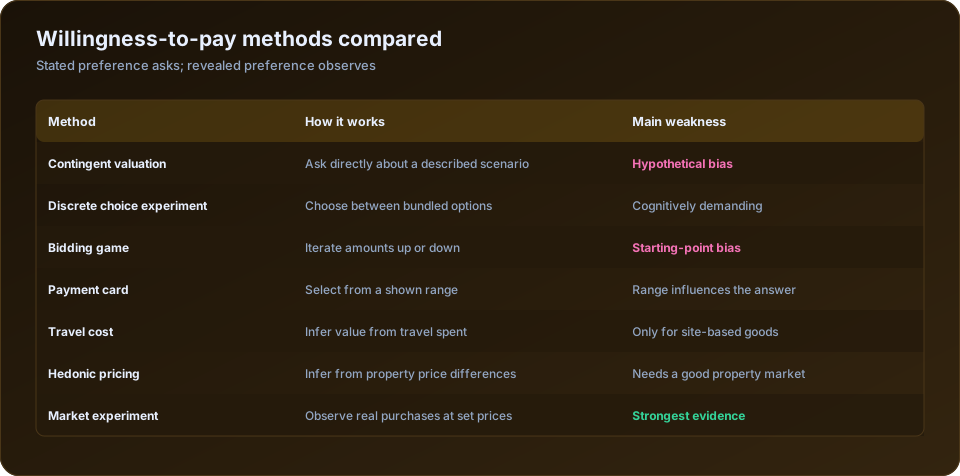
The full method comparison
| Method | Type | Data required | Main weakness |
|---|---|---|---|
| Contingent valuation | Stated preference | Survey with a described scenario | Hypothetical bias |
| Discrete choice experiment | Stated preference | Survey with bundled alternatives | Cognitively demanding |
| Contingent behaviour | Stated preference | Stated response to a price change | Hypothetical bias |
| Travel cost | Revealed preference | Visitor origins and travel spend | Only for site-based goods |
| Hedonic pricing | Revealed preference | Property transactions and attributes | Needs a functioning property market |
| Averting behaviour | Revealed preference | Spending to avoid a harm | Underestimates total value |
| Market experiment | Revealed | Real transactions at randomised prices | Costly; strongest evidence |
| Benefit transfer | Neither | Estimates from a comparable study | Depends on true comparability |
The fundamental division is between asking and observing. Stated preference methods can value anything, including goods that do not yet exist — a proposed water scheme, a wetland's existence value, a service not yet offered. Revealed preference methods observe real behaviour and are far more credible, but only work where a related market already exists.
Neither dominates. If you need to price a service that does not yet exist, revealed preference has nothing to observe.
Total economic value, and why the method must match the component
Environmental and public goods carry several kinds of value, and only some methods can capture each.
| Value component | What it is | Methods that capture it |
|---|---|---|
| Direct use | Consuming or using the resource | Travel cost, market prices, stated preference |
| Indirect use | Ecosystem services such as flood buffering | Production function, stated preference |
| Option value | Keeping the possibility of future use | Stated preference only |
| Bequest value | Preserving it for future generations | Stated preference only |
| Existence value | Valuing it without ever using it | Stated preference only |
This is the strongest argument for stated preference methods despite their weaknesses: existence, bequest and option value are unobservable by construction. No amount of behavioural data reveals what someone would pay to know a forest continues to exist. If your valuation must include non-use value — as most environmental assessments must — contingent valuation or a choice experiment is the only route.
Discrete choice experiments, and when they beat contingent valuation
A choice experiment presents respondents with several alternatives that differ across attributes, one of which is price, and asks which they would choose. Repeating this over several choice sets allows estimation of the value of each attribute separately.
| Contingent valuation | Discrete choice experiment |
|---|---|
| Values one defined package | Values each attribute separately |
| One WTP figure | A WTP figure per attribute |
| Simpler for respondents | Requires more concentration |
| Suits a single yes/no decision | Suits design and configuration decisions |
| Smaller sample sufficient | Larger sample required |
Choose an experiment when the design of the service is still open. If you need to know whether households value six hours of supply over four more than they value metered billing over flat rates, a choice experiment answers that and contingent valuation does not. Choose contingent valuation when the package is fixed and the only question is whether it is worth building.
Revealed preference methods in practice
Travel cost infers value from what people actually spend to reach a site — travel expense, plus the opportunity cost of time. It works well for parks, heritage sites and recreational water bodies, and not at all for anything people do not travel to. It also captures only use value.
Hedonic pricing infers value from property price differences. Two comparable houses, one near a clean lake and one not, differ in price by an amount that reflects the lake's value. It requires a property market with reliable transaction data and enough variation in the attribute of interest — often the binding constraint in Indian secondary towns, where recorded transaction values are frequently understated.
Averting behaviour looks at what people already spend to avoid a harm: water filters, bottled water, boiling fuel. This is highly credible evidence but a lower bound on total value, because it captures only what people could afford to do.
Judging the credibility of a WTP estimate
Whether you are commissioning a study or reading one, the same checks apply.
| Check | What passing looks like |
|---|---|
| Scope sensitivity | WTP rises when the good offered is larger |
| Theoretical validity | WTP rises with income and with use of the good |
| Payment vehicle stated | The mechanism is realistic and named |
| Protest responses separated | Zeros distinguished by reason |
| Convergent validity | Result is broadly consistent with another method |
| Hypothetical bias addressed | Budget reminder, certainty calibration, or a real-payment component |
| Sample representative | Not only current users or only the enthusiastic |
Scope sensitivity is the single most important test and the one contingent valuation is most often criticised for failing. If respondents state the same amount to protect one lake and to protect five, they are expressing a general willingness to support a cause rather than valuing a specific good, and the number cannot be used for cost-benefit analysis.
Benefit transfer, and its honest limits
Benefit transfer applies a WTP estimate from an existing study to a new context. It is fast, cheap, and widely used in appraisal where no primary study is feasible.
It is defensible when the good, the population and the market context genuinely resemble the original. It becomes unreliable quickly across income levels, cultures and substitute availability — a WTP estimate for water quality from a European study does not transfer to rural Madhya Pradesh, where incomes, alternatives and baseline conditions all differ fundamentally.
If you must transfer, adjust for income differences explicitly, prefer studies from comparable settings, and report the transfer as an approximation rather than an estimate.
For the practical design and fielding of a stated-preference study, see willingness to pay surveys: a practical guide. For the survey infrastructure around it, how to conduct a socio-economic survey step by step. Our socio-economic and baseline survey service runs valuation studies for EIA, tariff and programme design work. The OECD's cost-benefit analysis and the environment volume is the standard reference on the methods above.
The takeaway
From setting a water tariff to valuing a conservation project, WTP methods turn "how much is it worth?" into a defensible number. Pick the method that fits your good and context, design it carefully, and interpret the results with appropriate humility about their assumptions.
Frequently Asked Questions
What is contingent valuation?
A stated preference method that describes a good or service to respondents in a survey and asks what they would pay for it. It is the only approach capable of capturing non-use values such as existence and bequest value, which no observed behaviour reveals.
What is the difference between stated and revealed preference methods?
Stated preference methods ask people what they would pay in a hypothetical scenario, so they can value goods that do not yet exist. Revealed preference methods infer value from actual behaviour in related markets, which is more credible but only possible where such a market exists.
When should I use a discrete choice experiment instead of contingent valuation?
When the design of the service is still open and you need the value of individual attributes — supply hours, billing method, water quality — rather than a single figure for a fixed package. Choice experiments need larger samples and more respondent concentration.
What is the travel cost method?
A revealed preference technique that infers the value of a site from what visitors spend to reach it, including travel expense and the opportunity cost of time. It works for parks, heritage sites and recreational water bodies, and captures use value only.
Is willingness to pay reliable?
It is reliable enough for decision-making when the study passes standard validity checks: scope sensitivity, theoretical validity, a realistic payment vehicle, separated protest responses and some correction for hypothetical bias. Estimates failing a scope test should not be used in cost-benefit analysis.
Can I use a willingness-to-pay estimate from another study?
This is benefit transfer, and it is defensible only when the good, the population and the market context closely resemble the original. It is unreliable across large differences in income, culture or availability of substitutes, and should be reported as an approximation.
How DSTechnoverse Runs Your Survey
DSTechnoverse is a full-service socio-economic and baseline survey agency based in Indore. We do not just advise — we run the whole study end to end and hand you evidence you can defend:
- Design — objectives, indicators, and sampling (random, stratified, cluster, or multi-stage), with a piloted questionnaire translated into local languages.
- Field data collection — trained enumerators using CAPI (tablet) tools such as KoBoToolbox, ODK, and SurveyCTO-style apps, with GPS stamping, audio audits, and built-in skip-logic validation.
- Quality control — back-checks, spot-checks, and daily high-frequency data monitoring so problems are caught in the field, not after.
- Analysis — SPSS, R, Python, and Excel for indicators, cross-tabulations, and impact estimates, including baseline–endline difference-in-differences.
- A detailed report — cleaned datasets, indicator tables, charts, GIS maps, and clear interpretation, with interactive Power BI / Tableau dashboards on request.
Our survey experience in Indore includes Smart City citizen-feedback surveys, Startup India & MSME surveys, Swachh Survekshan (Swachh Bharat) cleanliness surveys, and skill-development impact evaluations — delivered for government, municipal, corporate, and NGO clients.
Planning a socio-economic, baseline, endline, or willingness-to-pay survey? Talk to our survey team for a scope and quote.