River Pollution Modelling: A Complete Guide for Industries and Environmental Consultants
Introduction
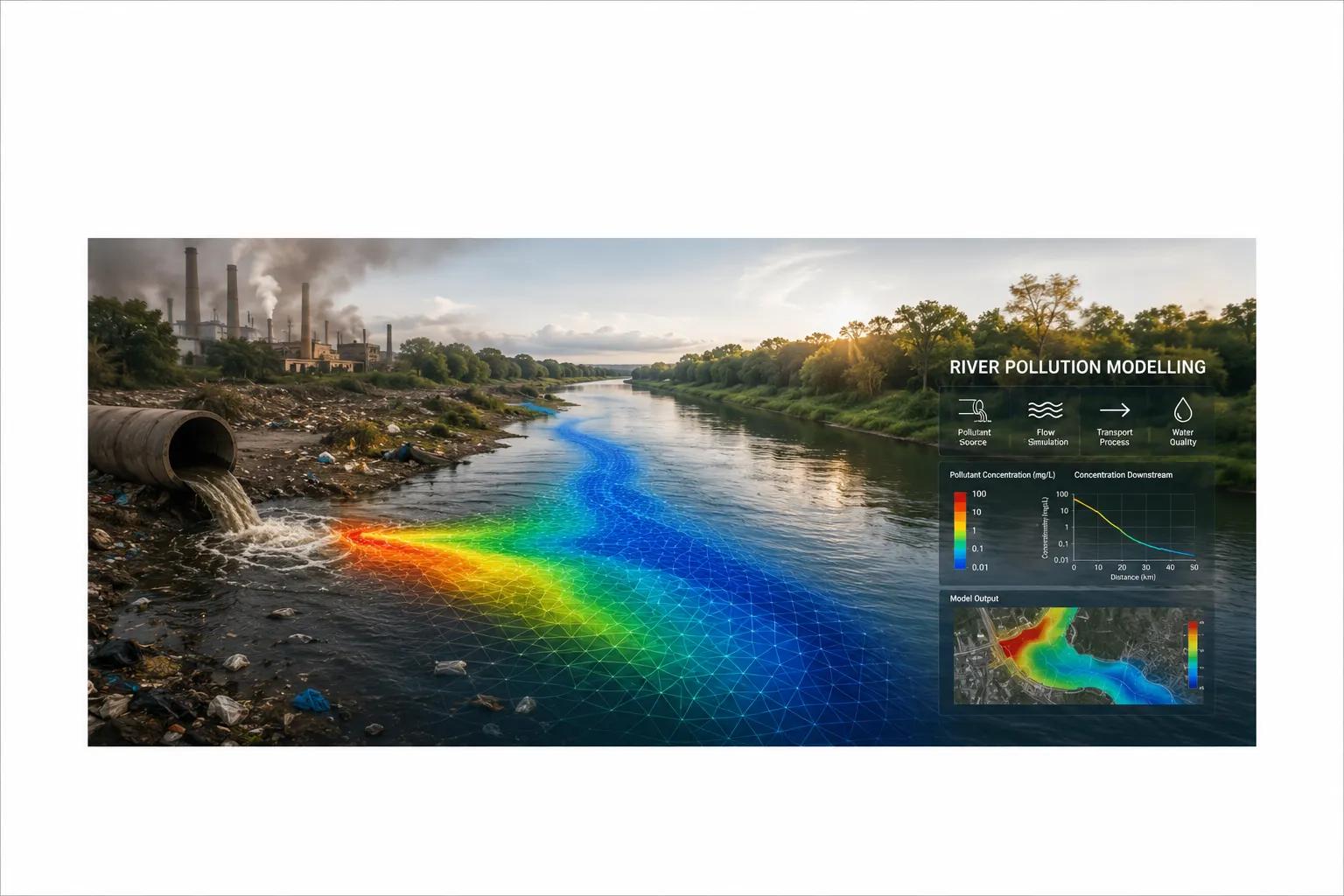
River Pollution Modelling is a scientific process used to predict how pollutants behave once they enter a river system — how they mix, disperse, degrade, and travel downstream. It plays a critical role in Environmental Impact Assessment (EIA) studies and industrial compliance projects.
Rivers are among the most sensitive natural resources, supporting drinking water supply, irrigation, aquatic biodiversity, and community livelihoods. Any discharge of industrial effluent, sewage, or wastewater can alter water quality and harm ecosystems if not properly assessed.
This is where River Pollution Modelling becomes essential. It allows environmental engineers to simulate pollutant behavior before discharge occurs, helping industries secure Environmental Clearance while protecting river health. For regulators, consultants, and project developers alike, accurate river water quality modelling is no longer optional — it is a regulatory and environmental necessity.
What is River Pollution Modelling?
River Pollution Modelling is the scientific simulation of pollutant transport, dilution, and dispersion within a river system, using hydrodynamic and water quality modelling techniques.
Purpose and Importance
The core purpose of River Pollution Modelling is to predict how a discharge — whether industrial effluent, treated sewage, or stormwater runoff — will affect downstream water quality over time and distance.
Types of Pollutants Analysed
- Biochemical Oxygen Demand (BOD) and Chemical Oxygen Demand (COD)
- Total Suspended Solids (TSS) and turbidity
- Heavy metals and industrial chemical contaminants
- Nutrients such as nitrogen and phosphorus
- Thermal pollution from power plant discharge
- Pathogens and microbiological contaminants
Environmental Significance
River Pollution Modelling supports sustainable water resource management by identifying safe discharge limits, mixing zones, and cumulative pollution loads — well before actual discharge begins, preventing irreversible ecological damage.
How River Pollution Modelling Works
1. Pollution Source Identification
The process begins by identifying discharge points — industrial outfalls, sewage treatment plant effluents, or diffuse agricultural runoff — along with pollutant characteristics and discharge volume.
2. River Flow Analysis
Engineers analyze river flow rate, velocity, depth, and seasonal variation, since low-flow (lean season) conditions typically produce the worst-case pollution scenarios.
3. Hydrological and Hydraulic Data Collection
Data such as river cross-sections, bathymetry, flow gauge records, and rainfall patterns are gathered to build an accurate hydraulic profile of the river stretch.
4. Water Quality Sampling
Baseline water quality samples are collected upstream and downstream to establish existing pollutant concentrations before modelling begins.
5. Pollutant Transport Modelling
Using mathematical transport equations, the model simulates how pollutants move with river flow, accounting for advection and diffusion processes.
6. Dispersion and Dilution Analysis
This step calculates how quickly a pollutant mixes across the river's width and depth, identifying the mixing zone where concentrations remain above permissible limits.
7. Mathematical and Hydrodynamic Simulation
Software-based hydrodynamic simulation integrates flow, discharge, and pollutant data to generate concentration profiles at various downstream distances.
8. Model Validation
Predicted results are cross-checked against field-monitored water quality data to confirm model accuracy and reliability.
9. Result Interpretation
Engineers interpret concentration contours, mixing zone boundaries, and compliance status against CPCB and SPCB discharge standards.
10. Environmental Reporting
Findings are compiled into technical reports supporting EIA documentation, Environmental Clearance applications, and regulatory submissions.
Applications of River Pollution Modelling
Industrial Effluent Discharge
Chemical and manufacturing industries use River Pollution Modelling to design safe outfall locations and confirm effluent discharge won't exceed permissible water quality limits.
Sewage Treatment Plant Outfalls
Municipal and urban development projects rely on this modelling to assess the impact of treated sewage discharge on receiving river stretches.
Mining Projects
Mining operations near river systems use pollution modelling to evaluate sediment load, heavy metal runoff, and acid mine drainage impacts.
Thermal Power Plants
Power plants use river modelling to assess thermal discharge impact, since elevated water temperature can significantly affect aquatic life.
Chemical and Pharmaceutical Industries
These sectors require detailed mixing zone analysis due to the presence of complex chemical compounds in their wastewater streams.
Infrastructure and Urban Development
Bridge construction, urban drainage systems, and riverside development projects use modelling to assess construction-phase and operational pollution risks.
River Restoration Projects
Government agencies use pollution modelling data to design and prioritize river rejuvenation and restoration programs.
Benefits of River Pollution Modelling
- Accurate Pollution Prediction: Enables precise forecasting of pollutant concentration and spread before actual discharge occurs.
- Better Environmental Planning: Supports informed decision-making on outfall design, treatment capacity, and discharge timing.
- Improved Environmental Clearance Outcomes: Strengthens EIA documentation with scientifically validated data.
- Regulatory Compliance: Helps industries meet CPCB and SPCB water quality discharge standards.
- Protection of Aquatic Ecosystems: Identifies safe pollutant thresholds to prevent ecological damage.
- Scientific Decision-Making: Replaces assumptions with data-driven environmental risk assessment.
- Reduced Environmental Risk: Minimizes the chance of non-compliance penalties and pollution-related liabilities.
- Sustainable Water Management: Contributes to long-term river health and community water security.
- Cost-Effective Environmental Management: Prevents costly remediation by identifying risks at the design stage.
Why Choose DS Technoverse for River Pollution Modelling Services?
DS Technoverse brings a team of experienced environmental engineers and hydrodynamic modelling specialists with strong expertise in Water & Effluent Dispersion Modelling and river water quality assessment.
We use advanced hydrodynamic and water quality modelling software to deliver accurate, defensible pollutant transport simulations tailored to your project's river system and discharge characteristics.
Our services support industries across chemical manufacturing, pharmaceuticals, mining, thermal power, and infrastructure development with:
- Detailed mixing zone and dilution analysis aligned with CPCB and SPCB norms
- Regulatory-compliant technical reports for Environmental Clearance
- Customized modelling solutions based on site-specific hydrology
- Fast turnaround without compromising technical accuracy
- PAN India consulting with dedicated technical support
If your project involves river discharge, effluent management, or EIA compliance, DS Technoverse offers the scientific rigor needed to protect both your project timeline and the environment. Contact DS Technoverse today to discuss your River Pollution Modelling requirements.
Conclusion
River Pollution Modelling is a vital scientific tool that helps industries, consultants, and government agencies understand and manage the impact of discharges on river ecosystems. From industrial effluent to sewage outfalls, accurate modelling ensures compliance while protecting water resources.
Its benefits — from improved Environmental Clearance outcomes to sustainable water management — make it indispensable for any project involving river discharge. Partnering with an experienced consultancy like DS Technoverse ensures your river pollution assessment is technically sound, regulator-ready, and environmentally responsible.
FAQs
Q1. What is River Pollution Modelling?
River Pollution Modelling is the scientific simulation of pollutant transport, dilution, and dispersion in a river to predict downstream water quality impacts.
Q2. Why is River Pollution Modelling important?
It helps predict pollution impacts before discharge occurs, supporting Environmental Clearance, regulatory compliance, and aquatic ecosystem protection.
Q3. Which industries require River Pollution Modelling?
Chemical, pharmaceutical, mining, thermal power, and infrastructure industries commonly require this modelling for discharge assessment.
Q4. Is River Pollution Modelling required for Environmental Clearance?
Yes, projects involving effluent or wastewater discharge into rivers typically require pollution modelling as part of EIA documentation.
Q5. What software is used for River Pollution Modelling?
Hydrodynamic and water quality modelling tools that simulate pollutant transport, mixing, and dilution are commonly used, selected based on river complexity and discharge type.
Q6. How accurate is River Pollution Modelling?
Accuracy depends on quality of input data, model validation against field monitoring, and the expertise of the modelling team conducting the analysis.
Further Reading
- Water dispersion modelling explained
- Effluent mixing zone modelling
- Hydrodynamic modelling guide
- Hydrodynamic model calibration
- Water and effluent dispersion modelling
Frequently Asked Questions
When is river pollution modelling needed?
When a project discharges effluent to a river or stream and the regulator or EIA requires evidence of the effect on downstream water quality, or when designing an outfall or treatment standard.
What data does a river water quality model need?
River flow and geometry, upstream water quality, the effluent flow and composition, temperature, and observed downstream water quality for calibration — ideally for low-flow conditions, which are usually the worst case.
Which models are used?
Simple mixing and decay calculations for screening, one-dimensional river water quality models for longer reaches, and two- or three-dimensional hydrodynamic models where mixing near the outfall matters.
How reliable are the predictions?
They depend on the quality of the flow and water quality data and on calibration against measurements. A calibrated model with a clearly stated uncertainty is far more defensible than an uncalibrated one.