Bioburden is the population of viable microorganisms on a product before it is sterilised. It matters because every sterilisation process delivers a defined lethality, and whether that lethality is sufficient depends entirely on how many organisms — and how resistant — it has to kill.
Why the Number Drives Everything Downstream
Sterility Assurance Level is the probability that a single unit remains non-sterile after processing, conventionally 10⁻⁶ for terminally sterilised product. Achieving it is a function of the starting population and the lethality applied.
For radiation sterilisation, dose setting under ISO 11137-2 derives the required dose directly from measured bioburden. A higher bioburden requires a higher dose, which may exceed what the material tolerates without degradation. For ethylene oxide and steam, bioburden informs cycle design and the selection and placement of biological indicators.
A cycle validated against a bioburden of 50 CFU per device provides very different assurance if the actual bioburden has risen to 5,000 — or if it was always 125 and the method only ever recovered 40 per cent of it.
Extraction Is the Whole Problem
Organisms adhere to surfaces, hide in device lumens and lodge in porous materials. A method that removes 40 per cent of them and reports the result as the bioburden understates the true load by a factor of two and a half.
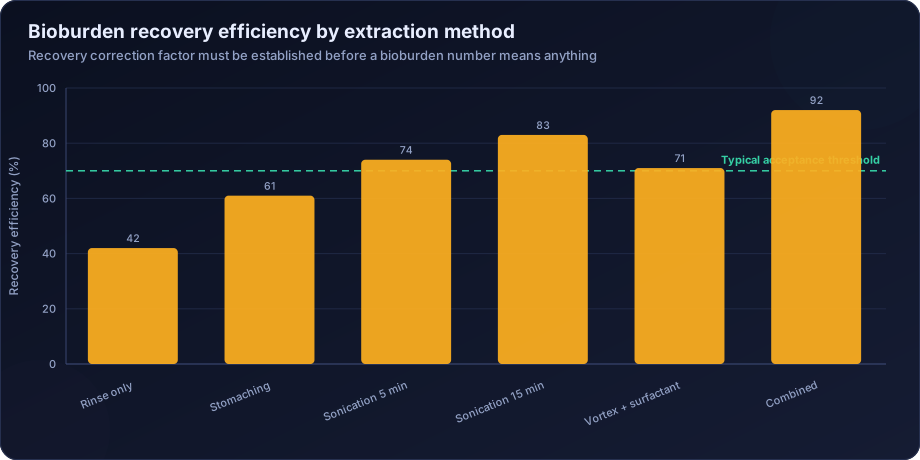
| Method | Typical recovery | Best suited to |
|---|---|---|
| Rinse / flush only | ~40% | Lumens, catheters, tubing |
| Stomaching | ~60% | Flexible materials, textiles |
| Sonication 5 min | ~74% | Rigid components |
| Sonication 15 min | ~83% | Rigid components, better penetration |
| Vortex + surfactant | ~71% | Small items, complex shapes |
| Combined sonication + vortex | ~92% | Where recovery matters most |
Extended sonication improves recovery but can damage vegetative cells if excessive, so the optimum is validated rather than assumed. Adding a surfactant such as polysorbate 80 reduces surface tension and improves release from hydrophobic materials, frequently by ten to twenty percentage points.
The Repeat-Extraction Recovery Study
ISO 11737-1 requires that extraction efficiency be determined and the correction applied. The repeat-extraction method is generally preferred over coupon inoculation, because it uses the product's natural contamination rather than a laboratory culture that adheres differently.
- Take a product unit carrying its natural bioburden — not an artificially inoculated one.
- Perform the extraction and enumerate. This is the first extract.
- Repeat the identical extraction on the same unit and enumerate again.
- Repeat a third time. Successive extracts should decline in a roughly geometric pattern.
- Calculate recovery from the series — commonly the first extract divided by the sum of all extracts, or by fitting the geometric decline to estimate the original total.
- Apply the resulting correction factor to routine results.
- Report both corrected and uncorrected figures, so the basis of any comparison is transparent.
- Repeat across at least three units, and revalidate on any product, material, process or method change.
If the extracts do not decline geometrically — if the second is as large as the first — the extraction is inefficient enough that the model does not hold, and the method needs improving before a correction factor means anything.
Composition Matters More Than Count
A bioburden count treats every organism as equivalent, and for sterilisation purposes they are not.
A population of 500 CFU consisting entirely of Gram-positive skin flora presents a far smaller challenge than 100 CFU containing a meaningful fraction of bacterial spores. Endospores — Bacillus, Geobacillus, Clostridium — are orders of magnitude more resistant to heat, radiation and ethylene oxide than vegetative cells.
This means a composition shift toward spore formers erodes sterility assurance even when the total count is falling. ISO 11737-1 therefore expects bioburden characterisation, not just enumeration.
- Identify a representative selection of isolates at initial characterisation, covering the dominant colony morphologies rather than only the unusual ones.
- Track the spore-forming fraction specifically, since it drives the sterilisation challenge.
- Heat-shock a portion of the extract to enumerate spores separately from vegetative organisms.
- Correlate composition changes with environmental monitoring and raw material data — a shift toward spore formers usually points to soil, dust or botanical material entering the process.
Routine Monitoring
Initial characterisation establishes the baseline; routine monitoring detects the drift that erodes it. Quarterly is the general expectation and is required for radiation dose audits under ISO 11137.
- Test a minimum of three product units per batch tested, across a defined number of batches per quarter.
- Include products from different production runs, shifts and, where relevant, different moulding cavities or assembly lines.
- Trend on a control chart rather than comparing each result to a limit, since a doubling within the limit is a meaningful signal.
- Derive an alert level from the historical distribution and an action level tied to the sterilisation validation assumption.
- Investigate excursions against the manufacturing environment, raw materials, personnel practices and surface hygiene results.
- Reassess the dose or cycle where a sustained rise means the validated assumption no longer holds.
Where Product Bioburden Comes From
- Raw materials and components — polymers handled in bulk, textiles, anything of natural origin.
- Manufacturing water — rinse, cooling and humidification water, the most common source of Gram-negative bioburden.
- Personnel — handling during assembly, inspection and packing.
- Environment — airborne deposition during open processing.
- Equipment surfaces and tooling, particularly where cleaning is difficult.
- Process aids — mould release agents, lubricants, cutting fluids, which support growth if not preserved.
- Extended in-process hold times in humid conditions, allowing proliferation before sterilisation.
- Packaging materials inside the sterile barrier, where not separately controlled.
That penultimate point is worth emphasising in Indian conditions. A wet intermediate held overnight in a warm humid plant can multiply a modest incoming load into a substantial one, and the growth happens entirely after every incoming test has passed.
Component-Level Versus Assembled-Product Testing
Testing only the finished assembly is efficient and it hides where the bioburden actually comes from.
A multi-component device may carry a total of 400 CFU, and knowing that number is enough to set a dose. It is not enough to control the load, because it says nothing about whether 380 of those organisms arrived on one moulded part, one textile component, or the packaging inside the sterile barrier.
Running a component-level bioburden survey once — testing each component separately before assembly, alongside the assembled product — is one of the more informative exercises available, and most manufacturers have never done it.
- It identifies which component dominates the load, which is where control effort should go.
- It reveals whether assembly itself is adding bioburden through handling, which shows up as an assembled count exceeding the sum of the components.
- It shows whether a supplier change has shifted the picture, since the affected component's contribution moves while the others stay stable.
- It distinguishes an incoming material problem from an in-house environmental one, which lead to entirely different corrective actions.
- It supports supplier specification setting, since a component contributing 90 per cent of the load deserves a microbiological limit in the purchase specification.
The survey does not need repeating quarterly. Once at characterisation, and again after any significant supplier or process change, is usually sufficient — and the first one frequently redirects a control programme that was focused on the wrong thing entirely.
Common Failures
- Recovery efficiency never determined, so results understate reality by an unmeasured factor.
- Coupon inoculation used where repeat extraction would be more representative.
- A single generic correction factor applied across dissimilar products and materials.
- Only the final assembled product tested, so a contaminated component is invisible.
- Composition never characterised, so a shift toward spore formers goes unnoticed.
- Testing frequency reduced during a cost exercise without reassessing the dose audit requirement.
- Bioburden and microbial limit testing confused — different standards, different purposes.
- Alert and action levels copied from another product rather than derived from the data.
Setting Bioburden Alert and Action Levels
Bioburden limits are frequently copied from a guidance figure or set at a round number, and both approaches produce levels that never trigger until something has gone badly wrong.
The action level has a natural anchor that most other microbiological limits lack: the bioburden assumed in the sterilisation validation. Exceed that and the validation no longer supports the sterility claim, which makes it a genuine action threshold rather than an arbitrary one.
The alert level should come from the observed distribution, giving warning while the process is still recoverable.
- Collect at least twenty routine results before deriving anything, and preferably a full year to capture seasonal variation.
- Log-transform, since bioburden data is log-normally distributed like most microbiological counts.
- Set the alert at roughly the 95th percentile of the historical distribution, or mean plus two standard deviations on the transformed data.
- Set the action level at the validation assumption, or the 99th percentile if that is lower.
- Where the two conflict — where your capability is far better than the validation assumed — use the tighter figure, since it gives earlier warning.
- Review annually and after any process, supplier or environmental change.
- Trend the spore fraction separately, because a composition shift can erode assurance at an unchanged total count.
A facility routinely running at 30 CFU with an action level of 1,000 taken from the dose-setting table has no early warning at all. The level is technically correct and practically useless, and the fix is to add a capability-based alert alongside it.
How DSTechnoverse Helps
We treat bioburden as an input to sterilisation assurance rather than as a standalone number, which changes what the testing has to deliver.
That covers extraction method development for your product geometry and materials, repeat-extraction recovery determination with documented correction factors per product family, initial characterisation including organism composition and spore fraction, routine quarterly monitoring with statistical trending and limit derivation, dose audit support under ISO 11137-2, excursion investigation linked to environmental and raw material data, and documentation for notified bodies, CDSCO and export submissions.
We work from Indore, Madhya Pradesh with device and pharmaceutical manufacturers across India, including the device clusters around Pithampur, Ahmedabad, Chennai and Delhi NCR.
Frequently Asked Questions
How often should bioburden be tested?
Quarterly is the general expectation and is required for radiation dose audits under ISO 11137. Higher frequency is appropriate during process changes, after an excursion, or where the manufacturing environment is less well controlled.
Why does recovery efficiency matter so much?
Because it is the difference between a reported number and the actual load. A method recovering 40 per cent reports 100 CFU when 250 are present, and any dose calculation built on the uncorrected figure carries a hidden deficit.
What is a typical bioburden for a device?
It varies enormously — under 10 CFU for a small moulded component made in a controlled environment, several thousand for a textile-containing or multi-component assembly. What matters is stability and consistency with the sterilisation validation, not the absolute value.
Can bioburden be too low?
In a specific sense, yes. Where counts sit at or below the limit of detection, dose setting methods may require more units or a more sensitive method, because the calculation needs a real distribution rather than a series of zeros.
What if bioburden rises above the validated assumption?
The sterilisation validation no longer supports the sterility assurance claim. Investigate and control the rise; if it cannot be reduced, the dose or cycle must be revalidated against the new population.
Is bioburden the same as microbial limit testing?
No. Microbial limit testing applies compendial acceptance criteria to non-sterile products. Bioburden quantifies pre-sterilisation load to support sterilisation validation. Different standards, methods and purposes.
An uncorrected bioburden number understates the real load by a factor nobody has measured. DSTechnoverse provides bioburden testing under ISO 11737-1 with validated extraction, recovery efficiency correction and quarterly monitoring. Based in Indore, Madhya Pradesh, serving device and pharmaceutical manufacturers across India. Talk to our microbiology team.