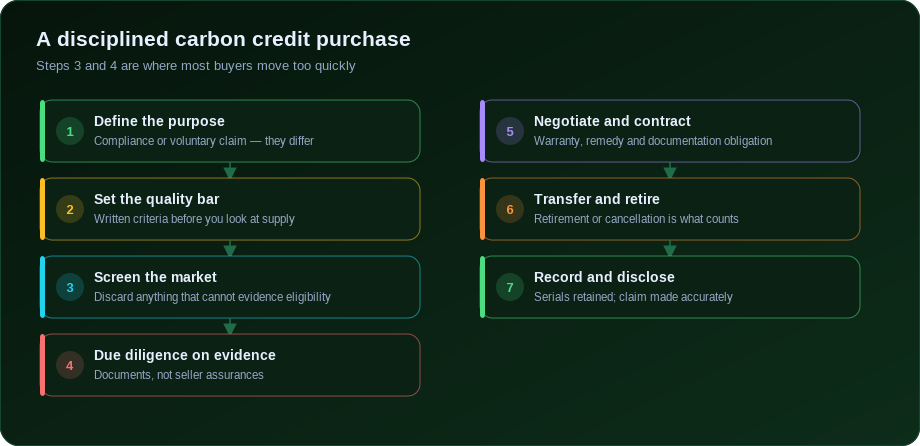
Quick answer: To work out how to buy carbon credits well, follow this order: define the claim the credits must support, decide between removal and avoidance credits, set a written quality bar (ICVCM CCP labels, ratings, corresponding adjustment where needed), choose a sourcing channel, run due diligence, sign a contract that allocates delivery and eligibility risk, then retire the credits in a registry in your name and disclose exactly what you retired. Most first purchases take three to six months.
How to buy carbon credits is a question most organisations start at the wrong end. They ask who sells them. That is the fourth question, not the first, and starting there is why so many buyers end up holding credits that do not support the claim they were bought for. If you need the basics first, read what a carbon credit is, then come back to this guide.
This page is for corporate buyers anywhere. If your question is how do you buy carbon credits without regretting it later, it sets out the carbon credit buying process in order, sourcing channels, contract terms, registry routes, buying routes by region, a worked example and a buyer checklist.
How to Buy Carbon Credits: The Process at a Glance
Whether you call it how to buy or how to purchase carbon credits, the steps are the same, and each is judged against the one before it.
| Step | Decision | Output |
|---|---|---|
| 1. Define the purpose | Which claim or obligation the credits serve | A one-page purpose statement |
| 2. Choose the credit type | Removal, avoidance or a mix | A target portfolio split |
| 3. Set the quality bar | Standards, labels, ratings, vintage, adjustment | A written procurement policy |
| 4. Choose the sourcing channel | Exchange, broker, developer, platform, offtake | A shortlist of routes and counterparties |
| 5. Due diligence | Is each lot real, eligible and clean? | A diligence file per lot |
| 6. Contract | Who carries which risk | A signed agreement with remedies |
| 7. Registry route | Own account or retirement on your behalf | Account opened or service agreed |
| 8. Retire and disclose | Discharge the claim and describe it | Retirement records and public wording |
The order matters: look at supply before setting the quality bar and the supply sets your standard.
Step 1: Define the Purpose of the Purchase
Write down, before anything else, what the credits are for. Everything downstream is assessed against this statement. There are four common purposes, and they lead to different purchases.
Compliance obligation. A legal requirement, such as CORSIA for an aircraft operator or a domestic scheme that allows offsets. The regulator's eligibility rules bind you exactly. Your preferences about project type are secondary to what the rules accept.
Compensation claim. You state that you have compensated for some or all of your emissions by retiring credits. This is the framing behind "carbon neutral" product or company claims. It carries the heaviest scrutiny, because the claim implies one tonne retired cancels one tonne emitted. See carbon neutral versus net zero for why regulators in several jurisdictions now look hard at that wording.
Contribution claim. You state that you have financed climate action beyond your own value chain without claiming the credits offset your footprint. This framing is gaining ground because it is harder to attack: it does not suggest your emissions have disappeared. Quality still matters, but the claim is more modest and more defensible.
Net zero neutralisation. Under the Science Based Targets initiative approach, credits are not counted towards near-term reduction targets. At net zero, residual emissions (the small share left after deep reductions) are expected to be neutralised by permanent removals. Credits bought before that point are framed as beyond value chain mitigation. The SBTi has been revising its Corporate Net-Zero Standard, so check the current version before you rely on any specific rule. The basics are in SBTi explained.
Aviation and CORSIA. If you are an aircraft operator with an offsetting requirement, the purchase is a compliance purchase with its own unit list, vintage window and authorisation rules. CORSIA Eligible Emissions Units are approved by the ICAO Council on the recommendation of its Technical Advisory Body, and first-phase units (2024 to 2026) need a host-country Letter of Authorization and a corresponding adjustment. That process is covered in depth in how to buy CORSIA carbon credits, so this guide only touches it.
Keep compliance and voluntary purchases separate. A unit cancelled for a compliance obligation discharges a legal requirement and cannot be used again for a voluntary claim.
Record volume and budget too: for compliance, from the obligation calculation; for voluntary claims, from your inventory after real reductions, budgeted for the quality you need. Carbon credit prices explained covers what drives the spread between credit types without repeating it here.
Step 2: Choose the Credit Type (Removal or Avoidance)
Credits fall into two broad families, and the claim you chose in Step 1 largely decides the mix.
| Feature | Avoidance or reduction credits | Removal credits |
|---|---|---|
| What they represent | Emissions that would have happened but did not | Carbon dioxide taken out of the atmosphere and stored |
| Typical examples | Renewable energy, efficient cookstoves, avoided deforestation (REDD+), methane capture | Afforestation and reforestation, biochar, direct air capture, enhanced weathering |
| Main integrity questions | Additionality and the baseline | Permanence, durability and measurement |
| Claim they suit | Contribution claims, near-term beyond value chain mitigation | Neutralising residual emissions at net zero |
| Supply | Larger, more established | Smaller, growing, often forward-sold |
| Relative cost | Usually lower | Usually higher, especially for engineered removals |
Within removals, buyers also distinguish nature-based removals (forests, soils, mangroves), which store carbon in systems that can be reversed by fire or land-use change, from engineered or hybrid removals (biochar, direct air capture with geological storage), which offer longer durability but at higher cost and in smaller volumes. The detail is in carbon removal credits explained.
Many corporate buyers hold a portfolio: mostly well-screened avoidance credits now, with a growing share of removals bought forward as the net zero year approaches. Record the split in your policy.
Step 3: Set a Written Quality Bar Before Looking at Supply
This is the step that most affects the outcome and the one most often skipped. A written policy, approved before offers start arriving, should cover:
- Accepted standards and programmes, for example Verra, Gold Standard, ACR, Climate Action Reserve, Puro.earth or Isometric, depending on the credit type.
- ICVCM Core Carbon Principles labels. The Integrity Council for the Voluntary Carbon Market assesses programmes and methodology categories against its Core Carbon Principles. Credits from approved categories issued by approved programmes can carry a CCP label in the registry. Decide whether CCP-labelled supply is required, preferred or simply noted. Approval decisions are ongoing and some popular categories have been rejected, so check the current list. See ICVCM Core Carbon Principles.
- Independent ratings. Ratings agencies publish project-level assessments of over-crediting, permanence and other risks. Decide a minimum rating and how you treat unrated supply. Methodologies differ between agencies, which is covered in carbon credit ratings explained.
- Corresponding adjustment. Whether the credit must be authorised by the host country under Article 6 of the Paris Agreement, with a corresponding adjustment applied. It is mandatory for CORSIA first-phase units and optional, but increasingly requested, for voluntary claims. Background: corresponding adjustments and Article 6.
- Vintage limits. The oldest vintage you will accept. Older vintages are cheaper and harder to defend.
- Project types excluded. Many buyers exclude categories with known over-crediting concerns.
- Co-benefits and safeguards. Requirements on community consultation, benefit sharing and grievance mechanisms.
- Evidence required before purchase, and who may approve an exception and how it is recorded.
That last line matters. Exceptions will arise. A policy with no exception route gets ignored; one with a documented route gets followed. The full assessment method is in carbon credit quality assessment, and the warning signs to screen for are in carbon credit greenwashing red flags.
Where to Buy Carbon Credits: Sourcing Channels Compared
Once the quality bar exists, choose where to buy carbon credits. Each channel changes the price you pay and how much diligence falls on you.
| Channel | How it works | Advantages | Drawbacks | Suits |
|---|---|---|---|---|
| Exchanges | Standardised contracts or listed project credits traded on a regulated or organised venue | Price visibility, settlement and clearing, counterparty risk reduced | Standard contracts may deliver a mix of projects; membership or access through a broker may be needed | Recurring, larger buyers who want transparency |
| Brokers and intermediaries | Broker sources lots across developers and traders, often over the counter | Speed, access to many projects, can aggregate small parcels | Margin on top; knowledge of eligibility varies widely | First-time buyers, specific project searches |
| Project developers direct | Bilateral purchase from the entity that runs the project | Best access to documents and site information, often better pricing for volume | Full diligence and counterparty risk on you | Large buyers, long-term relationships |
| Retail platforms and marketplaces | Online catalogues of projects with card or invoice payment and retirement on your behalf | Simple, small volumes, quick retirement | Limited control over terms; quality screening varies by platform | Small and mid-sized businesses, one-off purchases |
| Offtake and forward agreements | Commitment to buy future issuances at an agreed price and volume | Secures supply, especially removals; can support new projects | Delivery, performance and authorisation risk; long commitment | Buyers with a long-term net zero or compliance path |
Assessing an intermediary. Ask how they establish that a unit is what it claims to be. For a credit with a corresponding adjustment, a good answer names the host-country authority, the authorisation document and the unit serial numbers. "The project confirms it" is not an answer. Ask too whether they hold the units now or are selling forward.
Using a marketplace. If you want to browse listed projects with their standards, vintages and documents set out in one place, you can start on the DSTechnoverse marketplace and use the rest of this process to screen what you find.
Forward and offtake deals deserve their own reading before you sign. The contract issues are covered in CORSIA offtake agreement terms; most of them apply equally to voluntary offtakes.
Buying Carbon Credits by Region
The general process is the same everywhere, but local infrastructure and rules shape the route. The points below were checked against public sources at the time of writing; these frameworks are changing quickly, so confirm the current position with the relevant authority or venue before you transact.
Buy Carbon Credits in the UAE
The UAE has built national infrastructure for carbon credits. Cabinet Resolution No. 67 of 2024 created the National Register for Carbon Credits, run by the Ministry of Climate Change and Environment. Reported coverage is that large emitters must register and report, while smaller entities can register voluntarily, with compliance dates during 2025. Briefings on the resolution describe credits as tradable on approved platforms in the UAE, with oversight of trading platforms by the Securities and Commodities Authority, and transfers abroad needing prior approval. Check the current text and any implementing guidance if you are a UAE entity buying or holding credits.
On trading venues, AirCarbon Exchange (ACX) holds recognition from the Financial Services Regulatory Authority of Abu Dhabi Global Market as a recognised investment exchange and clearing house, and began operating in ADGM in 2023. For buyers this means an exchange route with regulated clearing, usually accessed as a member or through a member firm.
For UAE and wider Gulf buyers, including airlines and corporates in Dubai and Abu Dhabi, our CORSIA and carbon credit services for the UAE and Middle East page explains how we support sourcing and due diligence locally.
Buy Carbon Credits in Saudi Arabia
The Regional Voluntary Carbon Market Company (RVCMC) was set up in 2022 by the Public Investment Fund and Saudi Tadawul Group. It has run large voluntary credit auctions, including one in Riyadh in 2022 and one in Nairobi in 2023, and announced a trading platform around COP29 in late 2024. Saudi and regional buyers can participate in its auctions and platform subject to its onboarding rules. Its product range and access terms have changed over time, so check directly before planning a purchase around it.
Buy Carbon Credits in the US
There is no federal compliance carbon market in the United States, so most corporate buying is voluntary. The main US-based crediting programmes, including ACR, Climate Action Reserve and Verra, run their own registries, and US buyers commonly use brokers, exchanges and retail platforms.
The main exception is California. Its cap-and-trade programme, extended to 2045 and renamed cap-and-invest in 2025, allows covered entities to use compliance offset credits issued under California Air Resources Board protocols for a limited share of their obligation, with a portion required to come from projects with in-state environmental benefits. The exact limits differ by compliance period and are being updated through rulemaking, so check the current regulation. These compliance offsets are a separate product from voluntary credits and are only useful to entities with a California obligation. US airlines and operators with CORSIA requirements have a separate path; see our CORSIA and carbon credit services in the United States.
Buy Carbon Credits in India
India's Carbon Credit Trading Scheme is building a compliance market for obligated industrial sectors and an offset mechanism, administered through the Bureau of Energy Efficiency; see the Indian carbon market and CCTS explained.
Step 5: Due Diligence on Each Lot
Diligence means documents, not assurances. The core checks for each lot:
- Is the issuing programme currently approved for your purpose, and is any approval full or conditional?
- Does the credit carry a CCP label, and what do independent ratings say?
- Is the vintage inside your policy window, and for compliance, inside the eligible window for the period?
- Where required, is there a host-country authorisation naming these units, and evidence that the corresponding adjustment has been or will be applied?
- Is the verification report from an accredited body, and does it carry qualifications or open findings?
- Does the registry record show the serial numbers as issued and not retired, with a clean chain of custody?
- Does the seller hold the units now, or are they promising future delivery?
- Is the additionality argument credible for this project, in this market, today?
- Has the counterparty passed know-your-customer and sanctions screening?
Capture the evidence into your own files rather than linking to it. Approval status changes and a web page is not proof of what it said on the transaction date. Registry mechanics differ between programmes; see carbon credit registries compared. A worked buyer-side example of this step is in the carbon credit due diligence case study.
Step 6: Contract Terms That Matter More Than Price
For anything material, a purchase order with a price and a volume is not enough. Spot purchases are often documented on short-form terms; forward deals usually use an Emission Reduction Purchase Agreement (ERPA) or an industry master agreement. Whichever form you use, it should answer these questions:
| Term | The question it must answer |
|---|---|
| Unit specification | Exactly which programme, project, vintage, label and serial range is being sold |
| Eligibility warranty | What the seller warrants, for how long, and the remedy if it fails |
| Authorisation risk | Who bears the loss if the host country does not authorise or adjust |
| Delivery | Date, registry, and what happens if units arrive late |
| Volume tolerance | The band for under-delivery and how shortfalls are made good |
| Replacement | Whether the seller must replace invalidated or reversed credits |
| Documentation | Whether the full evidence pack is a contractual obligation |
| Conditions precedent | Settlement contingent on diligence outcomes |
| Payment | Against delivery, staged, or through escrow |
| Retirement | Who retires, in whose name, with what purpose wording |
| Termination | Rights if the project loses registration or the programme status changes |
Silence on any of these allocates the risk to you. Price is the easiest term to negotiate and usually the least important.
Step 7: Registry Account or Retirement on Your Behalf
You have two ways to end up with a retired credit, and the choice affects control, cost and timing.
| Route | How it works | Pros | Cons | Suits |
|---|---|---|---|---|
| Your own registry account | You open an account with the programme registry, units are transferred to you, and you retire them | Full control, serials held in your name, you choose timing and purpose wording | Onboarding with know-your-customer checks can take weeks; account fees; internal admin | Recurring buyers, compliance buyers, large volumes |
| Retirement on your behalf | The seller, broker or platform retires the units from its account, naming you as beneficiary | Fast, no account needed, suits small volumes | Less control, you rely on the provider to name you correctly | Occasional and smaller buyers |
If you choose retirement on your behalf, the contract must require the retirement to name your organisation as the beneficiary, state the purpose or claim, and be completed within a fixed number of days, with the public registry link and serial numbers provided to you. Check the public registry entry yourself; do not rely on a certificate alone.
If you choose your own account, open it before you need it. Onboarding is often the longest single delay in a first purchase. For compliance users, the account and cancellation procedures are set by the scheme; aviation buyers should read how to buy CORSIA carbon credits.
Step 8: Retire, Record and Make the Claim
Holding credits achieves nothing. Retirement, the permanent cancellation of the units in the registry, is the act that supports the claim. It is irreversible.
Record the serial numbers, retirement reference, date, quantity, beneficiary and purpose wording, and keep the full package: purpose statement, policy, diligence file, contract, authorisation documents, verification report, transfer and retirement confirmations.
Report credits separately from your scope 1, 2 and 3 inventory. They are never netted against it in greenhouse gas accounting. See ESG reporting and carbon credits.
Describe what you did. "We retired 4,200 credits from an improved cookstove project in Madhya Pradesh, verified under a named standard, vintage 2024" is checkable. "Carbon neutral" has attracted regulatory attention in several jurisdictions. The more specific the disclosure, the harder it is to attack. The Voluntary Carbon Markets Integrity Initiative's Claims Code of Practice is worth reading before you publish a claim.
Worked Example: An Illustrative Company Buying 5,000 Tonnes
The figures below are illustrative only. They show how the steps fit together, not a real transaction or market prices.
The buyer. A mid-sized manufacturing group in the UAE and India reports scope 1 and 2 emissions of about 40,000 tCO2e after two years of efficiency work. The board wants to finance action beyond its value chain while it keeps reducing, and to start building removal exposure.
Step 1: Purpose. The sustainability lead writes a purpose statement: a contribution claim for 5,000 tonnes this year, with no compensation or "carbon neutral" wording, and a target of increasing the removal share over five years. No compliance use.
Step 2: Credit type. The policy sets a split of 4,000 tonnes avoidance and 1,000 tonnes removals.
Step 3: Quality bar. Avoidance credits must carry a CCP label or come from a category the buyer's own review has passed, with a minimum rating from one recognised agency and vintages no older than three years. Removal credits must come from a programme with a buffer or replacement mechanism, with a durability statement. A corresponding adjustment is preferred but not required for the contribution claim.
Step 4: Channels. The team compares three routes: an exchange contract for avoidance credits, a broker for a specific clean cooking project with strong community safeguards, and a small forward agreement for biochar removals with a developer.
Step 5: Diligence. Of eight lots offered, three fail: one has an older vintage than the policy allows, one has an open verification finding, and one seller cannot show it holds the units. The remaining lots pass and the evidence is saved to the buyer's file.
Step 6: Contract. The broker lot uses short-form terms with delivery against payment. The biochar forward uses an ERPA with a volume tolerance, a replacement obligation for under-delivery and a right to terminate if the project loses registration.
Step 7: Registry route. Because the company plans to buy every year, it opens its own registry accounts with the two programmes involved, starting onboarding in month one. The first spot tranche is retired on its behalf by the broker while the account is pending, with the broker contractually required to name the company and send the registry link.
Step 8: Retirement and claim.
| Lot | Type | Volume (t) | Route | Status at year end |
|---|---|---|---|---|
| A | Clean cooking, avoidance | 2,000 | Broker, retired on behalf | Retired, beneficiary named |
| B | Landfill methane, avoidance | 2,000 | Exchange, own account | Retired by the company |
| C | Biochar, removal | 1,000 | Forward offtake | 600 delivered and retired; 400 due next year |
| Total | 5,000 | 4,600 retired |
The annual report states the exact projects, vintages, volumes and serial references, says that 400 removal tonnes are still to be delivered under contract, and makes a contribution claim rather than a neutrality claim. Total elapsed time from purpose statement to first retirement was about four months.
How to Buy Carbon Credits Without the Common Mistakes
- Looking at supply before setting a quality bar. The supply sets your standard and diligence turns into justification.
- Buying on price alone. The cheapest credits are usually cheap for a reason: older vintages, contested methodologies or weak documentation.
- Mismatching credit and claim. Buying avoidance credits and then making a removal-style or net zero claim is where many greenwashing findings start.
- Leaving registry onboarding until after a deal. Your own know-your-customer process then blocks delivery.
- Accepting "CORSIA-ready" or "eligible pending authorisation". Neither is a status. For aviation, a unit is eligible or it is not.
- Relying on a retirement certificate without checking the registry. Verify the public entry, the beneficiary and the serials.
- Treating a broker as your diligence. Brokers speed access; they do not take over your responsibility for the claim.
- Signing forward deals without delivery and replacement terms. A forward contract without remedies is a hope, not a supply.
- Netting credits against the inventory. Report them separately.
- No single owner. Procurement, sustainability and finance each hold part of the picture. Name one accountable owner with the authority to decline a transaction; diligence that cannot stop a deal is not diligence.
Buyer Checklist and Realistic Timeline
Use this checklist before each purchase cycle:
- Purpose statement written and approved, including claim type and volume
- Removal and avoidance split recorded
- Quality policy covering standards, CCP labels, ratings, vintage, adjustment and exclusions
- Exception route and approver named
- Sourcing channels and counterparties shortlisted and screened
- Diligence file complete for every lot, with evidence saved locally
- Contract covers specification, warranty, delivery, replacement, retirement and termination
- Registry account opened, or retirement-on-behalf terms agreed in writing
- Retirement checked on the public registry with correct beneficiary and purpose
- Public wording reviewed against the claim type and current guidance
- Records retained for audit
For a first purchase, allow roughly:
| Activity | Allow |
|---|---|
| Purpose and quality policy | 1-2 weeks |
| Registry account opening | 4-8 weeks, in parallel |
| Market screening | 2-6 weeks |
| Due diligence per lot | 1-3 weeks |
| Contract negotiation | 2-6 weeks |
| Payment and transfer | 1-3 weeks |
| Retirement and reporting | 1-2 weeks |
Three to six months is typical. Later cycles are faster once accounts and policies exist, but diligence does not shrink much because it is evidence gathering.
How DSTechnoverse Helps
We support buyers through the parts of the process where mistakes are costly. That includes writing a purpose statement and quality policy, screening offers against it, pre-transaction due diligence on registry records, authorisation and verification documents, reviewing contract terms from a delivery and eligibility angle, and checking retirements on the public registry. For aircraft operators we add CORSIA requirement estimates and cancellation support. See our CORSIA carbon credit services, our pages for the UAE and Middle East and the United States, or browse listed projects on the marketplace. To discuss a purchase, contact our team.
Frequently Asked Questions
How do you buy carbon credits as a company? Define the claim the credits must support, choose removal or avoidance credits, write a quality policy, then buy through an exchange, broker, project developer, platform or offtake agreement. Run due diligence on each lot, sign terms that allocate delivery and eligibility risk, and retire the credits in a registry in your name.
Where can I buy carbon credits? On regulated or organised exchanges, through brokers, directly from project developers, on retail platforms and marketplaces, or through forward offtake agreements. The right route depends on volume, how much control you want over documents, and whether you can carry the diligence yourself.
How do I purchase carbon credits in small quantities? Retail platforms and some brokers sell small volumes and retire them on your behalf, naming your organisation. Cost per tonne is usually higher because diligence and transaction costs do not shrink with volume. Still check the project, the standard and the public retirement record before making any claim.
Do I need my own registry account? Not always. You can have a seller, broker or platform retire credits on your behalf, provided the retirement names your organisation and you can verify it on the public registry. Recurring and compliance buyers usually open their own accounts for control, and should start onboarding early.
Should I buy removal or avoidance credits? It depends on the claim. Avoidance credits suit contribution claims and near-term action beyond your value chain. Removal credits suit neutralising residual emissions at net zero. Many buyers hold a mix and increase the removal share over time, often through forward agreements.
What is a CCP label? It is a tag applied in the registry to credits from programmes and methodology categories the Integrity Council for the Voluntary Carbon Market has approved against its Core Carbon Principles. It is a useful screen but not a substitute for project-level diligence, and the list of approved categories continues to change.
How do I buy carbon credits in the UAE? UAE buyers can trade through regulated venues such as AirCarbon Exchange in ADGM, or through brokers and developers, and should check obligations under the National Register for Carbon Credits created by Cabinet Resolution No. 67 of 2024. Confirm current registration and transfer rules with the Ministry before transacting.
Can US companies buy carbon credits for compliance? Only where a state scheme applies. California allows covered entities to use compliance offset credits issued under its own protocols for a limited share of their obligation. Most US corporate purchases are voluntary, bought through US-based registries such as ACR, Climate Action Reserve and Verra, plus brokers and exchanges.
What does retiring a carbon credit mean? Retirement permanently cancels the credit in the registry so it cannot be sold or used again. It is the step that supports your claim. Record the serial numbers, date, beneficiary and purpose, and check the public registry entry yourself rather than relying only on a certificate.
What is the most common first-time mistake? Looking at available supply before setting a written quality bar, then leaving registry onboarding until after a deal is agreed. The first lets the market set your standard; the second delays delivery by weeks. Writing the purpose and policy first avoids both.
Working out what to buy and what it should cost? DSTechnoverse provides CORSIA carbon credit services — requirement modelling, supply sourcing, pre-transaction due diligence and registry execution. We are based in Indore, Madhya Pradesh and work across India and internationally.
Apply as a CORSIA buyer or seller
Talk to our carbon markets team, or start with the complete carbon credits guide.
Sources and Further Reading
Official and primary sources for the standards, rules and data discussed on this page.
- Science Based Targets initiative (SBTi): corporate net-zero standards and the role of credits for residual emissions.
- ICAO: CORSIA Eligible Emissions Units: the current approved programmes and unit eligibility conditions.
- Integrity Council for the Voluntary Carbon Market (ICVCM): the Core Carbon Principles and CCP-approved methodologies.
- ICAO: CORSIA: the scheme home page with official documents and participating States.