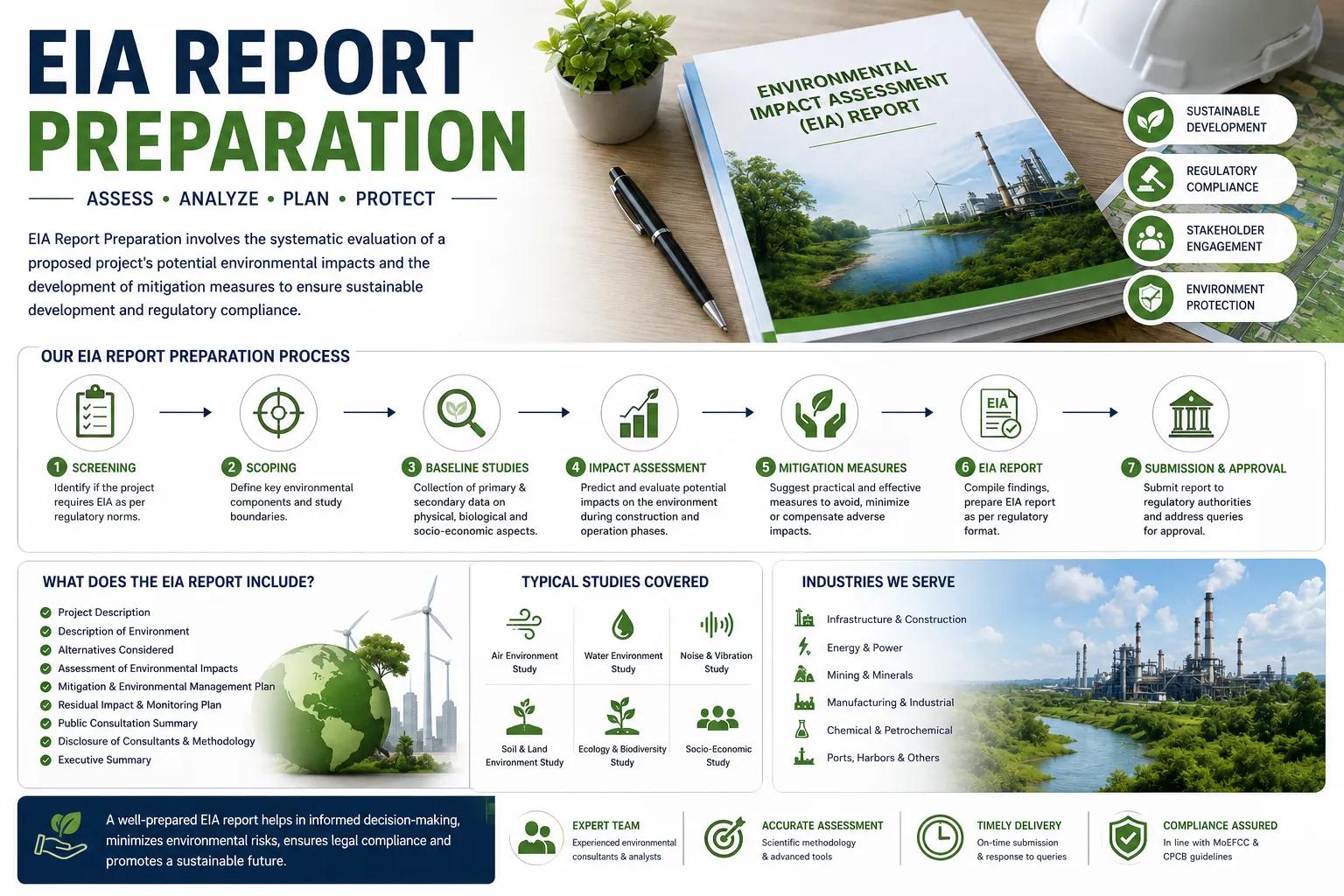
EIA Report Preparation: A Complete Technical Guide
EIA Report Preparation is the scientific and documentation process used to evaluate the potential environmental impacts of a proposed project before it receives approval. This report forms the foundation for obtaining Environmental Clearance (EC) from regulatory authorities in India.
Every industrial or infrastructure project with significant environmental implications must undergo this process under MoEFCC Guidelines. It ensures that development decisions are based on scientific evidence rather than assumptions.
Proper EIA Report Preparation supports sustainable project planning by identifying environmental risks early and suggesting mitigation measures. For industries and regulatory authorities alike, it provides a transparent, data-backed pathway toward responsible growth. In essence, EIA Report Preparation converts raw environmental data into a decision-ready regulatory document.
What is EIA Report Preparation?
EIA Report Preparation refers to the systematic process of assessing, documenting, and presenting the likely environmental effects of a proposed project. It combines field studies, data analysis, and regulatory compliance into a single comprehensive report.
The primary purpose is to help authorities decide whether a project can proceed, and under what environmental safeguards. Without an approved EIA report, most large-scale industrial and infrastructure projects cannot legally begin construction.
The legal importance of this process comes from the Environment Protection Act, 1986, and the EIA Notification, 2006, issued by MoEFCC. These regulations classify projects into categories requiring different levels of assessment before approval.
Why an EIA report matters before project approval:
- It identifies potential environmental damage before construction begins
- It provides regulators with scientific data to make informed decisions
- It sets binding environmental conditions that project developers must follow
- It creates a documented record for future compliance monitoring
Key sections typically included in an EIA report:
- Project description and site details
- Baseline environmental status of air, water, soil, and ecology
- Anticipated environmental impacts
- Environmental Management Plan (EMP)
- Public consultation summary, where applicable
- Risk assessment and disaster management plan
The regulatory framework in India is governed primarily by MoEFCC at the central level, supported by State Pollution Control Boards (SPCBs) for regional compliance monitoring.
How EIA Report Preparation Works
The complete workflow of EIA Report Preparation follows a structured, multi-stage process.
Project Screening: Authorities first determine whether a project requires an EIA study based on its category, size, and location sensitivity.
Scoping: The scope of study is defined, identifying which environmental parameters need detailed assessment for the specific project type.
Baseline Environmental Data Collection: Field teams collect existing environmental data before project activities begin, establishing a reference point for future comparison.
Air Quality Monitoring: Ambient air samples are collected at multiple locations to record existing pollution levels around the project site.
Water Quality Monitoring: Surface and groundwater samples are tested to document current water quality parameters.
Soil Quality Assessment: Soil samples are analyzed for fertility, contamination, and suitability for construction activities.
Noise Monitoring: Ambient noise levels are recorded at sensitive receptors like residential areas and schools near the project site.
Ecological Assessment: Flora and fauna surveys identify any protected species or sensitive habitats that could be affected.
Socio-economic Survey: Local demographic and livelihood data is collected to understand community dependency on natural resources.
Data Analysis: All collected data is analyzed to establish current environmental conditions and identify potential vulnerabilities.
Air and Water Dispersion Modelling: Scientific modelling predicts how project emissions and effluents will disperse, helping forecast future impact levels.
Impact Prediction: Based on modelling and baseline data, the likely environmental impacts of construction and operation phases are predicted.
Environmental Management Plan (EMP): A detailed plan outlining mitigation measures, monitoring schedules, and responsible parties is prepared.
Public Consultation: For applicable project categories, public hearings are conducted to record community concerns and suggestions.
Final Report Preparation: All findings are compiled into a structured, regulator-ready EIA document.
Submission for Environmental Clearance: The completed report is submitted to MoEFCC or SPCB for review and approval.
For example, a pharmaceutical manufacturing unit in Gujarat may undergo this entire workflow, including effluent dispersion modelling, to demonstrate that treated wastewater discharge will not affect nearby water bodies.
Industries That Require EIA Report Preparation
A wide range of industrial and infrastructure sectors require EIA Report Preparation before receiving project approval.
Manufacturing Industries need EIA studies to assess emissions, effluent discharge, and solid waste management practices.
Chemical Industries require detailed risk assessment due to the hazardous nature of raw materials and processes involved.
Pharmaceutical Industries must demonstrate safe handling of solvents and effective effluent treatment systems.
Cement Plants undergo assessment for particulate emissions and their impact on surrounding air quality.
Thermal Power Plants require comprehensive studies covering air emissions, water usage, and ash disposal management.
Mining Projects need ecological and land-use impact assessment due to significant terrain alteration.
Oil & Gas Facilities require specialized risk assessment covering spill scenarios and emergency response planning.
Renewable Energy Projects, including large solar and wind installations, need land-use and ecological impact studies.
Highways and Railways require assessment of forest land diversion, wildlife corridors, and community displacement.
Airports need noise impact assessment and air quality studies due to high passenger and aircraft traffic.
Industrial Parks require cumulative impact assessment covering multiple simultaneous project activities.
Infrastructure Development Projects in sensitive zones need EIA studies to balance growth with environmental protection.
In each case, EIA Report Preparation supports faster project approval by demonstrating regulatory compliance upfront.
Benefits of Professional EIA Report Preparation
Professional EIA Report Preparation delivers measurable value across regulatory, operational, and reputational dimensions.
Faster Environmental Clearance results from well-documented, scientifically accurate reports that reduce back-and-forth queries from regulators.
MoEFCC, CPCB, and SPCB Compliance is ensured through reports prepared strictly according to current regulatory guidelines.
Better Environmental Planning becomes possible when developers understand potential risks early in the project lifecycle.
Scientific Impact Assessment replaces guesswork with data-backed predictions of environmental effects.
Reduced Project Risks occur when mitigation measures are identified and implemented before problems arise.
Sustainable Development is supported by balancing industrial growth with environmental protection responsibilities.
Better Stakeholder Confidence is built when communities and investors see transparent, credible environmental documentation.
High-Quality Technical Documentation ensures the report withstands regulatory scrutiny and legal review if challenged.
Improved Environmental Decision-Making happens when accurate baseline and impact data guides project design choices.
Why Choose DS Technoverse for EIA Report Preparation Services?
DS Technoverse brings experienced EIA consultants and environmental engineers with deep subject-matter expertise across multiple industrial sectors.
The team specializes in advanced environmental data analysis, including air and water dispersion modelling, to strengthen the technical credibility of every report. Each project undergoes rigorous quality checks to ensure accurate technical documentation.
DS Technoverse provides strong regulatory compliance support, helping clients navigate MoEFCC, CPCB, and SPCB requirements without delays. With a fast turnaround time and customized project solutions, the team adapts to project-specific complexities and timelines.
Serving clients across PAN India locations, DS Technoverse offers dedicated technical support throughout the EIA Report Preparation process, from baseline data collection to final submission.
If your organization needs reliable EIA Report Preparation or Environmental Data Analysis services, contact DS Technoverse today to discuss your project requirements with experienced environmental professionals.
Conclusion
EIA Report Preparation is the scientific documentation process that evaluates environmental impacts before a project receives regulatory approval. It plays a vital role in Environmental Clearance, sustainable planning, and long-term environmental compliance.
Industries ranging from thermal power plants to pharmaceutical manufacturers depend on this process to demonstrate responsible project development. Professional EIA documentation reduces regulatory risk, builds stakeholder trust, and supports faster approvals.
DS Technoverse stands as a trusted environmental consulting partner, delivering accurate, science-based EIA Report Preparation services backed by experienced engineers and proven methodologies.
Frequently Asked Questions
1. What is EIA Report Preparation?
EIA Report Preparation is the process of assessing and documenting the potential environmental impacts of a project before it receives regulatory approval.
2. Why is an EIA report required?
It is legally required under India's Environment Protection Act and EIA Notification, 2006, to ensure projects do not cause unacceptable environmental harm.
3. Which industries require EIA Report Preparation?
Industries such as thermal power plants, cement plants, chemical units, mining projects, and infrastructure developments typically require EIA reports.
4. What is included in an EIA report?
It includes baseline environmental data, impact predictions, an Environmental Management Plan, and public consultation findings where applicable.
5. How long does EIA Report Preparation take?
Timelines vary based on project complexity, but baseline data collection and report preparation typically take several months to complete thoroughly.
6. Why should companies outsource EIA Report Preparation?
Outsourcing ensures accuracy, regulatory compliance, and access to experienced consultants like DS Technoverse who specialize in environmental documentation.
Further Reading
- Environmental Clearance consultant in India
- Air dispersion modelling for EIA in India
- EIA baseline data analysis
- Socio-economic survey for EIA
- EIA data analysis outsourcing
Frequently Asked Questions
What are the main chapters of an EIA report in India?
Project description, description of the environment (baseline), anticipated impacts and mitigation, analysis of alternatives, environmental monitoring programme, additional studies, project benefits, the environmental management plan, and summary and conclusions, following the generic structure in the EIA Notification, 2006 and the Terms of Reference.
Who can prepare an EIA report?
EIA reports must be prepared by an accredited EIA consultant organisation, with experts approved for the relevant sector and functional areas.
How long does an EIA take?
Typically several months: the baseline monitoring season, impact prediction and report preparation, followed by the public consultation where required and appraisal.
Which parts of an EIA are commonly outsourced?
Specialist studies such as air dispersion modelling, water quality and hydrodynamic modelling, noise modelling, data analysis and socio-economic surveys are often carried out by specialist teams for the accredited consultant.
Sources and Further Reading
Official and primary sources for the standards, rules and data discussed on this page.
- U.S. EPA: 2024 Appendix W final rule: the latest revision of the Guideline on Air Quality Models.
- PARIVESH (Ministry of Environment, Forest and Climate Change): the online system for Environmental Clearance applications in India.
- U.S. EPA SCRAM: preferred and recommended air quality models: the official home of AERMOD and the EPA-preferred models, with downloads and user guides.
- U.S. EPA: AERMET, AERMAP and other preprocessors: meteorological and terrain preprocessors used with AERMOD.