Carbon credit transactions do not usually fail on price. They fail on documentation — a buyer asks for something, the developer takes three weeks to produce it, the buyer's diligence stalls, and the airline buys elsewhere before the compliance deadline.
Assembling the pack before going to market is the cheapest thing a developer can do to improve both the speed and the price of a sale.
The Core Pack
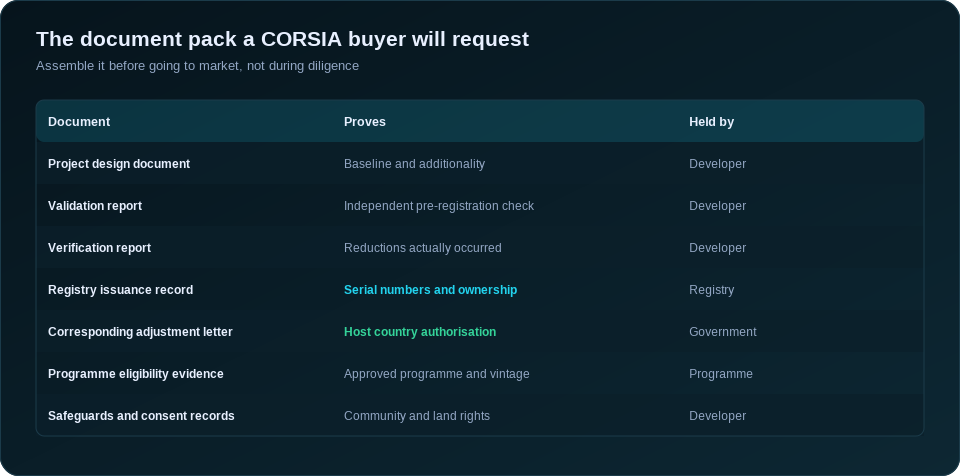
| Document | Proves | Held by |
|---|---|---|
| Project design document | Baseline and additionality | Developer |
| Validation report | Independent pre-registration assessment | Developer |
| Verification report | The reductions actually occurred | Developer |
| Registry issuance record | Serial numbers and ownership | Registry |
| Corresponding adjustment letter | Host country authorisation | Government |
| Programme eligibility evidence | Approved programme and vintage | Programme |
| Safeguards and consent records | Community and land rights | Developer |
Every one of these is requested in a serious diligence process. A developer who can produce all seven within a day is in a materially stronger negotiating position than one who produces them over a month.
Document by Document
Project design document
The foundational description: activity, boundary, baseline, additionality argument, methodology applied, monitoring plan and crediting period. Buyers read the additionality section and the baseline section most closely, because that is where over-crediting originates.
Registered PDDs are usually public on the programme registry, so assume the buyer has already read it before the first call. Know its weak points and be ready to discuss them — a developer who volunteers the contestable assumption and explains how it was handled conservatively builds far more confidence than one who waits to be asked.
Validation report
The independent assessment before registration. Buyers look for the findings raised and how they were closed. A validation with no findings at all is unusual; what matters is that findings were substantive and properly resolved.
Verification report
Confirms reductions actually occurred in the monitoring period. Buyers check the verified quantity against what was claimed, any qualifications in the opinion, and whether data gaps were handled conservatively.
Qualified opinions are a serious problem in a sale. If a verification is qualified, expect a discount and a longer diligence process, and be ready to explain the remediation.
Registry issuance record
Serial numbers, quantity, vintage, holding account. Buyers verify this directly on the registry, not from your document — so make sure what you present reconciles exactly to what the registry shows. Discrepancies read as either carelessness or something worse.
Corresponding adjustment letter
For CORSIA use, the decisive document. It evidences that the host country has authorised the transfer and will apply the adjustment.
Buyers will want to see the authorisation itself, understand its scope — which project, which vintages, what quantity — and confirm it is unconditional or, if conditional, what the conditions are. A general statement of policy intent is not an authorisation for your units.
See corresponding adjustments for Indian CORSIA projects.
Programme eligibility evidence
Confirmation that the issuing programme is ICAO-approved for the relevant unit type and vintage window, and that your units fall inside it. Programme approvals have scopes and dates; "Verra is approved" is not the same as "these units are eligible".
Safeguards and consent records
For land-based and community projects: free prior informed consent, benefit sharing, grievance mechanisms, land tenure documentation. Compliance buyers weight this lower than eligibility but they do check it, and reputational exposure has become a real factor in buying decisions.
The Supporting Pack
Beyond the core seven, prepare:
| Document | Why buyers ask |
|---|---|
| Monitoring reports for each period | Shows data discipline over time |
| Instrument calibration records | Supports the verified quantity |
| Title and credit ownership documents | Who is entitled to sell |
| Corporate documents and KYC | Standard commercial diligence |
| Prior sale record | Confirms units are unsold and unretired |
| Co-benefit evidence | Where claimed, must be measured |
| Photographs and site records | Confirms the project physically exists |
| Contact for the validator or verifier | Buyers sometimes verify directly |
The prior sale record matters more than developers expect. Double-selling — the same units offered to two buyers, usually through poor record-keeping across brokers — is a serious commercial and legal exposure. Maintain one authoritative inventory ledger showing every unit, its status, and every commitment against it.
How to Present It
- One index document listing every item, its date, and where it sits
- A data room, with controlled access and an access log
- Consistent naming — project code, document type, date, version
- A one-page summary stating project, programme, vintages, quantity, CA status, serial ranges
- A named contact who can answer a diligence question the same day
That one-page summary answers the first five questions any buyer asks. Sending it with the initial approach filters out buyers who cannot use your units and accelerates the ones who can.
What Weak Documentation Costs
| Symptom | Consequence |
|---|---|
| Documents produced slowly | Buyer moves to another supplier before the deadline |
| Registry record does not reconcile | Diligence escalates, trust falls |
| CA status vague | Compliance buyers walk away entirely |
| Qualified verification undisclosed | Discovered later, renegotiation or collapse |
| Title unclear | Legal review stalls indefinitely |
| No prior sale record | Buyer assumes the worst |
The pattern: documentation problems are read as project quality problems, because from the buyer's side they are indistinguishable. A well-run project with disorganised paperwork looks exactly like a weak project during diligence — and the buyer has a deadline.
Our buyer-side companion piece, the CORSIA credit due diligence checklist, sets out the same ground from the other direction, and how to buy CORSIA carbon credits covers the transaction itself.
Assembling the Pack: A Practical Sequence
Most of the pack accumulates naturally if it is collected as it is created. The developers who struggle are those reconstructing it at the point of sale, from people who have moved on.
| When | What to file, immediately |
|---|---|
| At design | Project design document, methodology reference, title and consent documents |
| At validation | Validation report, findings and closure evidence |
| At registration | Registration confirmation, project ID, programme correspondence |
| Each monitoring period | Monitoring report, raw data, calibration records, photographs |
| At verification | Verification report, findings and responses |
| At issuance | Registry record, serial ranges, holding account confirmation |
| On authorisation | Corresponding adjustment document and its scope |
| Continuously | Inventory ledger: every unit, its status, every commitment against it |
The inventory ledger is the one to start on day one. It is a simple table — vintage, serial range, quantity, status, contract, retirement — and it is what prevents a double-sale and what lets you answer a buyer's first question in minutes rather than days.
Two habits make the difference in practice. Scan on receipt, so nothing exists only as paper at a site office. And name files consistently from the beginning — project code, document type, date, version — because a data room whose contents cannot be identified from filenames signals disorganisation before a buyer opens anything.
Assume every document will eventually be read by someone looking for a reason to discount the price. That is not cynicism; it is simply what diligence is.
One final discipline: keep a short written note of every material judgement made during development — why a particular baseline parameter was chosen, why a conservative default was applied, why a boundary was drawn where it was. These decisions are obvious while you are making them and completely opaque three years later when a buyer's technical adviser asks. A one-page decision log costs nothing to maintain and answers the questions that otherwise require tracking down whoever wrote the project design document.
Frequently Asked Questions
What documents do CORSIA buyers ask for? Project design document, validation report, verification report, registry issuance record, corresponding adjustment letter, programme eligibility evidence and safeguards records.
Which document matters most? The corresponding adjustment authorisation. Without it the units cannot be used for CORSIA compliance regardless of everything else.
Do buyers check the registry themselves? Yes. Present figures that reconcile exactly to the registry record.
What if our verification report is qualified? Disclose it upfront with the remediation. Discovered later, it damages the transaction far more than it would have at the start.
How long should diligence take? Days to a few weeks with a prepared pack. Months where documents are assembled on request.
What is a prior sale record? Your authoritative ledger of every unit, its status and any commitment against it, evidencing that what you are selling is unsold and unretired.
Do co-benefits need documentation? If you claim them, yes — measured and verified, not asserted. Compliance buyers weight them lower than eligibility but they still check.
Should we use a data room? Yes, with controlled access and an access log. It signals professionalism and keeps sensitive documents traceable.
Who prepares the pack? The developer, usually with consultant support for the first project. It is a one-off effort that pays back on every subsequent sale.
What if a document does not exist? Say so plainly and explain why. Buyers accept explained gaps far better than gaps discovered during diligence.
Developing CORSIA-eligible credits in India? DSTechnoverse supports project developers with eligibility screening, methodology selection, monitoring design, documentation packs and buyer due diligence — and advises buyers on whether the units they are offered will actually count. We are based in Indore, Madhya Pradesh and work with clients across India. See our CORSIA carbon credit services, our carbon credit portal at carboncredit.dstechnoverse.com, or talk to our team about your project.
This article is general information, not legal, financial or regulatory advice. CORSIA eligibility criteria, approved programmes and vintage windows change — verify the current position with ICAO and your programme before committing capital.
Sources and Further Reading
Official and primary sources for the standards, rules and data discussed on this page.
- ICAO: CORSIA Eligible Emissions Units: the current approved programmes and unit eligibility conditions.
- UNFCCC: The Paris Agreement: the treaty behind Article 6 and corresponding adjustments.
- ICAO: CORSIA: the scheme home page with official documents and participating States.
- Bureau of Energy Efficiency (BEE): the administrator of India’s Carbon Credit Trading Scheme.