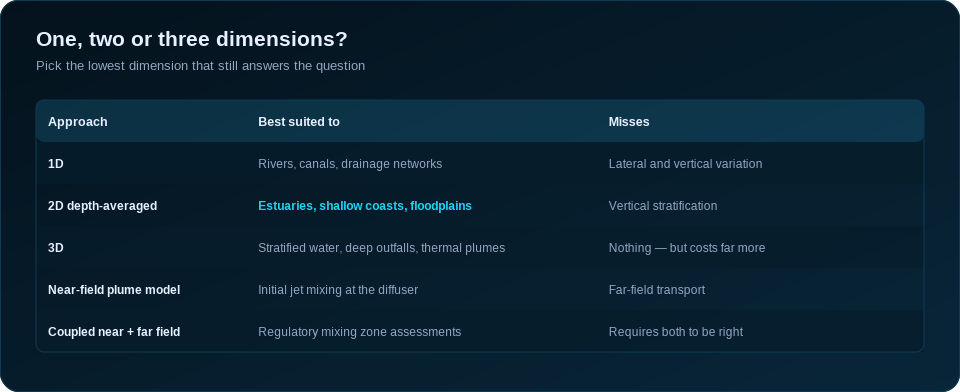
Software choice is the question asked first and the one that matters least. All the established codes solve the same equations; they differ in usability, licensing, modules and community, not in physics.
That said, the differences are real enough to matter for a project, so here is an honest comparison.
The Main Options
| Software | Origin | Strengths | Licensing |
|---|---|---|---|
| Delft3D | Deltares, Netherlands | Coastal, estuarine, morphology, water quality | Open source (FM suite partly commercial) |
| MIKE | DHI, Denmark | Broad module range, strong support, polished interface | Commercial, per-module |
| TELEMAC-MASCARET | EDF, France | Finite element, flexible mesh, research-grade | Open source |
| EFDC | US EPA lineage | Estuarine hydrodynamics and water quality | Open source, commercial GUIs exist |
| HEC-RAS | US Army Corps | Rivers, floodplains, 1D and 2D | Free |
| CORMIX / VISJET | Academic and commercial | Near-field mixing zone analysis | Commercial |
By Application
| Application | Usual choice | Alternative |
|---|---|---|
| River hydraulics and flood mapping | HEC-RAS | MIKE HYDRO River, TELEMAC-2D |
| Estuary hydrodynamics and salinity | Delft3D, MIKE 21/3 | EFDC, TELEMAC-3D |
| Coastal and nearshore | Delft3D, MIKE 21 | TELEMAC |
| Effluent near-field mixing | CORMIX, VISJET | UM3 |
| Sediment transport and morphology | Delft3D, MIKE | TELEMAC-SISYPHE |
| Reservoir stratification and water quality | EFDC, Delft3D-WAQ | CE-QUAL-W2 |
| Thermal plume from a power plant | Delft3D-FLOW 3D, MIKE 3 | EFDC |
| Oil or chemical spill trajectory | Delft3D-PART, MIKE spill modules | GNOME |
| Port siltation | Delft3D, MIKE | TELEMAC |
What Actually Separates Them
Licensing and cost. MIKE is commercial with per-module licensing and can be a substantial annual cost for a small consultancy. Delft3D, TELEMAC, EFDC and HEC-RAS are free or open source. For an occasional user, that difference dominates.
Ease of use. MIKE has the most polished interface and the shortest path from install to first run. TELEMAC and EFDC are more capable and considerably steeper — they reward users who model regularly and punish occasional ones.
Support. Commercial licensing buys a support desk and training. Open source relies on documentation, user forums and your own persistence. On a project with a regulatory deadline, that is a real consideration.
Mesh flexibility. Structured curvilinear grids (classic Delft3D) versus unstructured flexible meshes (Delft3D FM, TELEMAC, MIKE FM). Unstructured meshes refine locally around an outfall or a channel without refining the whole domain — a genuine advantage where geometry is complex.
Module ecosystem. MIKE and Delft3D both offer waves, sediment, water quality and particle tracking that couple with the flow model. If your study needs waves and morphology together, an integrated suite saves considerable effort.
Regulatory familiarity. Reviewers are more comfortable with codes they have seen before. Using a well-established package removes a line of questioning you do not need.
What Does Not Separate Them
All the established codes solve the shallow water equations with comparable numerical schemes. For a well-posed problem with good data, they produce comparable answers — differences between codes are typically far smaller than the differences produced by changing the bathymetry or the calibration dataset.
The confidence hierarchy from the hydrodynamic modelling guide holds:
- Calibration data quality
- Bathymetry accuracy
- Boundary condition data
- Effluent characterisation
- Mesh resolution near the source
- Software choice — last
A study built in free software with good ADCP calibration data beats a study built in an expensive commercial suite with none. That is not a close comparison.
Practical Selection
| Situation | Recommendation |
|---|---|
| Occasional user, river or flood work | HEC-RAS — free, well documented, widely accepted |
| Occasional user, coastal or estuarine | Delft3D — open source, strong documentation, large user base |
| Regular commercial modelling, budget available | MIKE — support and interface justify the cost at volume |
| Research or unusual physics | TELEMAC — flexible, open, actively developed |
| Water quality and reservoir focus | EFDC or Delft3D-WAQ |
| Mixing zone assessment | CORMIX for near field, coupled to whichever far-field code you use |
| Client or regulator specifies a package | Use it — this ends the discussion |
That last row is worth respecting. If a regulator or a client has a preference, the technical merits of an alternative rarely outweigh the friction of defending an unfamiliar choice.
Costs Beyond the Licence
| Cost | Notes |
|---|---|
| Licence or subscription | Zero for open source, substantial for commercial suites |
| Training | Weeks of learning curve regardless of package |
| Computing | 3D runs over long periods need real hardware or cloud |
| Data acquisition | Survey and ADCP deployment — usually the largest line |
| Staff time | Model build, calibration and reporting dominate the budget |
| Peer review | Worth budgeting on significant projects |
Data acquisition and staff time exceed software cost in almost every project. Choosing free software to save money, and then running the study without calibration data because the deployment was not budgeted, optimises the wrong line.
Building or Buying the Capability
For a consultancy running one or two water studies a year, the sensible options are:
Subcontract to a specialist. No licence, no learning curve, no staff time. You retain the client relationship and the report carries a specialist's calibration work. This is exactly the model that has become standard for air dispersion work — see white-label modelling partners and how to outsource dispersion modelling.
Build in-house with open source. Viable if there is a genuine pipeline of work to justify the learning curve. One study a year is not enough to maintain competence — the skill decays between projects and each study starts from scratch.
Licence a commercial suite. Justified where water modelling is a core service line with steady throughput.
The decision is the same one every specialist technical capability presents: occasional demand is served better by access than by ownership. The break-even is roughly the point at which someone is doing this work more than a few months a year.
Data Formats and Interoperability
A practical consideration that rarely appears in software comparisons: how easily data moves in and out.
| Task | What to check before committing |
|---|---|
| Importing bathymetry | Does it read the survey format you actually have — XYZ, GeoTIFF, ASCII grid, S-57 charts? |
| Boundary forcing | Can it ingest global tidal model output directly, or does it need manual conversion? |
| Mesh generation | Built in, or a separate tool with its own learning curve? |
| Output post-processing | Native viewer, Python and MATLAB libraries, or GIS export? |
| GIS integration | Shapefile and GeoTIFF import and export for reporting maps |
| Scripting and batch runs | Can scenarios be run from a script rather than a GUI? |
| Version control | Are input files text-based and diffable, or opaque binaries? |
The last two matter more than they appear. A study typically involves dozens of scenario runs — tidal states, discharge rates, design variants — and a package that can only be driven through a GUI turns that into days of clicking. Scriptable input files also make the study reproducible, which is what allows a reviewer, or you in eighteen months, to re-run it and get the same answer.
Post-processing is where a surprising share of project time goes. Extracting concentrations at named receptors, producing compliance tables and generating consistent map figures across twenty scenarios is a real workload. Packages with good Python libraries — Delft3D and TELEMAC both have active ecosystems — let you automate that; packages without leave you exporting by hand.
Before You Commit to a Package
Run one small pilot before making it your standard:
- Build a simple model of a domain you understand, with real bathymetry
- Import your actual data formats — not the tutorial dataset
- Run a short simulation and time it on your hardware
- Extract results at a few points and produce a map figure
- Estimate the effort for the full study from what that took
A week of this saves months of discovering, halfway through a deadline-bound project, that the mesh generator cannot handle your shoreline or that extracting time series at 40 receptors requires a manual export each time.
Frequently Asked Questions
Which hydrodynamic modelling software is best? There is no single best. HEC-RAS for rivers and floods, Delft3D or MIKE for estuarine and coastal work, TELEMAC for flexible research applications, EFDC for water quality.
Is Delft3D free? The classic Delft3D structured-grid suite is open source. Parts of the newer Flexible Mesh suite are commercial — check the current licensing before planning around it.
Is MIKE worth the cost? For a consultancy doing regular commercial water modelling, the support, interface and integrated modules can justify it. For occasional use, open source is more sensible.
What do regulators accept? All the established codes. Reviewers care about calibration, data quality and documentation far more than about which package produced the output.
What software is used for mixing zones? CORMIX or VISJET for near-field jet mixing, coupled to a far-field hydrodynamic model such as Delft3D or MIKE.
Can I model an estuary in HEC-RAS? HEC-RAS handles 1D and 2D river and floodplain hydraulics well. For tidal estuaries with salinity and stratification, a dedicated coastal code is the right tool.
How long does it take to learn? Weeks to a first working model, months to competence, and the skill decays without regular use.
Does software choice affect the result? Far less than bathymetry, boundary conditions and calibration data. Established codes solve the same equations.
Should we build the capability or outsource? Outsource for occasional work; build where water modelling is a steady service line with real throughput.
Need a hydrodynamic or effluent dispersion study? DSTechnoverse works as a confidential, white-label modelling desk for environmental consultancies, EPC contractors and industry — hydrodynamic and water quality modelling, near-field mixing zone assessment, calibration against measured data and EIA-ready reporting. We are based in Indore, Madhya Pradesh and work with clients across India. See our water and effluent dispersion modelling service, or get in touch to scope a study.