CORSIA is documented across several instruments, each governing a different part of the scheme. Knowing which one answers which question saves considerable time, and knowing which ones change saves considerably more.
The Document Hierarchy
| Instrument | Governs | Changes |
|---|---|---|
| Chicago Convention | The legal foundation for ICAO Annexes | Effectively never |
| Assembly Resolutions | The scheme's existence and design principles | Every three years, at Assembly |
| Annex 16, Volume IV | Standards and Recommended Practices for MRV | By Council amendment |
| ICAO documents series | Detailed implementation elements | Periodically |
| Environmental Technical Manual, Vol IV | Guidance on applying Annex 16 Vol IV | Periodically |
| Council decisions and published lists | Programmes, vintages, growth factors, participation | Frequently |
| National implementing law | What actually binds you | By State |
What Each One Answers
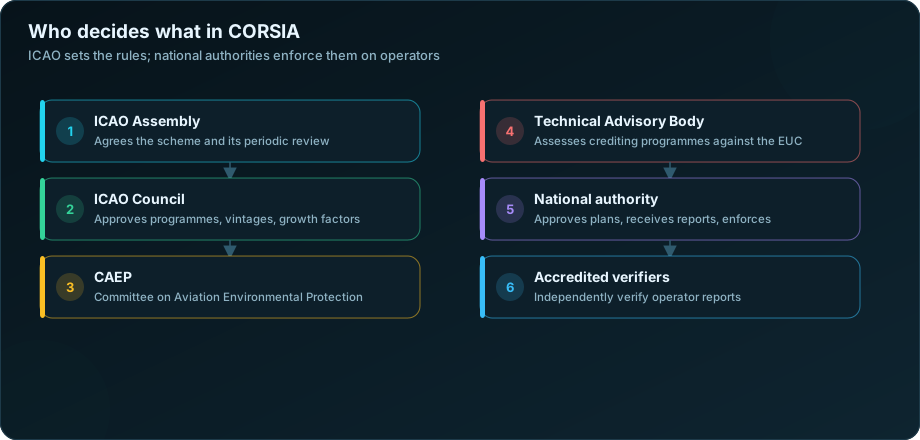
Assembly Resolutions
Answers: why the scheme exists, its objective, phase structure, participation principles, exemption categories, and the review mechanism.
Resolution A39-3 (2016) adopted CORSIA. Subsequent Assemblies have revisited and consolidated the position.
Use it for: understanding design intent and the political settlement behind the rules. Not for operational detail.
Annex 16, Volume IV
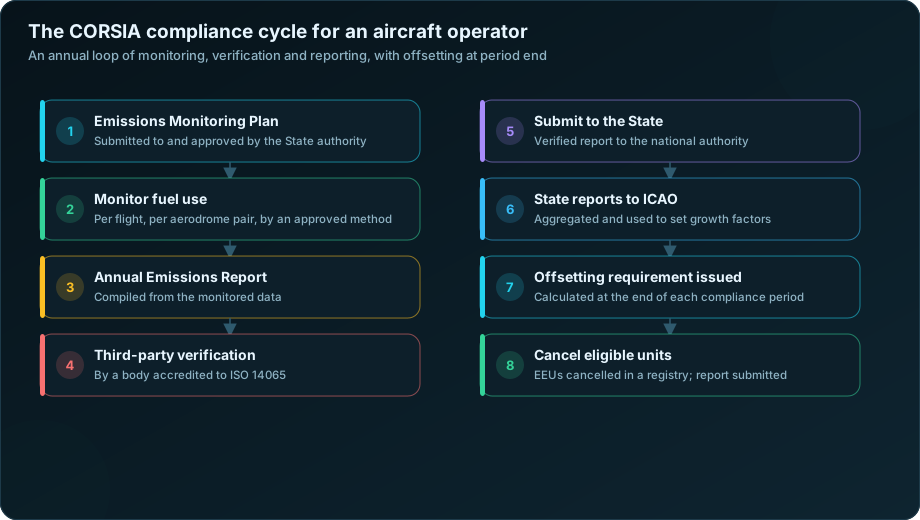
Answers: who must monitor, what must be monitored, the permitted fuel use monitoring methods, what the Emissions Monitoring Plan must contain, what the Annual Emissions Report must contain, and verification requirements.
This is the technical source of truth for MRV. When there is a question about how emissions must be determined, this is the document.
Use it for: monitoring plan development, method selection, reporting content, verification scope.
Environmental Technical Manual, Volume IV
Answers: how to apply Annex 16 Volume IV in practice. Worked guidance, examples and clarification.
Use it for: the "how do we actually do this" questions that the Annex states at standard level.
ICAO documents series
Answers: the detailed implementation elements — the CORSIA States list, eligible emissions units, eligible fuels, default lifecycle values, approved certification schemes, and the CERT tool.
Use it for: anything that is a list rather than a rule.
Council decisions and published pages
Answers: which crediting programmes are currently approved and under what conditions, which vintages are eligible for which compliance period, what the growth factors are, and which States are participating.
Use it for: everything commercially decisive.
National implementing law
Answers: your submission deadlines, your penalties, your authority's procedural requirements, and how the standards apply to you specifically.
Use it for: anything with a date attached. Never assume a deadline is common across States.
What Actually Changes
This is the distinction worth internalising.
Stable: the Chicago Convention, the broad design in the Assembly resolutions, the structure of Annex 16 Volume IV.
Changes periodically: technical detail in the Annex and the Environmental Technical Manual, following CAEP work.
Changes frequently and matters commercially:
- Crediting programme approvals and their conditions
- Eligible vintage windows
- Growth factors
- State participation lists
- Approved Sustainability Certification Schemes and default lifecycle values
If you are relying on any item in that last group, check it at the point you rely on it, and capture what it says on the day. A saved page or screenshot. A URL in a compliance file is not evidence of what a page said three years ago, and that is precisely when someone will ask.
Key ICAO Pages
| Page | What it holds |
|---|---|
| CORSIA main page | Entry point to all CORSIA material |
| CORSIA emissions units | Approved programmes, conditions, eligible units |
Annex 16 Volume IV and the ICAO documents series are published through ICAO's standard channels; some require purchase or an account.
Other Primary Sources
| Source | For |
|---|---|
| UNFCCC Article 6 | Corresponding adjustments and Article 6 mechanics |
| DGCA | Indian national implementation |
| EU climate action | EU ETS aviation scope |
| IATA | Industry guidance and SAF context |
| Crediting programme registries | Unit records, serialisation, chain of custody |
How to Use Secondary Sources
Articles, guides and knowledge bases — this one included — are orientation, not compliance references.
They help you understand the shape of the scheme, know which question to ask, and find the right primary document. They should never be the basis for a filing, a transaction, or a statement to a regulator.
Two specific cautions:
Lists go stale immediately. Any article listing approved programmes or eligible vintages is a snapshot of its publication date. Several such lists circulating are years out of date.
Prices quoted in articles describe nothing you can buy. Without project type, vintage, volume and authorisation status, a price per tonne is not information.
A Research Sequence
For any CORSIA question:
- 1Is this about design intent? Assembly resolutions.
- 2Is this about how to monitor or report? Annex 16 Volume IV, then the ETM.
- 3Is this a list — programmes, vintages, States, fuels? The ICAO pages, checked today.
- 4Is this about a deadline or penalty? Your national authority.
- 5Is this about a specific unit? The programme registry plus the host-State authorisation document.
- 6Is this about Article 6 accounting? UNFCCC.
Where to Go Next
- CORSIA governance — which body issues which document
- CORSIA glossary — terminology used across them
- CORSIA acronyms — abbreviation lookup
- CORSIA FAQ — common questions
DSTechnoverse tracks Council decisions and published lists as part of ongoing client support, so a programme approval lapse or vintage change does not arrive as a surprise. Talk to our team.