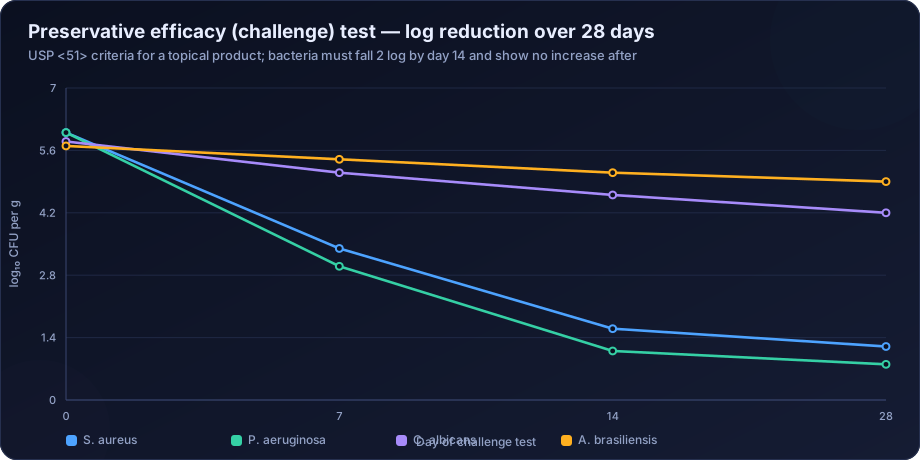
The preservative efficacy test — the challenge test — inoculates a product with a defined high level of specified organisms and tracks their reduction over 28 days. It establishes whether the preservative system can control contamination introduced by a consumer dipping a finger into a jar, and it is the central microbiological stability study for any multi-dose or aqueous product.
The Test Procedure
- Inoculate separate product samples with approximately 10⁵ to 10⁶ CFU per gram of each test organism, individually rather than as a mixed inoculum.
- The compendial panel is Staphylococcus aureus, Pseudomonas aeruginosa, Escherichia coli, Candida albicans and Aspergillus brasiliensis.
- Store at 20–25 °C protected from light for the 28-day period.
- Enumerate survivors at days 7, 14 and 28 — and at day 2 for the stricter categories.
- Neutralise at each sampling point, using a validated system, or the preservative continues acting during recovery and the log reduction is overstated.
- Compare against the criteria for the product category.
The neutralisation point is worth emphasising because it inflates results in the flattering direction. A challenge test run without validated neutralisation reports a preservative system as more effective than it is, which is precisely the wrong error to make.
Acceptance Criteria by Category
USP <51> divides products into four categories with different requirements.
| Category | Products | Bacteria | Fungi |
|---|---|---|---|
| 1 | Injections, ophthalmics, sterile nasal | 1-log by day 7, 3-log by day 14, no increase after | No increase from initial through day 28 |
| 2 | Topical, emulsions, non-sterile nasal | 2-log by day 14, no increase after | No increase from initial through day 28 |
| 3 | Oral products (non-antacid) | 1-log by day 14, no increase after | No increase from initial through day 28 |
| 4 | Antacids, aqueous-based orals | No increase from initial through day 28 | No increase from initial through day 28 |
Ph. Eur. 5.1.3 applies parallel criteria at two levels — A and B. Level A is the recommended standard; level B is acceptable where A cannot be achieved for justified reasons. Where a product is sold into both markets, the stricter applies.
Note that the fungal requirement is usually "no increase" rather than a reduction. Preservative systems are generally weaker against fungi than bacteria, and the criteria reflect that reality rather than demanding the impossible.
Margin Matters More Than the Pass
A binary pass discards the most useful information the test generates.
Two products can both pass Category 2 while one achieves 4.5-log bacterial reduction by day 14 and the other achieves 2.1-log against a 2-log requirement. Both are compliant. Only one has room to absorb the preservative depletion that will occur across shelf life.
Recording the actual log reductions against the required ones — and tracking that margin across formulation changes, packaging changes and supplier changes — turns the challenge test from a compliance record into an early warning. A margin that has narrowed from 4.5-log to 2.4-log across two reformulations is telling you something a series of passes never would.
When to Add Facility Isolates
The compendial panel uses laboratory reference strains, which may be considerably more susceptible than the organisms actually threatening your product.
Add facility isolates to the panel where:
- A preservative-tolerant organism has been recovered from the production environment — Burkholderia, Pseudomonas and Ralstonia are the usual candidates.
- A previous contamination event involved a specific organism.
- The product has a history of in-market spoilage complaints.
- The facility flora library shows a species repeatedly recovered from wet areas near the filling line.
This is not a compendial requirement, and it is increasingly expected in risk-based assessments. A product passing against P. aeruginosa ATCC 9027 while failing against the Pseudomonas strain living in your filling room has passed the wrong test. See preservative resistance and MIC creep.
When to Run It
- At formulation development, to select and optimise the preservative system before committing.
- At release for the initial batches of a new product.
- At end of shelf life on stability samples — this is the one most often omitted, and the one that detects depletion.
- After any formulation change, including a change in preservative supplier, since impurity profiles differ.
- After a packaging change, because absorption into a new container material changes the free preservative concentration.
- After a contamination event, with the recovered organism added to the panel.
Running it only at release tests the product as manufactured, not the product as it will be in month eighteen. Repeating on aged stability samples is what closes that gap.
Interpreting a Failure
A challenge test failure at development is useful information cheaply obtained. A failure on a marketed product is a different matter and requires an assessment of distributed stock.
The diagnostic sequence:
- Confirm neutralisation was adequate — an under-neutralised test can produce an artefactual failure at the recovery step, though this usually inflates rather than depresses apparent efficacy.
- Assay the preservative concentration in the failing sample. Depletion is the commonest cause, and it points at packaging, pH drift or formulation binding rather than at the preservative choice.
- Identify which organism failed. Fungal failures point at a system weak against moulds; Gram-negative failures point at tolerance or at inadequate concentration.
- Check water activity and pH against the original development values, since drift in either changes the requirement.
- Compare against the development data to establish whether the system was ever adequate or has degraded.
- Assess the margin history, since a system that has been narrowing for two reformulations was heading here.
Neutralisation in the Challenge Test
Neutralisation deserves its own treatment because it is the step that most commonly invalidates a challenge test, and it fails in the flattering direction.
At each sampling point, the product aliquot is diluted into recovery medium and plated. If the preservative is not inactivated at that moment, it continues killing during the dilution, the plating and the early incubation. The count recovered is lower than the count that was actually surviving in the product, and the reported log reduction is correspondingly higher.
The consequence is a preservative system that appears more effective than it is — and a product released on that basis is protected by less margin than the file suggests.
Validating the neutralisation requires two demonstrations:
- Efficacy — the neutraliser inactivates the preservative, shown by recovering a known inoculum from product plus neutraliser at a count comparable to a preservative-free control.
- Non-toxicity — the neutraliser does not itself inhibit the test organisms, shown by recovering the same inoculum from diluent plus neutraliser at a count matching plain diluent.
Both are required. A neutraliser that is itself mildly inhibitory suppresses the control as well as the test, which can make the pair look consistent while both are depressed.
Common systems are lecithin with polysorbate 80 for parabens and quaternary compounds, sodium thiosulphate for chlorine-releasing agents, and specific agents for isothiazolinones. The choice follows the preservative, and it must be revalidated when the preservative system changes.
Common Errors
- Neutralisation not validated, overstating efficacy.
- Mixed inoculum rather than separate samples per organism, which obscures which organism the system fails against.
- Testing at release only, missing depletion across shelf life.
- Testing in glass when the product ships in plastic, missing preservative absorption.
- Recording pass or fail rather than the actual log reductions, discarding the margin.
- Compendial organisms only where a tolerant facility isolate is the realistic threat.
- Inoculum too high or too low, since both distort the achievable reduction.
How DSTechnoverse Helps
We run challenge testing as part of a stability picture rather than as an isolated compliance test.
That covers USP <51> and Ph. Eur. 5.1.3 testing with validated neutralisation, facility isolates added to the panel where a tolerant organism has been recovered, preservative concentration assay alongside the microbiology, challenge testing on aged stability samples as well as at release, margin tracking across formulation and packaging changes, and failure investigation distinguishing depletion from inadequate design.
Our laboratory in Indore works with cosmetic, personal care, nutraceutical and pharmaceutical manufacturers across India.
Frequently Asked Questions
Which organisms are used?
S. aureus, P. aeruginosa, E. coli, C. albicans and A. brasiliensis as the compendial panel, inoculated into separate samples. Facility isolates should be added where a tolerant organism has been recovered from the production environment.
Why is the fungal criterion only "no increase"?
Because preservative systems are generally weaker against fungi than bacteria, and the criteria reflect achievable performance rather than an ideal. A system achieving fungal reduction has margin most do not.
Do unpreserved products need challenge testing?
If aqueous and multi-dose, the study is still informative — it establishes how quickly contamination would proliferate and therefore whether the container and in-use period are appropriate. For single-dose or non-aqueous products it is generally not required.
Should the test be repeated on stability samples?
Yes, and it is the most commonly omitted element. Release testing describes the product as made; end-of-shelf-life testing describes the product as used, after preservative depletion has occurred.
What if the product passes but only just?
Treat a narrow margin as a finding. Depletion across shelf life will consume it, and a product passing at 2.1-log against a 2-log requirement will very likely fail before expiry.
How is the inoculum prepared, and why does it matter?
Organisms are grown on appropriate media, harvested, washed to remove growth medium, and suspended in sterile saline or a suitable diluent to a defined concentration verified by plate count rather than by turbidity alone. Washing matters because carrying over nutrient-rich medium into the product provides the organisms with resources they would not otherwise have, artificially supporting survival and understating the preservative's performance. The suspension volume should also be small relative to the product — commonly not more than one per cent — so the formulation is not diluted enough to weaken the preservative concentration being tested.
Should the challenge test be run at the product's storage temperature?
The compendial condition is 20 to 25 degrees Celsius protected from light, and that is what a submission expects. Running an additional arm at the actual storage temperature is informative where the product is stored warm, because preservative efficacy and organism growth rate both change with temperature and the compendial condition may be gentler than reality. For Indian ambient-stored products this is worth considering as a supplementary study rather than a replacement, since deviating from the compendial condition in the primary study invites a question the extra data does not fully answer.
What counts as "no increase" for the fungal criterion?
No increase from the initial count, interpreted with the same measurement variability allowance that applies elsewhere in microbiology. In practice a result within about half a log of the day-zero count is treated as no increase, since plate counting cannot resolve smaller differences reliably. A rise of a full log is unambiguous growth. Facilities that treat any upward movement as a failure generate unnecessary investigations; facilities that treat any result under a log as acceptable miss genuine slow growth. Defining the interpretation in the protocol beforehand avoids arguing about it against a result you do not like.
Should fungal inocula be spores or vegetative cells?
Spores for Aspergillus brasiliensis, harvested from a sporulating culture and washed. Spores are the realistic contamination form for moulds, they are more resistant than hyphal fragments, and they survive in the environment in a way vegetative mycelium does not. For Candida albicans the inoculum is vegetative yeast cells, which is the form encountered. Using mycelial fragments for the mould challenge tests a form that rarely reaches product and produces an easier pass than the product deserves.
Can we use a mixed inoculum to save cost?
It is not compendially acceptable and it destroys the diagnostic value. Separate inocula tell you which organism the system fails against, which is what directs any reformulation.
An expiry date is a promise the product will still meet specification on its last day. DSTechnoverse runs shelf-life and stability studies — real-time and accelerated trials, USP <51> challenge testing, in-use stability and statistical shelf-life modelling at ICH Zone IVb conditions. Based in Indore, Madhya Pradesh, serving clients across India. Talk to our microbiology team.