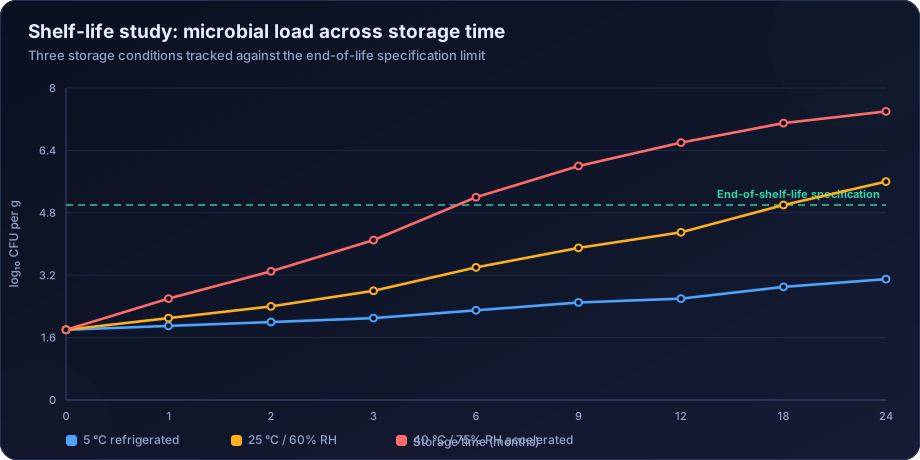
Unopened stability describes a product nobody has used. For any multi-dose product — a cream in a jar, an oral suspension, an eye drop, a shampoo — the microbiologically demanding period begins at first opening, when the consumer starts introducing organisms with every use.
What Unopened Stability Misses
A sealed container is a closed system. Whatever microbial load it carries at release is the load it carries throughout, modified only by the preservative acting on it and by any growth the conditions permit.
An opened container is an open system receiving repeated inoculation. Each use introduces a small number of organisms from fingers, applicators, air or the surface the product touches. The preservative deals with each one individually — and is depleted a little further each time.
The failure mode this creates is cumulative and invisible to both unopened stability and a single challenge test. A product can pass both and still fail in real use, because neither study replicates repeated inoculation against a progressively depleting preservative.
The Period-After-Opening Claim
Most multi-dose products carry a period-after-opening statement — the open-jar symbol with a number of months on cosmetics, or "use within 28 days of opening" on a pharmaceutical.
That claim needs substantiating like any other. An in-use study is what substantiates it, and a claim carried over from a similar product or set by convention is exactly the sort of thing that does not survive scrutiny when a contamination complaint arrives.
Designing an In-Use Study
- Define the in-use period being claimed and the specification that must be met at the end of it.
- Use the final commercial container and closure, since the dispensing mechanism is central to how contamination enters.
- Simulate realistic use frequency — a face cream used twice daily, an eye drop four times daily, a shampoo three times weekly. The frequency drives cumulative inoculation.
- Remove doses the way a consumer would. A finger into a jar is a very different contamination route from a pump dispenser, and simulating with a sterile spatula tests nothing.
- Store between uses as a consumer would — a bathroom shelf rather than a controlled chamber, which means warmer and more humid than a stability cabinet.
- Sample at intervals across the in-use period, testing the full microbiological specification.
- Assay preservative concentration alongside, because depletion is the mechanism and the counts are the consequence.
- Run on aged product as well as fresh — a container opened at month eighteen of a two-year shelf life has less preservative remaining than one opened on day one, and that is the worst case.
That final point is the one most often missed. The realistic worst case is a product near the end of its unopened shelf life, then subjected to the full in-use period. Testing only fresh product tests the easy case.
Simulated Versus Real Consumer Use
Two approaches exist and each has a place.
Simulated use in the laboratory is controlled and reproducible. Doses are removed on a defined schedule with a defined technique, and the contamination introduced can be standardised — some protocols deliberately inoculate a low level at each use to represent a realistic finger.
Real consumer use panels distribute product to users who return it after the in-use period for testing. It captures genuine variability in handling, storage and hygiene, which simulated use cannot. It is also uncontrolled, and returned samples vary in how much product remains and how it was stored.
For substantiating a claim, simulated use with a documented protocol is normally the primary study. A consumer panel is a valuable supplement where the product is unusual or where the simulated protocol is contested.
Dispensing Format Changes Everything
The contamination route is determined by the container, and the difference between formats is larger than most formulation differences.
| Format | Contamination route | Relative risk |
|---|---|---|
| Open jar, finger application | Direct, every use | Highest |
| Wide-mouth tub with spatula | Direct if spatula reused | High |
| Squeeze tube | Nozzle contact with skin or surface | Moderate |
| Pump dispenser | Nozzle only, no back-flow | Low |
| Airless pump | No air ingress, no back-flow | Very low |
| Single-dose sachet or ampoule | None | Negligible |
This is why packaging is a microbiological control rather than a marketing decision. Moving a product from an open jar to an airless pump can reduce the preservative requirement substantially, which matters as preservative options narrow under regulatory and consumer pressure.
What the Data Should Show
A well-designed in-use study produces three curves rather than a pass or fail.
Microbial count over the in-use period, which should remain within specification but is expected to be non-zero — a product in use is not sterile.
Preservative concentration, declining as it deals with each inoculation. The rate of decline determines how long the system holds.
Water activity and pH, which drift as the product is exposed to air and ambient humidity, and which change what the preservative has to achieve.
Where the preservative curve extrapolates below its minimum effective concentration before the end of the claimed in-use period, the claim is not supported regardless of what the counts show at the final time point — the margin has gone and the next batch may not be as fortunate.
Regulatory Context
For pharmaceuticals, in-use stability is an established expectation for multi-dose products, with the in-use period stated on the label and supported by data.
For cosmetics, the period-after-opening symbol is mandatory in the EU for products with a shelf life above thirty months, and substantiation is expected. Indian requirements follow BIS standards for specific product categories, with the practical position that a stated claim needs evidence behind it whether or not a specific regulation compels the study.
For nutraceuticals and food supplements under FSSAI, in-use conditions matter most for liquid and semi-solid formats where repeated opening is inherent.
Consumer Behaviour the Protocol Should Account For
A simulated-use protocol is an approximation of consumer behaviour, and the approximations chosen determine how conservative the study is.
Real use is worse than laboratory simulation in several specific ways, and a protocol that ignores all of them substantiates a claim the product may not deliver.
- Storage location. Bathrooms are warm and humid, and products are left near basins and showers rather than in cupboards. Ambient laboratory storage understates this.
- Sharing. Family products are used by several people, multiplying the inoculation events and the range of organisms introduced.
- Contaminated hands. Consumers do not wash before applying a face cream. The realistic inoculum is skin flora plus whatever the hand last touched.
- Water ingress. Products used in a shower or with wet hands receive water directly, which dilutes preservative locally and raises water activity at the surface.
- Applicators reused without cleaning — spatulas, brushes and sponges left in or beside the container between uses.
- Extended use beyond the stated period, since the period-after-opening symbol is widely ignored.
- Partially emptied containers, where a large air headspace and a large exposed surface accelerate both evaporation and contamination.
A protocol cannot replicate all of these, and it should state which it has and has not simulated. Where the claim is important and the product high-risk, a consumer panel supplementing the simulated study is the way to capture what the protocol cannot.
How DSTechnoverse Helps
In-use studies are the gap we most often find in an otherwise complete stability programme.
That covers protocol design with realistic use frequency and dose removal technique, simulated-use studies in the final commercial container, testing on aged product to capture the true worst case, preservative concentration assay across the in-use period, water activity and pH tracking, consumer panel study support where warranted, and period-after-opening substantiation documentation.
We run stability storage from Indore, Madhya Pradesh at ICH Zone IVb conditions, and for in-use work the ambient conditions of central India are a realistic proxy for how a product is actually stored in an Indian home.
Frequently Asked Questions
Is in-use stability legally required?
For multi-dose pharmaceuticals it is an established expectation. For cosmetics with a period-after-opening claim, substantiation is expected in most markets. The practical position is that a stated claim needs evidence regardless of whether a specific regulation names the study.
Why is it different from a challenge test?
A challenge test is a single large inoculation. In-use is repeated small inoculations against a progressively depleting preservative. A product can pass the first and fail the second.
Should we test fresh or aged product?
Aged, as the primary study. A container opened near the end of its unopened shelf life has less preservative remaining, and that combination is the realistic worst case.
How is dose removal simulated?
The way a consumer would do it — a finger into a jar, a pump actuation, a squeeze from a tube. Using a sterile spatula for convenience tests a contamination route that does not exist in practice.
Does packaging really change the requirement?
Substantially. An airless pump eliminates both air ingress and back-flow, and can reduce the preservative requirement enough to enable a preservative-free formulation that an open jar could never support.
How long should an in-use study run?
The full claimed in-use period plus a margin, with sampling at intervals across it. For a 28-day pharmaceutical claim, that means testing at least at days 0, 7, 14, 28 and preferably beyond, since consumers routinely exceed the stated period. For a cosmetic carrying a twelve-month period-after-opening symbol, monthly sampling across twelve months is the direct substantiation, and the study necessarily takes a year. Shorter studies with extrapolation carry the same weakness as accelerated unopened stability — the extrapolation is the part that has not been demonstrated.
What sample size does an in-use study need?
Enough containers to sample destructively at every time point without reusing any. A container opened, sampled and resealed has been disturbed in a way that affects subsequent results, so each time point needs its own units. For a study with five time points across three batches, that is fifteen containers minimum, and more where duplicate testing at each point is wanted. Underestimating this is a common protocol error that surfaces at the third time point when the containers run out and someone proposes resampling an earlier one.
How does in-use stability interact with the unopened shelf life?
They stack rather than run in parallel, and the label needs to make that clear. A product with a 24-month unopened shelf life and a 6-month period after opening does not offer 30 months of use — the in-use period runs within the unopened one, and a container opened at month 23 should be discarded at month 24 rather than month 29. Labelling that states both without clarifying the relationship causes genuine consumer confusion, and the study design should reflect the real worst case: a container opened as late as possible in the unopened shelf life and then used for the full stated in-use period.
Can in-use data be bracketed across a product range?
Sometimes, with justification. Products sharing the same preservative system, the same container and dispensing format, and comparable water activity and pH can reasonably be bracketed, with the study run on the worst case — usually the highest water activity or the format with the most direct contamination route. What does not bracket is a change of dispensing format, because that alters the contamination route itself rather than the product's ability to cope with it. A cream sold in both a jar and an airless pump needs the jar tested regardless of what the pump data shows.
What if the in-use period fails?
Shorten the claim to the last passing point, change the dispensing format, or strengthen the preservative system. Extrapolating past a failing point is not defensible.
An expiry date is a promise the product will still meet specification on its last day. DSTechnoverse runs shelf-life and stability studies — real-time and accelerated trials, USP <51> challenge testing, in-use stability and statistical shelf-life modelling at ICH Zone IVb conditions. Based in Indore, Madhya Pradesh, serving clients across India. Talk to our microbiology team.