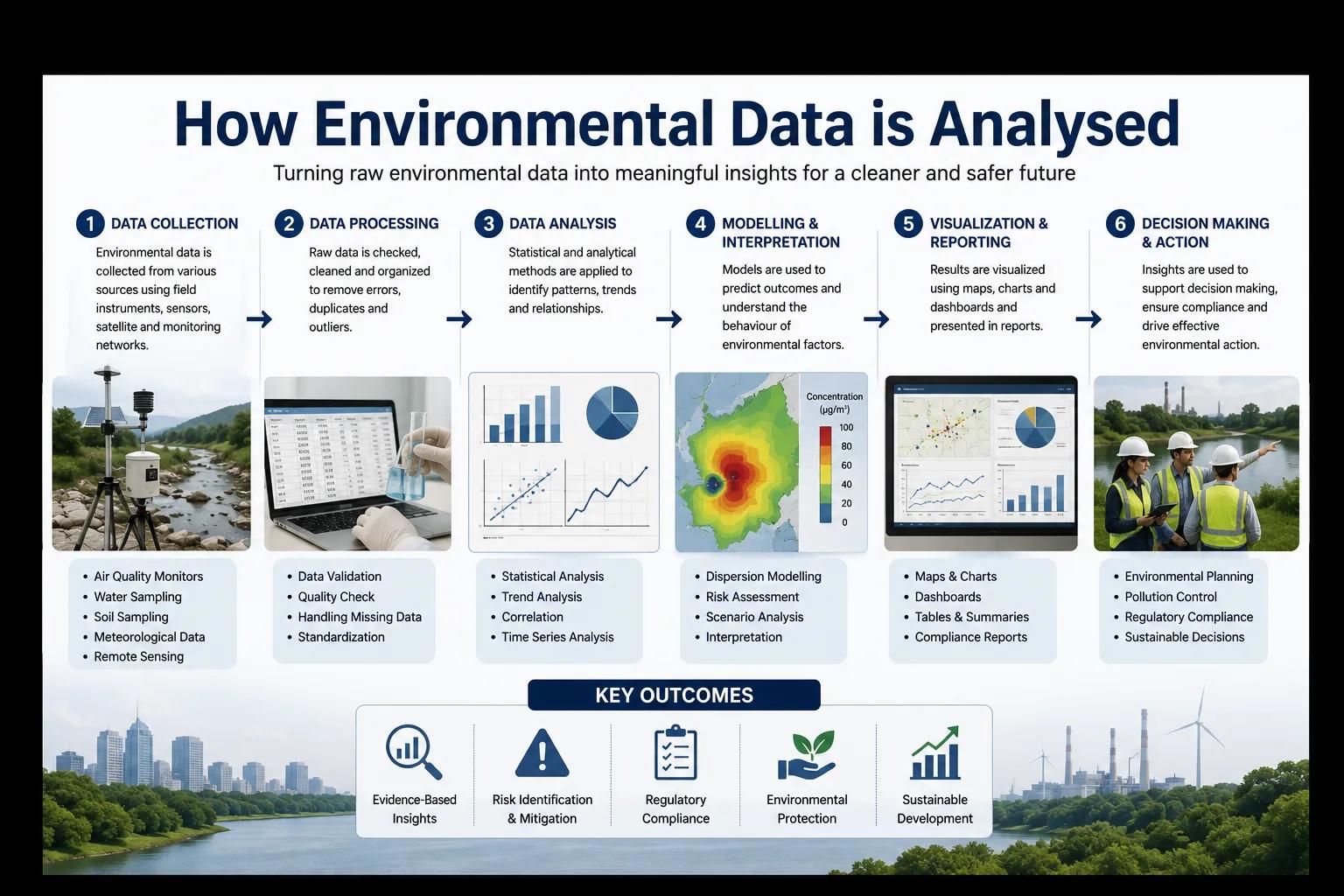
How Environmental Data is Analysed: A Complete Guide
Understanding how environmental data is analysed is fundamental to every Environmental Impact Assessment (EIA), regulatory submission, and sustainable development project. Raw monitoring data alone means little — it is the analysis process that transforms numbers into meaningful environmental insights.
For industries, consultants, and government agencies, knowing how environmental data is analysed helps ensure accurate impact predictions, faster Environmental Clearance, and stronger regulatory compliance. Poorly analysed data can lead to flawed conclusions, project delays, and non-compliance penalties.
Whether you are a mining company, a renewable energy developer, or an EIA consultant preparing a regulatory submission, this guide explains exactly how environmental data is analysed — from raw collection to final reporting — and why professional EIA Data Analysis Outsourcing Services matter.
What is Environmental Data Analysis?
Environmental data analysis is the systematic process of collecting, validating, processing, and interpreting environmental parameters to understand baseline conditions and predict potential impacts of a project or activity.
This data typically includes air quality readings, water quality parameters, soil characteristics, noise levels, and meteorological measurements gathered from field monitoring stations or laboratory testing.
The purpose of environmental data analysis extends beyond simple record-keeping. It supports scientific decision-making, helps regulators evaluate compliance with CPCB and SPCB standards, and forms the evidentiary backbone of any Environmental Impact Assessment.
Accurate environmental data analysis is essential because environmental clearance decisions, pollution control strategies, and long-term sustainability planning all depend on the reliability of the underlying data and its interpretation.
How Environmental Data is Analysed Step by Step
The complete process of how environmental data is analysed involves several structured stages, each building on the previous one.
Step 1: Data Collection
The process begins with field monitoring and laboratory sampling, covering air quality, water quality, soil quality, noise levels, and meteorological parameters over a defined baseline period.
Step 2: Data Validation
Collected data is validated against instrument calibration records, sampling protocols, and expected value ranges to identify anomalies, sensor errors, or inconsistencies before further processing.
Step 3: Data Cleaning
Invalid, duplicate, or incomplete data points are corrected or removed. Missing values may be flagged or estimated using accepted statistical methods, ensuring the dataset is analysis-ready.
Step 4: Quality Assurance and Quality Control (QA/QC)
QA/QC procedures verify that data collection and laboratory analysis followed standard protocols, maintaining consistency and credibility throughout the environmental monitoring process.
Step 5: Statistical Analysis
Statistical techniques — including averages, percentiles, standard deviation, and trend analysis — are applied to identify patterns, seasonal variations, and compliance with regulatory thresholds.
Step 6: GIS Mapping
Geographic Information System (GIS) tools are used to spatially map monitoring locations, pollutant concentrations, and sensitive receptors, providing a visual understanding of environmental conditions across the project area.
Step 7: Trend Analysis
Environmental data is analysed over time to detect long-term trends, such as gradually increasing pollution levels or seasonal fluctuations in water quality, which inform future risk assessment.
Step 8: Environmental Modelling
Where required, processed data feeds into predictive models — such as air dispersion or water quality models — to simulate future scenarios and project-specific environmental impacts.
Step 9: Impact Assessment
Analysts compare baseline data and modelling results against regulatory standards to assess the likely magnitude and significance of environmental impacts from the proposed project.
Step 10: Result Interpretation
Findings are interpreted in context, explaining what the data means for environmental health, regulatory compliance, and potential mitigation requirements.
Step 11: Report Preparation
Finally, all findings are compiled into a structured technical report, suitable for submission as part of an Environmental Impact Assessment or Environmental Clearance application.
This complete workflow of how environmental data is analysed ensures that conclusions are scientifically sound, defensible, and aligned with MoEFCC and CPCB regulatory expectations.
Tools and Techniques Used in Environmental Data Analysis
Professional environmental data analysis relies on a combination of specialized tools:
- GIS Software – for spatial mapping of monitoring stations, sensitive receptors, and pollution zones
- Statistical Software – for trend analysis, correlation studies, and compliance evaluation
- Spreadsheet Analysis – for organizing raw datasets and performing preliminary calculations
- Environmental Modelling Tools – for simulating air, water, and noise dispersion scenarios
- Data Visualization Dashboards – for presenting complex datasets as clear, interpretable charts and maps
- Air Quality Analysis Tools – for processing continuous ambient air monitoring data
- Water Quality Analysis Software – for interpreting physicochemical and biological water parameters
- Remote Sensing – for assessing land use change, vegetation cover, and large-scale environmental patterns
- Database Management Systems – for securely storing and managing long-term monitoring datasets
Each tool plays a specific role. For instance, a thermal power plant project may use GIS mapping to overlay ambient air quality data with nearby residential zones, helping planners identify areas requiring additional mitigation measures.
Benefits of Environmental Data Analysis
Robust environmental data analysis delivers tangible value across regulatory, operational, and strategic dimensions:
- Better environmental decision-making, grounded in validated, accurate data
- Faster environmental clearance, since well-analysed data reduces regulatory queries and delays
- Improved regulatory compliance with CPCB, SPCB, and MoEFCC standards
- Scientific impact assessment that withstands technical scrutiny during public hearings
- Reduced project risks by identifying environmental concerns early in the planning stage
- Better environmental management through data-driven mitigation strategies
- Accurate environmental reporting suitable for regulatory and stakeholder review
- Sustainable project planning that balances development with environmental protection
- Improved stakeholder confidence, as transparent, well-documented analysis builds trust with regulators and communities
These benefits demonstrate why environmental data analysis should be treated as a strategic investment rather than a procedural requirement.
Why Choose DS Technoverse for EIA Data Analysis Outsourcing?
Understanding how environmental data is analysed is only valuable when paired with experienced professionals who can execute the process accurately and efficiently. This is where DS Technoverse adds significant value.
DS Technoverse offers:
- Experienced environmental experts skilled in data validation, statistical analysis, and impact assessment
- Advanced analytical tools for processing large, multi-parameter environmental datasets
- GIS and statistical expertise for spatial mapping and trend analysis
- Accurate environmental reporting aligned with EIA documentation standards
- Regulatory compliance support in line with CPCB, SPCB, and MoEFCC requirements
- Fast turnaround time for time-sensitive EIA submissions
- Customized project solutions tailored to mining, infrastructure, renewable energy, and industrial sectors
- High-quality technical documentation suitable for regulatory and stakeholder review
- PAN India consulting services supporting projects across diverse geographies
- Dedicated technical support from data collection through final report delivery
If your organization needs reliable, regulator-ready environmental data analysis, DS Technoverse is a trusted environmental consulting partner ready to support your project from baseline monitoring to final compliance reporting. Contact DS Technoverse today to discuss your EIA data analysis outsourcing requirements.
Conclusion
Understanding how environmental data is analysed helps industries, consultants, and regulators appreciate the rigor behind credible environmental assessments. From data collection and validation to GIS mapping, modelling, and final reporting, every step in the process contributes to accurate, defensible environmental conclusions.
Professional environmental data analysis is essential for regulatory compliance, sustainable project planning, and long-term environmental protection. With proven technical expertise, DS Technoverse is well-positioned to deliver precise, compliant EIA Data Analysis Outsourcing services for industries across India.
Frequently Asked Questions
1. How Environmental Data is Analysed?
Environmental data is analysed through a structured process involving data collection, validation, cleaning, statistical analysis, GIS mapping, environmental modelling, and final report preparation to support Environmental Impact Assessment and regulatory compliance.
2. What is Environmental Data Analysis?
Environmental data analysis is the systematic process of processing and interpreting air, water, soil, noise, and meteorological data to understand baseline environmental conditions and assess project impacts.
3. Why is Environmental Data Analysis important?
It is important because it forms the scientific foundation for Environmental Impact Assessment, supports regulatory decision-making, and helps industries demonstrate compliance with CPCB and SPCB standards.
4. Which software is used for Environmental Data Analysis?
Environmental data analysis commonly uses GIS software, statistical analysis tools, environmental modelling software, and data visualization dashboards to process and interpret monitoring data.
5. Who requires Environmental Data Analysis?
Mining companies, manufacturing industries, infrastructure developers, renewable energy projects, and any organization undergoing Environmental Impact Assessment typically require environmental data analysis.
6. Why should companies outsource Environmental Data Analysis?
Companies outsource environmental data analysis to access specialized expertise, advanced analytical tools, faster turnaround times, and regulator-ready reporting without maintaining an in-house technical team.
Further Reading
- EIA baseline data analysis
- Air quality descriptive statistics and percentiles
- Visualising air quality data
- EIA data analysis outsourcing guide
- EIA data analysis outsourcing
Frequently Asked Questions
What are the main steps in analysing environmental data?
Data collection and validation, cleaning and treatment of missing or below-detection values, descriptive statistics, comparison with standards, trend or spatial analysis where needed, and clear tables, charts and maps for the report.
Which software is used for environmental data analysis?
Spreadsheets for small datasets, and R, Python, statistical packages and GIS for larger or more complex work. The method matters more than the tool, but scripts make the analysis reproducible.
How are values below the detection limit handled?
They are reported as below the limit and treated consistently in statistics — for example by substitution at half the limit for simple summaries, or by methods designed for censored data — with the method stated in the report.
How is data compared with standards?
Each parameter is compared with the applicable standard for its averaging period, such as 24-hour values for ambient air, with exceedances counted and explained.
Sources and Further Reading
Official and primary sources for the standards, rules and data discussed on this page.
- PARIVESH (Ministry of Environment, Forest and Climate Change): the online system for Environmental Clearance applications in India.
- U.S. EPA SCRAM: preferred and recommended air quality models: the official home of AERMOD and the EPA-preferred models, with downloads and user guides.
- U.S. EPA: 2024 Appendix W final rule: the latest revision of the Guideline on Air Quality Models.
- U.S. EPA: AERMET, AERMAP and other preprocessors: meteorological and terrain preprocessors used with AERMOD.