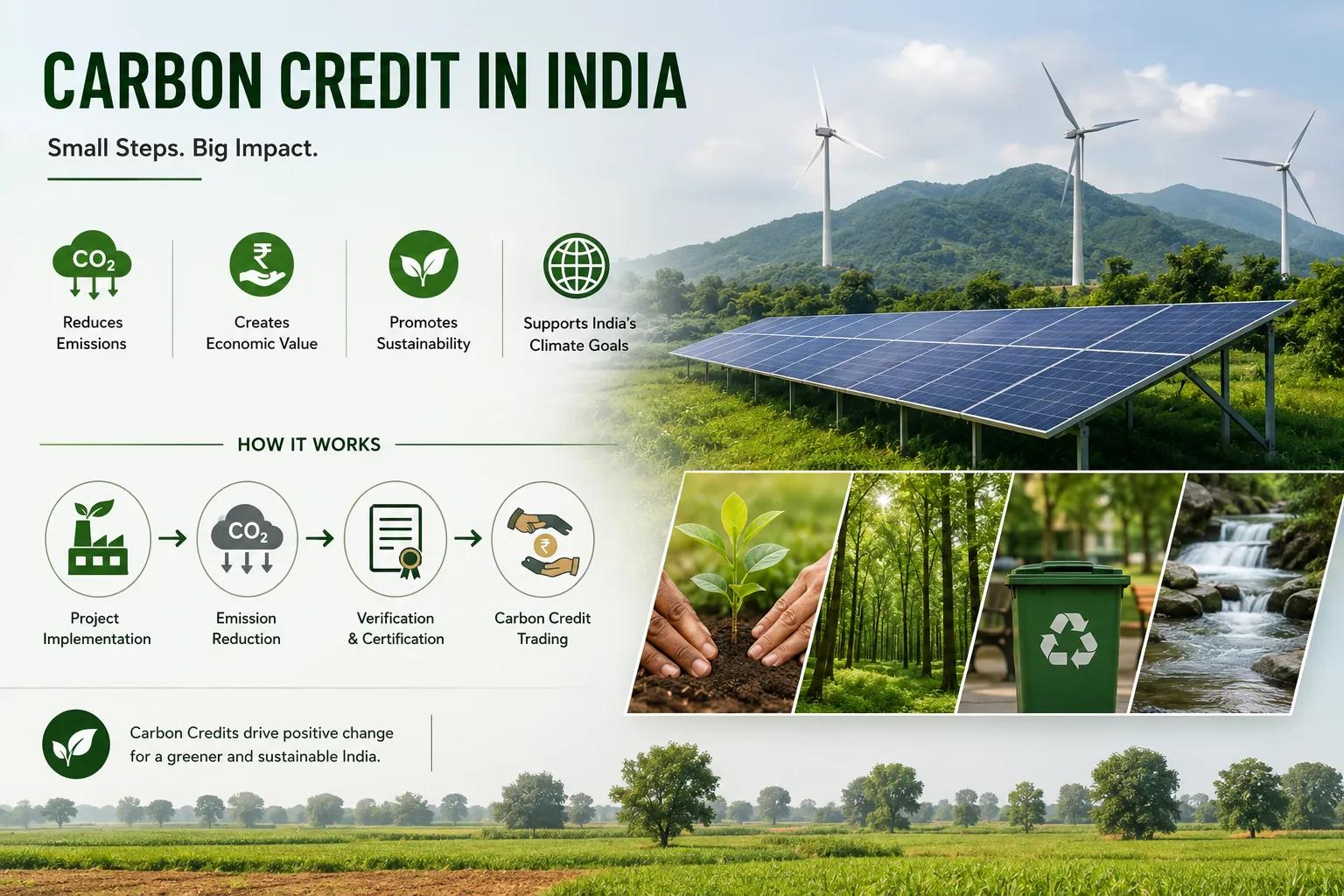
A carbon credit is a verifiable permit representing the removal or avoidance of one metric ton of carbon dioxide equivalent ($CO_2e$) from the atmosphere. For businesses navigating the green transition, a carbon credit in India serves as both a financial asset and a tool for climate change mitigation. As the government tightens environmental regulations, integrating carbon offset projects into your corporate framework is no longer optional—it is a financial and operational necessity.
Developing a robust net zero strategy through renewable energy carbon credits allows Indian enterprises to mitigate climate risks, improve ESG rankings, and secure sustainable revenue streams.
What is Carbon Credit in India?
A carbon credit in India is a tradeable certificate awarded to projects that successfully implement greenhouse gas reduction practices. The fundamental principle operates on a simple mechanism: companies that lower their emissions below a mandated cap, or deploy clean technologies, generate surplus credits.
1 Carbon Credit = 1 Metric Ton of CO2 (or equivalent GHG) Prevented/Removed
The carbon market India operates across two distinct avenues:
- The Voluntary Carbon Market: Driven by corporate sustainability initiatives, brand equity, and international buyers looking to offset their residual footprint.
- The Compliance Market: Transitioning rapidly under the Energy Conservation (Amendment) Act, establishing the framework for the upcoming Indian Carbon Market (ICM) and carbon credit trading scheme managed by the Bureau of Energy Efficiency (BEE).
Why Carbon Credits Matter for Indian Businesses
Adopting carbon trading opportunities India provides a distinct competitive edge across multiple corporate vectors:
- Financial Influx: Selling credits converts a carbon footprint reduction strategy from a cost center into a direct revenue stream.
- ESG Compliance India: Institutional investors utilize carbon accounting metrics to score corporate governance, making credit accumulation vital for capital acquisition.
- Corporate Responsibility: Demonstrating proactive environmental sustainability safeguards brand reputation against greenwashing allegations.
How Carbon Credit Projects Work
Navigating carbon project development services requires adherence to structured international and national validation protocols:
[Project Identification] ➔ [Carbon Assessment] ➔ [Validation & Registration] ➔ [Verification] ➔ [Issuance & Trading]
- Project Identification & Assessment: Evaluating whether a project (e.g., solar plant, biomass, biodigester) meets the criteria for additionality—proving the carbon emission reduction would not occur without project funding.
- Documentation & Registration: Developing a Project Design Document (PDD) outlining greenhouse gas reduction methodologies for carbon credit registration services.
- Carbon Verification Process: Independent third-party auditors validate the data, certifying the exact volume of offset generation before final credit issuance.
Industries Leading the Carbon Market in India
The scope for carbon offset programs India spans across multiple heavy-emitting and progressive sectors:
- Renewable Energy: Wind, solar, and hydro installations displacing fossil-fuel grid power.
- Manufacturing & Heavy Industry: Energy efficiency upgrades, waste heat recovery, and fuel switching.
- Agriculture & Waste Management: Methane capture from municipal solid waste and sustainable farming practices that promote soil carbon sequestration.
Strategic Support from Dstechnoverse
Navigating carbon asset management requires specialized technical expertise. Dstechnoverse helps businesses identify eligible carbon credit opportunities, prepare project documentation, navigate compliance requirements, and maximize the value of sustainability initiatives.
As an end-to-end provider of carbon credit consultancy services, Dstechnoverse delivers critical support across the project lifecycle:
- Comprehensive carbon accounting and carbon footprint analysis.
- Rigorous carbon credit certification and validation support.
- Tailored ESG advisory services to align your decarbonization map with global standards.
Frequently Asked Questions
What is a carbon credit in India?
It is a certified asset representing the prevention or removal of one metric ton of $CO_2e$ from the atmosphere, tradeable within domestic and international carbon markets.
How can businesses earn carbon credits?
By implementing verified sustainability solutions India, such as switching to renewable power, optimization of industrial energy efficiency, or establishing reforestation projects.
Who can apply for carbon credit projects in India?
Renewable energy developers, manufacturing facilities, agricultural groups, waste management entities, and infrastructure corporations are all eligible.
How are carbon credits verified?
Through an independent carbon verification process where accredited third-party auditors evaluate real-world performance data against recognized international methodologies (like VCS, Gold Standard, or BEE frameworks).
How can Dstechnoverse help with carbon credit projects?
We function as a full-service environmental compliance consultancy, delivering baseline carbon project development services, registration assistance, and strategic market placement to maximize asset valuation.
Sources and Further Reading
Official and primary sources for the standards, rules and data discussed on this page.
- Science Based Targets initiative (SBTi): corporate net-zero standards and the role of credits for residual emissions.
- Bureau of Energy Efficiency (BEE): the administrator of India’s Carbon Credit Trading Scheme.
- ICAO: CORSIA: the scheme home page with official documents and participating States.
- ICAO: CORSIA Eligible Emissions Units: the current approved programmes and unit eligibility conditions.