
Climate change is not just a problem for the future; it is a problem we are facing right now. We see it every day. The summers are getting hotter, the rains come at strange times, and extreme weather is hurting millions of people. India is the third-largest country in the world when it comes to releasing carbon emissions. Because of this, India has a very big responsibility. We need to do our part to reduce the gases that warm up the planet.
This is where the concept of Carbon Credit in India comes into the picture. It is a very practical solution. It helps the environment, and at the same time, it helps the economy. Carbon credits give a money-based reward to businesses, farmers, and regular people. If you can reduce your carbon footprint, you can earn money.
The market for Carbon Credit in India is growing very fast. The government is supporting it, international companies are partnering with Indian projects, and more people are learning about it. Because of this, the chances to make money in this sector are growing every single day. You might be a business owner who wants to join this market. You might be a farmer who wants to earn extra money from your land. Or, you might just be someone who is curious about how to live sustainably. No matter who you are, understanding Carbon Credit in India is becoming very important.
The government of India has launched something called the Indian Carbon Market (ICM). This system makes trading carbon credits official and organized. It makes it easier for people to buy, sell, and trade these credits. This is a golden chance. If you get into this industry now, while it is still new, you can establish yourself and be very successful.
To understand this, we need to look at the basics. A Carbon Credit in India is like a certificate. It is a piece of paper (or a digital record) that proves you have removed bad air from the atmosphere. Specifically, one carbon credit represents the reduction of one metric ton of carbon dioxide (CO₂) or other greenhouse gases.
Think of it as a type of currency for the environment. It works like a reward system. When you do something good that reduces emissions, you earn these credits. You can then sell these credits to other people or companies. Why would they buy them? Because they need to offset their own carbon footprint.
Let’s break it down into very simple terms:
India is part of carbon markets all over the world and inside the country too. Internationally, projects in India have been very active. They have participated in the Clean Development Mechanism (CDM) under global agreements like the Kyoto Protocol. Domestically, we now have the Indian Carbon Market (ICM). This provides a platform specifically for trading Carbon Credit in India within our own borders.
The best part of this system is that it makes saving the planet profitable. Farmers can earn money just by planting trees. Factories gain benefits by using machines that save energy. Projects that create renewable energy, like solar or wind power, become even better investments because they generate extra cash through credits.
The system for Carbon Credit in India works through two main types of markets. It is important to understand the difference between them.
1. The Voluntary Carbon Market:
This market is all about choice. Businesses choose to buy credits here because they want to meet their own sustainability goals. There is no law forcing them to do it.
2. The Compliance Market:
This market is about rules. Participation here is mandatory for certain industries.
The government is the main leader in this system. The Bureau of Energy Efficiency (BEE) and the Ministry of Environment are in charge. They decide the targets for reducing emissions. They watch to make sure everyone is following the rules. They oversee how the entire market for Carbon Credit in India operates.
There are also private players involved. These include project developers who build the green projects, verification agencies that check if the savings are real, and trading platforms where credits are sold. These groups help manage the whole process from the very beginning to the final sale.
The Indian Carbon Market (ICM) was launched in 2024. This was a huge milestone. It gave the country a structured and transparent place for carbon trading. It has clear rules and regulations. This makes the market safer and easier for everyone to use.
Starting a business in this field is a great opportunity. It is open to many different types of people. Here is what you need to know if you want to enter the market for Carbon Credit in India.
Who Can Start?
Eligibility Requirements:
To start, you need to meet a few criteria. First, you must have legal ownership or the rights to the land or facility where the project is happening. Second, you must be able to prove that your project really reduces emissions. You need to show measurable numbers. Third, you must follow all environmental laws. Fourth, you need enough money to set up the project initially. Finally, you need technical knowledge or help from consultants to manage the details.
Initial Investment:
The money you need depends on the size of your project.
Step-by-Step Process:
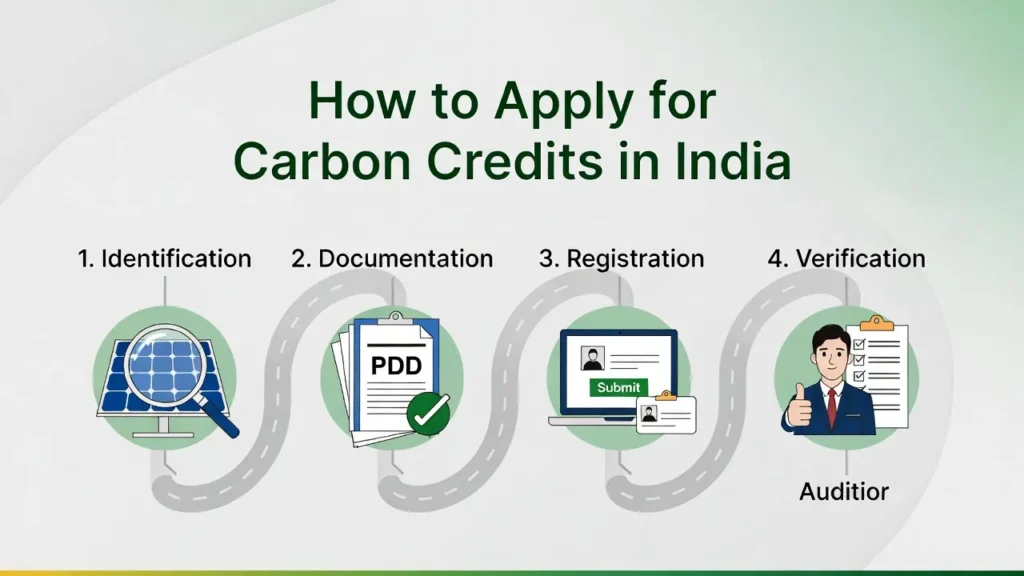
Applying for Carbon Credit in India requires you to be careful with your paperwork. You need to be prepared.
Project Identification:
First, determine exactly what activity will reduce emissions. You must ensure your project meets the “additionality” criteria. This means you must prove that the project would not have happened without the money from carbon credits. You also need to measure the “baseline emissions,” which is how much pollution was there before you started.
Documentation Required:
You will need a lot of documents. The most important is the Project Design Document (PDD). You also need proof that you own the land. You need reports on the environmental impact. You need to show your financial plans. You also need to show how you will monitor and measure the carbon savings over time.
Registration Process:
Choose a standard to register with, such as CDM, VCS, Gold Standard, or ICM. Submit your PDD to them. Then, an operational entity will validate your project. If they have questions, you must answer them. Once approved, you get a registration confirmation and a unique project ID.
Verification & Validation:
After the project is running, you must monitor it strictly. Collect data on your emission reductions. Hire an accredited third-party verifier to do an audit. This usually happens once a year. Submit your reports. Finally, you receive a statement confirming that you have earned Carbon Credit in India.
The whole process, from the day you register to the day you get your first credit, usually takes between 6 to 18 months. It depends on how complex your project is.
There are many ways or “pathways” to get credits. Different participants can choose different methods.
Renewable Energy Projects:
This is very popular. You can install solar panels on rooftops or on the ground. You can build wind farms in areas with lots of wind. Small hydroelectric projects are also eligible. Even using biomass from farm waste to make power counts. These projects get credits because they replace electricity that would otherwise be made from burning fossil fuels like coal.
Forestry & Plantation:
This involves planting trees. You can plant trees on land that was degraded (afforestation). You can replant trees on land that lost its forest recently (reforestation). You can mix trees with crops (agroforestry). You can even restore mangroves near the ocean.
Waste Management & Biogas:
Rubbish can be turned into money. You can convert organic waste into biogas. You can capture gas from landfills so it doesn’t go into the air. Composting municipal waste works too. Treating wastewater to capture methane is another great method.
Industrial Emission Reduction:
Factories can get credits by becoming more efficient. If they use less energy to make things, they save carbon. Switching from coal to cleaner fuels helps. Installing systems to capture waste heat or upgrading to better machinery are also valid ways to get Carbon Credit in India.
To actually earn the credits, you need to put in consistent effort. Here are some proven methods.
Solar & Wind Energy:
If you install solar panels, remember that higher capacity means more credits. Usually, projects need to be at least 1 MW in size to be worth it for trading, but smaller ones can sometimes be grouped together. Rural areas are great for this. You can earn credits for the whole life of the project, which is often 20 to 25 years.
Tree Plantation:
Plant native trees that belong in your local climate. You usually need at least 1 hectare of land. It is best to mix fast-growing trees with long-lasting ones. You can earn credits for 20 to 30 years. Plus, you get benefits from selling timber or fruits.
Organic Farming:
Farmers can switch from chemical farming to organic farming. This reduces emissions from chemical fertilizers. It also helps the soil hold more carbon. It takes about 3 years to get certified, but it is very valuable.
Energy-Efficient Technology:
Businesses can replace old machines with new, efficient ones. Changing lights to LEDs or upgrading motors can earn credits.
The amount you earn depends on the size. A 1 MW solar plant might give you 1,500 to 2,000 credits a year. A 10-hectare tree plantation might give you 100 to 150 credits a year.
Trees are special because they naturally suck carbon out of the air. This is a great option for farmers.
Afforestation & Reforestation:
Afforestation means planting trees on land that has not had a forest for over 50 years. Reforestation means planting on land that was cleared recently. Both types are eligible for Carbon Credit in India. You must prove the land was empty and that you wouldn’t have planted trees without the extra money from credits.
Minimum Land Requirement:
Usually, you need at least 1 hectare. However, larger areas like 10 hectares are better for making a profit. Small farmers can join together in a community project to reach this size. You must have the rights to use the land for a long time.
Tree Species & Duration:
Native species are best for nature. Fast-growing trees like Eucalyptus or Bamboo generate carbon stock quickly. Long-lasting trees like Teak, Neem, or Mango store carbon for a long time. The trees must stay standing for 20 to 30 years.
Monitoring:
You have to measure the trees regularly to see how much they grow. You need GPS maps of the land. You need photos to prove progress. Sometimes satellite images are used. You calculate the biomass (the wood) to know how much carbon is stored.
Calculating credits can seem like math homework, but the logic is simple.
Emission Baseline:
First, you figure out the “business as usual” scenario. This asks: what would happen if I did nothing? You look at historical data from the last 3 to 5 years. This gives you a starting point.
Reduction Calculation Method:
You compare two things:
Standard Formulas:
For renewable energy, it is often: Credits = (Baseline Emission Factor × Electricity Generated) ÷ 1000.
For trees, it is: Carbon stored = Biomass × Carbon content (usually 50%). Then you multiply by 3.67 to get the CO₂ equivalent.
Role of Auditors:
Third-party auditors are like teachers checking your answers. They verify your math. They check your data collection. They make sure you are being honest and conservative in your estimates. This costs money, but it is necessary to get verified Carbon Credit in India.
The certificate is what you actually sell. Here is how to get it.
Certification Bodies:
You need to choose a standard. “Verra” and “Gold Standard” are famous globally. The Bureau of Energy Efficiency (BEE) is the one for the Indian Carbon Market. Choose the one that buyers like.
Verification Process:
Submit your report. The auditor visits your site. They review your documents. If there are mistakes, you fix them. Then they issue a report. The standard body reviews it and approves it.
Issuance:
Getting the first certificate usually takes 8 to 12 months after you finish monitoring. After that, it takes 4 to 6 months for the next ones. If you keep good records, it is faster.
Validity:
The credits sit in a registry account. They do not expire, but buyers like “fresh” credits from recent years. Older credits might sell for less money. Blockchain is often used to make sure the certificates are real and not fake.
Once you have the credits, you want to turn them into cash.
Voluntary Carbon Market:
You can sell to companies that want to offset emissions voluntarily. These are often big international companies, tech giants, or airlines. They pay extra for projects that also help the community or biodiversity.
Buyers:
Buyers include corporations like Microsoft or Google, airlines, banks, and even event organizers. Government programs also buy credits.
Platforms:
You can use carbon trade exchanges. You can use online marketplaces. You can use brokers who connect you with buyers.
Pricing:
The price of Carbon Credit in India varies. It depends on the project type. Nature projects cost more. It depends on the standard. It depends on the “vintage” (year). Currently, prices can range from ₹800 to ₹5,000 per credit.
Trading has become easier with new infrastructure.
Indian Carbon Market (ICM):
This is the compliance market. Big sectors must participate. If they pollute too much, they must buy credits. If they pollute less, they can sell credits. This creates a steady demand.
Trading Mechanism:
You need a registry account. You list your credits on an exchange. Buyers place bids. The computer matches buyers and sellers. The money and credits are swapped instantly.
Exchanges:
The Indian Energy Exchange (IEX) allows carbon trading. Other exchanges like NCDEX and MCX are also looking into it. These platforms ensure fair prices and safe transactions.
Future Scope:
The market will grow. More industries will join. We might see carbon futures and derivatives soon. The market size could reach ₹1 lakh crore by 2030.
The system is good for everyone.
Environmental Benefits:
It lowers greenhouse gases. It helps renewable energy grow. It saves forests. It cleans the air and water. It protects animals. It helps India meet its climate goals.
Financial Benefits:
It gives businesses a new way to make money. It makes green technology cheaper to use. It turns pollution reduction into an asset.
Business Growth:
It creates a new industry with jobs for consultants and traders. It attracts investors who care about the planet. It helps companies build a good reputation.
Rural Support:
Farmers can earn money without selling their land. It supports sustainable living in villages. It empowers women through community projects.
There are some risks to know about regarding Carbon Credit in India.
Long Wait:
Tree projects take years to grow. The paperwork takes a long time. You need patience and money to survive the waiting period.
Price Changes:
The price of credits goes up and down. If the economy is bad, companies buy fewer credits. It is hard to predict the price in the future.
Complex Rules:
The rules are hard to understand for beginners. Policies change often. You need experts to help you, which costs money.
Verification Costs:
Audits are expensive. For small projects, the cost of the audit might be more than the money earned. This is why small farmers need to group together.
FAQ 1: What is carbon credit in India?
A Carbon Credit in India is a tradable certificate. It proves that one metric ton of carbon dioxide or equivalent greenhouse gas has been reduced. It is an environmental currency. Businesses, farmers, and individuals can earn these credits. They earn them by reducing emissions through projects like renewable energy, planting trees, saving energy, or managing waste. These credits can then be sold in markets to generate income.
FAQ 2: How to start carbon credit business in India?
To start a business in this field, you first need to pick a project type. This could be renewable energy or forestry. You must study if it is feasible. Then, create a detailed project plan. You must register with a carbon standard body like Verra or the Indian Carbon Market. You implement the project and keep records. After a third-party checks your work, you get credits. Finally, you sell them to buyers.
FAQ 3: How to get carbon credits in India?
You can get Carbon Credit in India by running projects that lower emissions. Examples include solar power, wind power, planting forests, or fixing waste issues. You must register your project first. Then you must prove your reductions are real through verification. Once audited, you receive the credits.
FAQ 4: How to earn carbon credits in India?
You earn credits by doing specific things. You can install solar panels. You can plant trees. You can make biogas from waste. You can use organic farming. The project must show measurable results. It must follow strict rules. Once verified, the credits are issued to you for sale.
FAQ 5: How to get carbon credit certificate in India?
To get the certificate, you register with a body like Verra or BEE. You track your data carefully. You hire a verifier to audit your project. You submit reports. Once they approve, they issue the credits to your account. These credits have unique serial numbers.
FAQ 6: How to get carbon credits for trees in India?
For trees, you need an afforestation project on at least 1 hectare. You plant native trees. You register the project. You monitor the growth of the trees. You keep records. You get verified every few years. You receive Carbon Credit in India based on how much carbon the trees store.
FAQ 7: How to apply for carbon credits in India?
Identify your project. Prepare a Project Design Document (PDD). Gather proof of land ownership. Choose a standard. Submit your application. Answer questions from the validator. Get your project registered with a unique ID.
FAQ 8: How to calculate carbon credit in India?
You calculate Carbon Credit in India by comparing two scenarios. First, calculate the “baseline” emissions (what happens with no project). Then measure “project” emissions (what happens with the project). Subtract project emissions from the baseline. Also, subtract any leakage. The result is your credit amount.
FAQ 9: How to sell carbon credits in India?
You can sell Carbon Credit in India on exchanges like the Indian Energy Exchange. You can use online marketplaces. You can use brokers. You can sell directly to big companies that want to go net-zero. Prices vary based on the type of project and the market demand.
FAQ 10: How to trade carbon credits in India?
You trade through the Indian Carbon Market (ICM) or voluntary exchanges. You need a registry account. You list your credits. Buyers bid on them. The exchange matches you. The settlement is instant.
The future of Carbon Credit in India is incredibly bright. The government has promised to reach net-zero emissions by 2070. The Indian Carbon Market is now set up. The infrastructure for trading is getting better and stronger every day.
India has a unique advantage. We have diverse land. We have forests in the Himalayas and mangroves on the coast. We have great sun in Rajasthan and wind in Tamil Nadu. We have a huge agriculture sector. This means millions of farmers can join this green economy.
Now is truly the best time to enter this market. The rules are becoming clear. Awareness is growing. People who start now will have a big advantage. They can learn and build networks early. The demand from big companies for Carbon Credit in India is exploding as they try to meet their climate goals.
Whether you are a business leader, a farmer, an entrepreneur, or just a citizen, there is a place for you here. The best thing about carbon credits is that they combine profit with purpose. You do not have to choose between making money and saving the nature. You can do both at the same time. This is the future of business in the 21st century.
Start small if you need to. Plant trees on a few acres. Put solar panels on your roof. Start a biogas unit. Learn how it works. Then scale up. The climate crisis needs action. Carbon Credit in India provides a real way to act. India can become a global leader in this field. Be a part of this change. The time to act is now.