As we navigate 2026, the global business landscape is increasingly shaped by climate action and sustainability imperatives. For businesses in India and worldwide, understanding the credit carbon price is no longer just an environmental consideration; it’s a strategic economic one. With heightened pressure from regulatory bodies, investors, and consumers alike to achieve ambitious ESG goals, the value of carbon credits is surging. Businesses that proactively engage with the carbon credit market can unlock significant revenue streams, enhance their brand reputation, and contribute meaningfully to global climate efforts. This article delves into the latest trends in the credit carbon price for 2026, exploring market dynamics, pricing factors, and the tangible benefits for businesses looking to participate in this vital market.
What is Credit Carbon Price?
At its core, the credit carbon price refers to the monetary value assigned to one carbon credit. A single carbon credit represents the certified removal or reduction of one tonne of carbon dioxide (CO₂) equivalent from the atmosphere. Think of it as a tradable permit or certificate.
The price of these credits can be determined in two main ways:
Fixed Price: Some projects or platforms might offer credits at a pre-set price.
Market-Driven Price: More commonly, the credit carbon price is determined by the forces of supply and demand within various carbon markets, fluctuating based on factors we’ll discuss next. This dynamic pricing is a key feature of modern carbon trading.
How Credit Carbon Price is Determined in 2026
The value of a carbon credit isn’t arbitrary. Several interconnected factors influence the credit carbon price in 2026:
Demand & Supply: The fundamental economic principle applies here. High demand for credits (driven by corporate net-zero commitments or regulatory obligations) coupled with limited supply naturally pushes prices up. Conversely, an oversupply can lower the carbon credit market price.
Project Type: The origin of the carbon credit significantly impacts its price. Credits from renewable energy projects, sustainable forestry (afforestation/reforestation), or advanced waste-to-energy initiatives often command different rates based on their impact, cost of implementation, and co-benefits. For instance, carbon offset projects with strong community and biodiversity benefits might fetch a premium.
Verification Standards: Rigorous and internationally recognized verification standards (like those from Verra, Gold Standard, or the American Carbon Registry) add credibility. Credits verified under stricter methodologies are generally valued higher, as they offer greater assurance of genuine emissions reductions.
Geographic Location: The origin of the carbon credit can also influence its price. Credits from certain regions might be more sought after due to specific policy environments or project co-benefits.
Voluntary vs. Compliance Market: The distinction between these two market types is crucial. The compliance carbon market (driven by mandatory regulations like the EU Emissions Trading System) typically sees higher and more volatile prices than the voluntary carbon market, where companies purchase credits to meet their self-declared climate goals.
Government Policies & Regulations: Supportive government policies, carbon pricing mechanisms, and clear regulatory frameworks (like those emerging in India) can significantly shape the credit carbon price. The Paris Agreement, for instance, provides a global framework encouraging emissions reductions and carbon market development.
Credit Carbon Price in India (2026 Update)
India is rapidly emerging as a key player in the global carbon market. The Indian government has been actively promoting carbon trading in India through initiatives like the Indian Carbon Credit Mechanism and the establishment of a robust regulatory framework.
In 2026, the expected carbon credit rates 2026 in India are seeing a steady increase. While prices can vary widely, we anticipate seeing a range for high-quality voluntary carbon credits from well-verified projects (like renewable energy, forestry, or agricultural practices) often falling between $5 to $15 per tonne of CO₂. However, specific project types or those bundled with significant co-benefits might command higher prices. The compliance market, when fully operationalised, is expected to set different price benchmarks. The growth of renewable energy projects, in particular, is a strong driver for generating carbon credits within India.
Global Credit Carbon Price Trends 2026
The global carbon market is dynamic, with significant regional trends influencing the overall credit carbon price:
Europe Carbon Market: The European Union Emissions Trading System (EU ETS) continues to be a benchmark, with compliance carbon prices often ranging significantly higher, sometimes exceeding €70-€100 per tonne. This reflects a stringent regulatory environment.
US Voluntary Market: The US remains a dominant force in the voluntary carbon market. Prices here can vary greatly depending on the project vintage, co-benefits, and the specific buyer’s requirements, often ranging from $10 to $30+ per tonne for high-quality credits.
Asia-Pacific Growth: Beyond India, countries in the Asia-Pacific region are also witnessing substantial growth in their carbon markets, driven by both compliance and voluntary actions. Increased investment in renewable energy and sustainable land use is boosting the supply of carbon credits.
Understanding these global benchmarks helps in contextualizing the carbon credit market price in India and identifying opportunities for arbitrage or strategic partnerships.
Voluntary vs. Compliance Market Price Difference
The core difference in pricing between the voluntary and compliance markets is driven by their underlying motivations:
How Businesses Can Benefit from Credit Carbon Price
Engaging with the carbon credit system offers substantial advantages for businesses in 2026:
Revenue Generation: Businesses that undertake emissions reduction or carbon sequestration projects can generate a new income stream by selling carbon credits. This is particularly relevant for renewable energy developers, forestry companies, and those implementing sustainable agricultural or waste management projects.
ESG Improvement: A strong ESG (Environmental, Social, Governance) performance is crucial. Participating in carbon markets demonstrates a tangible commitment to environmental stewardship, boosting a company’s ESG score.
International Trade Advantage: As global supply chains increasingly scrutinize carbon footprints, companies with lower emissions or those actively offsetting them gain a competitive edge in international markets.
Brand Reputation: Proactive climate action enhances brand image, attracting environmentally conscious consumers and stakeholders. This can lead to increased customer loyalty and market share.
Investor Attraction: Investors are increasingly directing capital towards sustainable businesses. A clear carbon strategy and participation in carbon markets can make a company more attractive to ESG-focused investors. Understanding the potential revenue from the credit carbon price can be a key talking point.
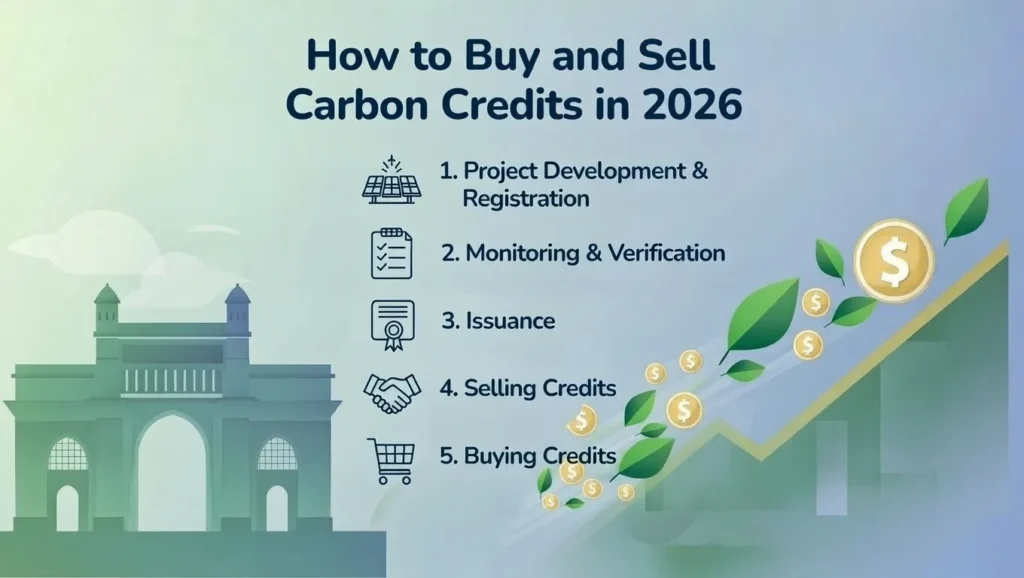
How to Buy and Sell Carbon Credits in 2026
Navigating the process of how to buy and sell carbon credits involves several steps:
Project Development & Registration: If you’re looking to sell credits, you first need to implement a project that reduces or removes emissions (e.g., a solar farm, a reforestation initiative). This project must be registered with a recognized carbon standard (like Verra or Gold Standard).
Monitoring & Verification: Regularly monitor your project’s emissions reductions/removals and have them independently verified by an accredited third-party auditor against the chosen standard.
Issuance: Once verified, the carbon credits are issued to your account on the registry.
Selling Credits:
Direct Sales: You can find buyers directly through your network or industry contacts.
Carbon Brokers: These intermediaries connect buyers and sellers, often negotiating on your behalf.
Carbon Exchange Platforms: Platforms like India’s upcoming exchanges or established global voluntary carbon markets facilitate the buying and selling of credits. These offer transparency and standardized transactions.
Buying Credits: If your business needs to offset emissions or meet compliance obligations, you can purchase credits from project developers, brokers, or exchanges. Research the credit’s origin, verification standard, and co-benefits to ensure it aligns with your goals.
Compliance Requirements: If operating under a compliance market, ensure you understand the specific regulations and reporting requirements of the relevant authority (e.g., the Ministry of Environment, Forest and Climate Change in India for domestic mechanisms).
Future of Credit Carbon Price (2026–2030 Outlook)
The future for the credit carbon price looks robust, driven by several key trends:
Predicted Growth: The market is projected for significant expansion, with many analysts predicting a doubling or even tripling of market value by 2030. This growth is fueled by escalating climate commitments and stricter regulations.
Digital Carbon Exchanges: The rise of specialized digital platforms is streamlining transactions, increasing liquidity, and improving price discovery for carbon credits.
Blockchain in Carbon Trading: Blockchain technology is being explored for enhanced transparency, traceability, and security in carbon credit issuance and trading, potentially impacting how carbon credit rates 2026 are tracked and validated.
Rising Corporate Demand: More companies are setting ambitious net-zero targets, directly translating into increased demand for high-quality carbon credits. This sustained demand is expected to support a higher credit carbon price trajectory.
Focus on Quality: There will be an increasing emphasis on the quality and integrity of carbon credits, with premium pricing for projects offering significant co-benefits (biodiversity, social impact) and robust verification.
Conclusion: Seize the Opportunity in 2026
The credit carbon price is a critical indicator of our collective progress towards a sustainable future. In 2026, the market is not just maturing; it’s becoming an indispensable tool for businesses aiming for climate resilience and competitive advantage. By understanding how carbon credits are priced, exploring opportunities in carbon trading in India, and leveraging platforms like a dedicated carbon exchange platform, businesses can transform their environmental efforts into economic assets. Whether through generating revenue from carbon offset projects, improving ESG compliance India, or simply contributing to a healthier planet, the time to engage with the carbon market is now.
Frequently Asked Questions (FAQs)
1. What is the current credit carbon price in 2026? The credit carbon price in 2026 varies significantly. In the voluntary market, high-quality credits often range from $5 to $30+ per tonne of CO₂, influenced by project type and verification. Compliance markets, like Europe’s, see much higher prices, often exceeding 100 per tonne. India’s market is evolving, with prices currently competitive within the voluntary range.
2. How is carbon credit price calculated? The credit carbon price is primarily determined by supply and demand. Other factors include the type of emission reduction project, the rigorousness of verification standards, the geographic location of the project, and whether it’s part of a compliance or voluntary market. Projects with significant co-benefits (like biodiversity or social impact) can also command higher rates.
3. Is carbon trading legal in India? Yes, carbon trading is legal and actively being promoted in India. The government is establishing frameworks for both voluntary and compliance carbon markets, with initiatives aimed at developing a robust carbon trading in India ecosystem. Businesses can engage in developing projects and generating credits.
4. How can small businesses benefit from carbon credits? Small businesses can benefit by adopting energy-efficient practices or implementing small-scale carbon offset projects (like waste management improvements or local reforestation). They can then potentially sell surplus carbon credits through exchanges or aggregators to generate revenue. Even improving ESG compliance India can attract business partners and investors.
5. What is the difference between voluntary and compliance carbon markets? The compliance carbon market is driven by mandatory regulations (like cap-and-trade systems) that require certain industries to reduce emissions or buy credits. The voluntary carbon market is where companies and individuals voluntarily purchase credits to offset their emissions, meet sustainability goals, or enhance their brand image. Prices in the compliance market are typically higher.