
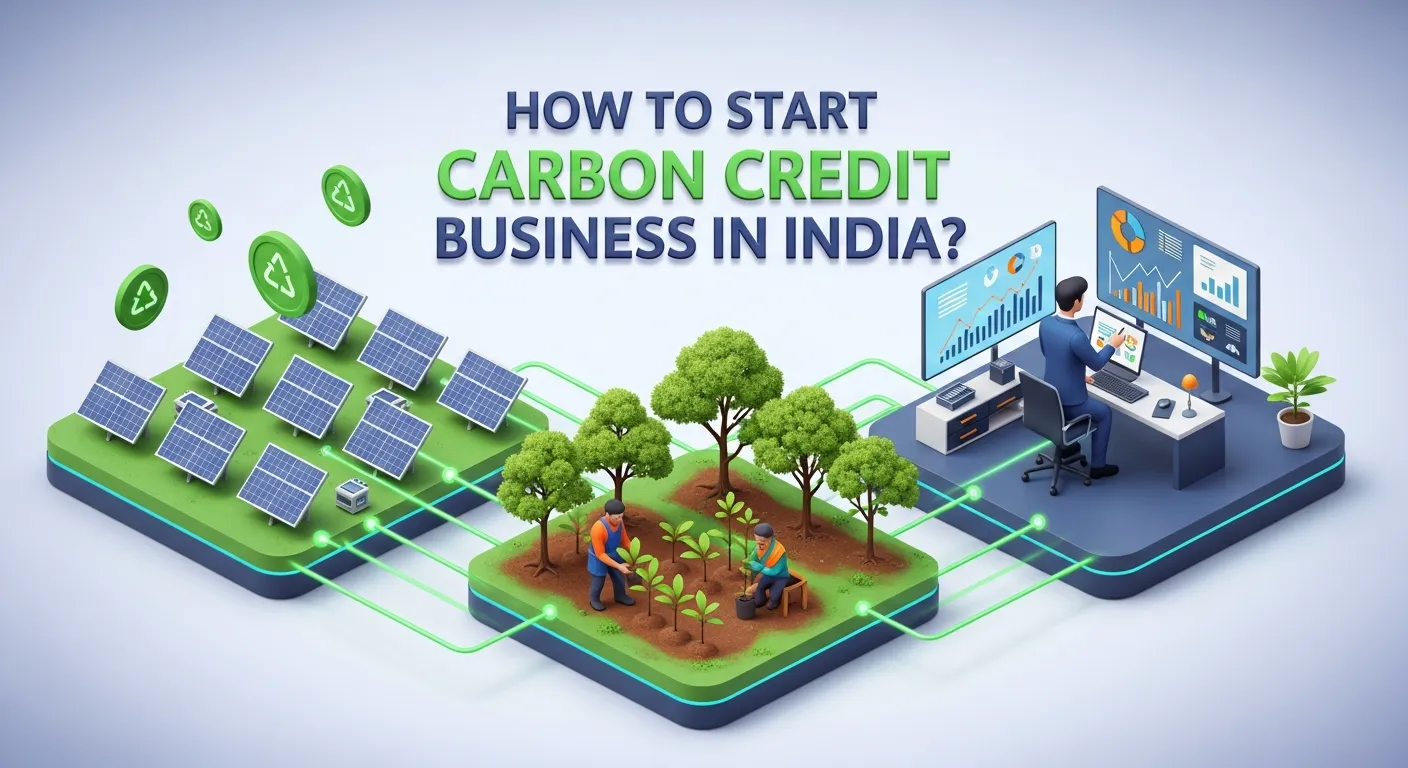
Climate change is no longer just a global concern—it’s affecting every corner of India. From unpredictable monsoons to rising temperatures, the impact of carbon emissions is visible everywhere. But here’s the good news: while the planet needs help, there’s a real business opportunity hidden in the solution.
If you’re wondering how to start carbon credit business in India, you’re looking at one of the most promising and impactful ventures of this decade. The carbon credit market in India is growing rapidly, driven by government policies, corporate commitments, and global climate goals.
In simple terms, carbon credits are like certificates that prove you’ve reduced or removed carbon dioxide from the atmosphere. Companies that can’t cut their emissions fast enough buy these credits from businesses that can. This creates a marketplace where environmental action meets profit potential.
India’s carbon market is expanding, with new regulations and increasing demand from industries looking to meet their sustainability targets. Whether you’re a farmer with land, an entrepreneur with vision, or a company exploring green revenue streams, this guide will walk you through everything you need to know about how to start carbon credit business in India.
Let’s break down what carbon credit business actually means in the simplest way possible.
Think of carbon credits as environmental currency. When you reduce one ton of carbon dioxide (or equivalent greenhouse gases) from entering the atmosphere, you earn one carbon credit. These credits can then be sold to companies or organizations that need them to offset their own emissions.
How the carbon credit business model works:
The Indian Carbon Market is still developing but shows massive potential. The government launched the Carbon Credit Trading Scheme (CCTS) in 2023, which created a structured framework for carbon trading in India. This makes it easier for businesses to participate and ensures transparency in the market.
India is at a unique position when it comes to carbon credits. Here’s why learning how to start carbon credit business in India is worth your attention:
Government support is strong:
Corporate demand is rising:
Long-term revenue potential:
The voluntary carbon market in India alone is projected to reach several billion dollars by 2030. This isn’t a temporary trend—it’s a fundamental shift in how businesses operate.
The beauty of carbon credit business is its accessibility. You don’t need to be a corporate giant to participate. Here’s who can enter this market:
Farmers and agricultural landowners:
Individual landowners:
Small and medium enterprises:
Renewable energy companies:
Waste management businesses:
Rural communities and cooperatives:
The entry barrier isn’t about who you are—it’s about what project you can implement and maintain.
Let me walk you through the practical steps to launch your carbon credit business. This is where how to start carbon credit business in India becomes actionable.
Your first decision is choosing what type of project you’ll develop. This depends on your resources, location, and expertise.
Popular project types in India:
What to consider:
Example: A farmer in Punjab with 10 acres of unused land might consider tree plantation. A small textile factory in Tiruppur might focus on solar installation and energy efficiency.
Before investing money, you need to understand if your project is viable for carbon credit generation.
Feasibility assessment includes:
You’ll need:
Many carbon credit certification companies in India offer preliminary assessment services. This investment (usually ₹50,000 to ₹2 lakhs) can save you from costly mistakes.
To earn carbon credits, your project must be registered with recognized certification standards. This is the carbon credit registration process in India.
Major certification standards in India:
Registration process:
Timeline: Registration typically takes 3-6 months depending on project complexity.
This is where independent third parties confirm that your project actually delivers the carbon reductions you claim.
Validation (before project starts):
Verification (after project implementation):
Costs: Validation and verification together can cost ₹3-15 lakhs depending on project size and type. This is typically the biggest upfront expense after project implementation.
Once verified, you receive carbon credits that you can sell.
Issuance process:
How to sell carbon credits in India:
Pricing factors:
Current prices in voluntary carbon markets range from ₹500 to ₹5,000 per ton of CO2 equivalent, with premium projects commanding higher prices.
Getting your paperwork right from the start saves time and headaches. When you’re planning how to start carbon credit business in India, here’s what you’ll need:
Land and ownership documents:
Project documentation:
Business and legal documents:
Compliance certificates:
Financial documents:
Start collecting these documents early. Missing paperwork is the most common reason for delays in carbon credit registration.
One of the most common questions about how to start carbon credit business in India is: how much money do you need?
The answer varies dramatically based on your project type. Let me break it down:
Low-investment models (₹5 lakhs – ₹20 lakhs):
Medium-investment models (₹20 lakhs – ₹1 crore):
High-investment models (₹1 crore+):
Additional costs across all projects:
Funding options:
Example: A farmer wanting to plant trees on 50 acres might invest:
Potential return: 5,000-10,000 carbon credits over 10 years = ₹25 lakhs to ₹1 crore depending on prices.
Earning carbon credits is one thing—converting them to cash is another. Understanding how to start carbon credit business in India includes knowing how the market works:
The voluntary carbon market in India:
This is where most small and medium projects sell their credits. Buyers voluntarily purchase credits to offset emissions or meet corporate sustainability goals.
Finding buyers:
What determines your carbon credit price?
Typical price ranges (as of 2024-2025):
Payment terms:
Tax implications:
Carbon credit income is taxable in India. Consult with a tax advisor to understand:
The Indian Carbon Market (ICM) is evolving, and understanding how carbon trading in India works is crucial when you’re learning how to start carbon credit business in India.
Current structure:
The Bureau of Energy Efficiency launched the Carbon Credit Trading Scheme in 2023, creating India’s first compliance carbon market. This works alongside the existing voluntary market.
Two types of markets:
Compliance market:
Voluntary market:
Indian Carbon Exchange (ICX):
Launched under NSE and BSE platforms, these exchanges enable:
How to start trading:
Trading strategies:
Understanding carbon trading in India helps you maximize returns and choose the right timing for sales.
Why should you seriously consider this opportunity? Beyond the obvious profit potential, there are compelling reasons for how to start carbon credit business in India:
Environmental impact:
Financial benefits:
Business advantages:
Social benefits:
Strategic positioning:
Being realistic about challenges helps you prepare better when planning how to start carbon credit business in India. Here are the main hurdles you’ll face:
Time lag before revenue:
Market price fluctuations:
High upfront verification costs:
Technical complexity:
Regulatory uncertainty:
Project risks:
Buyer risks:
Despite these challenges, thousands of carbon credit projects in India are successfully operating and growing. The key is thorough planning and realistic expectations.
1. How to start carbon credit business in India?
Starting a carbon credit business in India involves five main steps: identify a suitable carbon reduction project (like renewable energy or forestry), conduct a feasibility study, register your project with a recognized certification body, get it validated and verified by independent auditors, and finally sell the issued carbon credits. The entire process typically takes 2-3 years from start to first revenue, with initial investment ranging from ₹5 lakhs to several crores depending on project type. Understanding how to start carbon credit business in India requires patience and proper planning for long-term success.
2. Who is eligible to start carbon credit business in India?
Anyone can start a carbon credit business in India—farmers, landowners, small businesses, renewable energy companies, waste management firms, or even community groups. You need either land for projects like forestry and solar, or existing operations that can be made more carbon-efficient. There’s no special license required to start, but you must follow the certification process for the specific type of carbon credit project you choose. When considering how to start carbon credit business in India, focus on matching your resources with the right project type.
3. How much investment is required to start carbon credit business in India?
Investment varies widely based on project type. Small agricultural or forestry projects can start with ₹5-20 lakhs, while medium-scale renewable energy projects need ₹50 lakhs to ₹2 crores. Large solar or wind farms require ₹4-7 crores per MW. Besides project costs, budget ₹5-15 lakhs for certification, validation, and verification. Government subsidies are available for renewable energy projects, which can reduce your upfront costs significantly. This investment breakdown is essential to understand when planning how to start carbon credit business in India.
4. How long does it take to earn carbon credits in India?
The timeline typically spans 2-3 years for your first carbon credits. Here’s the breakdown: project planning and registration (3-6 months), project implementation (6-12 months), monitoring period before first verification (12-24 months), and verification process (2-3 months). After the first cycle, you can earn credits more regularly—usually annually or biannually depending on your verification schedule. This timeline is crucial when planning how to start carbon credit business in India and managing cash flow expectations.
5. Is carbon credit business profitable in India?
Yes, carbon credit business can be quite profitable in India, but it requires patience and proper planning. A typical forestry project on 50 acres might generate 5,000-10,000 credits over 10 years, earning ₹25 lakhs to ₹1 crore depending on market prices. Renewable energy projects offer both electricity sales and carbon credits. However, profitability depends on project management, certification costs, market prices, and your ability to find good buyers. Returns typically come after 2-3 years, so it’s a long-term investment. Understanding profitability is a key part of knowing how to start carbon credit business in India.
Understanding how to start carbon credit business in India opens up a world of opportunity that combines profit with purpose. This isn’t just another business trend—it’s a fundamental shift in how companies and individuals can participate in climate action while building sustainable income.
The carbon credit market in India is still in its growth phase, which means early movers have significant advantages. Government support is strong, corporate demand is rising, and the regulatory framework is becoming clearer. Whether you’re a farmer with unused land, an entrepreneur looking for the next big opportunity, or a business wanting to diversify into green revenue streams, learning how to start carbon credit business in India offers a viable path forward.
Key takeaways:
The question isn’t whether carbon credits will be important in India’s future—they already are. The question is whether you’ll be part of this growing market. With proper planning, patience, and commitment, knowing how to start carbon credit business in India can be both financially rewarding and environmentally impactful.
Now is the right time to start. Climate commitments are tightening, carbon prices are expected to rise, and India’s carbon market infrastructure is maturing. Take the first step today—assess your resources, identify a potential project, and begin your journey by understanding how to start carbon credit business in India.
The planet needs action, the market is ready, and the opportunity is yours to seize. Whether you’re just beginning to research how to start carbon credit business in India or ready to take the plunge, this comprehensive guide provides everything you need to launch your sustainable business venture successfully.
I appreciate the depth and clarity of this post.
This topic is usually confusing, but you made it simple to understand.
I’ll be sharing this with a few friends.
I love how clearly you explained everything. Thanks for this.